Has Elon Musk's "space computing power" created a capital story that could set the market ablaze?
The "hive mind" of tech giants is acting up again. This time, they've collectively set their sights on the same goal: building data centers in space.
Elon Musk's successive "bombardments" on social platforms ignited the fire first. But he's not alone in this. Jeff Bezos, the founder of Amazon and Blue Origin, and Eric Schmidt, the former CEO of Google, have long been believers in this concept. Huang Renxun, known as the "godfather of chips," has also prominently joined the fray.
In November 2025, Google announced that it would launch a prototype satellite by 2027 to test the performance of its AI chips in space. Last week, the startup Starcloud even claimed to have trained the first large language model in space on a satellite equipped with NVIDIA chips.
This "space fantasy" is indeed exhilarating, but upon closer inspection, it may conceal a more sober and even anxious awareness among the giants: they might think that the Earth can no longer bear the huge computing power and energy required for AI development.
What's even more intriguing is that this concept holds another layer of meaning for some of its proponents, apart from addressing real - world challenges.
This is not just a technological vision but also a capital narrative. For example, SpaceX, which is expected to go public next year, badly needs a story to set the market on fire. On top of its existing narratives about rockets and Starlink, adding the halo of "space AI infrastructure" will undoubtedly give its valuation a huge room for imagination. Just as Musk did for Tesla with initiatives like the Optimus humanoid robot.
However, the grander the ideal, the harsher the skeptical voices often are.
Technical feasibility is the first to be questioned. Opponents point out that cosmic radiation will "roast" delicate chips, and maintaining and updating these orbital devices will be incredibly difficult and costly. A space industry insider said bluntly that from a purely economic perspective, "it doesn't sound as cost - effective as building on the ground."
Nevertheless, Musk and his ilk seem confident due to two "definite advantages": free solar energy and a natural cooling environment, as well as the rapidly decreasing launch costs. Currently, the cost of sending each kilogram of supplies into orbit has dropped significantly thanks to rocket recovery technology. In the future, as the "Starship" rocket matures, the cost is expected to drop even lower, and the entry of competitors like Blue Origin will further drive down the price.
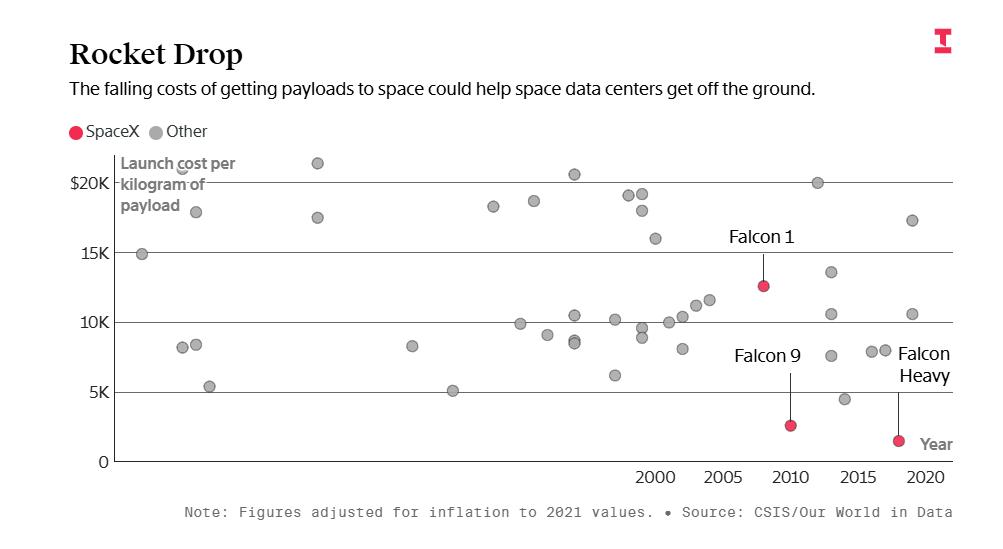
Image: The continuously decreasing cost of sending payloads into space may pave the way for the realization of space data centers.
According to the estimate of the Center for Strategic and International Studies, the most economical way to send supplies into orbit currently is by hitching a ride on SpaceX's "Falcon Heavy" rocket, with a cost of about $1,500 per kilogram. In a few years, the cost of launching with the "Starship" may drop to $100 per kilogram.
Musk himself even asserted, "The cost - effectiveness of space AI will completely outshine that of ground - based AI."
If this bold claim holds true, it will only highlight the numerous difficulties of building data centers on Earth.
The "space solution" is forced by reality. In the United States, the explosive growth of AI is overburdening the power grid, and the risk of power shortages is looming. Meanwhile, the "Not In My Back Yard (NIMBY)" effect is becoming increasingly prominent. Community residents' concerns about energy consumption, water usage, and environmental impact have stalled data center projects worth tens of billions of dollars.
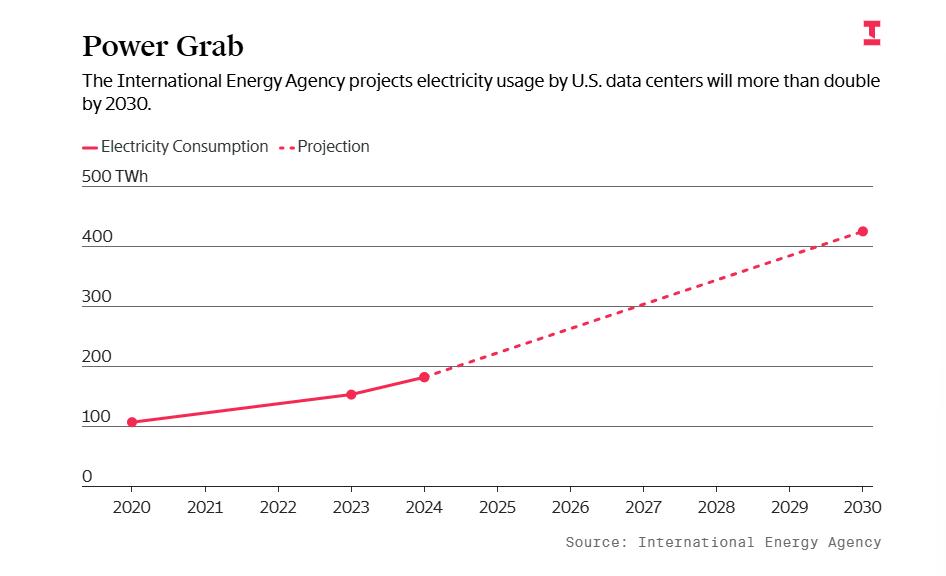
Image: The U.S. Energy Agency predicts that the electricity consumption of U.S. data centers is expected to double by 2030.
"People don't want data centers as neighbors," an industry insider pointed out, "We need a fundamental solution to bypass these ground - based problems."
Thus, the "space data center" has evolved from a science - fiction concept into a radical proposal to deal with the Earth's resource scarcity and community resistance. This is not only a competition of technical routes but also reflects the deep - seated constraints and games that tech giants face when seeking growth space.
When the demand for computing power goes through the roof, their eyes have no choice but to turn to the stars.
This article is from "Tencent Technology", author: Jin Lu. Republished by 36Kr with permission.