Terence Tao is shocked: The "pit" dug by a mathematician in 1975 was filled by AI and netizens around the world in just 48 hours.
In just 48 hours, a 50-year-old mathematical puzzle was solved! AI joined forces with mathematicians worldwide. Starting from the coin-splitting game to square packing, they dissected the problems left by Erdős layer by layer. The collaboration between humans and machines has completely ignited a new paradigm in mathematical research.
Just now, AI has solved another mathematical problem!
Problem Erdős#1026 has been solved, and a formal proof has been provided.
Before this, this problem had puzzled the mathematical community for 50 years.

Terry Tao announced this news on Mastodon and also detailed the story in a blog post.

He emphasized that with the assistance of AI, the human team successfully solved this problem in just 48 hours.
Moreover, what AI brought in this process was a brand - new understanding, far from just a simple search.
You know, if using traditional methods, relying solely on mathematicians using programming and literature retrieval, it might take weeks or even months.
In this process, AI is actually generating new mathematical insights, not just retrieving existing literature.
The official website of Harmonic also announced this news. Its AI system, Aristotle, participated in the process of solving this problem.

Problem Erdős#1026
In 1975, the legendary mathematician Paul Erdős casually wrote down a problem in the corner of a paper.
Half a century later, this problem quietly lay on the "Erdős Problems Website" with the number 1026.
No one expected that in the last month of 2025, a group of mathematicians would completely solve it in just 48 hours using AI tools.
Erdős' original problem reads a bit like a riddle.
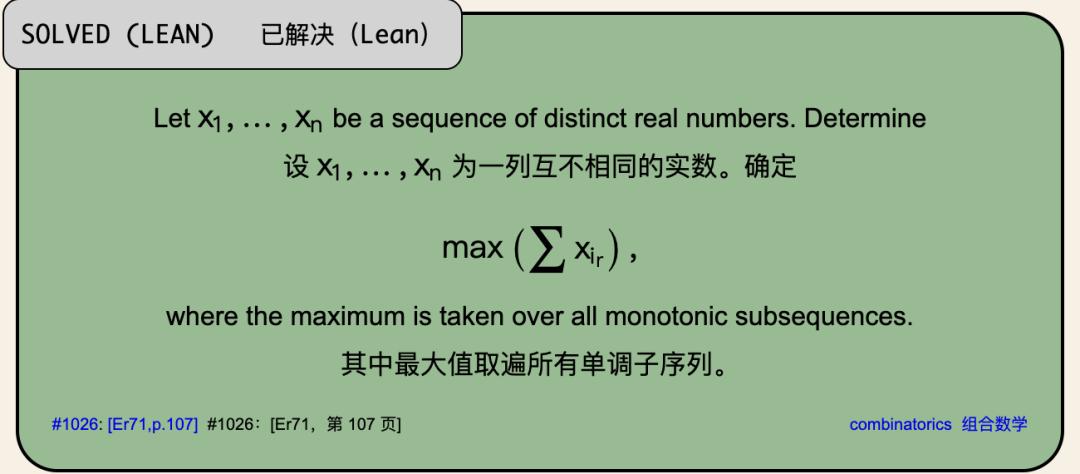
Given a sequence of distinct real numbers \(x_1,x_2,\ldots,x_n\), define \(S(x_1,\ldots,x_n)\) as the maximum possible sum of all monotonic subsequences (either increasing or decreasing).
What are the properties of this function?
As soon as the problem was presented, everyone looked at each other in confusion: What exactly was it asking? Was it to find an expression for \(S\)? Or to find the lower bound of the ratio between \(S\) and the total sum?
On September 12, 2025, when the problem was posted on the website, an additional note was added: "The problem statement is rather vague."
But the instinct of mathematicians is to turn vagueness into precision.
On the same day, netizen Desmond Weisenberg proposed a clear game - based interpretation:
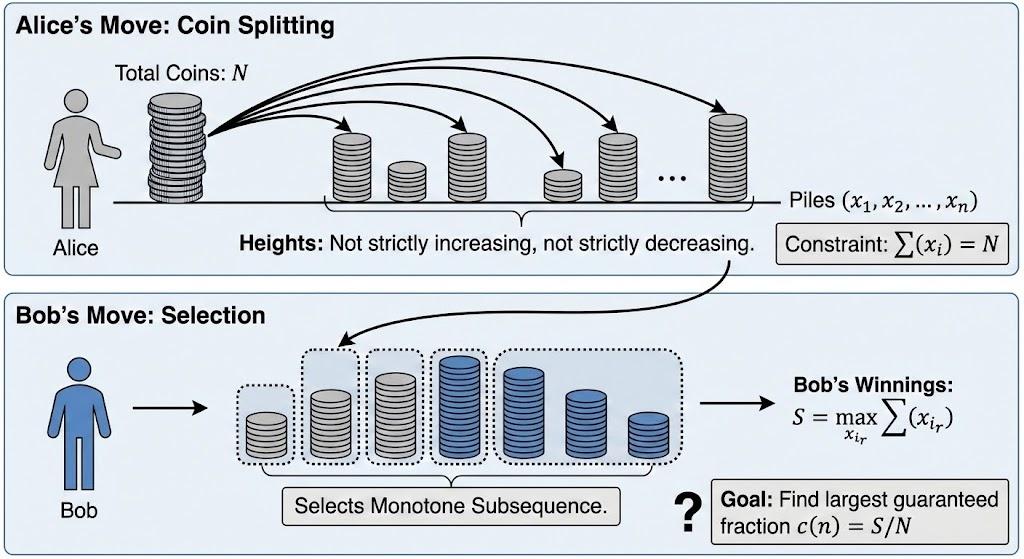
The coin game between Alice and Bob
Alice has \(N\) coins. She divides them into \(n\) piles, with \(x_i\) coins in each pile (\(x_i\) can be different). Bob can choose a monotonic subsequence (either increasing or decreasing) and take all the coins in those piles.
Question: No matter how Alice divides the piles, what proportion of the total number of coins can Bob take at least?
This proportion is denoted as \(c(n)\).
From \(n = 3\) to the square - number conjecture
Let's first look at a few examples.
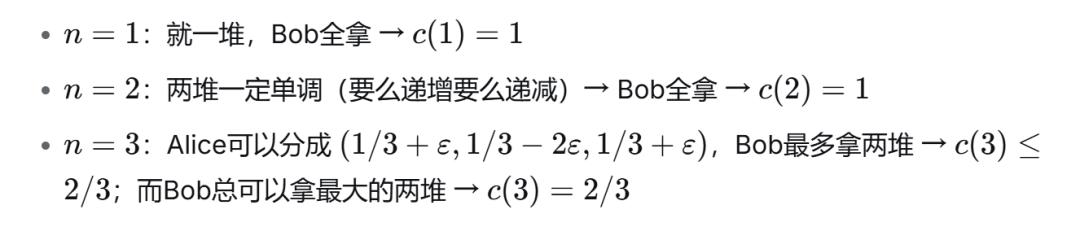
Soon, Stijn Cambie discovered that:
If Alice divides the coins into \(k^2\) piles, with each pile approximately the same size, and arranges them into \(k\) decreasing blocks, each block containing \(k\) piles, and the blocks increasing between each other, then the longest monotonic subsequence has only \(k\) piles.
So Bob can take at most a proportion of \(\frac{1}{k}\), that is, \(c(k^2)\leq\frac{1}{k}\).
Conversely, Wouter van Doorn used existing results to give a lower bound: \(c(n)\geq\frac{1/\sqrt{2}}{\sqrt{n}}\).
Then, what is the limit of \(\sqrt{n}\cdot c(n)\)? It lies between \(\frac{1}{\sqrt{2}}\) and \(1\).
The next day, Stijn calculated the values of small \(n\) by hand:

Although the data was limited, it was enough for him to boldly conjecture that \(c(k^2)=\frac{1}{k}\).
This means that \(\sqrt{n}\cdot c(n)\to1\). When \(n\) is very large, Bob can almost guarantee to take a proportion of about \(\frac{1}{\sqrt{n}}\).
AI steps in!
Two months later, on December 7, 2025, Boris Alexeev used the AI tool Aristotle to automatically prove \(c(k^2)=\frac{1}{k}\) in the proof - assistant language Lean.
Almost simultaneously, Koishi Chan gave an elegant human - proof - the "inflation method".

At this point, the upper and lower bounds coincided, and the conjecture was successfully proven.
Even more coincidentally, this answer actually already existed.
Google Scholar quickly found a 2016 paper that already contained this result and cited the earlier work of Wagner using the "inflation method" to deal with the Erdős - Szekeres theorem.
It turned out that mathematics had quietly solved this problem before, but it was not linked to Erdős' original question.
AI takes the stage and guesses the complete formula
But the climax of the story is yet to come.
Terry Tao decided to use another AI tool, the AlphaEvolve system, to explore \(c(n)\).
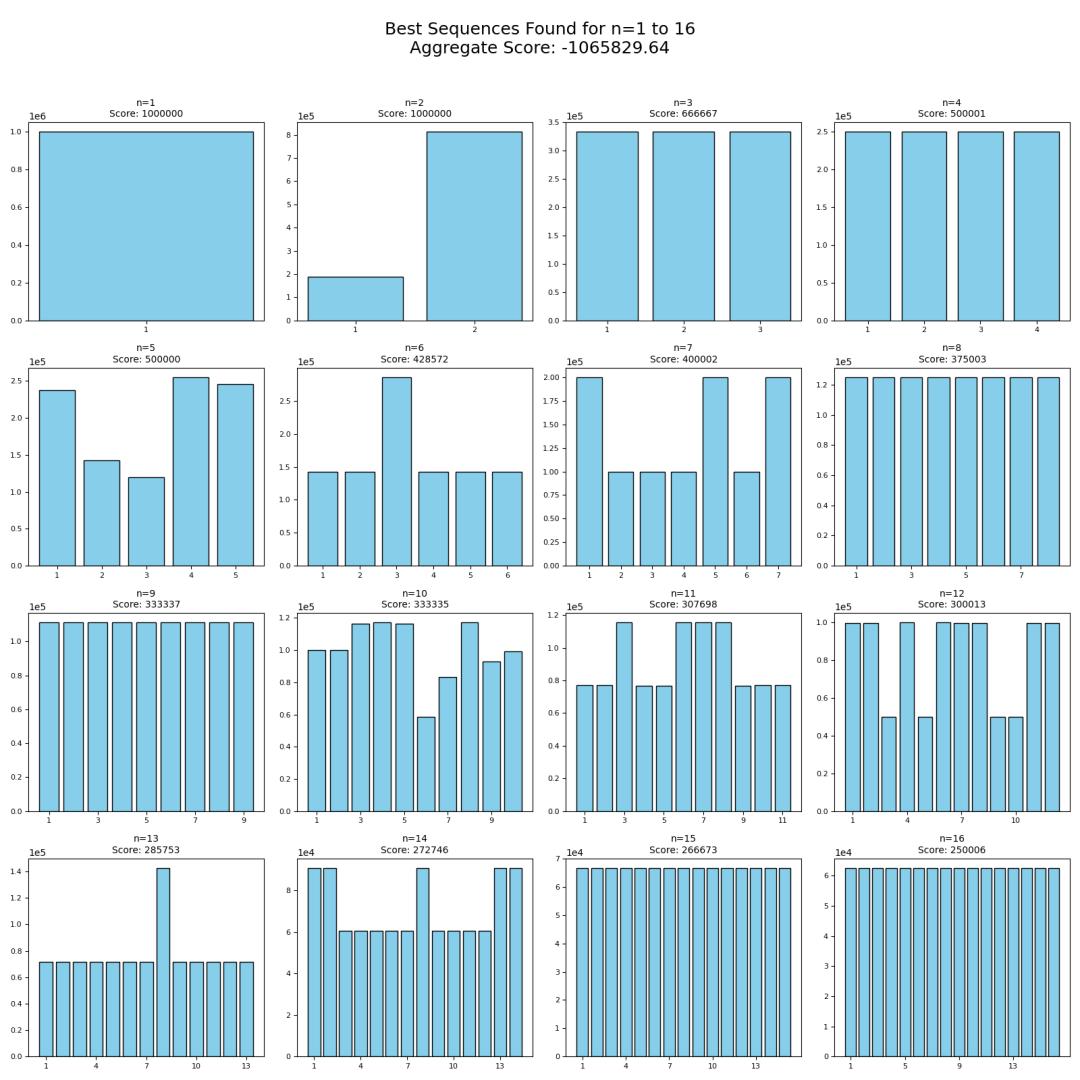
He let the AI try to construct sequences that made \(S\) as small as possible and quickly obtained numerical results for \(n = 1\) to \(16\):

These fractions seemed disordered at first, but after rearrangement, a pattern gradually emerged.
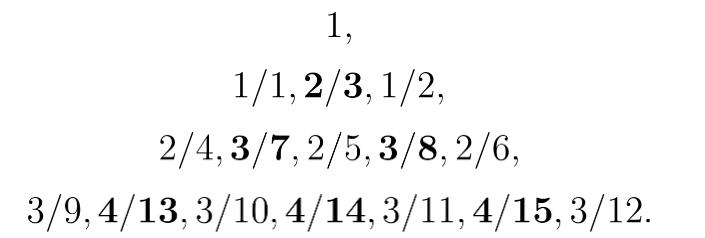
Boris extracted a clean formula from it:
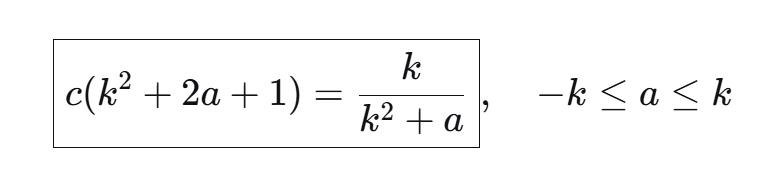
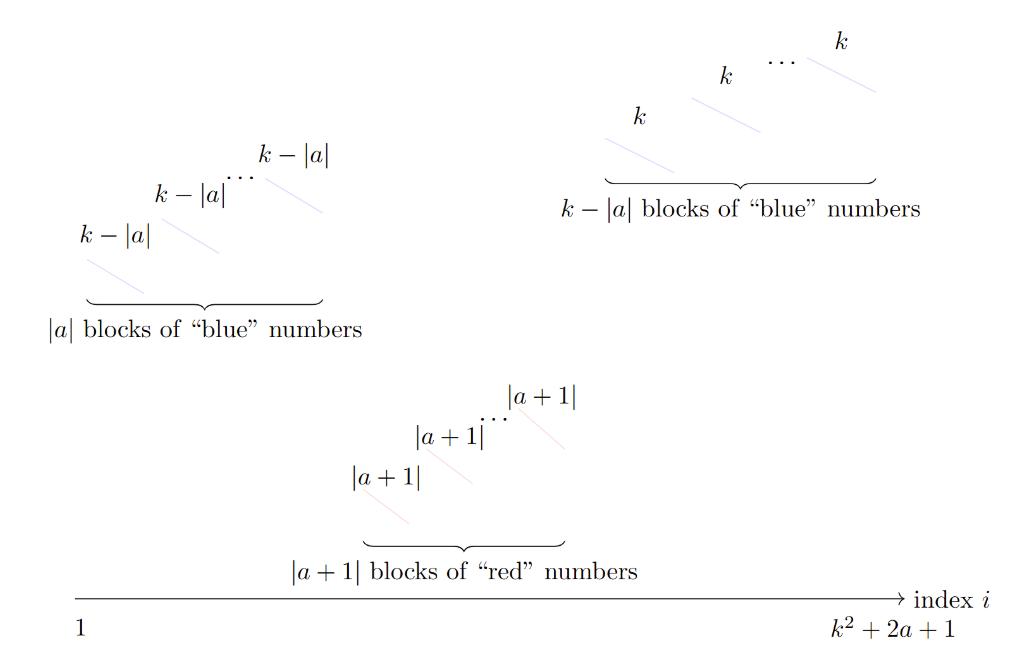
And constructed an extremal sequence: Alternately arrange blocks of two values, "red" and "blue", to control the length of the monotonic subsequence.
The following figure intuitively shows this construction (in the case of \(a\geq0\)):
And the graph of \(\frac{1}{c(n)}\) is exactly a piece - wise linear approximation of \(\sqrt{n}\):

Connecting to the classic square - packing problem
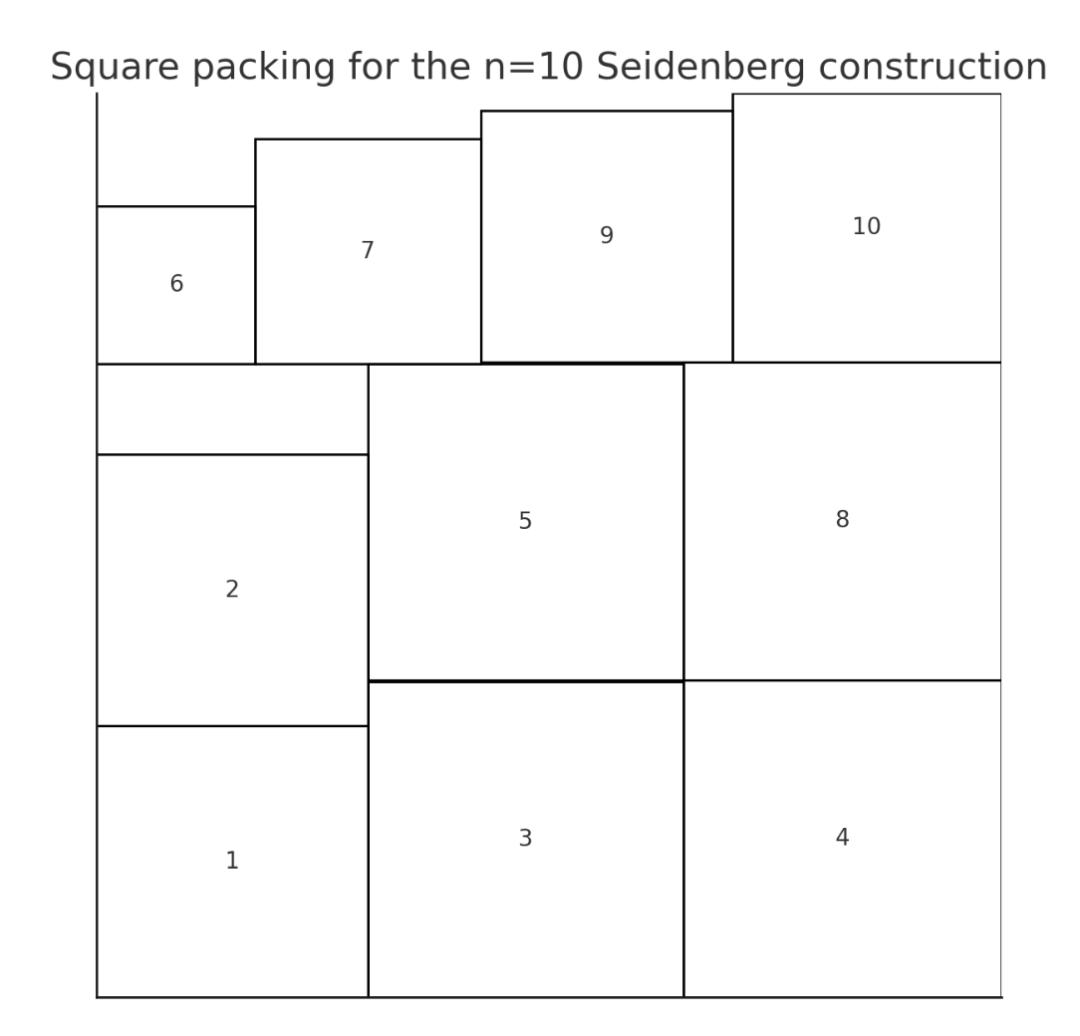
Subsequently, Lawrence Wu pointed out that this problem is equivalent to a square - packing problem (Erdős problem 106).
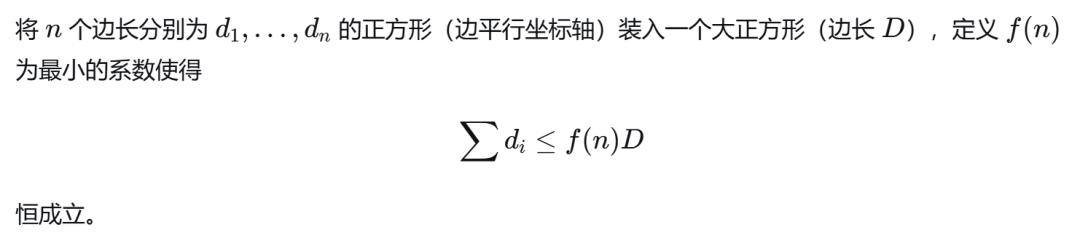
Lawrence proved that \(c(n)\geq\frac{1}{f(n)}\).
Reason: For any sequence, a series of non - overlapping squares can be constructed to fill a large square with side length \(S(x_1,\ldots,x_n)\).
The following figure shows the square - packing constructed from a sequence given by AlphaEvolve.
The final blow: the complete solution in the literature
Lawrence then used AI for in - depth search and found a 2024 paper by Baek, Koizumi, and Ueoro, which proved that \(f(k^2 + 2c+1)\leq k+\frac{c}{k}\).
Combined with Praton's embedding argument, this exactly gives \(c(k^2 + 2a+1)\leq\frac{k}{k^2 + a}\).
The upper and lower bounds coincided again, and the conjecture was completely proven!