Raised over 20 billion in half a year, but 70% of the robots are still "acting".
Robots from Zhipu and Unitree made their first “joint appearance”.
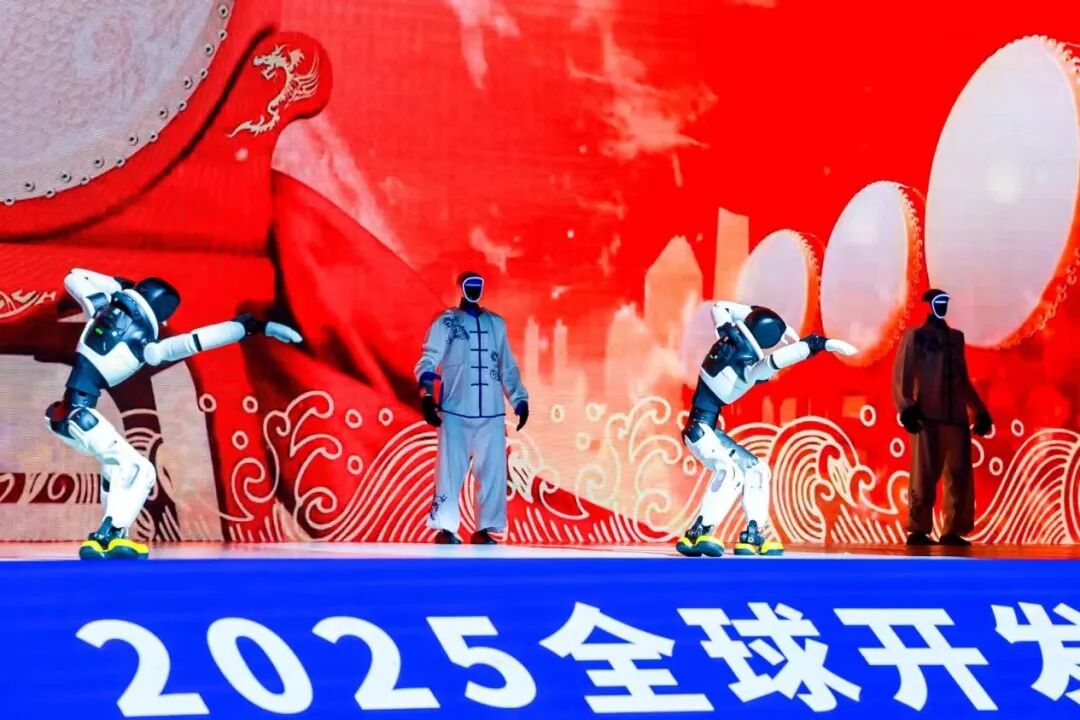
At the opening ceremony of the Global Developers Pioneer Conference and International Embodied Intelligence Skills Competition (GDPS 2025) held on December 13th, Zhipu's Yuanzheng A2 was dressed in the costume of a martial artist in Chinese Peking Opera, with four “flags” on its back, and waved drumsticks to beat the big drum. Two Zhipu Lingxi X2 robots on the stage coordinated with the drumbeats and made actions such as “blinking eyes”, “shaking hair”, and “stretching out their heads”. The performance was far from over. Unitree's G1, wearing a white Taiji suit, stood side by side with human martial - arts actors and performed Taiji...
The year 2025 is regarded as the first year of mass production of embodied intelligent robots. From the robots' appearance on the CCTV Spring Festival Gala stage at the beginning of the year to the competitions in scenarios such as industrial manufacturing, social services, home services, emergency rescue, medical care and rehabilitation, and dexterous hands at the end of the year, it can be seen that embodied intelligence is moving from laboratory demos to a broader stage and also into the deep - water area of the industry.
However, behind a gorgeous performance show, issues such as scenarios, data, and mass production are still hot topics in this industry. How can we make robots truly “smart”? Will the final outcome of the future embodied intelligence industry be “dominated by one” or “a hundred flowers blooming”?
Change the “Three Hots and Three Cold” Situation with Standards
The “China Development Report 2025” written by the Development Research Center of the State Council and released in October this year shows that the current development of China's embodied intelligence industry is in its infancy, but the market scale is expected to reach 400 billion yuan in 2030 and exceed one trillion yuan in 2035.
Such a large - scale industrial system has attracted the favor of capital. According to IT Juzi, in 2025, there were more than a hundred financing events in the “humanoid robot” label track, involving an amount of over 20 billion yuan. The valuations of embodied intelligence companies represented by Zhipu and Unitree have been pushed to over 10 billion yuan, and Zhipu is even approaching 20 billion yuan.
Other mid - tier and even start - up companies have also continuously reported financing news. For example, after completing a financing of nearly 500 million yuan in July this year, on December 9th, Hangzhou Deep Robotics Co., Ltd. announced that it had completed a Series C financing of over 500 million yuan. On December 11th, Beijing Xingyuanzhi Robot Technology Co., Ltd., which was established at the beginning of August this year, announced that it had completed an Angel + round financing of over 100 million yuan...

“Currently, the embodied intelligence industry has the distinct characteristics of ‘three hots and three colds’.” Meng Wen, the co - founder of Robot Home and Yueqian Alliance, pointed out in a keynote speech at the “Embodied Era, Intelligent Innovation of a Hundred Enterprises” forum. On the one hand, technology is hot, but collaboration is cold. Many large - scale models at the international advanced level have emerged in China, and breakthroughs have been made in aspects such as humanoid robot joint modules and balance algorithms. However, the hardware interfaces and data formats of different enterprises are incompatible with each other, resulting in the problem of data islands. On the other hand, capital is hot, but implementation is cold. Although there were more than 100 investment and financing events in the first half of 2025, more than 70% of the applications still remain at the scientific research demonstration stage, and the large - scale delivery model has not been fully established. Moreover, demand is hot, but trust is cold. Specifically, the demand in scenarios such as industry, healthcare, and family is relatively urgent. However, due to the lack of unified safety certification and performance evaluation standards in the industry, users have doubts about the reliability of products.
“Organize enthusiastic industry players with standards to embrace this trillion - dollar market.” Industry insiders at the scene unanimously emphasized the necessity of standards. Jiang Lei, the chief scientist of the National - Local Joint Innovation Center for Humanoid Robots, gave an example and analyzed that under the guidance of standards, a closed - loop of data, grading, interfaces, pilot testing, and finance can be achieved. For example, at the data level, the “data base” can be made into a “national network”; in terms of grading, the “grading standard” can be made into an “admission ticket”.
“The standard system of embodied intelligence has never been a ‘solo performance’ of a single institution. Instead, it is a consensus formed through the multi - party collaboration of industry, academia, research, and investment and dynamically iterated in practice.” Meng Wen appealed on - site to reject “making a cart behind closed doors” and advocated the concept of “flexible” standards. That is, clear rigid specifications should be defined in key areas such as core safety interfaces, while elastic space should be reserved in frontier areas such as technological innovation and scenario expansion.
“We need to change from fighting alone to unified evaluation.” Yao Qizhi, a Turing Award winner, an academician of the Chinese Academy of Sciences, and the director of the competition's steering committee, also emphasized at the opening ceremony that open benchmarks and safety specifications should be established, open - source reproduction should be encouraged, and excellent algorithms should be promoted to be repeatable, verifiable, and industrializable through challenges. In his opinion, the collaboration between the industry and academia will accelerate the entry of intelligent robots into all industries and households, truly serving humanity.

Analogous to Autonomous Driving, Who Will Be the Final Winner?
The development of embodied intelligence has made many industry insiders think of autonomous driving in 2016. That year was an important year for the rapid development of autonomous driving technology, attracting a large amount of capital and technology investment. Large companies represented by Apple, Google, Tesla, and Baidu entered this field one after another. Subsequently, the number of start - up companies also continued to increase. After nearly a decade, a real - world problem is that the market will ultimately test the strength of these companies.
“Will a few giants stand out in the future?” In the embodied intelligence industry, industry insiders at the scene also raised this question.
Oriental Fortune Capital is a professional venture capital management company initiated by several professionals with long - term experience in China's venture capital field, rich practical experience, and great influence in the industry. Public information shows that it manages funds with a scale of over 35 billion yuan and has nearly 700 investment projects. In 2025, the company invested in more than a dozen robot companies.
“Similar to the mobile phone and automobile industries, a few giants will emerge in the whole - machine field of the future embodied intelligence industry. However, in the supply - chain link, especially in the core component field with high barriers, a large number of investment and entrepreneurship opportunities will emerge. Multiple representative companies may be born in any single component.” Wang Bing, a partner of Oriental Fortune Capital, said.
Xu Weiran, the executive general manager of Furong Investment, said that the company pays great attention to the data - generation link, such as remote operation, simulation, and world models. In her opinion, embodied intelligence is a broader market than mobile phones and automobiles. The downstream terminals will be more diversified, and the upstream applications will also explode accordingly.
Overall, the consensus in the industry is gradually becoming clear: on the one hand, data is the core competitiveness. Whether it is simulation, remote operation, or real - scenario collection, high - quality and large - scale data have become the key fuel for training the “embodied brain”. On the other hand, the industrial chain is long enough. From sensors, dexterous hands, and joint motors to whole - machine integration, algorithm platforms, and scenario applications, leading enterprises may be born in each link. Moreover, China has the dual advantages of supply chain and scenarios. In terms of hardware manufacturing and vertical - industry implementation, domestic enterprises are expected to find a differentiated path.
Regardless of who the final winner is, the industry currently needs to think about a way to break the situation.
As Yao Qizhi said on - site, first, we need to move from imitation to reasoning. Current methods mostly rely on imitation and lack an interpretable world model and physical causal reasoning. In the future, reasoning, planning, and control should be placed in the same closed - loop framework. Second, we need to move from data scarcity to a data leap. The cost of collecting embodied data is high, and new data - collection technologies need to be explored to build a data factory that can be planned and scaled up to verify the large - scale path of embodied intelligence. Third, we need to move from local skills to whole - body coordination. The motion ability and operation ability of existing robots are still two separate systems. In the future, unified whole - body control and fine - hand operation planning are needed to support multi - step general skills.
This article is from the WeChat official account “IT Times” (ID: vittimes), author: Sun Yonghui, editors: Hao Junhui, Sun Yan. Republished by 36Kr with permission.