Behind the soaring sales of Dreame's lawn mowing robots, why can LiDAR reshape the "yard economy"?
In an era where everything can be made intelligent, private gardens seem to have become the "last" enclave in the technological revolution.
For a long time, the rules here have been written by fuel and sweat. In the early days when lawn mowing robots tried to enter this territory, compared with human labor, they were more like a group of stumbling "blind people": either users had to pre - bury boundary lines in the garden like laying landmines, which was not only cumbersome, but also more troublesome to repair once the lines were broken; or although they used RTK positioning technology, once they got into the shade or near a corner, the robots would immediately lose their way on the large lawn and get stuck in an embarrassing situation when the signal was lost.
This was the "eve" of the lawn mowing robot industry: there was demand, but no good experience.
However, a change is taking place. Recently, Frost & Sullivan, an international authoritative consulting firm, awarded Dreame's lawn mowing robot the certification of "the world's highest cumulative sales of LiDAR - equipped lawn mowing robots", shining the spotlight of the industry back on the technological core.

On the surface, it is just a Chinese company achieving commercial success in the global market, but it also sends a clear technological signal to the industry: in outdoor scenarios with complex lighting and unpredictable terrain, the LiDAR technology route has crossed the early stage and officially entered the commercial maturity stage.
This inevitably reminds people of the development history of new energy vehicles. Once, LiDAR was regarded as a "luxury" in autonomous driving, but now it has become a standard feature of high - end models.
The same logic of technology popularization is playing out in the courtyard: this technology is becoming the core barrier of high - end lawn mowing robots and the "ticket" to the future smart courtyard.
So, why has LiDAR become the key variable in reshaping the courtyard economy? At the crossroads of technological evolution, what exactly has Dreame's lawn mowing robot done right?
What does LiDAR mean?
It all starts with a "perception revolution" in the courtyard.
Looking across the ocean, in the context of the European and American middle class, lawn maintenance has never been a trivial matter. A well - trimmed lawn represents decency and social status, which has created a rigid - demand market worth hundreds of billions.
According to estimates by authoritative institutions such as Statista, the global gardening and outdoor market is expected to exceed $130 billion in 2025. Among them, the annual market volume of the core lawn mower segment alone remains stable at over $35 billion.
Before the introduction of LiDAR technology, this huge market was basically occupied by traditional fuel - powered tools and bulky "first - generation" buried - wire robots. The stagnant user experience made this industry look like the feature - phone era before the emergence of smartphones - stable, but boring and full of compromises.
Therefore, the achievements of Dreame's lawn mowing robot are actually a successful breakthrough of "Made in China" in complex outdoor scenarios.
If compared to mobile phones, the lawn mowing robot industry is undergoing a commercial logic transformation similar to the "transition from feature phones to smartphones". In the past, consumers may have simply paid for mechanical performance, but today, when sweeping robots have achieved the ultimate experience of seamless interaction indoors, consumers also have higher expectations for outdoor robots.
Compared with the cumbersome deployment and the occasional malfunction of the machine, the intelligent experience of "no installation, zero intervention, and full coverage" is the real lever to pry open the existing market.
From the underlying logic of intelligent hardware consumer products, to achieve this kind of experience reconstruction, technological upgrading is necessary.
This must be related to the particularity of outdoor courtyards. This is a typical unstructured environment: the strong sunlight at noon and the shadows at dusk, the lighting conditions change drastically over time; the terrain is uneven, with both flat lawns and potholed slopes, and dense vegetation and houses are "natural killers" of GPS signals.
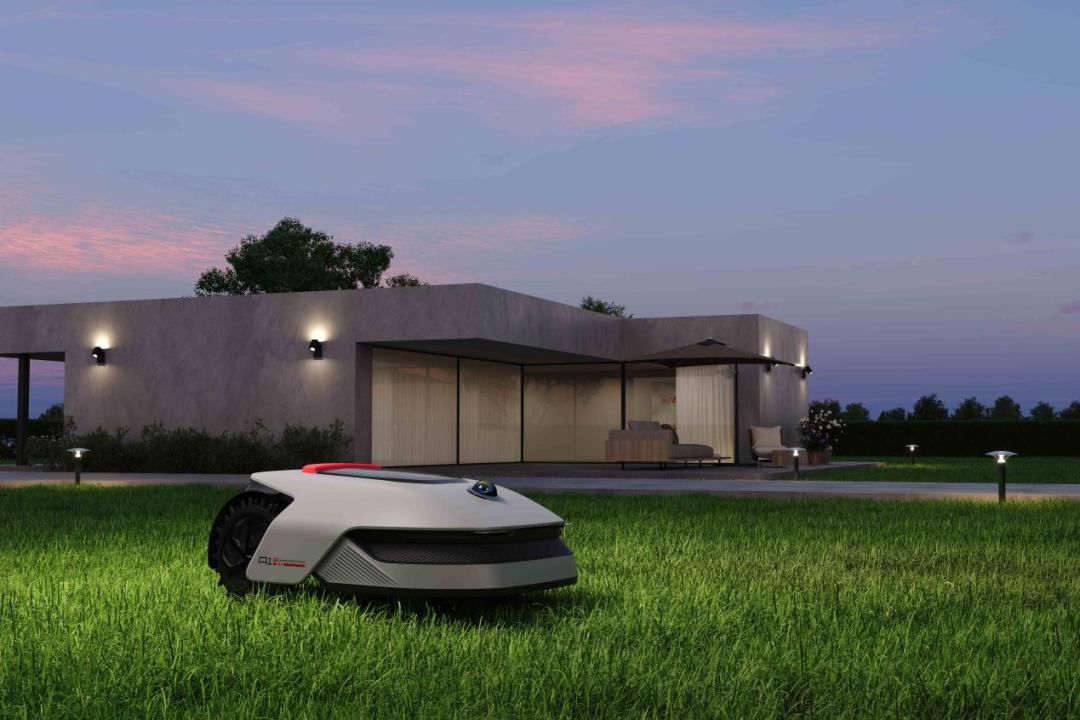
Dreame A1 PRO in low - light conditions
In such an environment, traditional vision - based solutions have limited vision and are easily affected by the intensity of light, while pure RTK solutions are like "new drivers" who are extremely dependent on navigation apps. Once the satellite signal is unstable, they will be at a loss. This "inherent deficiency" in perception has kept lawn mowers at the stage of "tools" rather than "robots" for a long time - you have to take care of them instead of them serving you.
The success of Dreame's A - series lawn mowing robots is essentially a precise strike against the pain points of this industry.
The introduction of LiDAR technology is like equipping the robot with a pair of "night - vision eyes that can see far". Its unique advantage lies in active detection: it does not rely on ambient light, but emits laser beams on its own to perceive the world. This means that under any time period and lighting conditions, it can have centimeter - level ranging accuracy and a detection distance of up to 70 meters.
By migrating the mature SLAM (Simultaneous Localization and Mapping) algorithm of indoor sweeping robots to the outdoor environment, Dreame's lawn mowing robot has completed a beautiful technological transplantation. It also makes the whole industry realize that only with the "omnidirectional" perception ability of actively emitting lasers can lawn mowing robots truly get rid of the dependence on external base stations and physical fences.
The integration of new technologies not only brings an improvement in technical parameters, but also a qualitative change in product attributes - it finally enables lawn mowing robots to cross from a "semi - automatic tool" that needs human assistance to a "new species" that can make independent judgments.
From "seeing" to "understanding the environment"
Behind the "experience economy" represented by Dreame's lawn mowing robot, an important moat is to let new technologies actively understand the environment and eliminate consumers' invisible "psychological barriers" to the entire product category.
In the consumer electronics field, there is an unwritten rule: the advancement of technology must ultimately be reflected in the convenience of use. For users, they don't care about the number of radar lines, but only about one thing: can the trouble of lawn mowing be reduced?
In the traditional lawn mower industry, there has always been an invisible "high wall":
In order to prevent the machine from running around randomly, users often need to hire a professional team to come to the house and bury boundary lines around the garden. This is not only time - consuming and labor - intensive, but also often accompanied by an installation cost of 200 to 400 euros. Imagine having to spend thousands of dollars to hire someone to install a network cable to use a mobile phone, which seems incredible today, but this is the norm in the lawn mower industry.
This high "invisible threshold" directly excludes a wider range of potential consumers and the incremental market.
The key to Dreame's lawn mowing robot's breakthrough lies in using LiDAR technology to completely tear down this wall.
While innovatively verifying the potential of large - scale application of LiDAR in the field of lawn mowing robots, Dreame's lawn mowing robot has also developed a solution that can achieve high - precision positioning, mapping, and omnidirectional obstacle avoidance in outdoor environments relying only on LiDAR, greatly reducing the installation and use thresholds for users and turning the complex deployment process into an "out - of - the - box" experience.
For channel partners, this means a sharp reduction in after - sales pressure - no more complaints about broken lines and no more returns due to signal blind spots. This is also an important reason why Dreame's A - series products have topped the global market share during this year's autumn promotion and maintained the lead.
In 2025, the courtyard economy is actively pursuing intelligence and usability centered around AI recognition. However, the complexity of the outdoor world far exceeds imagination. Solving the "navigation" problem is just the first step, and solving the adaptability to complex environments is the key.
A single sensor is like having only one eye and cannot cope with the complexity of the real world. For example, a stone in the grass and a lying pet dog may just look like two similar bumps to a single - line radar. At this time, the focus of industry competition has begun to shift from simple "hardware stacking" to a more user - friendly "multi - sensor fusion algorithm".
Dreame's addition of a vision - based solution to the new A3 AWD PRO model is an embodiment of this evolutionary logic. As the world's first four - wheel - drive lawn mowing robot with a "360 - degree 3D LiDAR + binocular vision" system, the A3 AWD PRO series was unveiled at this year's IFA exhibition. The industry - first binocular vision + AI algorithm fusion obstacle - avoidance system has increased the accuracy of dynamic obstacle recognition to 98%.
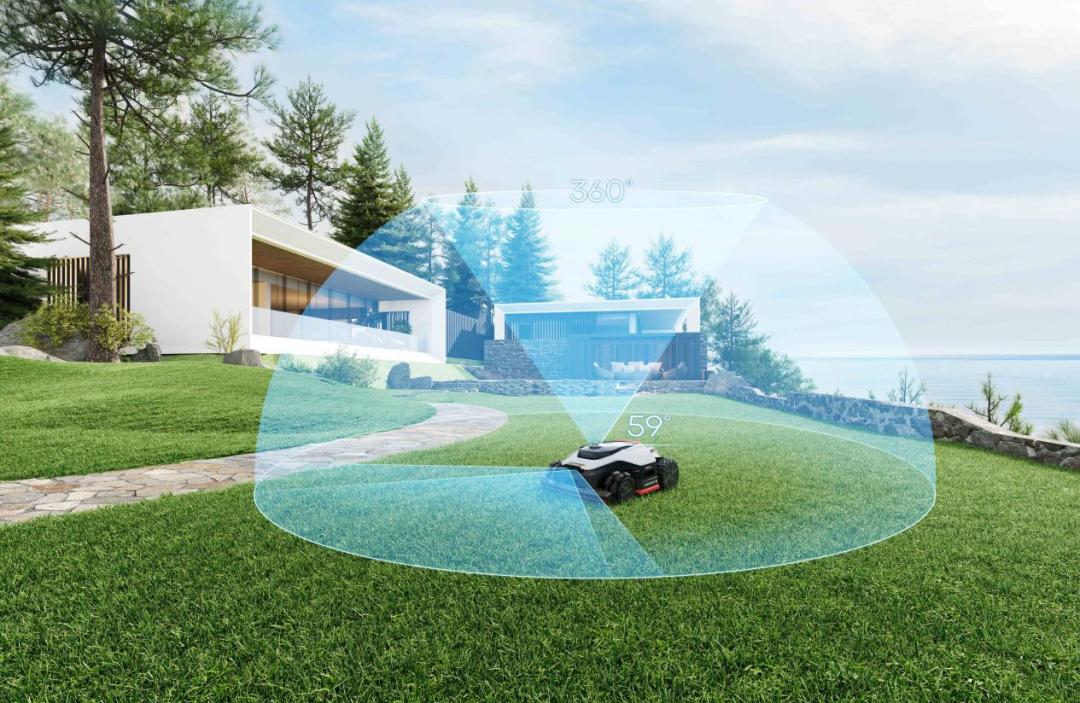
Dreame A3 AWD PRO
This is like equipping the robot with a "professional driver's brain": the LiDAR builds the framework, the binocular vision fills in the details, and then uses the AI algorithm for semantic understanding. It is no longer a cold obstacle - avoidance mechanism, but a respect for the warmth of life - it can distinguish where the grass is, where the children's toys are, and where the pets that need to be bypassed are.
The difference between high - end consumers and ordinary consumers often lies in their picky requirements for this "last 10%" of the experience.
Most machines can run on flat ground, but are helpless when facing complex slopes and dead corners. Especially the large - slope terrain common in European and American courtyards is a touchstone for testing the quality of the machine's chassis. Dreame's A3 AWD PRO has achieved a climbing ability of 80% (about 38.7°) through its four - wheel - drive hub motors and shortened the edge - trimming distance to 3 cm using the EdgeMaster™ 2.0 offset cutterhead. These seemingly insignificant details can precisely impress consumers in the existing market.
Only by solving these "extreme problems" through the integration of technologies can the trust of high - end users be won. In the highly competitive European market, Dreame's lawn mowing robot has quickly broken through not by relying on price wars, which "Made in China" was good at in the past, but through the adaptation of special technologies for large - area, multi - slope geographical features.
In the future competition, it is no longer about who has the more expensive radar hardware. The real decisive factor is who can make the robot truly "understand" the environment through algorithms. This evolution from "seeing" obstacles to "understanding the environment" is the deepest technological moat that Dreame has built.
It gives the machine a sense of humanity and makes the concept of a "smart courtyard butler" a possibility for the first time.
Overwriting the "outdoor rules" with technological spill - over
If we take a broader view and examine Dreame's technological reserves for its lawn mowing robot, we will find that it is not accidental that it has quickly built a technological barrier in the lawn mower field.
One of the innovative barriers of Dreame's A - series lawn mowing robots is the core technology - intelligent algorithm - that Dreame Group has accumulated over the long term.
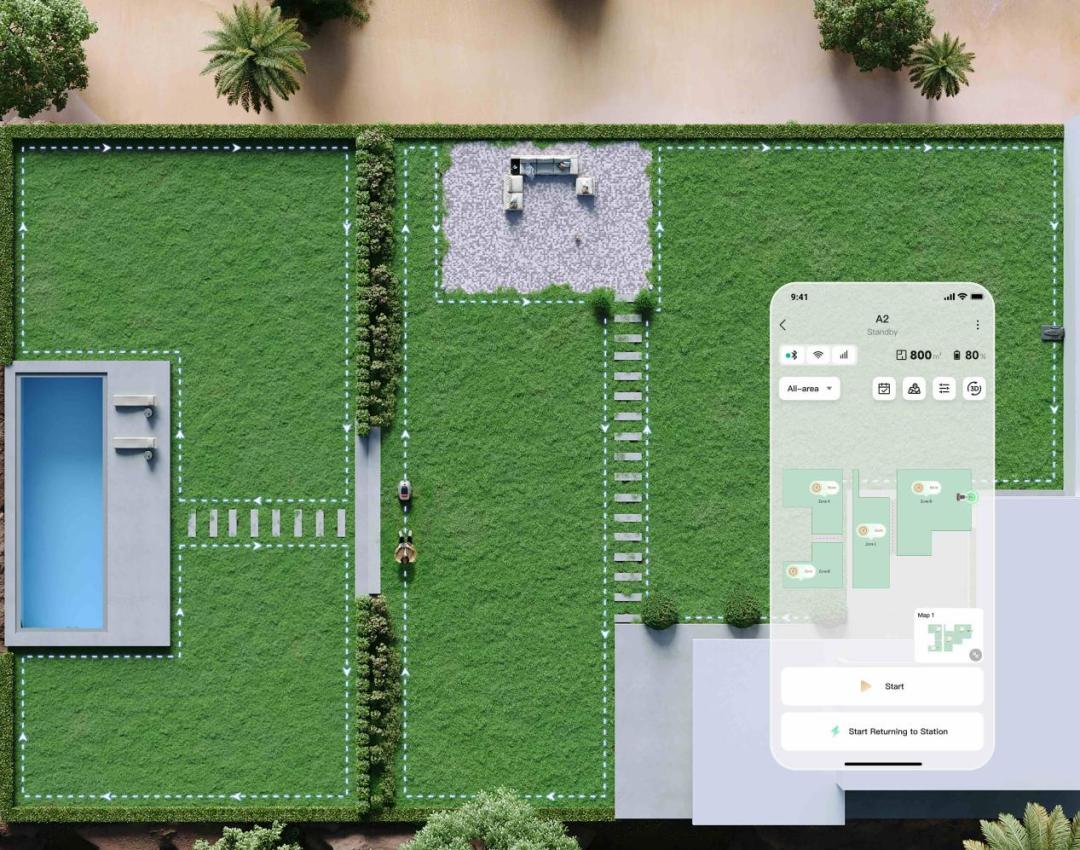
Dreame A2 navigation and mapping
This is a unique "technological concentric circle" strategy, also known as the technological spill - over effect.
Dreame's lawn mowing robot is not a traditional gardening tool. Its genes carry the long - term accumulation of a technology company. Relying on Dreame's deep accumulation in the field of indoor cleaning robots, it has "transferred" and adapted the extremely mature indoor SLAM algorithm and motion control logic, like modules, to outdoor scenarios.
This approach is extremely smart. While traditional gardening giants are still groping for how to make the motor run more stably, Dreame's lawn mowing robot has entered the battlefield with the intelligent algorithm that has been refined millions of times indoors.
From the OmniSense™ integrated perception system to the intelligent obstacle - avoidance strategy, Dreame's lawn mowing robot is actually using the logic of manufacturing precision sweeping robots to "outperform" traditional lawn mower products. This cross - border reuse of technology not only spreads the high R & D costs, but also endows the product with an Internet gene that traditional hardware manufacturers are difficult to possess, such as rapid iteration and software OTA upgrades.
This is not only an iteration of the product itself, but also a victory for the Chinese intelligent hardware industry chain.
Looking to the future, LiDAR - equipped lawn mowers are repeating the path of Chinese electric vehicles and drones going global. Dreame's lawn mowing robot is currently conducting pre - research on solid - state LiDAR and developing a multi - sensor fusion solution. To some extent, this technological architecture is actually reconstructing the standard of "courtyard intelligence" using the underlying logic of autonomous driving.
That is to say, in the eyes of Dreame's lawn mowing robot, the future lawn mower will not just be a weeding tool. It will be a mobile platform with high environmental adaptability, capable of interacting with other smart home devices and becoming a real "smart courtyard butler".
In this process, China's advantages in core algorithms and supply chains can also quickly awaken the synergy behind a precision robot and redefine the high - quality standard for the global courtyard economy. Currently, Dreame's lawn mowing robot has topped the markets in multiple European countries and will fully enter the North American market in 2026, which verifies the effectiveness of this "high - end technology transfer" strategy.
The North American market is the "ultimate boss" level in the courtyard economy: the lawns there are larger, the terrain is more complex, and the grass species are harder. The four - wheel - drive technology and binocular vision fusion algorithm that Dreame's lawn mowing robot has in reserve are the ammunition for this "tough battle".
In addition, in this traditional industry, to achieve a breakthrough in overseas sales, technology alone is not enough. It is also necessary to deeply cultivate local operations. Analyzing Dreame's channel layout for its lawn mowing robot, we will find that it is not just focusing on e - commerce data, which Chinese companies going global are more familiar with, but is also patiently laying out professional dealer channels in the vertical courtyard field.
Overseas, dealers are not only sales points, but also nodes of trust. Doing a good job in local channel penetration, allowing global consumers to see, touch, and repair the machine at their doorsteps, is a key step for Dreame's lawn mowing robot to continuously expand its market share and enhance brand penetration globally.
The second half of the intelligent hardware era has long passed the wild - growth stage. Only the upgrading of experience brought about by technological innovation can open up a new blue ocean in a traditional industry with a huge existing market.
The story of Dreame's lawn mowing robot shows that Chinese brands are fully capable of taking the lead in the intelligent hardware field. This revolution in the courtyard has just begun, and those who hold the map have already set off.