Commercial space is not just about launching rockets; it's about building "space infrastructure": The next-generation industrial chain is being reconfigured.
In the era of Commercial Space 2.0, the biggest competitor is still the United States
On December 12th, Long March 12 was launched as scheduled. This big guy with a diameter of 3.8 meters and a height of 62 meters has a take - off mass of about 430 tons. It can carry 12 tons at a time in the low - Earth orbit. It uses the same engine as the future lunar - landing rocket, and the thrust can be finely adjusted. As the end of the year approaches, China has been launching rockets frequently. What are the strategic considerations behind this? It is necessary to explain them one by one today.
AI is not the last straw that breaks the back of ground - based computing power, but the first match that propels computing power into space.
As the model scale grows from tens of billions of parameters to trillions of parameters, global data centers are all powering up crazily, but the supply still falls short of demand. At this time, a direction that has been ignored for many years suddenly becomes extremely popular: space - based computing power.
Beyond 700 - 800 kilometers, satellites can obtain uninterrupted solar power supply, extremely low cooling costs, and low - latency coverage across continents. These characteristics are exactly a perfect match for the next - generation computing power requirements. Once space - based computing power is scaled up, the Earth will have, for the first time, a data center with "unlimited power + near - zero cooling costs".
This is not a technological fantasy but a new starting point for industrial competition. In the foreseeable future, commercial space will no longer be just the rocket industry but a "space - version information industry revolution". So far, commercial space has officially entered the 2.0 era dominated by "space infrastructure" from the 1.0 era of mechanically and repeatedly launching missiles.
01 The current rocket launch frequency cannot meet the requirements of the Commercial Space 2.0 era
The commercial space industry chain is divided into upstream manufacturing, mid - stream launch, and downstream application and operation. Before the advent of the commercial space era, the high cost of upstream manufacturing and the low frequency of mid - stream launches greatly restricted the development of the industry.
In the 1.0 era, commercial space was market - driven space activities carried out by private and mixed - ownership enterprises through business models, including investment, operation, and risk - taking. It had core features such as market - oriented entities, product - based technologies, full - chain coverage of the industry chain, and innovation - driven development, covering the entire industrial chain from research and development, manufacturing, launch, to application of space technologies.
If "Commercial Space 1.0" was about taking rockets out of the national military - industrial system and entrusting their mass production to commercial companies, then "Commercial Space 2.0" is about turning satellites from billion - dollar "luxury goods" into "space terminal devices" that can be industrially replicated.
Compared with the 1.0 era, Commercial Space 2.0 is capable of reconstructing the entire industry chain. The unit cost of low - orbit satellites has been reduced by more than 90% in 10 years. This is a comprehensive revolution in business models, supply chains, and systems engineering, rather than a single - point technological breakthrough.
For a long time in the past, the cost of satellites was restricted by manual assembly, custom - made components such as MCUs and sensors. The rockets carrying satellites could only be used once, and the unit price of satellite launches remained high. Before the emergence of "stainless - steel reusable rockets", countries focused on researching and developing the "multiple - satellite launch" technology.
Since 1960, the United States, the former Soviet Union, and the European Space Agency have successively achieved multiple - satellite launches. On September 20th, 1981, China first used the "Fengbao 1" carrier rocket to successfully launch three satellites, Shijian 2, Shijian 2A, and Shijian 2B, becoming the fourth country in the world to master this technology. By June 15th, 2023, "41 satellites in one launch" set a new record for the number of satellites launched in a single Chinese space mission.
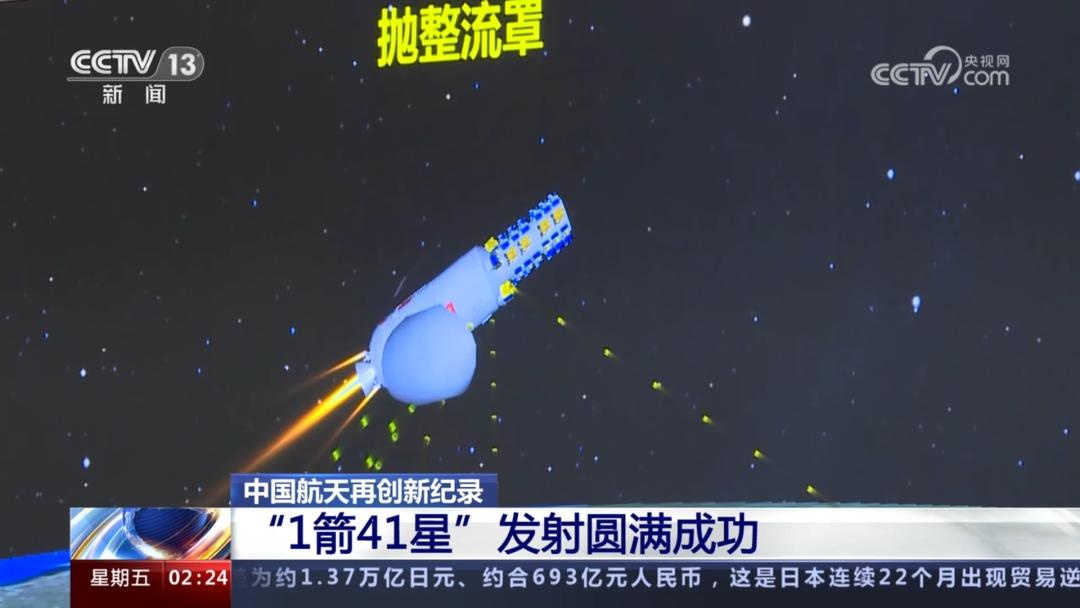
The Long March 8 can launch 22 satellites at a time. The low - orbit launch service price is less than $50,000 per kilogram, which is lower than that of other mainstream single - use carrier rockets. In high - orbit missions, the launch service prices of the "Long March" series of rockets are generally lower than those of foreign carrier rockets. The reduction in the launch cost of single satellites has laid the foundation for the batch launch of satellites.
According to the analysis of the authoritative industry journal "China Space", China's satellite launch prices have significant advantages globally and are in the first echelon. The low - orbit service price is not much higher than that of SpaceX. If China wants to win in the accelerating development of the global low - orbit constellation, it must upgrade the traditional satellite manufacturing and launch methods, reducing costs through assembly - line mass production and "multiple - satellite launch" methods.
So now the satellite manufacturing industry has evolved from component customization and manual assembly to modular design of the whole satellite (standardized separation of communication, energy, and attitude control); a large number of commercial off - the - shelf (COTS) electronic components are used; and the production lines are replicable (very similar to those of new - energy vehicles and battery factories). According to public information, China Satellite Communications Co., Ltd. (sh.600118) alone has a production line capable of mass - producing 240 small satellites weighing less than 1 ton per year.
To further improve the level of commercial space, at the end of 2023, China's first commercial space launch site - Hainan International Commercial Space Launch Center was built in Wenchang, Hainan. To meet the growing demand for satellite networking, both launch pads at the center are designed for 16 launches per year. Now it has the ability to conduct high - density launches on a regular basis with two pads, greatly improving the launch efficiency, and aims to achieve a high - density launch capability of "one launch per month" by 2025.
Meanwhile, to meet the future rapid growth in satellite demand, a satellite super - factory and a satellite - rocket industrial park supporting project were built in the Wenchang International Space City in Hainan. The satellite super - factory was capped in December 2024. The satellite super - factory and the satellite - rocket industrial park adopt a "1 + 1+8" structure, consisting of one satellite super - factory, one test and detection center, and eight core single - unit research and development centers.
On April 3rd, 2025, Spacecraft Super - Factory (Hainan) Co., Ltd., the first overseas - invested space satellite super - factory by a Chinese commercial satellite company, was officially established. The project will be located in Wenchang, Hainan, building a satellite super - factory. The factory is planned to be completed and put into operation by the end of 2025, and the first satellite will roll off the production line. After the project is completed, the annual production capacity can reach 1000 satellites.
Compared with traditional launch sites, the flexible launch arrangements of commercial space launch sites are obviously more in line with the requirements of the Commercial Space 2.0 era for high - frequency rocket launches.
02 Starlink is just the beginning. Sending computing power into space has become a new battlefield for space infrastructure
The acceleration of the commercial space industry into the 2.0 era originated from the "Starlink Project" in the United States. Due to the convention of "first - come, first - served" in the use of satellite orbits, countries have to flock to the "commercial space" track to obtain enough satellite orbits.
In 2014, SpaceX proposed a low - orbit Internet constellation plan, which is now well - known as "Starlink". Its purpose is to improve the accuracy and anti - interference ability of the US navigation and positioning system.
The initial idea of the Starlink project was to complete a "Starlink" network consisting of 12,000 satellites before 2024, and the total number is planned to increase to 42,000 satellites later, aiming to replace traditional ground - based communication facilities and provide low - cost, high - speed, and stable satellite broadband services globally, building a space - based communication system with global coverage, large capacity, and low latency to provide high - speed Internet services worldwide.
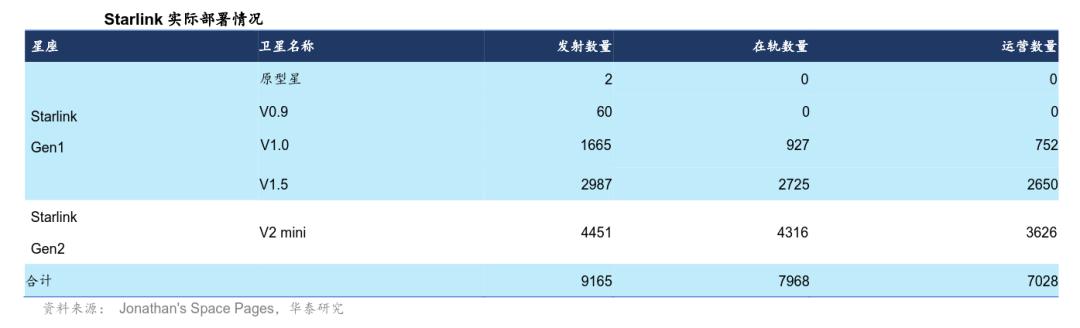
According to public information, the Earth's low - Earth orbit (LEO) is expected to accommodate about 60,000 satellites. Once Starlink is completed, it will occupy most of the orbits, thus triggering a fierce competition among space - faring countries. As of July 10th, 2025, SpaceX has launched a total of 9165 Starlink satellites, with 7968 in orbit. The number of launched satellites accounts for 47% of the total approved satellites and 22% of the total planned satellites.
If all the in - orbit satellites are low - orbit satellites, the total number in orbit already accounts for 13.3% of the total capacity of the LEO orbit. If all 29,988 satellites in the second - generation satellite constellation are approved, the complete Starlink will consist of 41,914 satellites. Currently, the number of launched satellites only accounts for 22% of the total plan.
In 2016, China proposed low - orbit satellite Internet plans such as "Hongyan" and "Hongyun", but the number of satellites was only more than 400. In April 2021, China Satellite Network Group Co., Ltd. was established, specializing in the design, construction, and operation of satellite Internet. Its constellation plan, "Satellite Network Project", is expected to launch 12,992 low - orbit satellites (6080 satellites at an orbital altitude of 500 - 600KM and 6912 satellites at an altitude of 1145KM), building a huge constellation system.
Source: Soochow Securities
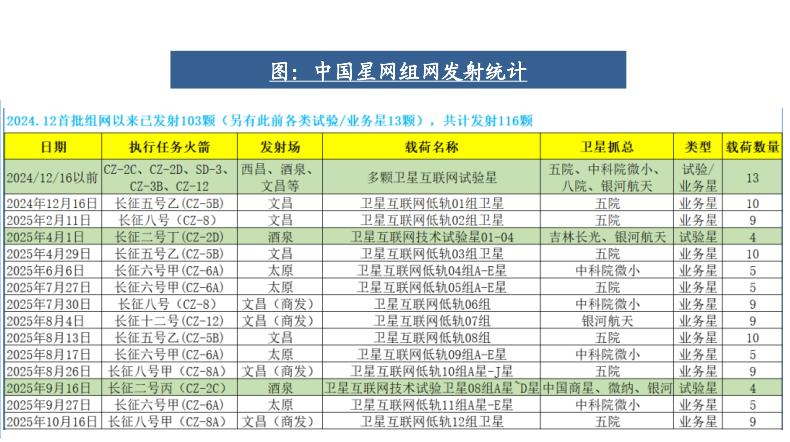
According to the regulations of the ITU (International Telecommunication Union), the first satellite must be launched within 7 years of application, 10% of the total constellation must be in orbit within 9 years, 50% within 12 years, and 100% must be deployed within 14 years. Taking the 12,992 satellites planned by China Satellite Network Group (applied for in September 2020) as an example: at least one satellite must be launched by 2027 (already completed), about 1300 satellites (10%) must be in orbit by 2029, 6500 satellites (50%) must accumulate by 2032, and all 13,000 satellites must be deployed by 2034. As of October 2025, China Satellite Network Group has launched a total of 116 satellites (including experimental and operational satellites).
Driven by multiple factors such as the decline in satellite broadband costs, the increasingly prominent national strategic position, and the scarce space frequency and orbit resources, in addition to China Satellite Network Group, there are also two constellation plans for 10,000 satellites in China: Shanghai Yuanxin (G60 Qianfan Constellation) and LanJian HongQing Technology (Honghu - 3 Constellation).

Source: Soochow Securities
Recently, the Ministry of Industry and Information Technology issued a notice saying that it will organize a two - year commercial trial of satellite Internet of Things services. According to the "Notice on Organizing Commercial Trials of Satellite Internet of Things Services", the service targets of the commercial trials of satellite Internet of Things are enterprises and institutions using satellite Internet of Things for applications, mainly including industry users in the industrial, transportation, energy, agriculture, emergency, and other fields that use satellite Internet of Things for data collection and transmission.
In terms of trial objectives, the notice clearly states that through the commercial trials of satellite Internet of Things services, the supply of the satellite communication market will be enriched, the service capabilities of the industry will be improved, a safety supervision system will be established, and replicable and promotable experiences and models will be formed to support the safe and healthy development of emerging industries such as commercial space and low - altitude economy.
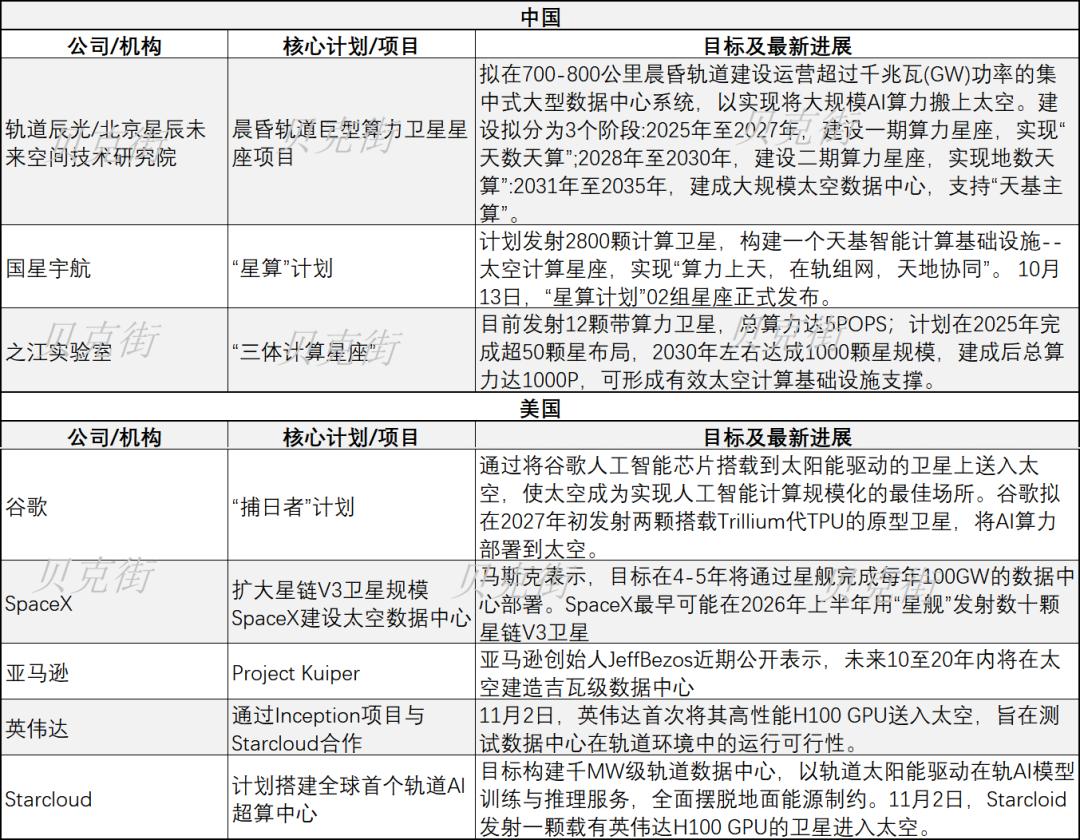
In addition to constellation plans for navigation and communication, with the rapid development of the artificial intelligence industry in recent years, the demand for computing power has increased exponentially. Many companies plan to send computing power into space, including but not limited to domestic companies/institutions "Beijing Xingchen Future Space Technology Research Institute", "Guoxing Aerospace", "Zhijiang Laboratory"; well - known technology companies such as Google and SpaceX in the United States.
Source: Made by Baker Street Detective Officer
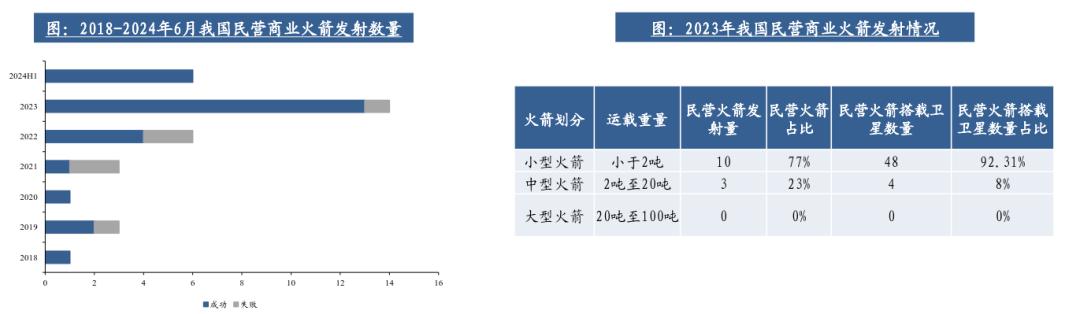
In the era of Commercial Space 2.0, the strength of private enterprises in the commercial space field should not be underestimated. Public information shows that from 2018 to June 2024, private enterprises launched rockets 34 times in total, with 27 successful launches and 7 failed launches. Generally speaking, the number of rocket launches by private enterprises has been increasing. After an exploration period from 2018 to 2021, the launch success rate has gradually increased. Since 2022, the number of rocket launches by private enterprises has gradually increased. In 2023, there were 14 launches, which was the same as the total number of launches from 2018 - 2022.
Source: Sooch