Cotte Intelligent leads the way in implementing industry-level AGI and upgrades "Made in China" to "Intelligently Made in China"
In the past few years, artificial intelligence has undergone an extremely aggressive process of expansion and iteration. Almost the entire industry has been urgently asking: Where will it go next? However, one thing is becoming increasingly clear: we are about to enter the era of Artificial General Intelligence (AGI). Regarding the descriptions and visions of AGI, technology giants have different focuses, but all of them show great ambitions in betting on AGI. Last year, the secret agreement between OpenAI and Microsoft was exposed, in which the goal of "AGI" was priced at $100 billion.
In any case, the ultimate and ideal super artificial intelligence will not suddenly emerge, but will naturally penetrate into all industries and unfold gradually, becoming more powerful over time. With the iterative upgrading of architectures, data, and training methods, artificial intelligence systems are developing in a very "pragmatic" way and achieving breakthroughs in specific fields through in - depth exploration.
The Chinese market, which is "application - oriented", is becoming an important observation sample for the practical implementation of artificial intelligence and its in - depth integration into industries. Perhaps, the ambition for AGI and solid enterprise applications are not two completely different paths? In Qingdao, Shandong, a company named Kute Smart, which has been deeply involved in intelligent manufacturing for more than 20 years, has taken the lead in finding the answer to this question.
PART1 The Dawn of Hope
Against the backdrop of AI reshaping the global industrial landscape, almost all industries have been caught up in the same accelerating trend, without exception.
The manufacturing industry, which was once in a transformation dilemma, has shown immeasurable future potential driven by artificial intelligence. According to the data released by the Ministry of Industry and Information Technology, the total scale of China's intelligent manufacturing industry has exceeded 4.5 trillion yuan, marking that the digital transformation of China's manufacturing industry has entered an acceleration period.
Zhang Daili, the 70 - year - old founder of Qingdao Kute Smart Co., Ltd., has witnessed the industry changes over the decades. He led a clothing personalized intelligent customization enterprise to gradually grow and then transformed it into a C2M industrial Internet AI technology intelligent enterprise, actively participating in the digital and intelligent wave. First, as a strategic partner of Huawei Cloud, it deeply integrated into Huawei's digital and intelligent ecosystem. After years of technological investment and R & D, it finally achieved a revolutionary breakthrough.
Kute Smart's scientific research and application started from the clothing personalized intelligent customization field as an industrial test - bed. Through more than 20 years of technological refinement and data accumulation, it deeply integrated AI into the entire clothing production process and gradually expanded its technological capabilities to all clothing categories. Finally, in 2025, it ran through the industry - level general artificial intelligence - Kute AGI.
In order to truly implement AGI technology in various scenarios of enterprise operation and make it a real industry - level general artificial intelligence, Kute Smart pioneered a new paradigm for enterprise AI native applications. Its core consists of three industrial applications supported by synergy, namely: the digital and intelligent enterprise - level operating system, the intelligent enterprise, and the intelligent enterprise cluster. The three form an overall closed - loop evolution, helping enterprises fully enter a new stage of fine - management and self - governance evolution driven by AI. Among them, the digital and intelligent enterprise - level operating system is the enterprise's all - domain intelligent hub, which consists of three AI native core products:
One is Kuxiaojiang (Demand - side - AI Designer). Its core value is to break through the information barrier between customers' customization needs and the production process, realizing the automatic flow of data from customers' creativity to workshop production without manual translation. For example, if a customer only expresses "I want such clothes" through pictures, voice, or text, it can instantly analyze the needs and automatically generate patterns, process sheets, and material lists, truly achieving what you see is what you get, and the needs can be directly sent to the production end with one click.
Two is Kuxiaoyi (Operation - side - AI Operation Assistant). Its core function is to convert the strategies generated by AI into specific tasks in real - time, monitor the progress of each link throughout the process and report to managers in real - time, ensuring the efficient progress of tasks. It features a "conversation is work" mode, which can instantly reply with data, locate problems, recommend solutions, and also automatically assign tasks, follow up on progress, and organize meetings, promoting the transformation of management from "people looking for data" to "data helping people", making complex management simple and efficient.
Three is Kuxiaozhi (Governance - side - AI Organizational Architect). It dynamically evaluates and optimizes enterprise systems and processes based on the task execution results, constructing a high - speed closed - loop of "strategy - plan - execution - feedback" to help enterprises achieve agile trial - and - error and continuous iteration. It supports natural language development and zero - code application generation, allowing business personnel to directly participate in innovation practices. The system continuously evolves with use, and the organization becomes more agile with iteration, disassembling the heavy IT "monolith" into flexible and assembleable intelligent "building blocks".
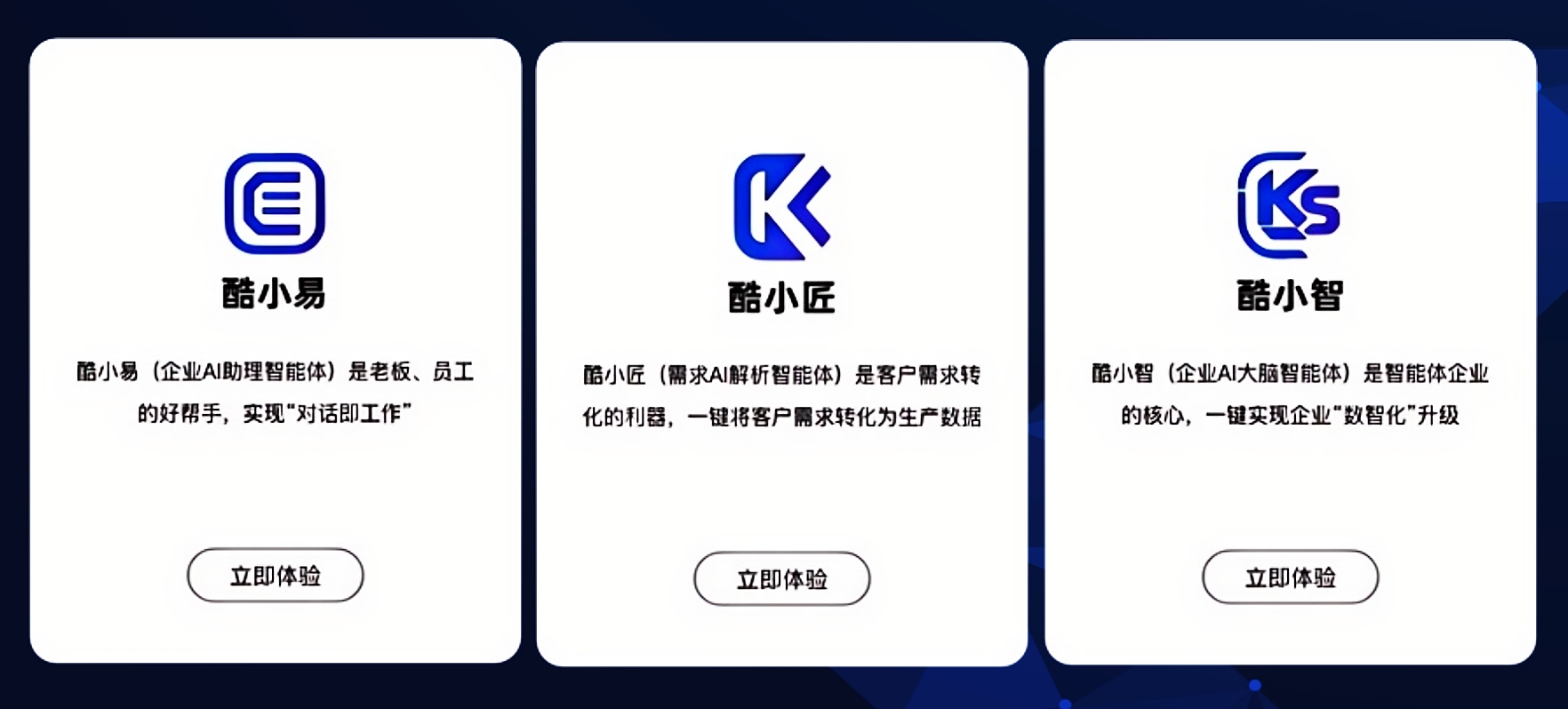
These three AI native core products cooperate with each other to build a flexible manufacturing intelligent hub covering the entire "demand - operation - governance" link, converting Kute AGI's technological capabilities into tools that enterprises can directly use, realizing the complete implementation of "technology - product - value", enabling enterprises of different scales and in different scenarios to quickly enjoy the dividends of the transformation brought by AGI.
In fact, many enterprises have been testing the waters of digitalization in recent years, implementing MES, trying ERP, installing sensors... However, there are not many cases that can truly embed artificial intelligence into the entire production and management chain and achieve intelligent drive. It shows the phased characteristic of "emphasizing technology and neglecting application", and the proportion of applications that can truly be implemented to generate actual value is extremely low, failing to achieve the goal of true "flexible manufacturing".
Kute Smart's practice proves that the key to achieving this transformation lies in basing on industrial reality.
In the past few years, Kute Smart took the customized business C2M as the core scenario and its own factory with thousands of employees as the actual combat test - bed, comprehensively integrating the real operation scenarios of enterprise production, supply, sales, personnel, finance, and materials into it, and constructing a credible and controllable PDCA R & D closed - loop. This provides rich real - scenario support for technological R & D, helping scientific research to make small and fast progress and rapid iteration, and laying a solid foundation for the implementation of the digital and intelligent enterprise - level operating system and AGI technology.
This breaks the inherent perception that "general artificial intelligence is out of reach": as long as enterprises deeply cultivate their own fields and convert data resources into assets, they can make AI technology play a real role.
While people are still arguing about the definition of AGI, Kute Smart has taken the lead in running through the industry - level AGI, implemented AGI in actual industrial operations, and achieved actual results. According to Kute Smart's data, with the support of AGI, the intelligent manufacturing management cost has been reduced by more than 50%, and the overall efficiency has been improved by more than 20%.
On the basis of its practical nature, Kute AGI also has an aggressive side. Based on a deep understanding of the industry, Kute Smart realizes that what AGI will completely break is the shackles of enterprise organization and management.
PART2 Breaking the Shackles
In addition to the digital and intelligent enterprise - level operating system composed of three AI native core products, Kute AGI also includes intelligent enterprises and intelligent enterprise clusters. The latter two originate from Kute Smart's new vision for enterprise organization and development models.
In Kute Smart's view, "the native application of artificial intelligence has reached a critical moment." In the past, "chips accounted for 100, models accounted for 10, and applications accounted for 1, which was the primary stage called 'intelligent emergence'. Now, applications account for 100, models account for 10, and chips account for 1, which is the stage of 'effect emergence'." Zhang Daili, the founder of Kute Smart, said. The reason why Kute AGI can achieve "effect emergence" lies in the three core breakthroughs of its native applications: completely breaking through the shackles of data governance, completely breaking through the shackles of organizational change, and completely breaking through the shackles of traditional ERP.
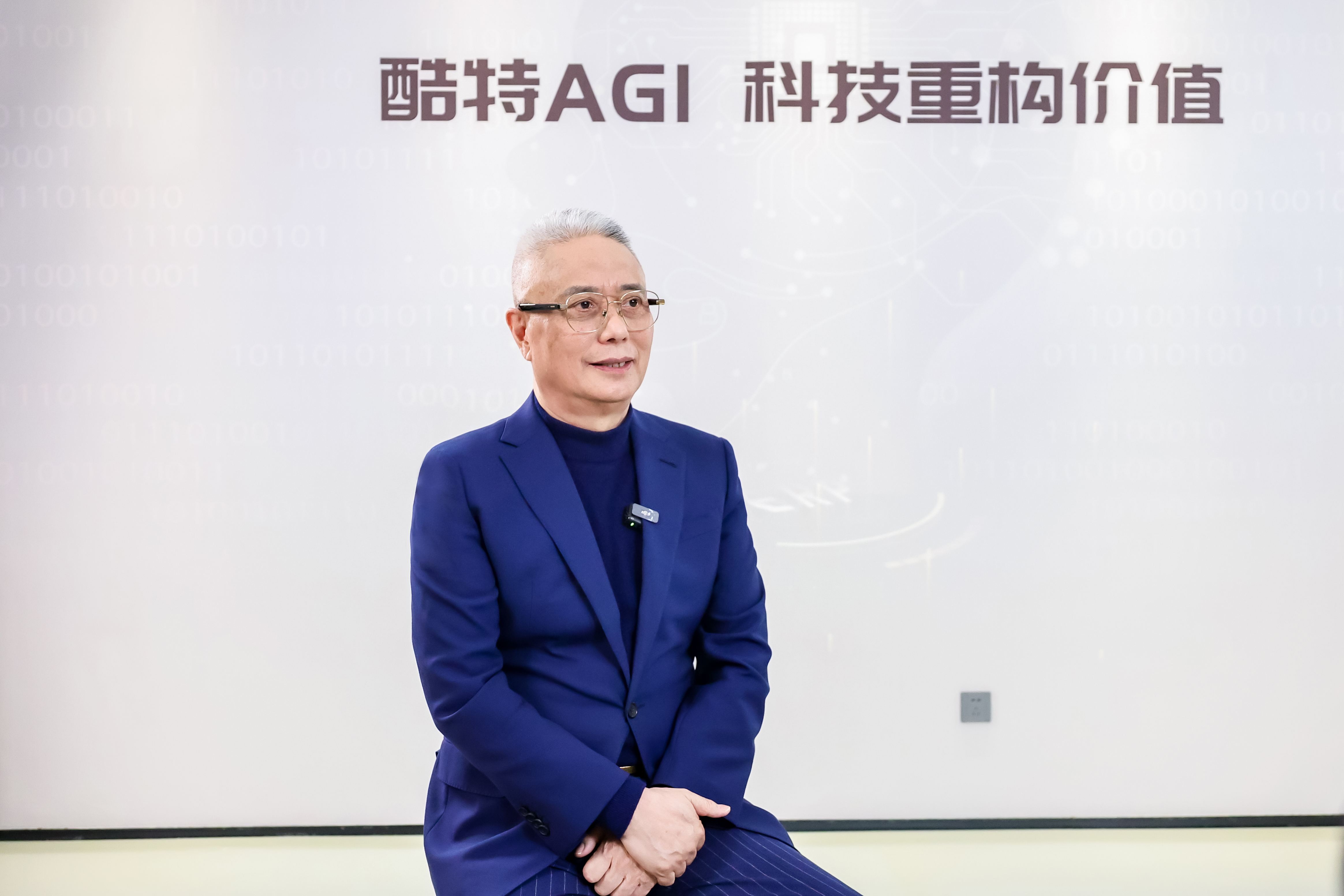
Zhang Daili, the founder of Qingdao Kute Smart Co., Ltd.
Kute Smart's goal is not just to build a more intelligent factory, but to create a new supply - chain infrastructure, an intelligent cluster network, a decentralized, and highly flexible industrial ecosystem. In other words, Kute Smart's ambition is not just to optimize production, but to reshape the industrial structure.
Starting from the clothing industry, Zhang Daili has witnessed the systematic shocks the industry has suffered in the past few decades: fragmented demand, shortened product life cycles, and compressed delivery windows. The underlying logic of "supply - determining - demand" can no longer keep up with the times, and "flexible manufacturing" is not just "icing on the cake", but even determines the survival of some enterprises.
If the competition in the previous era was about production capacity and channels, then now, the market has made it very clear: whoever can convert customized demands into deliveries the fastest will survive. This is the real meaning of the "demand - supply era". More than 20 years ago, the coping model Zhang Daili came up with was C2M (Customer to Manufacturer), enabling enterprises to meet consumers' customized demands through large - scale production.
The subsequent market trends have confirmed Zhang Daili's prediction. When consumers prefer personalization and fast delivery, and the supply chain is under great pressure, inventory costs are high, and there are ceilings for both cost and efficiency, this "demand - supply" - oriented solution has gradually become the mainstream direction. According to a report by CIC Industry Research Institute, the global flexible manufacturing market size may reach $1.8 trillion in 2030, of which the Chinese market accounts for 35%.
In order to take the lead in the new market wave, Kute Smart actively invested in digital and intelligent transformation, gradually deploying cutting - edge technologies from production and manufacturing, supply chain to data - based operations. Big data, cloud computing, artificial intelligence... With the evolution of technology, the reborn Kute Smart has finally entered the era of AGI.
Now, when you enter Kute Smart's factory test - bed, you can see that there is no factory director, no workshop director, no team leader, and no approval. The entire operation is completely carried out by the artificial intelligence system. As described by Zhang Yunlan, the chairperson of Kute Smart, different production elements are like building blocks, and what Kute AGI does is to naturally combine these building blocks to form an orderly and efficiently operating enterprise.
It doesn't just stay at the concept level, but has been tested in the factory test - bed, real orders, and production lines; it doesn't rely on ideal conditions, but forms multiple coordinated closed - loops; it has a replicable and expandable mechanism and is steadily moving towards the goal of an intelligent enterprise cluster... Kute Smart's current layout has proven that it has the opportunity to solve the core challenges in the intelligent era.
PART3 Based on Belief
What has supported Kute Smart to reach where it is now is a very simple and pure original intention.
In Zhang Daili's view, enterprises are the core subjects of social value creation, and the ultimate mission of science and technology is to create value and reconstruct productivity. "If science and technology do not exist for the sake of value, then the meaning of their existence is out of the question."
Based on the core concept of value creation, it has run through the entire R & D process of Kute AGI. For example, it pursues ultimate simplicity, making the intelligent agent easy to operate and use for every staff member; it tries to reduce costs as much as possible so that more enterprises can reuse it. Cui Peng, a tenured associate professor at the Department of Computer Science and Technology of Tsinghua University, proposed that "from the perspective of generalizability, the process from AI to AGI is a gradual one. The core indicator of gradualness is the proportion of migration cost to the original system development cost." Currently, Kute AGI has basically achieved zero migration cost.
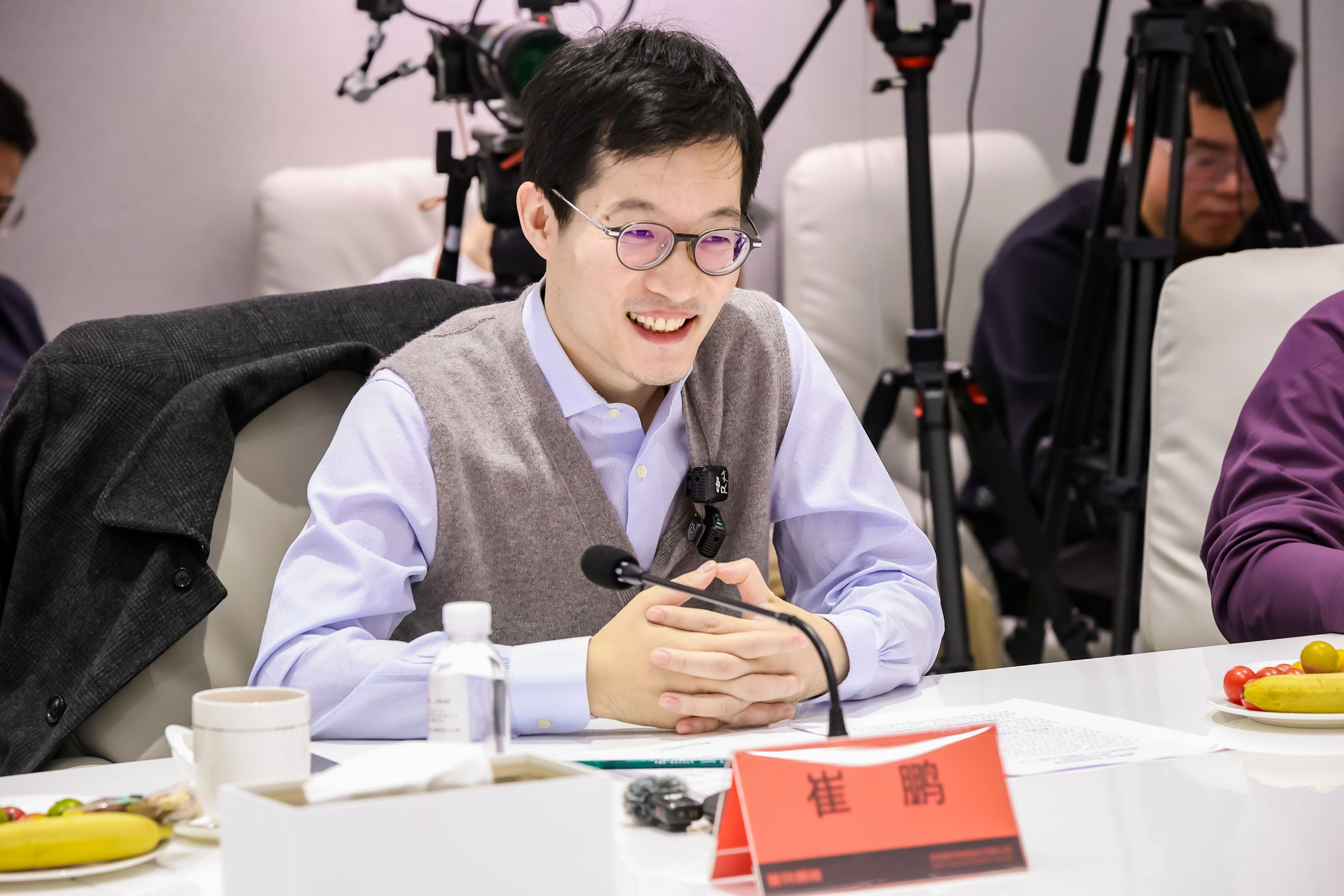
Cui Peng, a tenured associate professor at the Department of Computer Science and Technology of Tsinghua University
Kute Smart wants to provide opportunities for the industry and more practitioners to participate in the transformation and create value. After all, the full - industry and general intelligentization has never been a "self - indulgence" of technology, but should return to the real market economic environment.
Take the clothing industry as an example. An obvious industry signal is that a large number of global clothing brands pursuing personalization and flexible and rapid iteration have once again turned their attention to China. Currently, Kute Smart has won cooperation orders from multiple clothing industry customers. With its system of "one - person - one - pattern, one - garment - one - style, one - piece - one - flow, and delivery in 7 working days", it can undertake the high - customization needs of more enterprises. Kute Smart's large - scale goal is also steadily advancing. Its vision is to build 100 intelligent enterprise clusters and create a real high - level intelligent demand - supply supply chain system serving 500,000 people.
The real transformation does not only exist in the production line but will extend along the value chain to the front - end of business. In April this year, Kute Smart and the South Korean apM Group jointly opened the first apM CUBE store in China in Shanghai Xintiandi. At the same time, Kute Smart also introduced the South Korean fashion brand KWL. This also means that the AI - native supply chain is forcing changes in the retail structure. The front - end fashion inspiration, consumer demands, and back - end flexible manufacturing can achieve real - time linkage. The relationship between brands and factories is no longer a simple connection but a common operation under the same set of AGI logic.
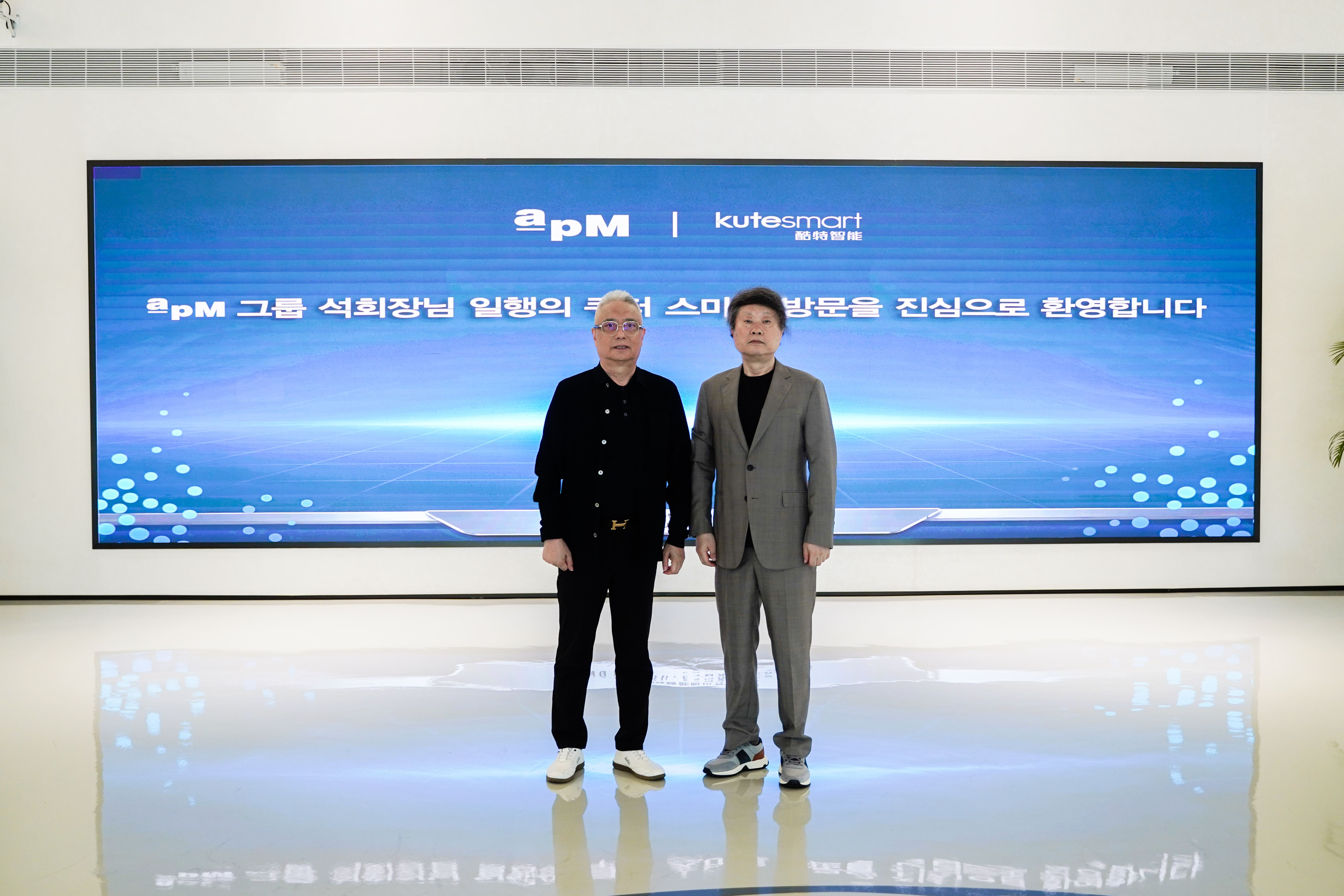
△ Zhang Daili (left), the founder of Kute Smart, and Seok Joo - hyung (right), the chairman of the South Korean apM Group
PART4 The Future is Here
At the current time point, Kute Smart is in the right place at the right time.
In the story told by Zhang Yunlan, the chairperson of Kute Smart, many people have asked her why Kute Smart can achieve this. "In terms of money, you are not the richest; in terms of technology, how can you be more knowledgeable than Tsinghua, Alibaba, or Tencent? I thought about it and realized that it is because of our sentiment, cognition, ability, available resources, and a bit of luck that have pushed