Why is the "leading example" of Made in China hidden in Hikvision's smart factory?
Forging a "leading example" for Made in China in highly complex manufacturing scenarios.
At Hikvision's smart factory, change is the norm every day. Spanning over 100 industries and covering more than 30,000 types of IoT products, with an average of 10,000 orders per day, but only about 40 units per order on average - 75% of which require customization. Such a production structure is destined to be unable to maintain efficiency and quality relying on the traditional mass - manufacturing logic.
However, large - scale speed, cost - effectiveness, and reliability have still been achieved here. Mass customization of multiple varieties in small batches, a term that used to exist only in the ideal of the manufacturing industry, has become a daily task that this factory must break down.
More importantly, it accomplishes all this with a large amount of independent technological capabilities. Industrial vision equipment, flexible robotic arms, over 1,500 mobile robots and their scheduling systems, scheduling agents, and Hikvision's Guanlan industrial large - model covering key production processes... Most of them are self - developed by Hikvision and continuously iterated and improved at the business site.
Since they were forced to mature in a more complex environment first, they can then be replicated and exported externally: connecting with over 2,000 upstream suppliers for collaborative production and serving over 800,000 downstream industry customers. Their capabilities have been implemented in a wider range of scenarios such as steel and non - ferrous metals, electronics and electrical appliances, and mechanical equipment.
In 2025, this factory was included in the first batch of 15 "leading - level smart factories" cultivation list in China - the highest level of the national smart factory gradient cultivation system. It represents a verifiable and replicable systematic ability of Made in China in high - complexity scenarios. Only by achieving intelligence in more difficult areas can it represent the direction of transformation.
Hikvision is forging the next stage of Made in China in highly complex manufacturing scenarios.
01
Hikvision's evolution is also the evolution of Made in China
Evolution is embedded in the time axis of the modern transformation of Made in China. The Hikvision smart factory we see today is actually a phased result of a long - term evolution path. This factory has gone through three stages of evolution that are highly synchronized with Made in China:
From 2015 to 2020, from equipment automation to digital collaboration. During this period, systems such as MES, MPM, APS, and WMS were successively self - developed and launched, laying the digital foundation for the factory.
From 2020 to 2023, data - driven and intelligent decision - making entered the main business line, and the factory completed the transformation from seeing to understanding.
Since 2023, the pattern of perception - decision - execution has been accelerating to form. After the integration of large - models and multi - modal perception, complex manufacturing has entered the stage of systematic intelligence.
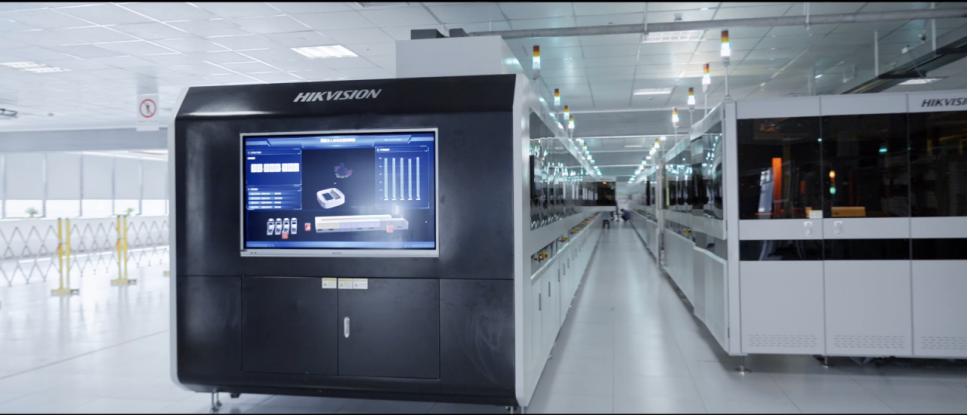
Fully automated unmanned production line
Going back to 2001, Hikvision started in a rented factory building in Gudang, the western part of Hangzhou. For some time, its main products were only boards, DVRs, and analog cameras. At that time, Made in China still won by scale and standardization, and stable supply was a very important ability.
In 2011, Hikvision moved into the first - phase R & D and manufacturing building in Binjiang. The company's business entered the "fast lane" of growth, and its product line also expanded rapidly. By 2015, the company's revenue reached 25.2 billion yuan, seven times that at the time of listing, with over a thousand new models added each year. As R & D and the market continued to move forward, the manufacturing end had to keep up with the increasingly complex product and demand structures.
During this period, a new production paradigm took shape: mass customization of multiple varieties in small batches. At this time, large - scale no longer simply meant mass - replicating the same products, but also meant meeting differentiated needs while ensuring quality.
Behind this is the era signal of the role transformation of Made in China: For a long time in the past, the Chinese manufacturing industry played the role of the cost and scale center in the global industrial chain, winning by scale, cost, and reliable delivery. However, around 2015, as the capabilities of Made in China and innovation continued to strengthen, and with the changes in the global market structure, the Chinese manufacturing industry not only had to undertake growth but also support innovation.
Looking back ten years later, this evolution has real - world significance. In 2024, the annual output of Hikvision's intelligent IoT products reached 256 million units, covering over 30,000 hardware models. The factory needs to process about 10,000 orders per day on average, with only 40 units per order on average, and 75% of them involve customized configurations. Taking the SMT patch production line as an example, each production line needs to change the line 18 times a day on average, and the production line with the highest switching frequency can reach 40 times a day.
This means that as the manufacturing industry moves towards more differences and faster changes, Hikvision has to maintain efficiency in the face of differences and maintain large - scale production capacity under customization constraints every day.
Without a stable and reliable system support, the manufacturing end cannot meet the changes in products and demands. However, paradoxically, around 2015, the digitalization and automation of manufacturing in China were still in the initial exploration stage.
What Hikvision encountered at the production end at that time was not some earth - shattering big problems, but some subtle yet widespread "hiccups": scattered process documents, time - consuming on - site traceability, inaccurate material matching... These problems would not immediately cause a loss of control, but they quietly consumed efficiency, stability, and delivery resilience. Many factories would choose to maintain the status quo first and let the on - site staff use manpower and experience to absorb these hidden costs. However, this manufacturing company keenly realized that if these hidden frictions were not resolved today, they would become the ceiling for scale growth tomorrow.
For Hikvision's manufacturing team at that time, they needed to connect all production processes and make them visible, and also make quality management truly online, rather than just taking remedial measures afterwards.
So, since 2015, Hikvision has started to systematically build core business systems such as the MES production execution system, MPM process platform, APS/APO production scheduling system, and WMS warehousing system at the manufacturing end, gradually bringing the originally scattered offline process documents, equipment status, and material flow online. When there is a problem with the production line, the specific process can be quickly traced in the system; product design and process changes can also take effect synchronously across the entire link through the system.
While laying the digital foundation, automation and the internal logistics system were also rolled out simultaneously in several major bases. The manufacturing bases in Tonglu, Chongqing, Wuhan, etc. successively launched full - line automation equipment and mobile robot logistics systems. Materials no longer relied on manual carts and manual sorting, but were sent to the production line according to the scheduling instructions, forming a rhythmic automatic material supply system.
In the process of the factory's evolution, from digital systems, automation equipment to the application of AI large - models... Compared with many factories, a prominent feature of Hikvision's factory is the application of a large number of self - developed systems, products, and intelligent algorithms to solve problems. From an internal perspective, they are not self - developing for the sake of self - development. In essence, Hikvision is building a base - level ability that can manage, monitor, and deliver for a business feature that has taken shape and will become increasingly prominent - tens of thousands of orders per day, with only dozens of units per order and high customization.
Product diversification and demand personalization are not only the manufacturing requirements faced by Hikvision but also the long - term trend of manufacturing. The ability to support this trend must be provided by automation, digitalization, and even intelligence. This is the source of ability that Hikvision has gradually discovered and firmly embraced in more than a decade of evolution.
In this way, Hikvision's factory has gradually evolved towards digitalization, automation, and intelligence.
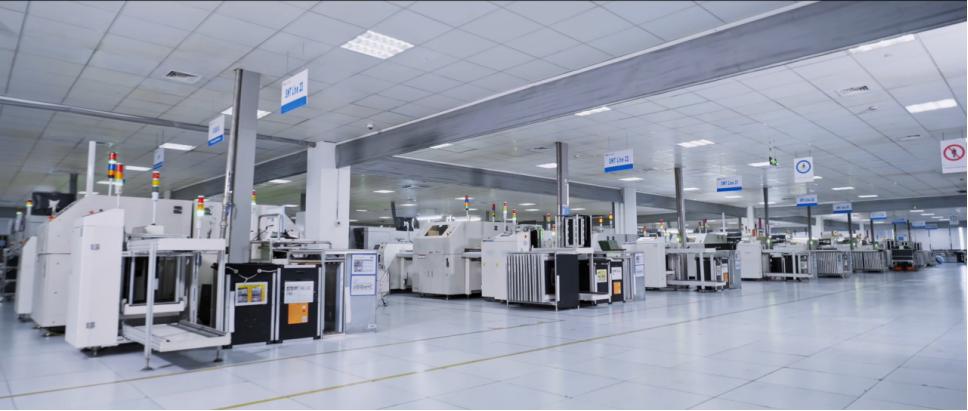
PCBA automated production workshop
02
Building a "super intelligent agent"
The manufacturing scale forces the evolution of capabilities, and technological capabilities in turn expand the business boundaries. The two form a continuously strengthening positive - feedback loop system, which is a true portrayal of Hikvision's more than a decade of evolution.
Employees of Hikvision told us that the upgrade of manufacturing has never been just for the sake of being "advanced." Instead, it is constantly forced by the increasing business complexity and supported by independent technologies.
If the first stage was to install systems and equipment in the factory to achieve automation, then the second stage is to enable these systems and equipment to start thinking and collaborating. Algorithms have moved from the management end to the production line site, extracting knowledge from data, and then feeding it back to the production execution end through scheduling, material supply, and process automation in a closed - loop manner.
Around 2020, as the business complexity continued to rise, new demands emerged: although the data was recorded in the ledger, it had not been truly utilized. There were still many links in production scheduling that relied heavily on manual experience; process changes were frequent, the code volume was huge, and engineers needed to spend a lot of time on repetitive work; while the automation equipment was "working," its capabilities had not been fully utilized by the digital system.
To meet these new demands, Hikvision started to do something more difficult - making data the driving engine of the factory.
A typical representative of intelligence is the evolution of the MPM process platform from a "recording tool" to a "process brain." Initially, it only replaced paper process cards and Excel spreadsheets. But after Hikvision structured data such as BOM, process methods, and equipment parameters, capabilities based on knowledge graphs and intelligent algorithms began to emerge: new products can automatically generate process routes, and the efficiency of process design has been improved by about 60%; process changes have also changed from manually searching hundreds of Excel spreadsheets to one - time structured synchronization.
At the same time, the scheduling system and the intelligent order - combining model collaborate between APS and MES: the first - level scheduling is responsible for overall resources and delivery dates, and the second - level scheduling is accurate to the production line. Under the constraints of hundreds of thousands of calculations and tens of thousands of SKUs, the system will automatically combine orders with similar process, material, and furnace temperature attributes for production scheduling, reducing switching and waiting times, and making small - batch production approach the efficiency of large - batch production.
The logistics system has also been upgraded accordingly: over 1,500 mobile robots are connected to the entire link from the supply chain to the workshop, realizing automatic distribution in the form of "goods to people, goods to stations." Relying on a nearly ten - thousand - square - meter dark warehouse and cross - floor robot scheduling, the logistics efficiency has been improved by about 40%. These capabilities are formed by the deep coupling of scheduling systems such as MES and WMS and are continuously refined and iterated through years of business verification.
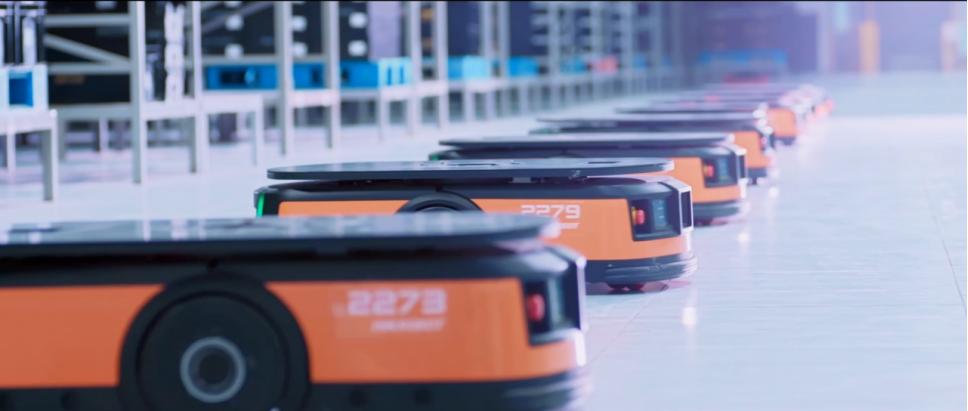
Mobile robots
After being driven by data, the intelligentization process of the factory has accelerated like a snowball. Soon, around 2023, Hikvision entered the third stage of evolution of the intelligent system: large - models and multi - modal perception systems are fully embedded in the factory's "brain" and "neural network," enabling the factory to have the capabilities of self - perception, self - judgment, and self - execution.
Hikvision's artificial intelligence technology, which has been deployed for many years, has become an important technological foundation for systematic intelligence. The real - time data of 10,000 orders per day, over 1,500 mobile robots, and over 30,000 product models are constantly flowing. On this basis, multiple types of intelligent agents make collaborative decisions: the planning agent is responsible for overall deduction and balanced scheduling, the scheduling agent is responsible for second - level decomposition to specific production line workstations, and the execution agent promotes robots and equipment systems to complete actions.
The boundaries of perception capabilities have also been significantly expanded. Hikvision's perception capabilities over the years have already broken through the visible light range and expanded to fields such as millimeter - wave, infrared, X - ray, and sound waves. When digitalization enters the "deep water area," the more multi - dimensional the perception ability of the manufacturing scenario, the more real - time the grasp of the manufacturing site, the more closed - loop the digitalization, and the more accurate the decision - making can be.
In Hikvision's smart factory, a large number of self - developed cameras, X - ray equipment, etc. in use no longer just collect images and signals, but understand the physical world through large - models and automatically capture key states. During the component completeness inspection, by combining the production line cameras and hand - movement recognition, automatic inventory and review can be achieved under zero - delay production line change; in the scenario of warehouse location status recognition, AI will determine whether the pallet has been emptied and automatically trigger material replenishment.
These seemingly scattered local optimizations in fragmented scenarios actually point to the same thing: Hikvision's smart factory is gradually being built into a "super intelligent agent" with an "intelligent sensory system," an "AI decision - making brain," and "flexible execution limbs." Plans can be corrected in real - time, decisions can be implemented immediately, and the execution results will immediately flow back to the system, enabling the factory to maintain an optimal state through continuous self - renewal.
In the future, as more perception nodes are connected and more intelligent agents are launched, Hikvision's factory will also move from data - flow - driven to model - driven and begin to release emergent value: more balanced production capacity scheduling, leaner inventory, lighter personnel organization, and significantly enhanced overall resilience and adaptability of the factory.
03
Creating a manufacturing sample in more complex scenarios
IDC data shows that the global digital transformation investment scale exceeded $1.5 trillion in 2022 and is expected to exceed $3 trillion by 2026, with a compound annual growth rate of about 16.7% from 2021 to 2026. This means that digitalization and intelligence are becoming the long - term certain directions for the global manufacturing industry, and at the same time, they form a highly fragmented, diverse, and complex market structure. The opportunities are huge, but the implementation path is not smooth. Each industry, each production line, and each factory presents completely different technological conditions and business constraints.
In such a market structure, only a system that can complete autonomous evolution in a high - complexity environment can establish truly replicable competitiveness for enterprises.
From this perspective, the "leading" significance of this factory is not only for Hikvision. The most difficult part of Hikvision's intelligent manufacturing is that there is no ready - made path to follow. Many automation equipment, industrial software, or algorithm models on the market are also difficult to naturally adapt to such a high - complexity production environment. This determines that its manufacturing practice has been at the highest level of complexity from the beginning - it is its own most difficult - to - serve customer.
Moreover, IoT perception products need to meet the demand for digitizing the real world: from urban rail transit to industrial parks, from steel to chemical industry... Every time it enters a new industry, new models, new structures, and new process requirements will emerge. Therefore, Hikvision cannot rely on a set of fixed automation equipment or general - purpose industrial software to handle such rich changes. Instead, it must rebuild certainty in uncertainty - solve problems and accumulate capabilities in real - time at the business front line and then feed them back to the production system.
That is to say, many technological capabilities in Hikvision's manufacturing system