Have new energy vehicles and batteries entered a downward cycle?
Overnight, it seems that the arguments of "China's new energy industry facing both internal and external challenges" and "the huge pressure on the automotive market" have swept through the entire industry again.
First, Morgan Stanley released forecasts twice, believing that China's automotive market will decline again next year, with a year-on-year decline of up to 6%. Meanwhile, bad news came from the new energy industry chain. The prices of materials such as lithium carbonate have risen, and the cost pressure has been transmitted to the battery manufacturing end.

There was also disturbing news. The six Gulf countries imposed anti-dumping duties on lead-acid batteries produced in China and Malaysia. Readers who confused lead-acid batteries with power batteries regarded this as another example of "China's new energy industry suffering another heavy blow."
Articles like "New energy vehicles entering a downward cycle" are prevalent. It's hard to tell whether they are out of concern for the country and the people or just spreading anxiety.
However, on December 11th, news came that the "two new" policies would be optimized and implemented - large-scale equipment renewal and trade-in of consumer goods. The trade-in of consumer goods is often referred to as the "national subsidy."
For the automotive industry, subsidy policies have always been like a shot in the arm. However, there are still voices arguing that "a policy-driven market is not natural development and will overdraw demand."
So, does the Chinese automotive market boosted by subsidies really lack substance? Why does the state keep introducing subsidy policies? The profound meaning behind it is not as simple as just talking about it.
01 Tearful analysis report
Morgan Stanley's prediction that "China's automotive market will decline significantly" may become invalid as soon as it comes out.
Let's talk about this report first. Its original name is "China Autos & Shared Mobility: On the verge of both recession and innovation." Unfortunately, many domestic self-media only focus on the word "recession" and don't see the word "innovation."
In Morgan Stanley's prediction, China's wholesale sales of automobiles after excluding exports in 2025 will be about 29.9 million units, a year-on-year increase of 9%; in 2026, it will be 28.5 million units, a year-on-year decrease of 6%. There will be a significant month-on-month decline of 30 - 35% in the first quarter. The domestic automotive sales volume is expected to decline by 7% throughout the year.
What are the reasons and basis?
First, the local subsidies that started in the fourth quarter of 2024 ended earlier this year, and the policy of purchase tax compensation in 2026 is unclear. Note that what Morgan Stanley values most is still the policy factor. It even believes that it's difficult for enterprises to maintain demand even if they offer subsidies on their own.
Second, the rising price of lithium carbonate at the cost end and the continuous price war in the industry are putting pressure from both sides.
Actually, Morgan Stanley's prediction of China's automotive market is not that pessimistic because there is also the "innovation" part.
For example: Chinese local giants will rise further. The Huawei alliance may account for 8 - 10% of the market share in 2026. In other words, the total sales volume of Hongmeng Zhixing and brands deeply bound to Huawei, such as Avita, may reach the level of 2 million units next year.
Overseas expansion will also continue to grow. Great Wall Motor will focus more on overseas markets, and exports will account for 20% of its sales volume.
Although half of the Chinese automotive stocks covered by Morgan Stanley are expected to decline, Morgan Stanley is optimistic about the future performance of enterprises that have made substantial progress in non-automotive fields such as artificial intelligence, robotics, and humanoid robot technology, including XPeng Motors, Hesai, and Agile Technology.
Why is it said that Morgan Stanley's prediction will become invalid as soon as it comes out?
Because the biggest premise of "China's automotive market decline" is "the unclear subsidy policy in 2026." However, just a few hours later, the news of "a new round of national subsidies is coming" came.
According to relevant reports, from December 10th to 11th, the Central Economic Work Conference was held in Beijing. This conference deployed the economic work for 2026. When deploying next year's work of "adhering to domestic demand as the leading factor and building a strong domestic market," it was said that the implementation of the "two new" policies should be optimized.
The subsidy in the fourth quarter of 2024 mentioned by Morgan Stanley was that 150 billion yuan of ultra-long-term special treasury bond funds were used for the trade-in of consumer goods. In 2025, the state issued another 300 billion yuan of ultra-long-term special treasury bond funds. Not only was the amount doubled, but the scope of consumer goods was also expanded to three categories of digital products such as mobile phones, tablets, and smart watches and bracelets, and four categories of household appliances such as microwave ovens, water purifiers, dishwashers, and rice cookers.
According to data from the Ministry of Commerce, the national subsidy has achieved remarkable results. From January to November 2025, the trade-in of consumer goods drove the sales of relevant goods to exceed 2.5 trillion yuan, benefiting more than 360 million people. Among them, the trade-in of automobiles exceeded 11.2 million units, the trade-in of household appliances exceeded 128.44 million units, the purchase subsidies for new digital products such as mobile phones exceeded 90.15 million units, the trade-in of electric bicycles exceeded 12.91 million units, and the "renewal" of home decoration and kitchen and bathroom products exceeded 120 million units.
Morgan Stanley's conclusion was refuted before it could be realized.
02 Subsidies can be a good medicine rather than an aphrodisiac
Followers of Hayek are always distressed about the state's intervention - they think that government intervention is not natural growth, and they even compare subsidies to an "aphrodisiac," believing that it will cause endless harm after the effect wears off.
This is a typical dogmatic thinking.
First, economic development and work deployment need to be divided into stages.
Long before Morgan Stanley's bearish report came out, senior financial officials predicted to C Dimension that "subsidies will definitely come" regarding the subsidy policies for the automotive industry.
Industry analysts pointed out that in the past decade, in order to upgrade industrial technology, a large amount of capital expenditure was focused on production and R & D, which suppressed consumption. However, with the rise of the domestic manufacturing and technology sectors, the state will allocate more budgets to boost consumption. "Only focusing on local debts without making stage distinctions is purely a stereotype."
Second, from the perspective of the essence of value change, both the automotive price war and subsidies have their underlying causes.
If we look back before 2015, the state had restrictions on automotive price wars. But why did the state not stop the large-scale price war initiated by Tesla and Citroen C6 after 2020, especially since 2022?
This is because when the global economy was dragged down by the COVID-19 pandemic and there had been no significant technological progress to improve productivity for many years, both consumers' purchasing power and consumption confidence declined. In order to match the automotive price with the purchasing power/consumption confidence and maintain the liquidity and operational vitality of the industry, automobiles had to be discounted.
There are two main strategies for price cuts: 1. Subsidy policies, where the state bears the discount. 2. Manufacturers and the supply chain bear the discount themselves.
Third, the lag and blindness of the market mean that the state must manage the flow of value to promote the rapid development of the industry.
Yes, China's new energy industry currently has meager profits, but it has indeed achieved a leapfrog development in terms of technology and brand.
Why do electric vehicles have low profits? It took 140 years for fuel vehicles to reduce costs, while electric vehicles have only emerged in just a few years.
Why can't the high profits of fuel vehicles be because the cost is actually very low and does not match the current price? Then why can't fuel vehicle manufacturers reduce the price by 20 - 50% on the current basis and easily defeat electric vehicles?
After all, the electric vehicle, or the new energy strategy, is driven by the state to promote the upgrading of the national industry, while fuel vehicles are still a profit channel dominated by capital and business owners.
Fourth, we can take a close look at the sales volume change curve of the Chinese automotive market in the past two decades.
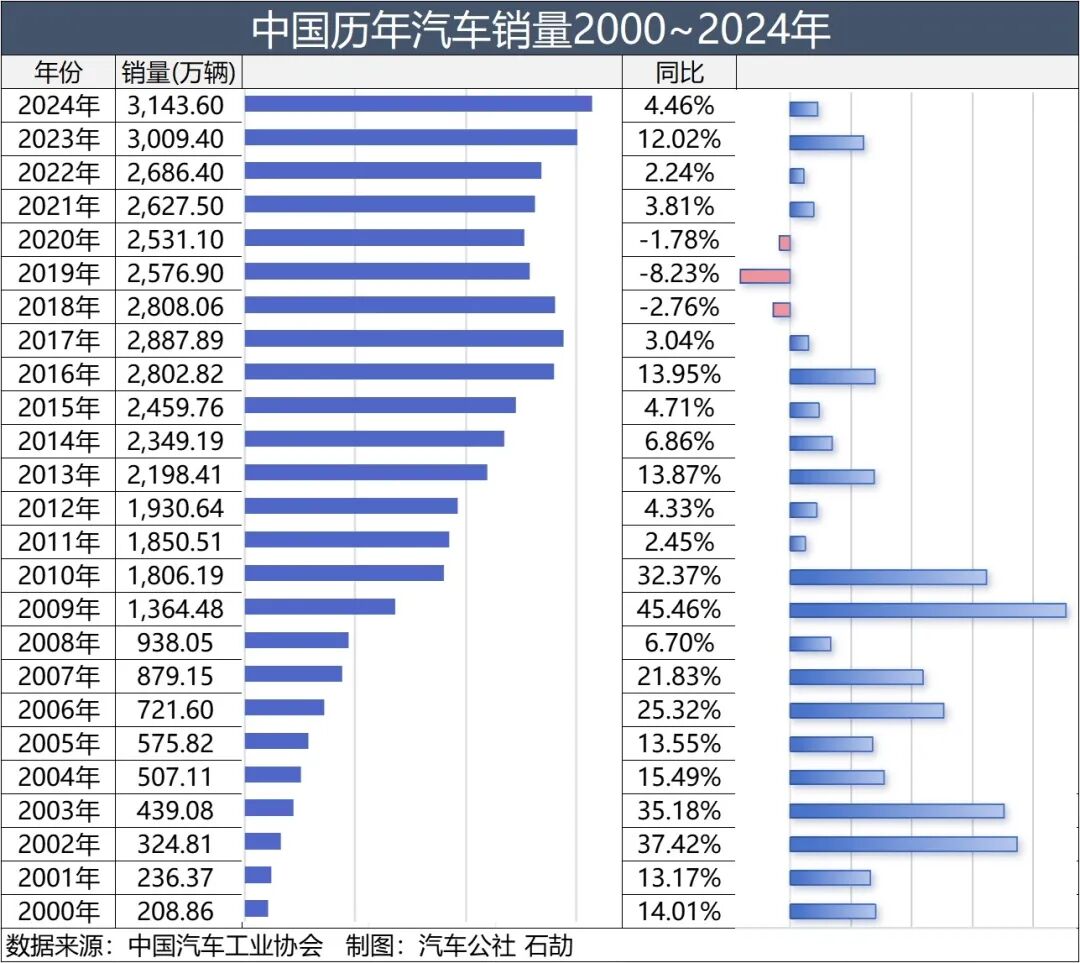
Starting from the "automobile going to the countryside" and the subsidy policies of "trade-in of household appliances and automobiles" from 2009 to 2011, the Chinese automotive market began a high-speed growth phase after the annual sales volume exceeded 10 million units.
The policy of reducing the purchase tax for small-displacement vehicles has also promoted the upward trend of the automotive market several times.
Since 2014, the exemption of vehicle purchase tax for new energy vehicles and the current "two new" policies have all promoted automotive consumption.
Each policy has not only boosted sales volume but also driven long-tail benefits through the growth of the industrial scale and the increase of employment opportunities. When have you ever seen an "aphrodisiac" that can be used repeatedly and still be effective? From a strategic and macroscopic perspective, this is truly a good medicine.
03 Batteries with limited price increases, automobiles with boundless prospects
When the argument that "new energy vehicles are in a prisoner's dilemma" cannot be directly established, the bearish voices will search for various arguments from the industrial chain.
Initially, it was the move of the six Gulf countries.
In December 2025, the Ministerial Committee of the Gulf Cooperation Council (GCC) officially approved the imposition of final anti-dumping duties on lead-acid batteries for vehicle starting, which are originated from or exported from China and Malaysia.
This marked the end of the anti-dumping investigation launched in August 2024 and became one of the most important trade remedy measures taken by the Gulf countries against Chinese battery products in recent years. The six Gulf countries believe that relevant products from China and Malaysia have flooded in at prices lower than the normal value, seriously impacting the local industries in the GCC.
However, this clause targets components rather than complete vehicles, and lead-acid batteries rather than lithium-ion power batteries. The direct impact on the entire new energy industry chain and the automotive industry is very limited.
Then, there was the strong voice of "a significant price increase of lithium batteries."
It started with "a first-tier enterprise in the diaphragm industry announcing a 30% increase in the selling price of its wet-process diaphragm products." Then, Degjia Energy raised the selling price of its battery series products by 15% since December 16th, and Funeng responded to investors that "the price increase of lithium batteries is an industry trend." In just a few days, it seemed that the price of lithium batteries would skyrocket.
However, Mo Ke, the founder and president of True Lithium Research, pointed out that the impact of this round of price increase in the lithium battery industry chain on terminal new energy vehicles is relatively limited.
First, if the demand side of complete vehicles is suppressed, the impact of battery costs will be weakened instead. Second, automobile enterprises will disperse risks through price agreements, self-research, etc. Third, there are many links in the price increase of the industrial chain. The first wave starts from lithium carbonate, the second wave includes lithium hexafluorophosphate, VC, etc., the third wave is related electrolytes, the fourth wave is cathode materials using lithium carbonate, and the fifth wave is non-lithium-related materials such as diaphragms and anodes. When it comes to batteries, due to the long chain and many buffer zones, the price increase will be lower than that of upstream materials.
The most obvious example is that the current price of battery-grade lithium carbonate is 94,000 yuan per ton, which has been hyped up to a "doomsday level" by some views. However, four years ago, lithium carbonate reached a high of about 600,000 yuan per ton, but it did not lead to a sharp increase in the prices of batteries and electric vehicles.
Cui Dongshu, the secretary-general of the Passenger Car Association, pointed out that due to the reduction of preferential policies for vehicle purchase tax at the beginning of 2026, the demand was weak from January to February, which would inevitably lead to a slowdown in battery demand and further affect the supply - demand expectation of lithium carbonate. The price of lithium carbonate reached a high of nearly 600,000 yuan at the end of 2022 and then declined significantly in early 2023.
Therefore, it is expected that there will be no obvious gap in the supply and demand of lithium carbonate in the future, which will promote the reduction of the cost of new energy vehicles in 2026 and stabilize the growth of new energy vehicles in 2026.
04 The false proposition of the downward cycle
If we conduct in-depth analysis of the statement that "new energy vehicles are entering a downward cycle," we can say that it is a false proposition.
First, the definition of the downward cycle is often extremely vague and the concept is being misused.
What is a downward cycle? Is it a shrinkage in the sales volume of new energy vehicles, a decline in market share, or a slowdown in growth rate? From beginning to end, there is no rigid definition or quantifiable indicators.
We all know that subsidy policies will release a part of the demand in advance, resulting in a "high - low" curve. But what about the third stage, is it an upward or downward trend? Without policy intervention, whether the natural development is upward or downward should be judged by looking beyond the stage of the policy-driven market.
Although there may be a long - tail impact of policies, if we want to explore the underlying "upward - downward logic," we need to extend the observation period.
In other words, whether new energy vehicles can support overall growth for decades or even centuries cannot be concluded based on one or two years of regression caused by the policy - driven market. Moreover, there is no actual data showing a decline in new energy vehicles at present.
Second, new energy vehicles conform to the evolutionary framework of "human - energy manipulation."
Vehicles will inevitably become new - energy - powered. The essence is that electric vehicles are more adaptable to the underlying logic of energy control.
Why do electric vehicles accelerate fast? Because the single - output energy of electric drives can easily be several times or even an order of magnitude higher than that of internal combustion engines. At the same time, the control accuracy is also several levels higher. A simple Hall - effect sensor or one - or two - level control can achieve the adjustment of electric drives, without the need for the complex and expensive transmission system of internal combustion engine vehicles.
In addition, although in the development stage, we can distinguish the first half of vehicle electrification and the second half of intelligentization, in fact, vehicle electrification and intelligentization are integrated.
If we want to achieve high - speed communication response inside the vehicle and support more functional applications to realize a high degree of intelligentization, the vehicle itself needs electrification to solve problems such as power supply, thermal control, and response speed. Now Huawei and Bosch can solve the problems of fuel vehicles in L2+