The cultural and tourism industry is booming. Young employees from big companies return to their hometown counties and only sell three-piece sets.
01
Recently, Linlin, a post - 95 girl from Guangde, Anhui, has been constantly showing off the "three - piece set" in her WeChat Moments: a steaming stew pot, the long - queuing Kawangka milk tea, and the must - be - limited Zhanji Chinese walnut shortbread.
If you don't follow the top tourism and cultural trends, it's hard to imagine how crazy this small city at the junction of Anhui, Zhejiang, and Jiangsu has become. In the past week, over 500,000 people flocked in, and they bought this originally ordinary combination into a phenomenon - level hit.
Linlin's captions are no longer those with a delicate and relaxed vibe. Instead, she either complains about the long queues that made her legs ache or shows off in a humblebrag way that she finally grabbed the last portion of tiger - skin taro puree.
Seeing her so energetic, I'm curious about why this former public relations staff of a large Internet company in Beijing, who used to talk about empowerment and closed - loop all day, suddenly went back to her hometown?
When I asked her in a private message, Linlin replied straightforwardly, saying that she had long quit the intense competition in the big company. "I originally went back to my hometown to take a good rest. But then Guangde suddenly became popular these days. The traffic is just there for the taking, so I just started my business right away."
Then she began to list her detailed customized small business on Xianyu.
After listening to her, I summarized it as queuing up on behalf of others, paying the bill on behalf of others, and enduring bad temper on behalf of others. For example, before tourists even get off the high - speed train, Linlin has already bought the milk tea for them. She has also planned for her guests the most labor - saving way to take the newly launched free city buses, the bamboo township gallery buses, and the coffee buses by the government.
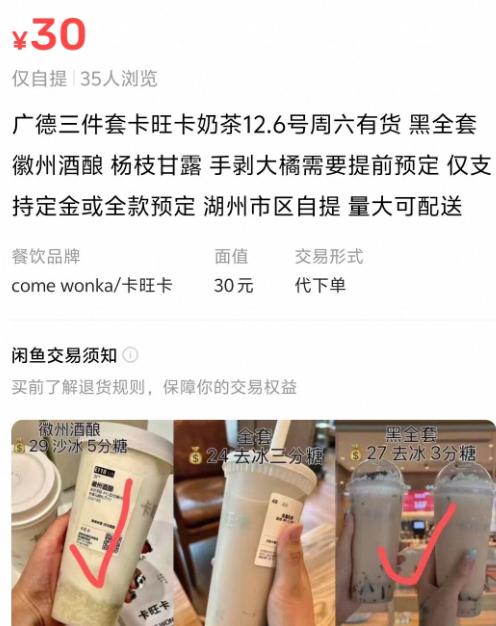
Linlin's exact words were, "I used to draw big pictures for media professionals in the big company. Now I'm buying pastries for tourists." She sent a sneaky smile emoji and said, "But this time, every cent is earned for myself."
Just as I was about to congratulate her on finding a new direction in life, Linlin sent me a voice message, sounding a bit tired but excited: "Actually, this money is not easy to earn. There's also intense competition in this line, and there are too many people doing it..."
Her anxiety is not unfounded. In recent years, the focus of tourism and cultural entrepreneurship has shifted downward, and more and more young people are going back to their hometowns to start businesses, and tourism and culture are an important area among them.
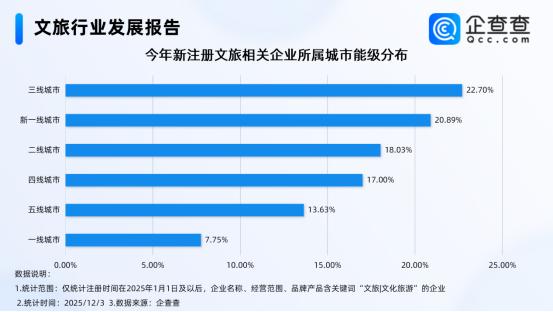
Data from Qichacha shows that the existing number of domestic tourism and cultural enterprises has reached 123,500, but the structure has changed dramatically. Among the newly registered tourism and cultural enterprises this year, those in first - tier cities only account for a pitiful 7.75%.
In sharp contrast, the proportion of newly registered tourism and cultural enterprises in third - tier cities is as high as 22.7%, even exceeding that in new first - tier cities, making them the most concentrated areas for entrepreneurship.
This makes me recall around 2010 when I just started working as a journalist. It was during an economic up - cycle, and the entrepreneurial atmosphere in Beijing was as intense as strong liquor. Walk into any Starbucks in Haidian, and you could hear young people talking about business plans all around.
I clearly remember the names like Qie Travel, WorldBang, and Miaoji Travel. They were once the darlings of capital, easily getting Pre - A or Series A financing, full of ambition to revolutionize the industry and talking about going public on NASDAQ. In the business world, which is like a battlefield, most of these names have now failed. But even though it was so cruel, there were still countless people rushing forward, believing that they could catch the wave of opportunity.
Now, the times have completely changed.
Seeking stability is the first rule in big cities. Against this background, working as an employee or taking the civil service exam has become the consensus among young people staying in Beijing, and starting a business has ranked first among the three ways to go bankrupt for workers.
While there are no more entrepreneurial stories heard in the cafes of first - tier cities, those most vibrant young people are flowing along the high - speed rail lines to third - tier small cities like Guangde. These small and passionate businesses are the new choices for young people fleeing the 996 work culture in big companies.
02
Behind Linlin's seemingly capricious decision, there is actually official macro - data support.
According to the latest data released by the Ministry of Culture and Tourism, in the first three quarters of 2025, domestic residents spent 4.85 trillion yuan on trips, a year - on - year increase of 11.5%.
But if you look into it in detail, you'll find an amazing gap. The travel expenditure of urban residents increased by 9.3%, while the growth rate of rural residents' travel expenditure was as high as 24%.
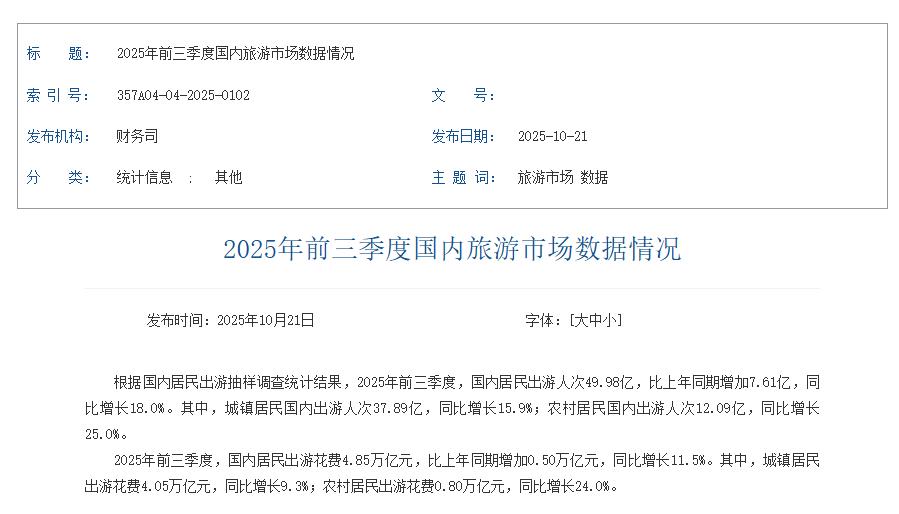
This means that while people in first - and second - tier cities are seeking the ultimate cost - effectiveness through "special forces tourism", there is a silent consumption upgrade taking place in the vast county and rural markets.
Linlin also pointed out sharply that she was shocked by the amazing purchasing power of the ladies in the small town after she went back home. "In Beijing before, I only dared to drink Starbucks when my monthly salary was 20,000 yuan. But in my hometown, girls of the same age with a monthly salary of 4,000 - 5,000 yuan often spend 300 - 400 yuan on a meal because they don't have a huge mortgage to pay off."
It's worth mentioning that capital always has a sharper sense than individuals.
As early as a few years ago, OTA platforms like Tongcheng Travel bet on this wave of downward - sinking dividends. Public data shows that the proportion of registered users of Tongcheng Travel living in non - first - tier cities has long remained at around 87%, and it has not suffered a loss since the first day of the pandemic.
Looking through its annual financial reports, this company, which has always been jokingly called the "Pinduoduo in the tourism industry", has been living a very comfortable life among a group of OTA platforms still struggling on the verge of losses by deeply cultivating non - first - tier cities.
Even listed companies are competing for this kind of business. Linlin sighed that she was a bit late in fleeing the 996 work culture. She sighed, "In Beijing, I was just a replaceable screw. Every day in that office building, I could see myself being laid off at the age of 40."
For people like Linlin, starting a business back in their hometowns is not only about seeing the business prospects but also about breaking through that invisible ceiling. Talking about this, she suddenly seemed quite happy. "In my hometown, although the income is unstable, this business is like a house I built myself. Here, I don't know how much I'll earn tomorrow, but I can decide my own ceiling."
Linlin's sense of control is actually a microcosm of countless small - town entrepreneurs.
For example, the chicken - cutlet guy in Jingdezhen who became an internet sensation. He was just a middle - aged man selling chicken cutlets at a street stall. Who would have thought that his unique rap - style service would become a must - visit attraction for tourists, and some people even took a high - speed train there just to have a chat with him.
This was simply unthinkable in the past, but under today's tourism and cultural logic, everything can become a traffic entry point.
The same goes for the "three - piece set" in Guangde, Anhui. The changes it has brought are obvious. The most direct one is that the small - town residents who used to have a slow - paced and even idle life have found a reason to be busy again.
Before, people might only gather together to play mahjong or soak up the sun and complain about how boring life was.
Now it's different.
Young people are coming back and starting gallery buses. Aunts are selling Chinese walnut shortbread at the entrance of scenic spots. Even the female boss of the food stall has to learn how to reply to negative reviews on Dianping.
The explosion of the tourism and cultural industry is like a huge catfish, stirring up the originally quiet pond.
It not only solves the problem of making a living but also brings a sense of being needed that the small - town residents have never had before. This feeling of being expected by guests from afar may be more addictive than making money itself.
03
There is never a permanent blue ocean in the business world.
When Qichacha data clearly shows to everyone that the main battlefield of tourism and cultural entrepreneurship has shifted to third - tier cities, it means that the days of making money simply by information asymmetry are coming to an end.
It's like Taobao in the early days. The first people who opened stores could sell products like crazy just by hanging a product photo because there was too much traffic and too few merchants. The same is true for the current county - level tourism and culture. Since Guangde has become popular and tourists want to drink that milk tea, people like Linlin can get orders as long as they show up.
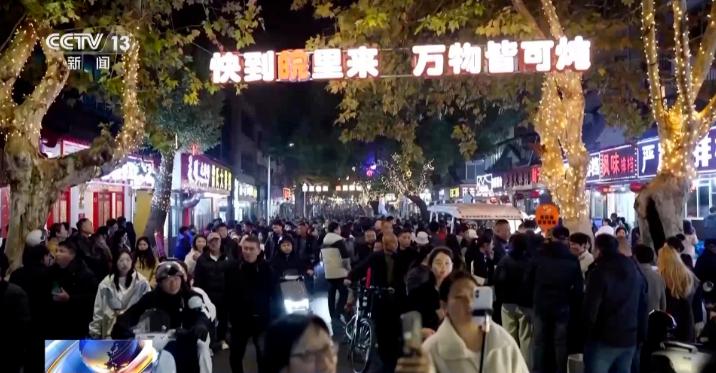
But this is just the first stage, which we call the dividend period.
The biggest feature of the dividend period is the imbalance between supply and demand. Tourists are pouring in like a tide, while the local service supply is still stuck in the level of ten years ago.
At this time, whoever can take one more step than others can make this quick money.
Linlin has applied the user - centered thinking from the cut - throat competition in the big company to the county - level market. While local food stall owners are still shouting out numbers and keeping accounts in their heads, she has solved the chaos with a free online collaborative document, allowing her guests to see at the first time whether the milk tea has been bought, how much sugar is in it, how many tables are ahead of them for the stew pot, and when they are expected to be able to eat.
Moreover, she doesn't treat tourists as just passing - by guests. For everyone she adds on WeChat, Linlin carefully labels them. She takes you to eat the stew pot this year, and next spring, she is also planning to invite you back to dig bamboo shoots.
This makes me think of a very interesting business phenomenon.
In the past, when we talked about tourism and culture, the core resources were mountains, rivers, and historical relics. At that time, the competitive barrier was geographical location. Huangshan is right there, and no one can move it.
Now the logic has completely changed. Strictly speaking, the stew pot, milk tea, and Chinese walnut shortbread in Guangde's "three - piece set" are not scarce resources. And the future county - level tourism and culture will definitely be polarized.
One type is the traditional resource - based players. They still guard the entrances of scenic spots to collect tickets and wait for tour - bus loads of tourists. The business of this type will become more and more difficult because OTA giants will use digital means to squeeze the profit of standardized products to the extreme.
The other type is the operation - based players like Linlin. They don't have scenic spots in their hands, and they don't even have fixed assets. What they have is the ability to accurately capture the pain points of specific groups of people.
People are no longer obsessed with building large platforms in crowded first - tier cities. Instead, they choose to become small and beautiful service providers in counties with traffic dividends.
This is actually a more difficult path.
Because it requires you to have dual abilities. You need to have the knowledge of big cities, understand the logic of traffic, IP, and service design, and at the same time, you need to have the perseverance of small - town people, be able to bend down and handle those trivial, non - standard, and even earthy specific affairs.
Whoever can combine these two well will be the winner in the next stage.
So, rather than saying that these young people are fleeing from big cities like Beijing, Shanghai, and Guangzhou, it's better to say that they are taking the torch to ignite the wilderness in counties.
Maybe this is the most charming part of county - level tourism and culture.
This article is from the WeChat official account "Travel Industry", author: Theodore Xishao. It is published by 36Kr with authorization.