The state has decided to continue the subsidy next year. You who are planning to buy a car are in luck.
If the purchase tax exemption is the "awakening agent" for the 2026 auto market, then the continuation of the national subsidy is undoubtedly a "reassuring pill".
From the "Automobile to the Countryside" campaign to the exemption of purchase tax for new energy vehicles, from the "trade-in" program to the substantial investment in infrastructure... In recent years, a series of policies introduced at the national level have effectively boosted consumer confidence, successfully released potential market demand, and injected significant impetus into the market's development.
However, by the end of 2025, the trade-in subsidies for automobiles in many places were suspended, the purchase subsidies for new energy vehicles were about to end, and the policy of exempting new energy vehicles from purchase tax was also coming to an end. These series of policy changes have not only become a reason for consumers to buy cars in the fourth quarter of this year but also a concern for their car purchases in 2026. After all, the decline of various preferential policies means an increase in the cost of buying a car.
Just when the "scrambling" and "panic" emotions in car - buying consumption were about to spread, a national - level meeting timely gave a "reassuring pill" to those who haven't bought a car yet.
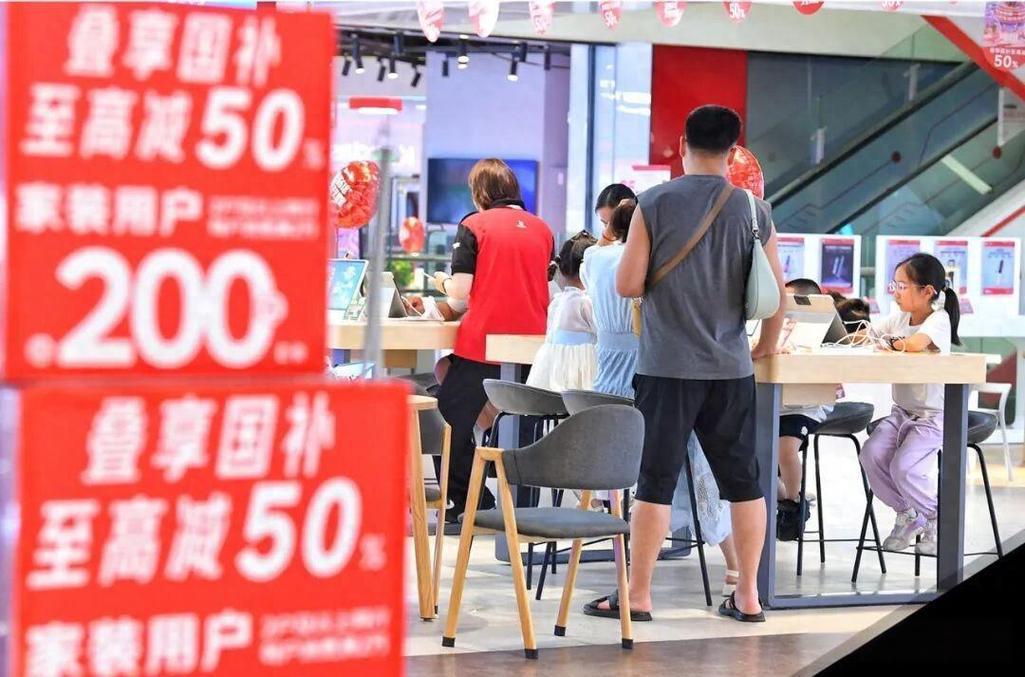
From December 10th to 11th, the Central Economic Work Conference was held in Beijing. This conference deployed the economic work for 2026. When deploying next year's work of "adhering to domestic demand as the leading factor and building a strong domestic market", it said that it is necessary to optimize the implementation of the "Two New" policies.
The so - called "Two New" policies refer to the large - scale equipment renewal and the trade - in policy for consumer goods. Among them, the trade - in policy for consumer goods, which is directly related to the interests of the common people, has attracted much attention and is called the "national subsidy".
This conference clearly stated that the implementation of the "Two New" policies will be optimized in 2026, which means that the national subsidy policy will continue to be implemented next year. This tone - setting has sent a clear signal to the market and consumers: the policy direction of promoting automobile consumption in 2026 will not change.
Policy Tone - setting: The "National Subsidy" Continues
In order to further promote consumption, the state issued 150 billion yuan of ultra - long - term special treasury bond funds in 2024 for the trade - in of consumer goods, which is what people call the "national subsidy". Due to the good implementation effect last year, the state increased its efforts in 2025 and issued 300 billion yuan of "national subsidies" for the trade - in of consumer goods. The amount of the "national subsidy" doubled compared with that in 2024.
The effect brought by the "national subsidy" is very obvious. It can be said that the "policy red - envelope rain" has watered the prosperity of the auto market.
Data from the Ministry of Commerce shows that from January to November this year, the trade - in of consumer goods drove the sales of related products to exceed 2.5 trillion yuan, benefiting more than 360 million people. Among them, the trade - in of automobiles exceeded 11.2 million, bringing good consumption vitality and terminal sales to the auto market.
Some industry insiders pointed out that among this report card of over ten million vehicles, nearly 70% of private car - buying users have become the beneficiaries of the "trade - in" program. This shows that, catalyzed by policies, the demand for additional and replacement purchases driven by consumption upgrading has become the main force in the current auto market. Consumers take advantage of the subsidy window period to replace their old cars with new ones of higher quality, more intelligence, and better environmental protection.
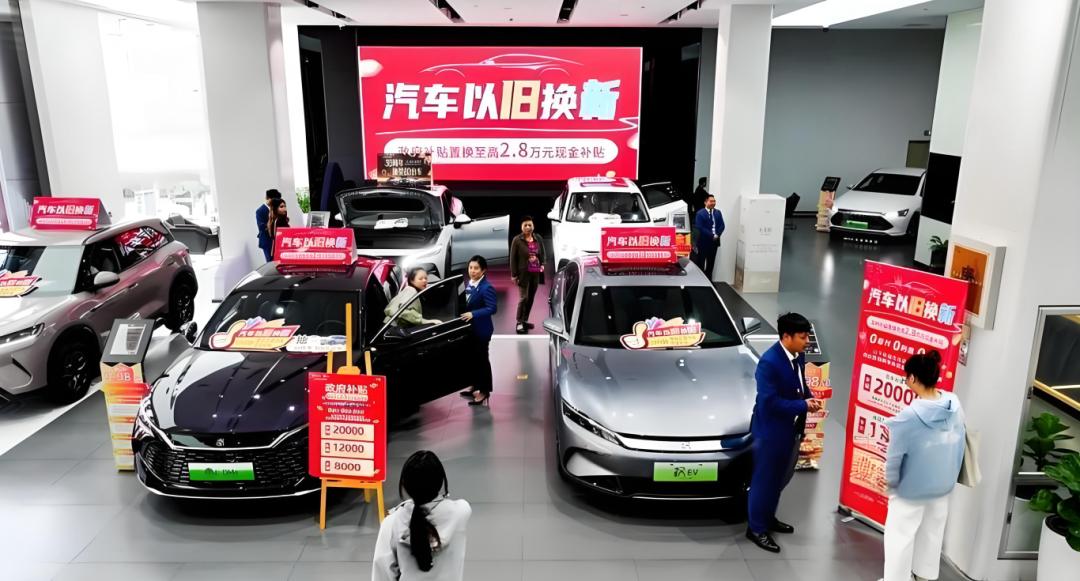
Among them, new energy vehicles have become the preferred choice for consumers. Data from 2024 shows that the proportion of new energy vehicles in the trade - in program exceeded 60%. In the first half of 2025, the remarkable achievement of 5.468 million retail sales of new energy passenger vehicles is a continuation and deepening of this trend, making the "Two New" policies a key driving force for accelerating the replacement of fuel - powered vehicles by new energy vehicles.
Moreover, it should be noted that the core logic of the "trade - in" policy lies in revitalizing the huge stock auto market. By stimulating with subsidies, old vehicles are replaced with new ones. This not only directly drives the sales of new cars but also promotes the circulation of the second - hand car market and indirectly stimulates related industries such as maintenance, finance, and insurance, releasing a huge market incremental space.
It is precisely because the "national subsidy" has achieved good results that when Guangzhou, Jiangxi, Tianjin and other places successively announced the suspension of the automobile replacement and renewal subsidy policy in the second half of the year, it caused quite a stir, and consumers have expressed their hope that the policy will be continued.
Now, with the Central Economic Work Conference deciding that the national subsidy policy will continue to be implemented next year and optimizing the implementation of the "Two New" policies on the current basis, potential consumers who are planning to buy a car have finally relaxed.
As for how the "national subsidy" will be adjusted next year, some industry insiders speculate that the amount of the "national subsidy" in 2026 may be moderately increased on the basis of 2025, and the investment areas of funds will be further optimized, such as increasing service consumption, so as to further give play to the role of fiscal funds in driving consumption, promoting industrial transformation and upgrading, and boosting the economy.
Looking back at 2024, the state launched the "Two New" policies, which effectively stimulated automobile consumption. Data from the Ministry of Commerce shows that in 2024, the number of scrapped and renewed automobiles exceeded 2.9 million, and the number of replaced and renewed automobiles exceeded 3.7 million, directly driving the sales of more than 920 billion yuan. After the implementation of the "Two New" (scrapped and renewed, replaced and renewed) policies, the proportion of new energy vehicles in the trade - in program has exceeded 60%, effectively guiding green consumption and stimulating the vitality and potential of the auto - market consumption.
In contrast, this year's new subsidy policy has further expanded the scope and intensity of subsidies on the basis of last year's scrapping and replacement policy. From the results, the state's intensified and expanded "Two New" policies have formed a strong support covering the entire chain of automobile consumption. Therefore, we have witnessed the achievement of more than 11.2 million trade - in automobiles in the first 11 months of this year.

Therefore, if the policy is further optimized and the amount of the "national subsidy" is increased next year, the consumption vitality of the auto market is expected to be further stimulated.
Endogenous Motivation under Policy Adjustment
From the initial exploration of the "Automobile to the Countryside" campaign in 2009, to the "New Energy Vehicle to the Countryside" campaign starting in 2019, and then to the central fiscal consumption subsidy of up to 300 billion yuan invested in 2025, preferential policies have always been the "reassuring pill" for automobile market consumption.
However, we cannot rest easy about the prospect of the automobile consumption market.
The purchase subsidy for new energy vehicles, which has been implemented since 2016, will officially end on January 1, 2026. Under the current standard, pure - electric passenger vehicles can enjoy a maximum subsidy of 12,000 yuan per vehicle. Data shows that from January to August 2025, nearly 40% of new energy vehicle sales still enjoyed purchase subsidies, with an average subsidy of about 8,000 yuan per vehicle.
In 2026, the purchase tax exemption policy will undergo a dual adjustment of "halving the tax + setting technical limits".
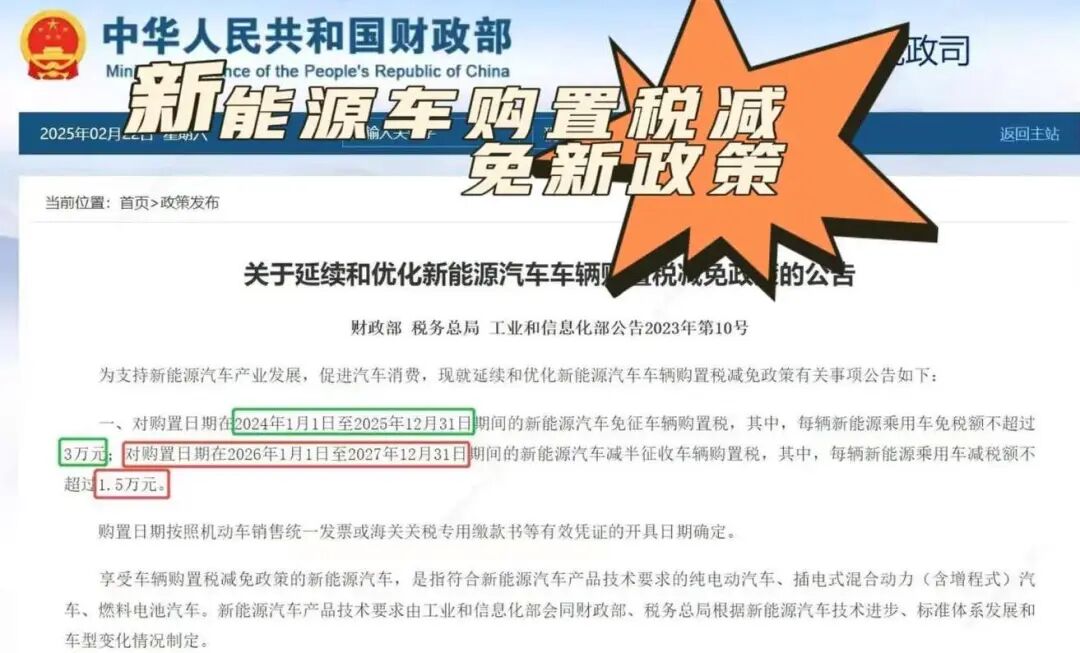
This is the first time since the implementation of the new energy vehicle purchase tax preferential policy that the full exemption has been changed to a 50% reduction. According to the new regulations, those who purchase eligible new energy vehicles can enjoy a 50% reduction in vehicle purchase tax, which is valid until the end of 2027. The calculation method is "the tax - exclusive selling price of the vehicle × 5%", and the maximum reduction per vehicle is 15,000 yuan.
At the same time, the policy has put forward higher technical requirements for the vehicles eligible for the exemption.
For pure - electric models, the power consumption per 100 kilometers cannot exceed the "power - consumption upper limit" set by the state for the same - type vehicles. For plug - in hybrid models, the new regulations clearly state the conditions that must be met: the pure - electric driving range must reach at least 100 kilometers; stricter requirements are set for fuel consumption and power consumption; if the total mass of the vehicle exceeds 3.5 tons, the standards for 3.5 - ton models shall apply.
Obviously, the new policy will have a direct impact on consumers' car - buying costs.
For example, from 2026 to 2027, the intensity of the new energy vehicle purchase tax exemption will decline, changing from full exemption from 2024 to 2025 to a 50% reduction. Under this rule, taking a new energy vehicle with a tax - inclusive price of 400,000 yuan as an example, after the new regulations are implemented, the purchaser will have to pay about 15,000 yuan more in purchase tax than under the current policy; if the vehicle fails to meet the new technical requirements, the actual tax difference will expand to about 30,000 yuan.
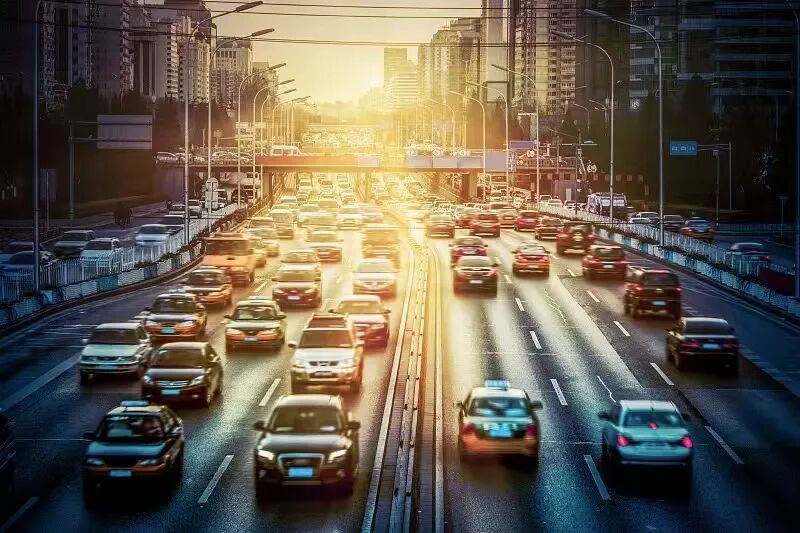
Based on this, Morgan Stanley predicts that investors are worried that fierce market competition and potential subsidy cuts will continue to put pressure on the sentiment of the Chinese auto industry and may affect the operational performance of vehicle manufacturers and suppliers in the first quarter of 2026.
The company expects that the sales of domestic passenger vehicles in China will decline by 6% - 8% in 2026, based on the fact that a 5% purchase tax will be added to new energy vehicles in 2026, which may correspond to a 4.4% tax - increase impact under the 13% VAT, and the adjustment of the "Two New Policies" (scrapped and renewed, replaced and renewed), referring to the historical law of callback after policy stimulus.
As the subsidy policy ends, the new energy vehicle industry will face a real market test. In addition to the possible decrease in consumers' purchasing sentiment, car manufacturers are also making strategic adjustments and technological breakthroughs in response to the upcoming policy changes.
Data shows that about 30% of plug - in hybrid models in the current market may face the risk of being removed from the subsidy catalog because they cannot meet the new requirement of a 100 - kilometer pure - electric driving range under the WLTC working conditions. Enterprises that focus on technological innovation, such as NIO and XPeng, have begun to demonstrate the unique value of the battery - swapping model in the new era. When the purchase tax exemption reaches the upper limit, the cost advantage brought by the battery - swapping solution will become more obvious.
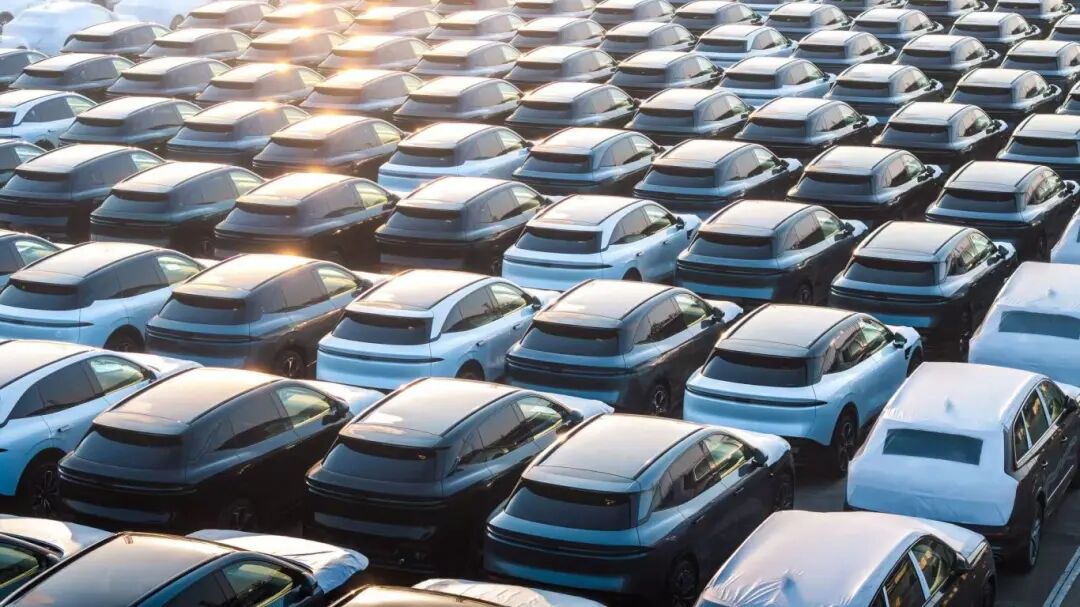
Since self - owned brands have a fast product iteration speed, many models have met the requirements of the new regulations in advance. Joint - venture brands, with a relatively slow platform replacement rhythm, face greater challenges.
In addition, in terms of price strategy, some brands have begun to control the tax - inclusive price of their main models within 339,000 yuan to avoid consumers feeling a significant increase in car - buying costs due to reaching the 15,000 - yuan exemption limit.
Overall, the car - buying decision in 2026 has become more complicated. Under the game between policy adjustment and the market's endogenous motivation, although the decline of the purchase tax exemption may bring short - term pain, the continuation of the trade - in policy and the strong growth of the export market have injected a new stabilizer into the industry.
This article is from the WeChat official account "Automobile Commune" (ID: iAUTO2010), author: Li Sijia. Republished by 36Kr with permission.