Valued at 10 trillion, the largest IPO in history is coming. SpaceX has announced its listing plan.
According to Bloomberg, Elon Musk's space technology unicorn SpaceX is planning an IPO at a valuation of approximately $1.5 trillion (equivalent to about ¥106 trillion). The targeted fundraising scale far exceeds $30 billion (equivalent to about ¥211.89 billion). If it goes public successfully, this will become the largest IPO in history.
Elon Musk also commented on the social platform X, confirming the news that SpaceX is about to go public.
SpaceX can support such a huge valuation not only because of its rockets but also because it is building the "infrastructure ticket" for humanity to reach low Earth orbit.
Elon Musk said, "The valuation growth depends on the progress of the Starship and Starlink projects and the ability to obtain the global direct - connected cellular network spectrum, which will greatly expand our target market size."
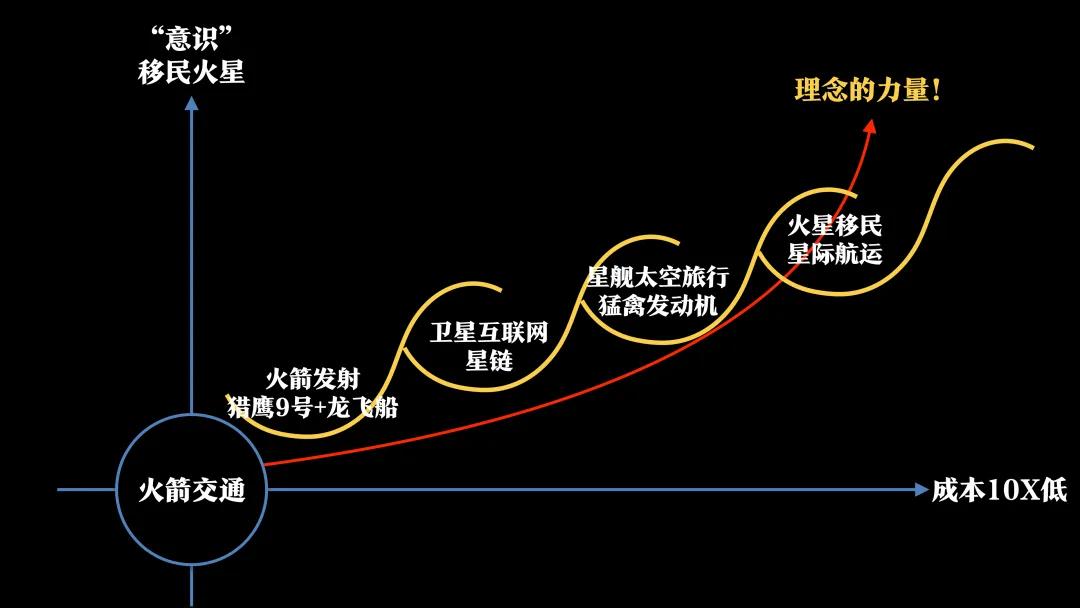
What? Are SpaceX's second and third growth curves already so strong?!
Why can Elon Musk always turn one "grand narrative" after another into reality?
What is the real driving force that makes a person continuously break through?
What practical thinking patterns and action principles can we learn from Elon Musk's experience?
The following is a wonderful interpretation of Elon Musk and SpaceX by Li Shanyou, the founder of Hundun University:
Elon Musk's First - Principle Thinking and SpaceX's Business Modeling
When we look back at the trajectory of his career, we will find that all his undertakings are closely related to his mission list. He can always combine grand dreams ("the big Y - axis") with practical business strategies ("the X - axis"). This combination shows us that when he has a huge dream, his business becomes even more successful.
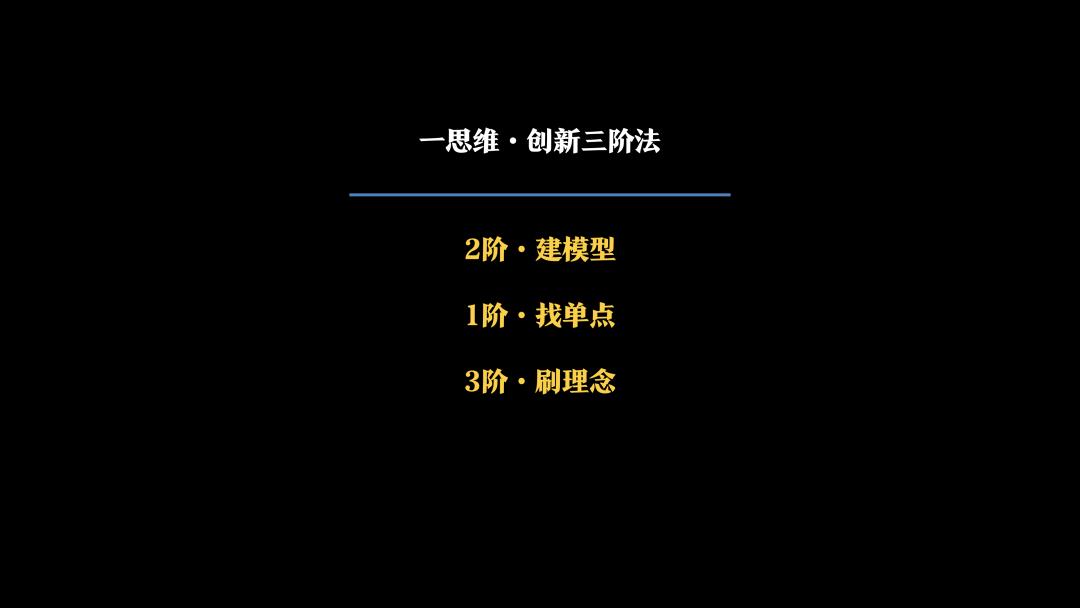
We usually mention three stages: the first - order, the second - order, and the third - order. The first - order represents the power of action; the second - order represents the power of cognition; the third - order represents the power of ideas, which is a transcendent power.
I will explain the "Three - Stage Method of Innovation" to you and combine it with the framework of "One Thinking · Three Stages · Four Questions" to elaborate on the four key questions of business strategy in the "Three - Stage Method of Innovation" through a complete case.
Value Modeling: From "Single - Use" to "Reusable"
Let's start with modeling, which is divided into two parts: value modeling and competitive modeling. First, look at value modeling, that is, value upgrading. The key is to find unique value and different cognition and establish a new value Y - axis above the X - axis.
Let's start with the word "rocket". Wittgenstein believed that language contains human subconsciousness. When we think of fireworks or rockets, we always associate them with single - use. But inspired by science fiction novels, Elon Musk put forward the new technological hypothesis that rockets can be reusable. If we base on this hypothesis, what will rockets become? Let's analyze it.
Back to the model, the implicit hypothesis is that rockets are single - use. But after discovering this hypothesis, we can put forward a new hypothesis - reusable. Once rockets are reusable, they become a means of transportation, just like airplanes, trains, and cars. This is SpaceX's value modeling. Its innovation begins with adding a new dimension (Y - axis) on the basis of predecessors to establish its own value model.
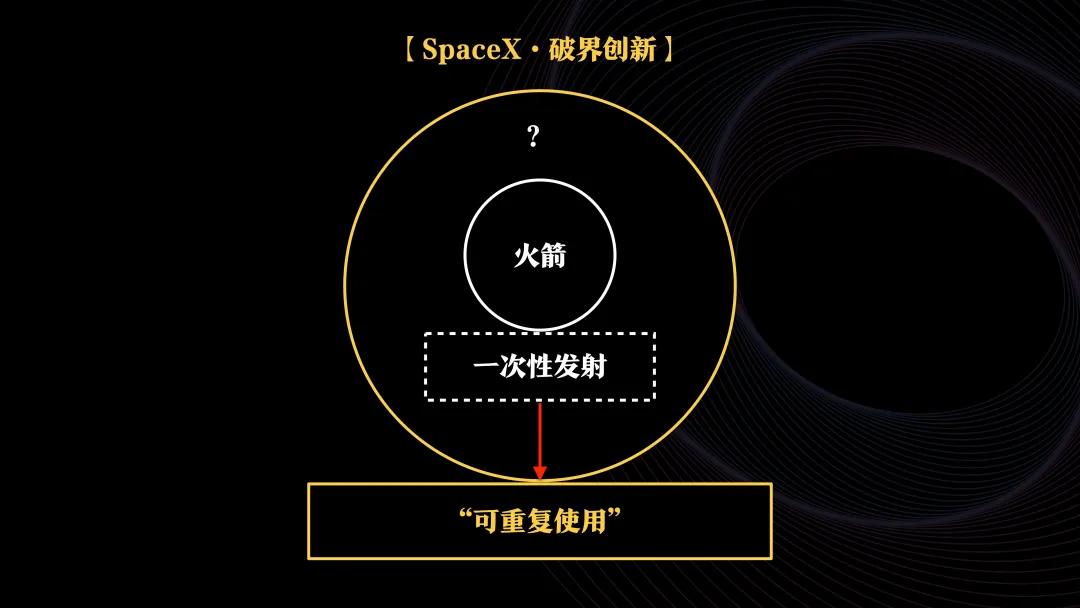
All innovation stems from this: adding a new dimension on the existing basis. Elon Musk gets inspiration from other industries. Introducing what is common in other industries into the rocket industry makes it extraordinary.
Elon Musk draws inspiration from other industries and introduces common technologies into the rocket industry, creating extraordinary results. He combines reusable rockets (with only a 1% chance of success) with space transportation (a concept that even science fiction novels have abandoned). This seemingly impossible combination reflects great ambition.
If he was seeking financing at that time, would you be willing to invest? Now, it seems that everyone might be willing to invest. But if we go back to 2002, an internet entrepreneur with $100 million entered the space exploration industry without any relevant experience, but wanted to disrupt the entire rocket industry. Would you believe in him? Whether you believe it or not, I didn't. But he finally achieved it. So how did he do it?
Next, we will talk about the second part, which is how to find the single - point breakthrough.
Single - Point Breakthrough: Three Elements of Ten - Fold Change
In the first step of the modeling stage, we have completed the value modeling at the second - order logic level.
Then, in the second step, we need to find the single - point breakthrough.
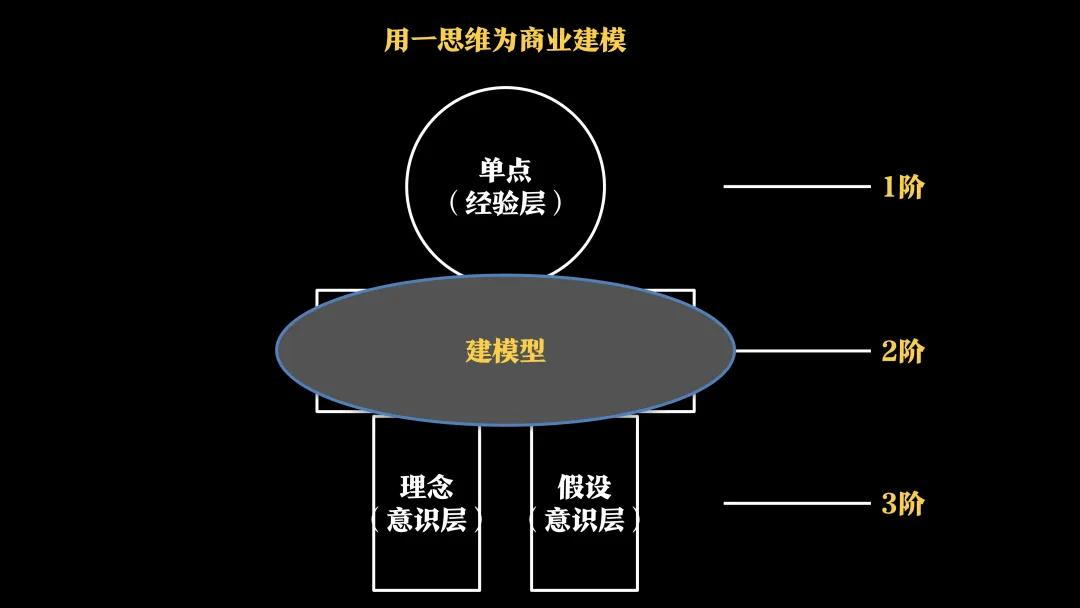
I suggest that you look for the single - point breakthrough from three directions.
First, is there a single element with a ten - fold change on the demand side?
Second, is there a single element with a ten - fold change on the supply side?
Third, is there a single element with a ten - fold change at the connection end?
Then, can these three single elements with ten - fold changes be integrated into a system?
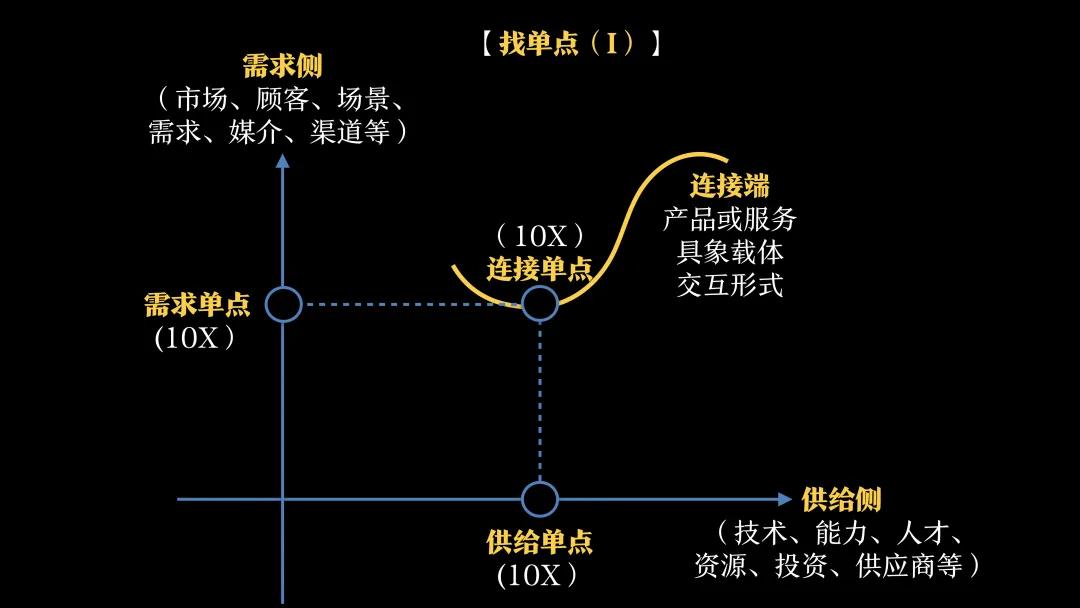
When SpaceX was founded, it didn't even have the basic rocket launch capability. Its first - step path was to master rocket launch technology, that is, to successfully launch rockets and accurately send payloads. In this process, there was also a small end - game: the transformation from single - use rockets to reusable rockets, which is a problem of basic scientific research and technological application.
To achieve rocket reusability, SpaceX needed financial support. Without direct national funding, it had to take the commercial path and make money by launching rockets. NASA, especially the National Aeronautics and Space Administration (NASA) of the United States, was the best customer for SpaceX. NASA stopped the space shuttle project due to its high cost and complex technology and outsourced space transportation services, which provided an opportunity for SpaceX.
By undertaking NASA's business, SpaceX not only made money but also helped it move towards its end - game goal. The direction was highly consistent. This is different from some people whose commercial income goes against their ideals. Therefore, in the early stage of entrepreneurship, SpaceX chose NASA as its customer and carried out government - oriented business (To G business), which is its unique development path.
Cost Revolution: Idiot Index and Ten - Fold Reduction
The core requirements of NASA for outsourcing space missions are: first, safety; second, technical details; and finally, cost. In the early days, the US military adopted cost - plus contracts. The outsourcing company listed the cost list, and the military paid according to the cost and an additional 15% profit. This model seems to be able to control costs, but the outsourcing company has no incentive to reduce costs. Instead, it will increase costs to obtain more profits.
But when Elon Musk entered the space industry, he became a disruptor.
He proposed a fixed - price contract with a fixed total price. The technical details were determined by his company, and NASA only needed to clarify the requirements. If the cost exceeded the budget, the company would bear the loss; if the cost was lower than the total price, the difference was the profit. This model was beneficial to the government and was finally accepted by the military under the pressure of the Senate.
The second step is the product. Elon Musk and SpaceX believe that reusable rockets can replace the space shuttle to meet the needs of transporting personnel and supplies to the space station, which is in line with Elon Musk's dream. This contract is consistent with his original intention and technical path and also meets his ultimate goal - Mars.
SpaceX's product direction is clear: reusable rockets. The first step is to successfully launch rockets. Elon Musk's goal was to reduce the rocket cost by ten times, so he proposed the "ten - fold reduction of the idiot index". The idiot index is the multiple of the total cost of the finished product to the cost of raw materials, which points directly to the key to cost reduction.
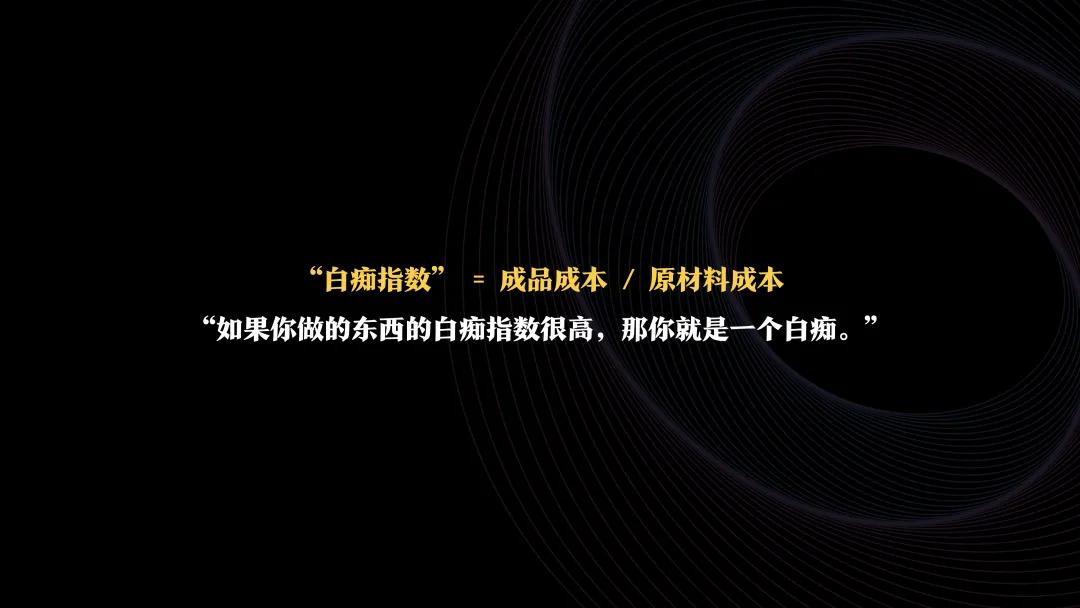
The manufacturing cost of a product consists of the cost of raw materials and the manufacturing cost. The multiple of the total cost divided by the cost of raw materials represents the optimization space in the process flow and manufacturing. The larger this multiple is, the greater the optimization space. Elon Musk's goal of reducing costs by ten times was derived from here.
Elon Musk said that first - principle thinking is a superpower. First - principle thinking requires us to trace back to the origin. Only by delving into the essence of things can we achieve a ten - fold change. If we only make adjustments on the surface, we can only bring about a 10% change.
The first - principle thinking advocated by Elon Musk is essentially the thinking mode of physics. Someone once asked him, "Do you believe in God?" He replied, "No, I only believe in physics." When he makes decisions, his team may object, saying that this thing violates the law. He will ask, "Does this thing violate physics?" If the answer is "no", then he will say "it can be done".
If we want to briefly describe this thinking mode, the most core concept is reductionism, which holds that the essence of any thing is composed of its smallest units. Therefore, as long as we can disassemble things into their smallest and most valuable units, we can insight into the essence of things.
Under the influence of Elon Musk, the SpaceX team and companies like Tesla have developed a real core ability, the engineering ability of engineers.
Five - Step Working Method: The Thinking Weapon of Engineers
Although his ideal is abstract, his specific methodology is very practical, such as the five - step working method. The five - step working method solves the problems we encountered when learning first - principle thinking in the past.
The first step is to question.
The second step is to delete.
The third step is to simplify.
The fourth step is to accelerate.
The fifth step is to automate.
SpaceX's single - point thinking is clear: achieve a ten - fold transformation on the demand side, create exponential growth on the supply side, and the final product is a reusable rocket. After setting the goal, action is needed. Single - point penetration is the key to a winning battle.
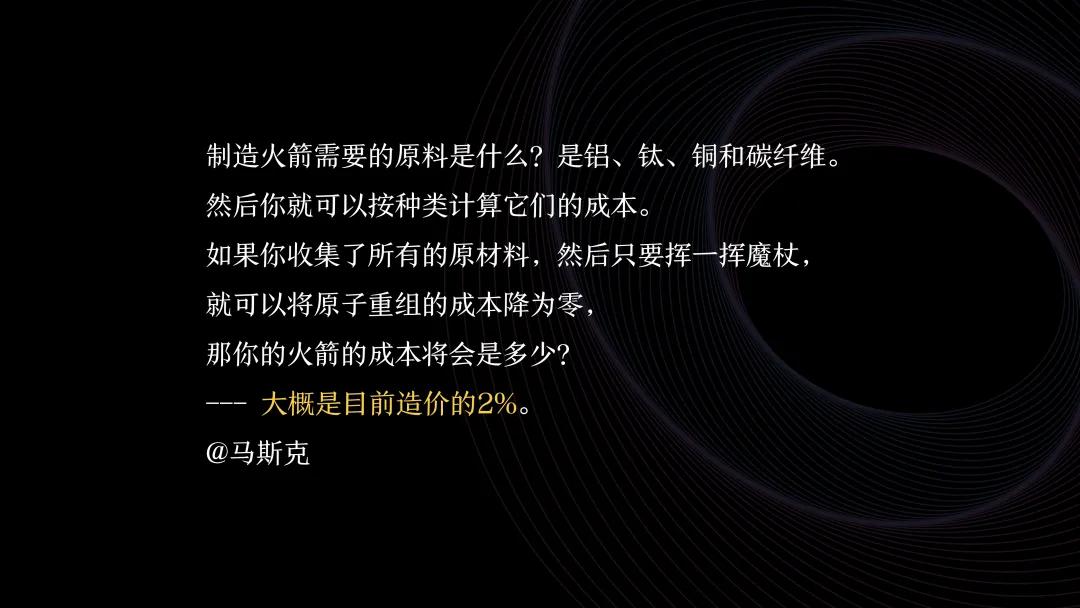
Elon Musk firmly believes in a saying: "As long as I have a goal, I can achieve it." Even if he doesn't know the specific path, he has this natural belief. The methods he uses are the five - step working method and first - principle thinking we talked about today: he thinks from the atomic level, which is the application of first - principle thinking.
He disassembled the components to the atomic level and found that the cost of raw materials was only 2% of the construction cost, and the idiot index was as high as 50 times, which means there was a huge optimization space. Therefore, he controlled the cost to one - tenth or even one - fortieth of that of his competitors, achieving a ten - fold reduction in cost and promoting structural changes.
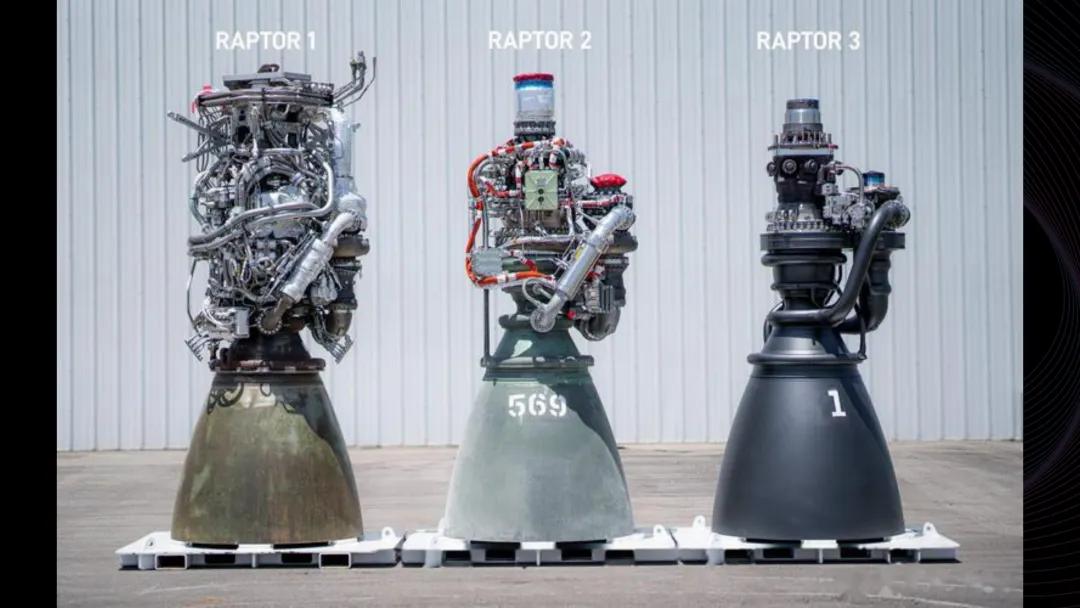
As we all know, rocket engines are very important, and their manufacturing is extremely difficult, especially the engines used for Mars missions. In 2021, Elon Musk found that the Raptor engine had problems such as complexity, high cost, and cumbersome processes. He believed that technological complexity was a sign of reaching the limit and needed to be changed.
After that, he launched the "Rapid Development Campaign" with the goal of reducing the engine cost by ten times within 12 months. He regularly launched similar challenges, striving for a ten - fold improvement, which was achieved through the five - step working method: disassemble the components, find the top 20 components with the largest optimization space, analyze the requirements of each component, delete the unnecessary parts, and ensure thorough optimization.
Elon Musk believes that performance can be improved while reducing costs. To this end, he replaced most of the raw materials of the rocket engine components with stainless steel. This innovative measure not only reduced costs but also simplified the process and reduced the difficulty of welding.
Let's take a look at the first - generation Raptor engine. Its design was complex. The second - generation was improved, and the third - generation achieved integration due to cost reduction, which actually improved performance. His core ability lies in promoting technological innovation through cost reduction. The designs he released, which seem like concept maps, have been verified in flight tests, and future designs may be even simpler.
Currently, the cost of the US space shuttle to enter orbit is $50,000 per kilogram. SpaceX's Falcon 9 is about $3,000, and the future Starship is expected to be reduced to $200, which means a further 90% reduction on the