Owing 2.5 billion to Chinese companies, the global robot hegemon: I'm out of money.
The leading American robotic vacuum cleaner company, iRobot, has once again found itself at the center of the storm.
Reports indicate that this company, which has revolutionized global household cleaning methods, is now in an embarrassing situation of being "cash - strapped": it owes more than $350 million (approximately 2.5 billion RMB) to Shenzhen Shanchuan Robotics, while it only has $24.8 million on hand, not even enough to cover a fraction of the debt.
In other words, iRobot is walking on a tightrope and could easily fall into the "technical bankruptcy" zone. It's worth noting that in 2021, its market value reached 11 billion RMB.
Why has it accumulated so much debt? The answer can be found in the latest financial report.
In the third quarter of 2025, iRobot's revenue was $146 million, a 25% year - on - year decline. During the same period, it had a net loss of $17.7 million, marking 11 consecutive quarters of losses.
The cash burn rate is even more alarming: it burned through approximately $35 million in a single quarter, and its cash reserve dropped directly from $40 million to $24.8 million.
The debt situation is also critical. As of the end of the third quarter, iRobot's total assets were $481 million, total liabilities were $508 million, and shareholders' equity was - $26.8 million, truly "insolvent on paper".
Who is the biggest creditor? It's actually a Chinese company: Shenzhen Shanchuan Robotics.
Shanchuan is both iRobot's contract manufacturer and its biggest creditor: through its Hong Kong subsidiary, Santrum, it acquired a $190.7 million loan from iRobot. Meanwhile, iRobot also owes Shanchuan $161.5 million in goods payments, of which $90.9 million is overdue.
The total of these two debts amounts to $352 million (approximately 2.5 billion RMB), accounting for over 70% of iRobot's total liabilities.
In other words, Shanchuan has the initiative to initiate default remedies or bankruptcy liquidation at any time.
Just think about it. This was once an industry leader with a global market share of over 50%, but now it's deeply mired in debt. Where did the problem lie? Was it iRobot's operational mistakes, or is the entire robotic vacuum cleaner industry on a downward trend?
- 01 -
iRobot was founded in 1990 and is a pioneer in bringing robots into household life globally.
In 2002, it launched its first Roomba robotic vacuum cleaner, which was once hailed as the "ancestor" of the robotic vacuum cleaner industry. In 2005, the company went public on the NASDAQ.
In its early days, iRobot's business was not limited to cleaning robots. It also conducted R & D in multiple fields such as military robots, exploration robots, and security robots. However, these businesses ultimately failed to become the core engine for its continuous growth.
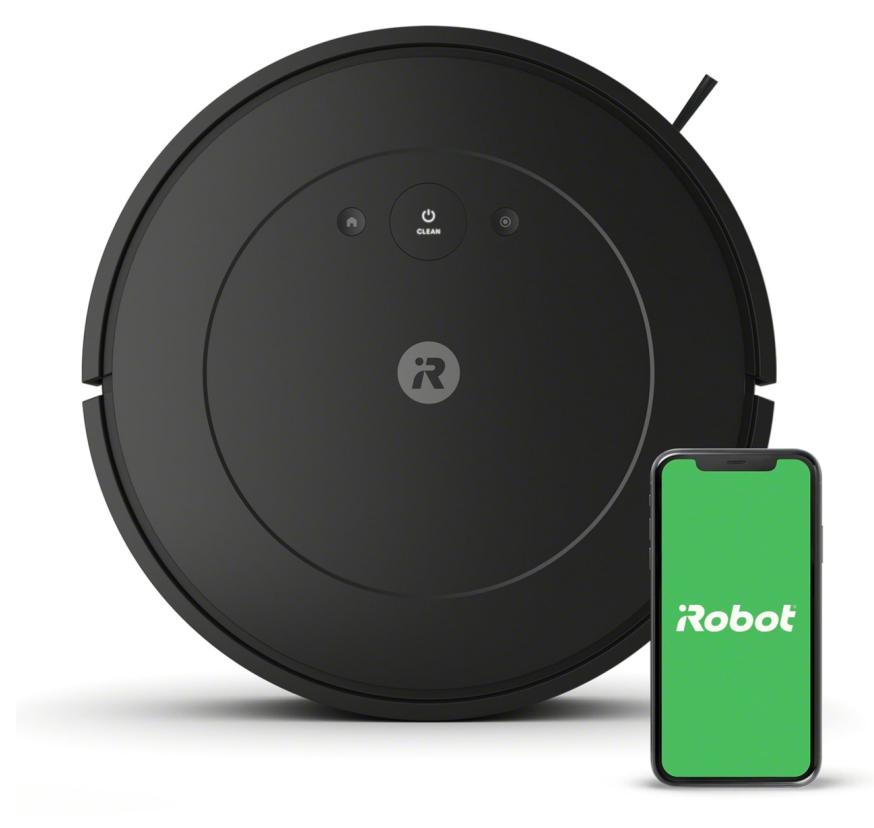
The Roomba robot, with a classic circular appearance, supports intelligent APP control.
In 2022, iRobot's revenue decreased by 24% year - on - year to $1.1834 billion, and its net profit turned from positive to negative, with a net loss of $286.3 million.
In the same year, Amazon proposed to acquire iRobot for approximately over one billion dollars, hoping to inject funds and resources. However, after failing to pass the EU's anti - monopoly review, the deal ultimately fell through.
After that, iRobot carried out large - scale layoffs (cutting approximately 31% of its employees), its CEO left, the company's strategy was scaled back, and its financial situation further deteriorated.
Surprisingly, iRobot has fallen in a high - growth market.
Taking the latest market data as an example: in the first three quarters of 2025, the cumulative global shipments of intelligent robotic vacuum cleaners were approximately 17.424 million units, a nearly 19% year - on - year increase.
The growth rate of Chinese manufacturers is particularly remarkable, occupying the top five positions in global shipments.
In particular, Roborock shipped approximately 3.788 million units in the past three quarters, ranking first globally; Ecovacs shipped a cumulative 2.453 million units; Dreame performed prominently in the European market.
In other words, the industry as a whole is growing, but iRobot's market position is being rapidly eroded.
- 02 -
From the 2010s to around 2020, robotic vacuum cleaners were one of the first categories to boom in the smart home market. However, iRobot gradually fell behind in the crucial years, and the reasons are well - documented:
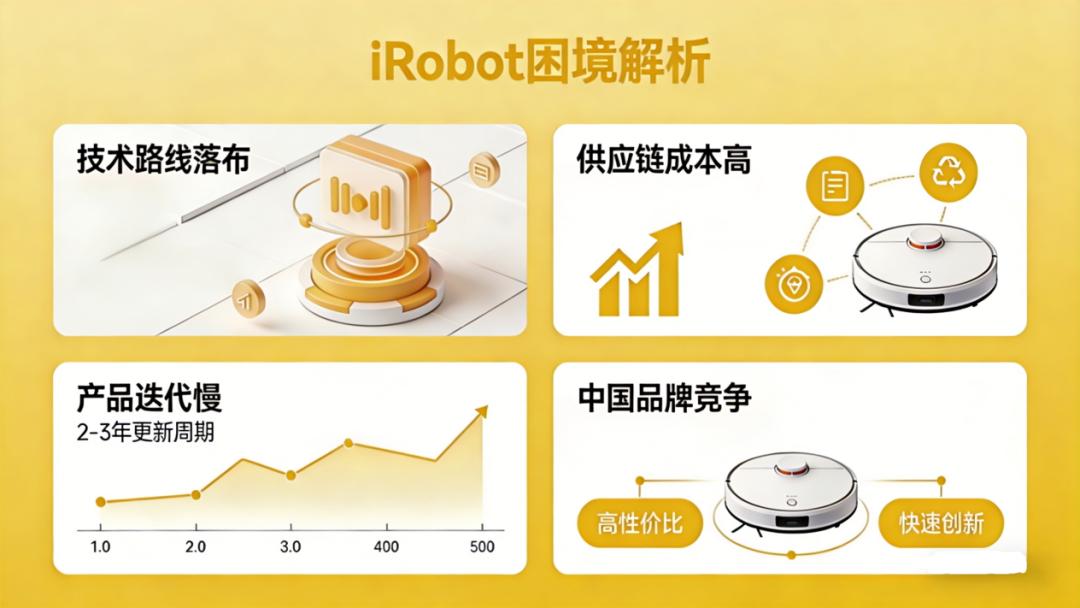
1. Slow product updates and outdated technology.
iRobot adhered to its own visual navigation technology, while Chinese brands adopted technologies such as lidar + AI navigation and integrated sweeping and mopping early on to improve cleaning efficiency and the intelligent experience.
In contrast, iRobot didn't launch corresponding products in the Roomba j series until around 2023.
2. Losing the Chinese market, especially during the pandemic.
In the Chinese market, which is the fastest - growing region globally, iRobot's online market share once dropped to single digits (according to Aowei Cloud Network data) and was comprehensively surpassed by local brands such as Ecovacs, Roborock, and Yunjing.
You Danni, a senior expert in the cleaning appliance industry, believes that iRobot failed to keep up with the industry's development pace, especially losing touch with the Chinese market during the pandemic.
3. Insufficient adaptability of the business model.
Most competitors in the industry not only promote hardware upgrades but also actively layout value - added models such as software, subscription services, and ecological synergy. However, iRobot still mainly relies on one - time hardware sales and has failed to effectively develop continuous revenue sources such as cloud service subscriptions.
4. Intensified supply - chain and cost pressures.
As the global supply chain has concentrated in China and neighboring regions, iRobot is relatively weak in supply - chain bargaining and cost control. This not only affects its profit margin but also restricts its ability to rapidly iterate products.
- 03 -
So why are Chinese brands becoming stronger and stronger? iRobot's crisis is, in a sense, the result of the rise of Chinese manufacturing.
Chinese brands have a complete, agile, and low - cost supply chain, which allows them to outpace their foreign competitors in technology upgrades and new product iterations.
In terms of core components, taking lidar as an example, Chinese company UCAS Technology has a 50% shipment volume and often ranks first in the domestic market; in the field of visual sensors, it is dominated by giants such as Will Semiconductor and Sunny Optical.
This local ability from the chip level to the module level enables Chinese robot manufacturers to be much faster than companies relying on imported components in procurement, testing, and iteration.
This leads to several results.
1. Faster iteration speed of Chinese brands.
Chinese manufacturers can usually "update products twice a year" and even launch multiple minor version upgrades based on seasonal promotions and market feedback; while traditional overseas companies often only update major version models once every two years.
Robotic vacuum cleaners are essentially consumer products, and user experience and market sensitivity are crucial.
Rapid iteration allows Chinese brands to quickly introduce AI functions such as visual obstacle avoidance, intelligent path planning, and optimization of automatic charging/cleaning strategies.
For example, Roborock's latest flagship model integrates lidar + AI visual obstacle avoidance, which can autonomously plan cleaning paths in complex furniture layouts to avoid repeated or missed areas. These functions were slow to be popularized in iRobot's products during the same period.
2. Lower prices of Chinese brands.
The local supply chain reduces costs, allowing Chinese brands to be 20% - 30% cheaper than overseas brands with the same configuration.
In the Japanese market, retailers have reported that the price of Ecovacs models is approximately $295, while similar - function iRobot products are priced at approximately $399. Consumers tend to choose more cost - effective Chinese models.
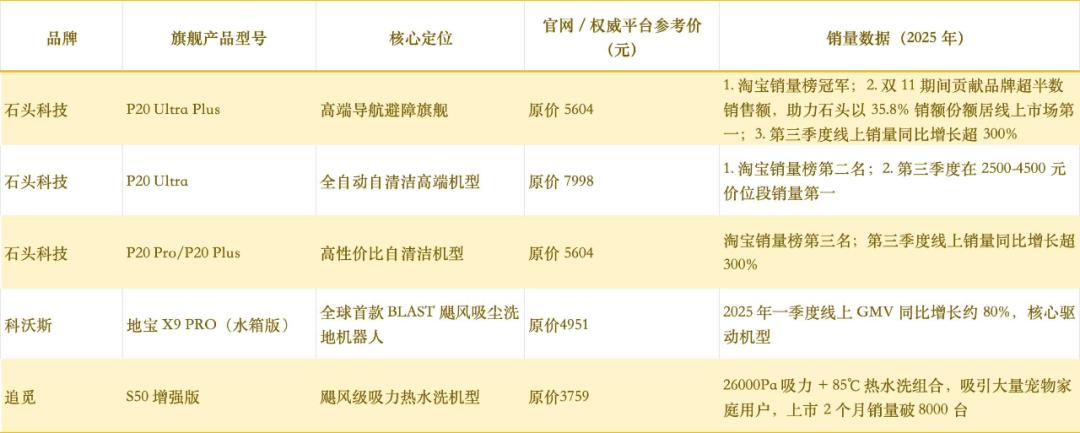
An overview of some domestic robotic vacuum cleaner products
- 04 -
What is the next opportunity for high - growth? Of course, it's household service robots.
Robotic vacuum cleaners are just the beginning of household service robots.
According to the "Global and Chinese Household Service Robot Market Size and Trend Forecast Report", so - called household service robots are no longer just cleaning tools but cover a wider range of household chores and monitoring tasks.
Their functional positioning includes automatic cleaning, cooking assistance, daily security, and care support.
A report from SNS Insider shows that the global household robot market size was approximately $1.015 billion in 2023 and is expected to reach approximately $4.885 billion by 2032, with a compound annual growth rate of approximately 19.1% during the forecast period.
In the wave of the development of household service robots, Ecovacs' Deebot X1 Omni is a typical example.
It was initially a robotic vacuum cleaner, but it has gone far beyond simple cleaning: it can not only vacuum, mop the floor, and automatically clean the dustbin and mop but also is equipped with AI visual recognition and SLAM navigation, which can intelligently plan routes, avoid obstacles, and achieve precise whole - house cleaning.
More importantly, it is becoming the prototype of a household intelligent platform.
The Deebot X1 Omni can be linked with IoT devices such as air conditioners, lights, and air purifiers in the home through the Ecovacs Smart Home App to achieve preliminary whole - house control; the built - in voice assistant can also execute voice commands to start cleaning or trigger linked scenarios, forming the prototype of a household interaction center.
Although robotic vacuum cleaners have been recognized by many families, when it comes to more complex functions such as "companionship, interaction, and assistance", elderly users don't have a unified opinion.
A study of 85 elderly people with different physical conditions found that only about half (53%) were willing to use assistive robots.
What they care about is actually very practical: Can safety be guaranteed? Is the price reasonable? Is it easy to operate?
Another study also shows that the emotional interaction needs of the elderly of different age groups for robots vary greatly: some hope that robots can help with practical things, such as reminding them to take medicine and checking the status of household appliances; but they are not very enthusiastic about anthropomorphic companionship functions and may even worry about privacy.
This tells manufacturers a key point: Don't just focus on adding functions. It's more important to solidify the basics, make the products easy to use, and meet real needs than to have a bunch of fancy functions.
This article does not constitute any investment advice.
This article is from the WeChat official account “Pencil News” (ID: pencilnews), author: Song Ge, published by 36Kr with authorization.