Schulden von 2,5 Milliarden Yuan an chinesische Unternehmen, der weltweite Roboterriese: Es ist kein Geld mehr im Geldbeutel.
The US market leader in robotic vacuum cleaners, iRobot, is once again in the spotlight for criticism.
According to the latest reports, this company, which has changed the way households around the world are cleaned, is now in an embarrassing situation: It owes more than $3.5 billion (about 25 billion yuan) to Shenzhen Sunchon Robotics, but only has $24.8 million available, which isn't even enough for the overheads.
In other words, iRobot is on thin ice, and one wrong move could push it to the brink of "technical insolvency." In 2021, the company still had a market capitalization of 11 billion yuan.
Why does it owe so much money? A look at the latest business reports provides the answer.
In the third quarter of 2025, iRobot's revenue was $146 million, a 25% decline compared to the previous year. During the same period, the net loss was $17.7 million. This is already the eleventh consecutive quarter of losses.
The waste of liquidity is even more shocking: In a single quarter, about $35 million was burned, and the cash reserves dropped directly from $40 million to $24.8 million.
The debt situation is also critical. By the end of the third quarter, iRobot's total assets were $481 million, total liabilities were $508 million, and the equity was -$26.8 million. It is actually in a state of "balance - sheet over - indebtedness."
Who is the biggest creditor? Surprisingly, it's a Chinese company: Shenzhen Sunchon Robotics.
Sunchon is both the contract manufacturer of iRobot and the biggest creditor: Through its Hong Kong subsidiary Santrum, it acquired loans from iRobot worth $190.7 million. In addition, iRobot still owes Sunchon $161.5 million for goods deliveries, of which $90.9 million is already due.
The above - mentioned two debts add up to a total of $352 million (about 2.5 billion yuan), which accounts for more than 70% of iRobot's total liabilities.
In other words, Sunchon has the initiative to issue a default notice or initiate bankruptcy liquidation at any time.
Think about it: This was once an industry giant that once had more than 50% of the global market, and now it's deeply in debt. Where lies the problem? Is it due to wrong decisions in iRobot's corporate management, or is the entire robotic vacuum cleaner industry on a downward trend?
- 01 -
iRobot was founded in 1990 and is a pioneer company that was the first in the world to bring robots into daily household life.
In 2002, it launched the first robotic vacuum cleaner, Roomba, which was once referred to as the "father of the robotic vacuum cleaner industry." In 2005, the company went public on the NASDAQ.
At the beginning, iRobot's business included not only cleaning robots. It also carried out R & D attempts in other fields such as military robots, research robots, and security robots. However, these business areas could not establish themselves as the core engine for the company's continuous growth.
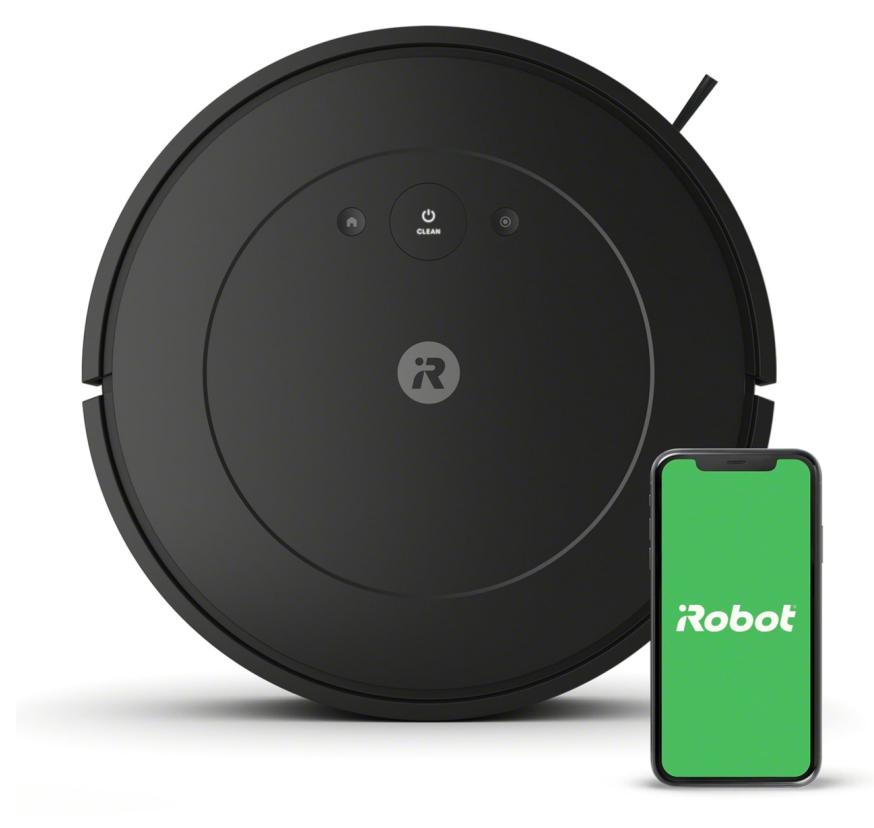
The Roomba robot with its classic round design and support for intelligent app control
In 2022, iRobot's revenue decreased by 24% to $1.1834 billion. The net result changed from a profit to a loss, and the net loss was $286.3 million.
In the same year, Amazon tried to acquire iRobot for about a few billion US dollars to strengthen it with capital and resources. However, the deal failed after being rejected by the EU antitrust authority.
Subsequently, iRobot carried out a massive wave of lay - offs (about 31% of the employees were laid off), the CEO stepped down, and the company restricted its strategy, which led to a further deterioration of the financial situation.
Surprisingly, iRobot failed in a rapidly growing market.
Take the latest market statistics as an example: In the first three quarters of 2025, a total of about 1.7424 million intelligent robotic vacuum cleaners were shipped worldwide, a nearly 19% increase compared to the previous year.
Chinese manufacturers are growing particularly strongly, occupying the top five positions in the global shipping statistics.
In particular, Roborock shipped about 3.788 million devices in the last three quarters and took the first place worldwide. Ecovacs shipped 2.453 million devices, and Dreame has performed particularly well in the European market.
In other words, the overall market is growing, but iRobot's market position is being rapidly eroded.
- 02 -
From the 2010s to around 2020, the robotic vacuum cleaner was one of the first categories in the field of intelligent household appliances to grow strongly. But iRobot gradually gave up in those crucial years. The reasons are evident:
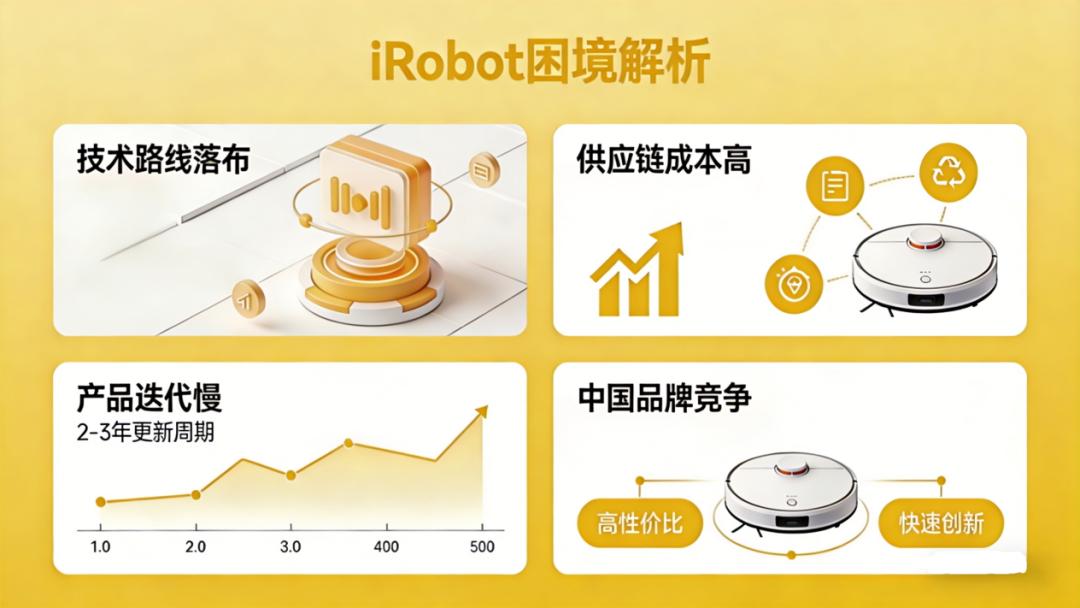
1. Slow product development and outdated technology.
iRobot relies on its own optical navigation technology, while Chinese brands have already early on adopted technologies such as laser scanners + AI navigation and combined vacuuming and mopping functions to improve cleaning performance and the user experience.
In comparison, iRobot only launched corresponding products of the Roomba j - Series around 2023.
2. Loss of the Chinese core market, especially during the pandemic.
In the Chinese market, the fastest - growing market in the world, iRobot's online market share once dropped to single - digit figures (data from Aowei Cloud Network) and was completely overtaken by local brands such as Ecovacs, Roborock, and Yunjing.
You Danni, an experienced expert in the cleaning appliance industry, believes that iRobot was unable to keep up with the industry's growth pace, especially during the pandemic when it disconnected from the Chinese market.
3. Insufficient adaptability of the business model.
Most competitors in the industry not only promote hardware development but also focus on value - creation models such as software, subscription services, and ecosystem synergies. iRobot, on the other hand, still mainly relies on one - time hardware sales and has failed to effectively develop sustainable revenue sources such as cloud subscriptions.
4. Increasing pressure in the supply chain and costs.
With the concentration of the global supply chain in China and the surrounding regions, iRobot is in a weaker position in terms of supply - chain bargaining power and cost control compared to other companies. This not only affects profitability but also hinders the ability to quickly update products.
- 03 -
Why are Chinese brands becoming stronger and stronger? iRobot's crisis is, to some extent, the result of the rise of Chinese manufacturing.
Chinese manufacturers have a comprehensive, flexible, and cost - effective supply chain, which enables them to improve technologies faster and bring new products to the market faster than their foreign competitors.
In core components, such as laser scanners, the Chinese company Camsense has a 50% market share and regularly takes the first place in the Chinese market. In the field of visual sensors, companies such as Will Semiconductor and Sunny Optical dominate.
This local ability from the chip to the module level enables Chinese robot manufacturers to carry out purchases, tests, and product updates much faster than companies that rely on imported components.
This leads to several results.
1. Faster product updates of Chinese brands.
Chinese manufacturers can usually manage to "update two product generations per year" and even release several small versions based on seasonal promotions and market feedback. Traditional foreign companies, on the other hand, often only update their major product versions every two years.
Robotic vacuum cleaners are basically consumer goods, and the user experience and market sensitivity are crucial.
The rapid update enables Chinese brands to quickly introduce AI functions such as optical obstacle recognition, intelligent path planning, and optimization of automatic charging/cleaning.
For example, the latest flagship model of Roborock integrates a laser scanner + AI optical obstacle recognition, which can autonomously plan the cleaning route in complex furniture arrangements and avoid repetitions or omissions. These functions are spreading more slowly in iRobot's products during the same period.
2. Lower prices of Chinese brands.
The local supply chain reduces costs, and Chinese brands can offer products with the same specifications 20% - 30% cheaper than foreign brands.
In the Japanese market, dealers report that Chinese Ecovacs devices cost about $295, while comparable iRobot products cost about $399. Consumers tend to choose the more cost - effective Chinese models.
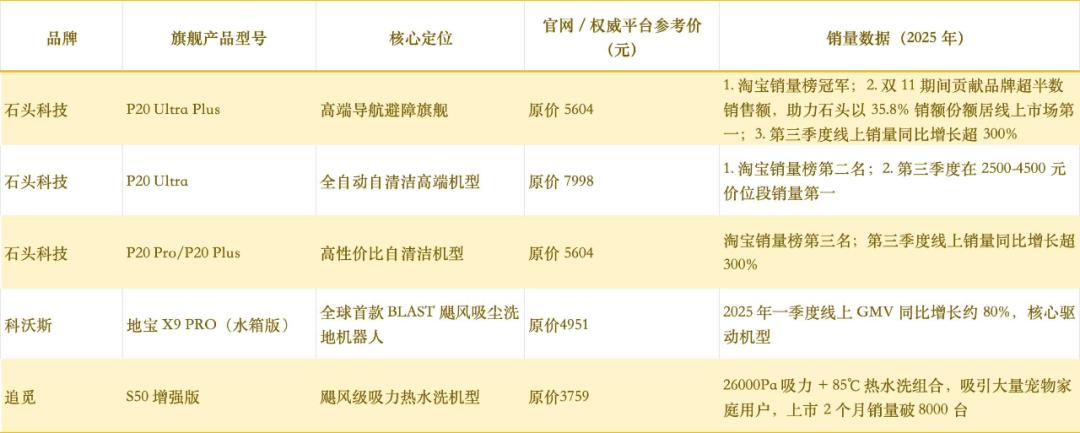
Overview of some Chinese robotic vacuum cleaner products
- 04 -
What is the next growth opportunity? Naturally, it's household service robots.
The robotic vacuum cleaner is just the beginning of household service robots.
According to the "Global and China Household Service Robot Market Size and Trend Forecast Report", household service robots are no longer just cleaning appliances but cover a wider range of household and monitoring tasks.
Their functions include automatic cleaning, cooking assistance, daily security, and care support.
A study by SNS Insider shows that the global market for household robots was about $1.015 billion in 2023 and is expected to rise to about $4.885 billion by 2032, corresponding to an average annual growth rate of about 19.1%.
In the process of the growth of household service robots, Ecovacs' Deebot X1 Omni is a typical example.
Initially, it was a robotic vacuum cleaner, but it can do much more than just vacuum: It can not only vacuum and mop but also automatically clean the dust collection container and the mopping pad. It is also equipped with AI optical recognition and SLAM navigation to intelligently plan the route, avoid obstacles, and precisely clean the entire house.
More importantly, it is gradually developing into a prototype of an intelligent household platform.
The Deebot X1 Omni can be connected to IoT devices such as air conditioners, lamps, and air purifiers in the household via the Ecovacs Smart Home App to enable basic control of the entire household. The integrated voice assistant can also execute voice commands, start cleaning, or connect scenarios, which forms the prototype of a household interaction center.
Although robotic vacuum cleaners are accepted by many households, there is no consensus among older users when it comes to more complex functions such as "companionship, interaction, and support."
A study of 85 elderly people in different health conditions shows that only about half (53%) are willing to use support robots.
What really interests them is very realistic: Can safety be guaranteed? Is the price reasonable? Is it easy to operate?
Another study also shows that the needs of the elderly in different age groups for emotional interaction with robots vary greatly: Some want the robot to do practical things, such as reminding them to take medicine or checking the status of household appliances. But they are not very interested in the anthropomorphic companionship function and even fear the invasion of privacy.
This shows manufacturers an important point: Don't just think about adding functions, but first make the basics solid, make the products easy to operate, and adapt them to real needs. This is more important than a lot of elaborate functions.
This article does not constitute an investment recommendation.
This article is from the WeChat account ...