In 2025, those cross - border robot - related car - making forces
At the 23rd Guangzhou International Automobile Exhibition that ended in November, many car - making enterprises, including XPeng and GAC, showcased their humanoid robot products, diverting a lot of attention from the exhibited cars.
On the 28th at the end of the month, Lei Jun, the CEO of Xiaomi, also announced in an interview that in the next five years, a large number of humanoid robots will enter Xiaomi's factories to work, shifting people's attention briefly from the company's highly - publicized automobile business this year to its robot business.
Coupled with the gradual launch of Tesla's Optimus robot trial - production line, for a while, it seems that car - making enterprises have all pressed the accelerator button on their humanoid robot business.
Reasons for car companies to "rush into robot - making"
It's not new for car companies to make robots. As early as 1986, Japanese company Honda started researching and developing a humanoid robot project, and it wasn't until 32 years later in 2018 that the project was officially terminated. During this period, companies including car manufacturers such as Toyota and Hyundai have all made their own attempts in the robot field.
However, this new wave of "robot - making" enthusiasm among car companies in 2025 is different from the previous ones.
Second Sister sorted it out and thought that there are four main reasons for car companies to "coincidentally" speed up their robot R & D at this time:
Firstly and most straightforwardly, it is the need for a new market - value story.
After the debut of its humanoid robot IRON in early November caused a sensation, XPeng Motors' Hong Kong - listed stock price witnessed a significant consecutive increase. On the other side of the ocean, Tesla's trillion - dollar compensation plan for Elon Musk was approved. Looking further ahead, the implementation of this plan is firmly tied to Tesla's future market - value target.
This increase in market value brought about by the "robot concept" undoubtedly has great appeal to many car companies caught in homogeneous competition. At Li Auto's earnings conference call on November 26th, CEO Li Xiang also put forward the company's goal of developing towards embodied intelligent robots in the future.
This "coincidence" in timing makes it hard not to suspect that they are riding on the "robot wave".
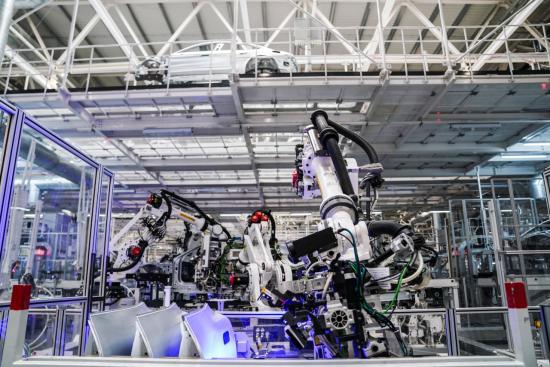
Xiaomi's automobile production line
The second need comes from car companies' desire to improve future productivity.
Going back to Lei Jun's interview at the beginning of the article, he mentioned that "taking Xiaomi's automobile factory as an example, it is very difficult to detect large castings with the human eye. However, through X - ray machines and large AI vision models, the detection can be completed within 2 seconds, with an efficiency 10 times that of manual labor and an accuracy more than 5 times that of manual labor."
This huge gap in productivity is an important factor driving car companies to scramble to invest more in robots. The emergence and continuous application and training of large AI models make it possible for future robots to have intelligent decision - making and high - precision operation capabilities far superior to their mechanical "predecessors in the workplace".
Especially for many traditional car companies, robots with embodied intelligence capabilities are already quite suitable for implementation in their highly structured industrial scenarios.
If the above two points are just the needs of car companies for robots, then the following is the practical possibility for this industry to accelerate, and this possibility is also the reason why car companies are willing to "take a gamble".
One is the multi - faceted capabilities that car companies can reuse in robot manufacturing. From the underlying logic, embodied intelligent robots and the popular intelligent driving in recent years are essentially both processes of the carrier "perception - decision - execution".
For example, in terms of supply - chain capabilities in software and hardware.
From a hardware perspective, car companies that have explored the "intelligent driving" path for many years can apply many capabilities involved in autonomous driving, such as sensing, lidar, and battery - related capabilities for battery life, to robot hardware.
The algorithm capabilities accumulated in autonomous driving can be migrated to robots at the software level. A typical example in this regard is Tesla's robot, which combines the FSD autonomous driving algorithm model. It is reported that the algorithm similarity between its intelligent driving and the robot exceeds 60%.
Years of experience in the manufacturing supply chain have also enabled car companies to have stronger capabilities in cost and quality control of the supply chain, giving them an advantage in areas such as integrating mass - producible robot solutions.
In addition to the reuse of capabilities, there is also the reuse and penetration of scenarios. For example, for a company like Xiaomi, which also has a consumer - oriented nature, if its robots can enter consumer scenarios such as households in the future, they can form a linkage with its smart home products, enriching the functions available to users while reducing the usage threshold.
Secondly, it is also related to policies and the changing industrial layout.
With the stage - by - stage development of the economy, guidance and policies at different levels, whether national or local, are causing changes in industrial structure and layout. This change is reflected in the renewed emphasis on the manufacturing industry on the one hand, and the focus on future - oriented industrial technologies such as AI computing power on the other hand.
The automotive industry has always been a key part of the manufacturing industry. If the "theme song" of the automotive industry in the past 10 years was the electrification of automobiles resulting in electric vehicles, then in the next period, it will be the stage of automotive intelligence represented by intelligent driving.
In this process of industrial evolution, there has been or will be an accelerated clustering of industrial chains including batteries, battery cells, and computing power, as well as the attraction of talents. And the manufacturing of embodied intelligent robots just cannot do without these industrial resource factors.
Difficulties and hopes
However, car companies face no fewer difficulties than others when trying to make robots.
The first is the issue of funds, which is also a difficulty that all players in the robot field have to face.
In mid - November, a Silicon Valley robot startup called K - Scale Labs announced its closure. Failing to cross the threshold of commercialization was considered the reason for its failure. One month earlier, Yixing Robot, which was considered part of Geely's ecosystem in China, also shut down.
As a capital - intensive field, in the process of commercial exploration, how to ensure that robot R & D projects can withstand the pressure of funds and costs is a practical problem facing every player.
Secondly, there is still a seemingly high technical threshold and the problem of data accumulation in more extensive scenarios.
The motion control capabilities of embodied intelligent humanoid robots are still in the stage of continuous improvement. Just look at the repeatedly postponed mass - production time of Tesla's Optimus and the news that XPeng's IRON will have to wait another year for mass production after its debut, and you can feel that there are still many technical problems for robots to overcome.
As mentioned above, like other players in the robot industry, apart from industrial scenarios, the prospect of the richness of usage scenarios for robots is still unclear at present. This lack of richness is affecting the accumulation of effective data for robots in consumer - level scenarios.
However, some industry insiders believe that compared with other players, car companies that have accumulated certain experience in the process of intelligent driving R & D can find a suitable balance between technological iteration and product commercialization.
Furthermore, car companies can first use robots in their own factories to digest the robot production capacity and accumulate experience in technological iteration. Then, through external cooperation with open - source model data and other methods, gradually improve the intelligence level of robots until their robots are competitive in terms of cost and capabilities in consumer - level scenarios.
At the same time, car companies are also considered to be able to effectively reduce the cost pressure of funds and other aspects in the robot R & D process by systematically reducing costs in the production supply chain and integrating other internal corporate resources.
The presence of car companies in the humanoid robot standard - setting committee
With the rapid development of the robot industry, the standardization and regulation of the industry have become an inevitable event at this juncture.
At the end of November, the Ministry of Industry and Information Technology of China announced the list of the "Humanoid Robot Standardization Technical Committee". Among them, Chery and XPeng Motors became the "cross - border" representatives of car companies on the list.
Compared with XPeng Motors, which has a higher - profile robot product, Chery Automobile has actually been involved in the robot field for some time: last year, the robot Mornine jointly developed by Chery and Aimoga has already taken on the role of a shopping guide in some stores; in October this year, its robot company "Mojia Zhichuang" launched a humanoid robot named "Moyin".

The inclusion of these two car companies in the standard - setting committee symbolically shows that the investment, progress, and importance of car companies in the robot field in recent years have been recognized by the industry.
Second Sister believes that the influence of car companies joining the standard - setting committee can be further divided into the following three aspects:
Firstly, car companies bring industry capabilities to the standardization of the robot industry.
Car companies transfer some of their capabilities related to manufacturing quality control, in - vehicle connectivity, and intelligent driving to functions such as robot movement and system interaction. This technological output accelerates the R & D progress and maturity of the robot industry in these functions.
Secondly, they provide ecological value and user potential for the robot field.
Car companies' exploration in the implementation of robot scenarios, such as in factories and stores, is beneficial to the accelerated expansion of usage scenarios and the resulting industry ecosystem in the robot industry.
The user groups accumulated by different car companies over the years may also become the "early adopters" of these new robot businesses or services when the cost and selling price of robots are reduced to a certain level.
Thirdly, it ensures the smooth integration of future robot applications and the infrastructure of the digital society.
As a means of transportation, cars have been used maturely for a long time. And intelligent driving cars, which are "smarter" on this basis, can also well adapt to the supporting social infrastructure due to their inheritance in form and basic functions.
Embodied intelligent robots, like cars with intelligent driving capabilities, can be regarded as a kind of mobile intelligent terminal contact point. Through steps such as continuous data collection, information feedback, and machine learning, a data - interaction foundation layer covering a wide - range digital society can be established, and the infrastructure construction standards of the future society cannot do without this underlying data reference.
In the long run, car companies' participation in the robot field is a comprehensive consideration by enterprises under the strategic window period and the wave of the times, and it is expected to bring many benefits to both themselves and the industry. However, the process of car companies' business transformation from intelligent vehicles to embodied intelligent robots still needs time to tell.
Disclaimer: This article is based on the company's legally disclosed content and publicly available information for comments, but the author does not guarantee the completeness and timeliness of this information. Additionally, the stock market is risky, and you should be cautious when entering the market. This article does not constitute investment advice, and you must make your own judgment on whether to invest.
This article is from the WeChat official account "Caiguan Erjie", author: Erjie, published by 36Kr with authorization.