MEET2026 is packed! Here are over 20 of the most worth - listening speeches and talks in the AI circle this year.
DeepSeek has taken the stage by storm. The world model has opened the path to AGI. It's the "Year of the Agent," with embodied intelligence flourishing everywhere. The Doubao phone has taken the popularity of AI terminals to a new level...
The high - energy nodes that were originally scattered throughout the year in the AI world have been ignited all at once today.
At the QbitAI MEET2026 Intelligent Future Conference, these buzzwords that have been trending throughout the year were once again dissected and passionately debated by the big names in the industrial, academic, and investment circles.
The conference hall was packed to the brim, and the aisles were filled with people standing. On the stage were the front - line operators from academia and the industry, while in the audience were the long - term observers from large companies, unicorns, research institutions, and capital providers.
On the other side of the screen, online viewers kept cheering in the bullet comments, and the popularity remained high throughout the day.

In 2025, AI is evolving, splitting, and restructuring, forcing all participants to take a clear stance on the future.
The stage of the MEET2026 Intelligent Future Conference today has put all the forces, differences, ambitions, and opportunities on the table.
From the cloud to the edge, from models to agents, from software to hardware, in this one - day event with top - notch density, we witnessed the most important thing: the people driving AI forward truly believe that the next growth curve is right in front of them.
Come on, let's sort out the key signals thrown out by this conference together with QbitAI's carbon - based editing.
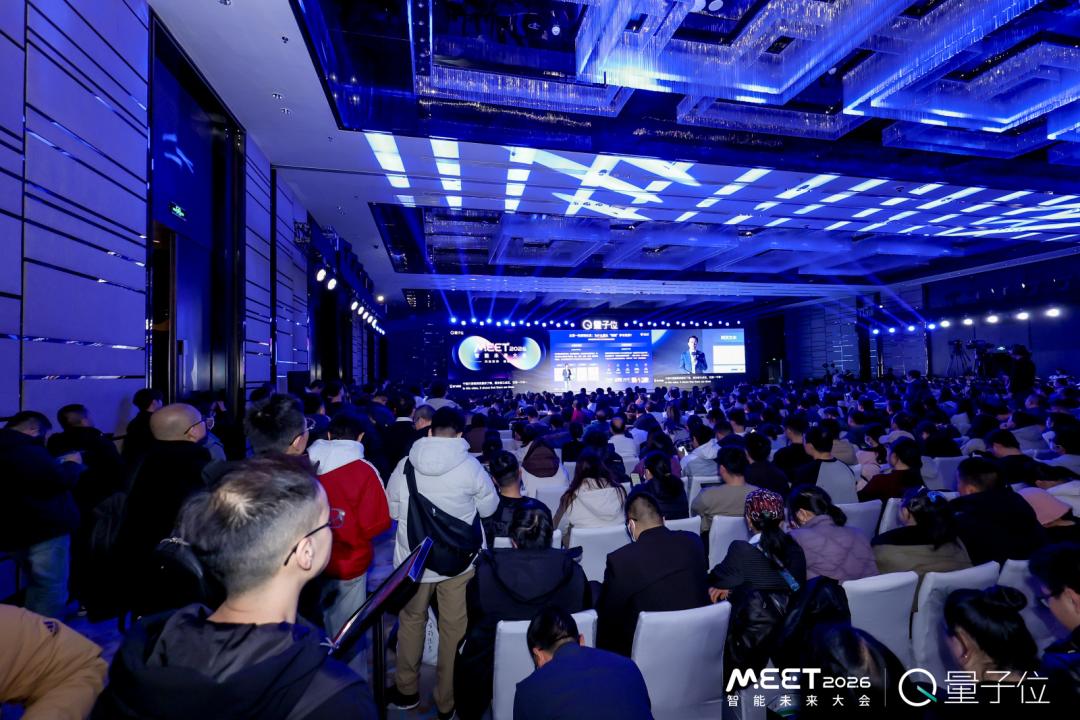
The MEET2026 Intelligent Future Conference is an industry summit hosted by QbitAI. Nearly 30 industry representatives participated in the discussions. Nearly 1,500 offline attendees and over 3.5 million online live - stream viewers attended, and it received extensive attention and coverage from mainstream media.
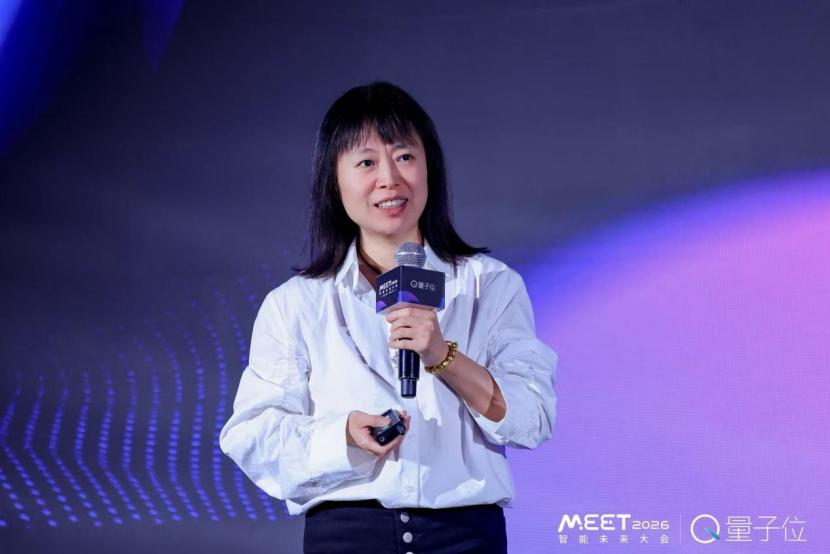
Zhang Yaqin, Founding Dean of the Institute for AI Industry Research (AIR), Tsinghua University, and Foreign Academician of the Chinese Academy of Engineering
At the MEET2026 conference, Zhang Yaqin, the founding dean of the Institute for AI Industry Research (AIR), Tsinghua University, and foreign academician of the Chinese Academy of Engineering gave a presentation titled "Artificial Intelligence + Trends".
Here are the key points of his views:
- Represented by ChatGPT and DeepSeek, AI is moving from discriminative to generative and reasoning, and is being implemented at an accelerated pace in an environment of high efficiency, low cost, and an open - source ecosystem.
- The new round of artificial intelligence is the integration of information intelligence, physical intelligence, and biological intelligence, which is essentially the integration of atoms, molecules, and bits.
- Generative AI is rapidly evolving into agents, with the length of tasks and capabilities increasing simultaneously, and risks also magnifying.
- In the next 5 - 10 years, the number of large - scale foundation models will converge to no more than 10 globally, similar to operating systems.
- The main battlefield will enter the era of the "Agent Internet". Agents will replace most of today's SaaS and apps and become the default form for enterprises and individuals to interact with the world. This is also the inevitable path to AGI.
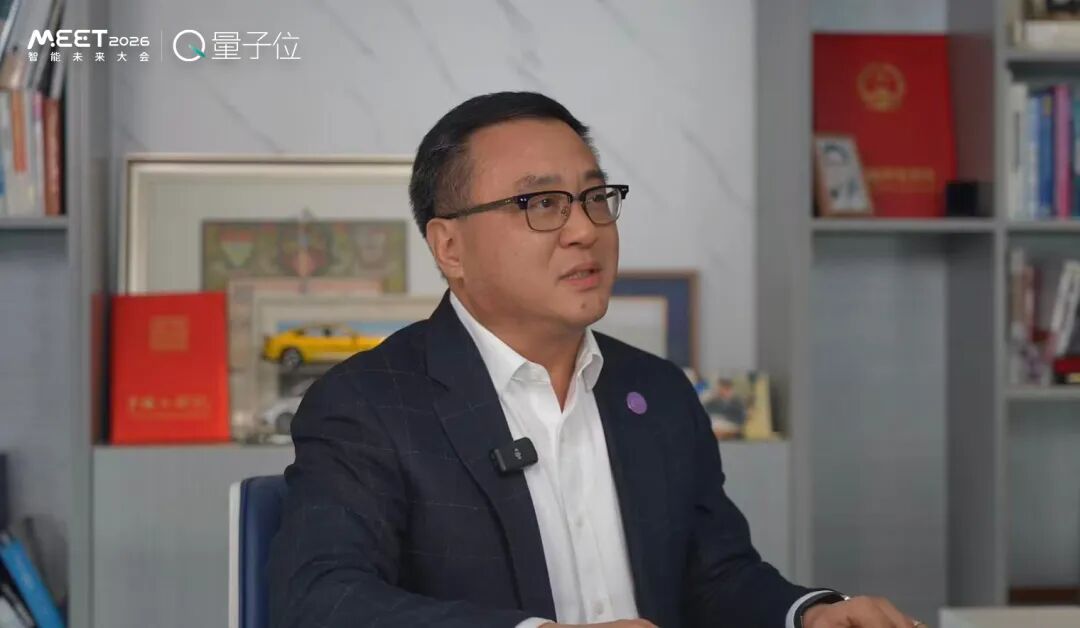
Wang Ying, Vice President of Baidu Group, and Head of the Document Library Division and Cloud Storage Division
Wang Ying, vice president of Baidu Group and head of the Document Library Division and Cloud Storage Division shared her insights on the topic of "Using AI to Build Super Agents to Achieve Super Individuals, Super Teams, and Super Organizations".
Here are the key points of her views:
- Cognitive biases, implementation gaps, and fragmented user experiences have become the three major pain points for users when using AI products.
- To build a real super - personal agent to empower users to become super individuals, AI applications should be comprehensive in thinking, correct in judgment, and excellent in execution, achieving personalization, freedom, and generalization, and doubling everyone's capabilities.
- GenFlow is the scheduling center of Baidu's framework for designing super agents. With a monthly active user base in the tens of millions, it has become the world's largest general - purpose agent. As the first full - modality, full - link general - purpose agent, it can cover all scenarios of learning, work, life, and entertainment, meeting core needs such as chatting, answering questions, searching, and creating. The newly updated GenFlow 3.0 version has been built into both Baidu's Document Library and Cloud Storage.
- Baidu's Document Library has launched the AI learning platform OREATE AI, which can complete full - scenario, full - modality creation end - to - end. The monthly active user base of the new version exceeded 1.4 million in one month after its launch, topping the global daily list on ProductHunt.
- Baidu's Cloud Storage was launched in 175 countries and regions around the world in September this year, featuring functions such as multi - language subtitles, AI cameras, and AI notes.
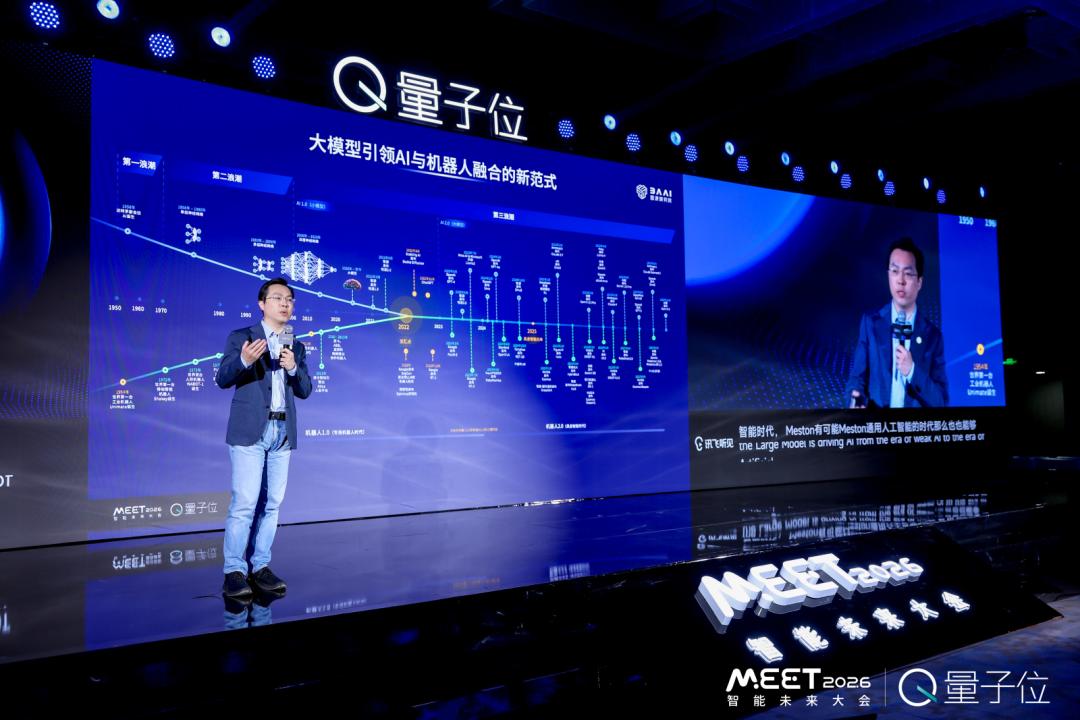
Wang Zhongyuan, Dean of the Beijing Academy of Artificial Intelligence
"The Year of AI Awakening: From the Digital World to the Physical World" was the topic shared by Wang Zhongyuan, dean of the Beijing Academy of Artificial Intelligence at the MEET2026 Intelligent Future Conference.
Here are the key points of his views:
- Currently, artificial intelligence is at an important turning point in its third wave. Large - scale models are driving it from weak AI to general AI and robots from the 1.0 era of dedicated robots to the 2.0 era of general embodied intelligence.
- Video is an efficient carrier for obtaining a large - scale simulation of the real world, containing various elements such as time, space, physics, causality, and intention.
- From 2025 onwards, the key to the third - generation Scaling paradigm lies in multi - modality. The WuJie·Emu3.5 of the Beijing Academy of Artificial Intelligence has upgraded the Next - Token Prediction of large - language models to Next - State Prediction on multi - modal data through a unified autoregressive architecture, indicating that AI is moving from language learning to multi - modal world learning.
- Currently, embodied large - scale models are still not user - friendly, not general - purpose, and not easy to use. "Not user - friendly" means that embodied large - scale models have not reached the level of ChatGPT; "not general - purpose" means that many models can only be applied to one body or bodies of the same brand; "not easy to use" means that the compatibility between the "brain", "cerebellum", and the body is still not high enough.
- Since its establishment, the Beijing Academy of Artificial Intelligence has adhered to the principle of open - source and open - sharing. It has open - sourced more than 2,200 models in the past two years, with a download volume exceeding 690 million times, and nearly 100 datasets, with a download volume exceeding 1.2 million times.
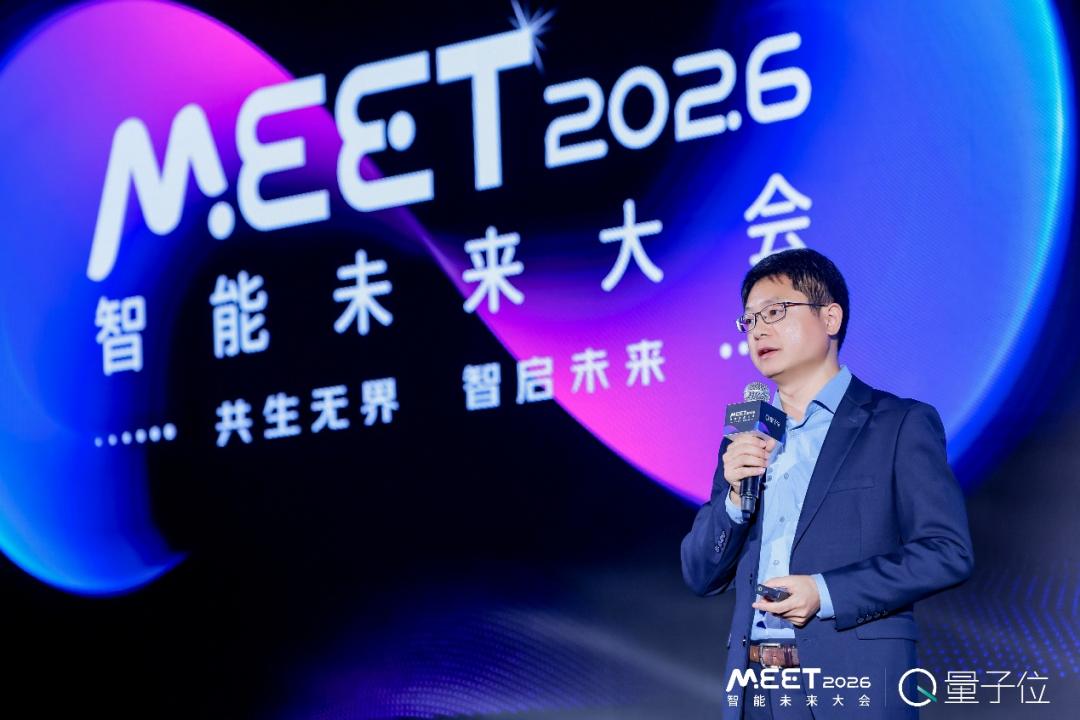
Wan Weixing, Head of AI Product Technology in China at Qualcomm
At the conference, Wan Weixing, head of AI product technology in China at Qualcomm gave a speech focusing on "Hybrid AI: From Cloud to Edge Intelligence".
Here are the key points of his views:
- The evolution of the AI industry can be divided into four stages. The first stage is perceptual AI; the second stage is generative AI, which emerged with the rise of ChatGPT; the third stage is agent AI, which can act autonomously with little human intervention; the fourth stage is physical AI, which can understand the real physical world and make feedback and responses based on real physical laws.
- Two years ago, the edge side could only handle a context of 1 - 2K. Last year, it could handle 4K, and this year it already supports 8K - 16K. At the Snapdragon Summit in September, it was shown that in some special scenarios, it is even possible to deploy large - scale models with a maximum context of 128K on the edge side.
- In terms of modality, the edge side is evolving from a single text modality to supporting multi - modalities such as text, images, videos, audio, and voice, and even full - modality. The transformation of the ecosystem from a single model to a composite system is the foundation for moving towards agent AI.
- One of the greatest advantages of running large - scale models on the edge side is personalization.
- Running large - language models on the edge side mainly faces challenges such as memory limitations, bandwidth limitations, and power consumption control. To address these issues, Qualcomm has carried out a series of technology reserves and pre - research, including quantization and compression, parallel decoding technology to improve inference efficiency, and advanced NPUs and heterogeneous computing architectures.
Chen Xiaojian, General Manager of the Product Department in Greater China at Amazon Web Services
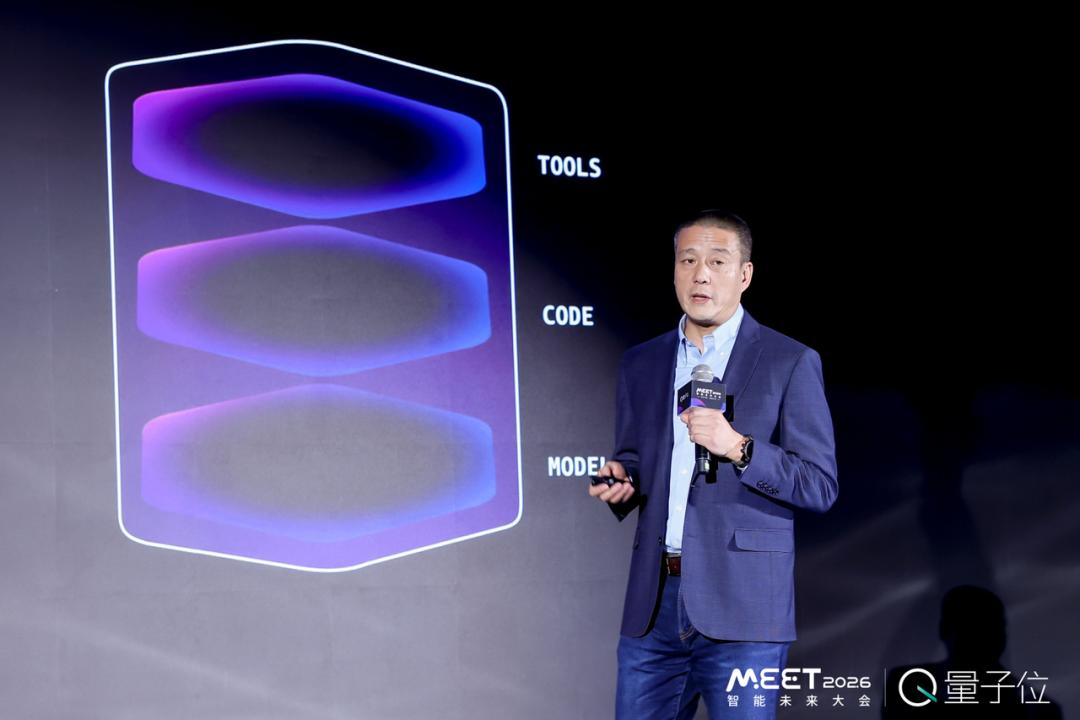
Chen Xiaojian, general manager of the product department in Greater China at Amazon Web Services shared his insights on the topic of "The Future of Agentic AI is Here".
Here are the key points of his views:
- Agents can generalize powerful productivity in all aspects, replace many human jobs, and even do things that humans couldn't do before.
- To build a successful agent, three crucial modules are required. The first is the underlying model "brain", which can provide effective decision - making; the second is the intermediate code; and the special part is the third module, tools, which are equivalent to the "hands and feet" in the entire three - layer architecture.
- There are often challenges when moving from the POC stage to production deployment, and the differences between the two are significant. On the one hand, POC uses high - quality filtered data, while the data in the production environment cannot be artificially optimized. On the other hand, production also needs to solve a series of problems such as security, scalability, cost, and high availability.
- Model customization still faces many challenges. Amazon SageMaker AI provides comprehensive model customization support, including four types of customization capabilities such as enhanced fine - tuning, checkpoint - free training, and Nova Forge.
- The key advantage of Nova Forge is that it allows customizing the model by introducing proprietary data during the foundation model training stage. Just as it is easiest for humans to learn languages in childhood, customizing the model during its "growth" process usually yields better results than fine - tuning after training is completed.
Zhao Junbo, Researcher of the "Hundred Talents Program" at Zhejiang University, Doctoral Supervisor, and Senior Technical Expert at Ant Group
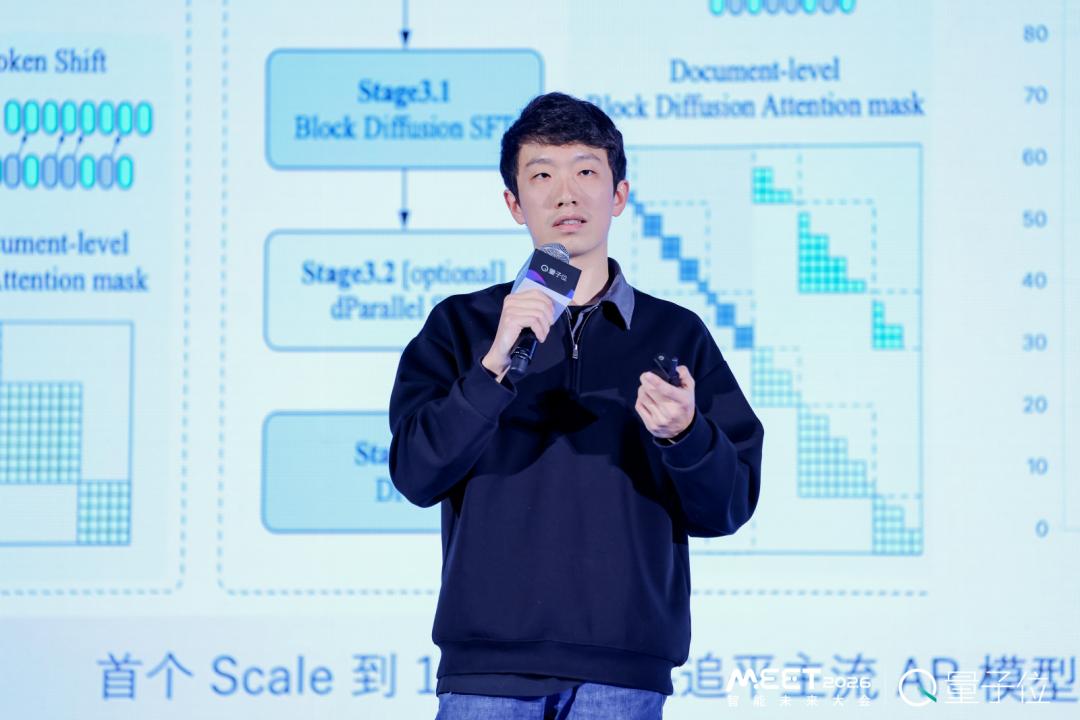
Zhao Junbo, researcher of the "Hundred Talents Program" at Zhejiang University, doctoral supervisor, and senior technical expert at Ant Group gave a cutting - edge presentation titled "LLaDA: A Non - Consensus Manifesto on the Road to AGI".
Here are the key points of his views:
- All generative models are essentially fitting data distributions. Autoregressive models provide a way of fitting by decomposing the overall distribution into a series of conditional probabilities following a one - way causal order for step - by - step modeling. However, this is not the only approach.
- The open - source model LLaDA uses a diffusion language model architecture. Without considering MoE, under the same computational resources and performance goals, the parameter scale required by LLaDA can be smaller than that of autoregressive models.
- The diffusion architecture can directly modify and control tokens during the inference process, without the need to regenerate the entire content like autoregressive models.
- Under computational constraints, LLaDA uses a "fill - in - the - blank" prediction method. Compared with autoregressive models, it is more data - hungry, has a greater demand for data, and absorbs data faster.
- There are differences in the Scaling Law between LLaDA and autoregressive models. We have verified that LLaDA can be scaled up to the scale of hundreds of billions of parameters, but further scaling will face new challenges.
Yu Youping, President of Zhongguancun Kejin
Yu Youping, president of Zhongguancun Kejin gave a presentation on the topic of "Digital - Intelligence Integration and Dual Improvement in Quality and Efficiency: Empowering the Leap of New - Quality Productivity with Enterprise Agents".
Here are the key points of his views:
- From the Internet era to the AI era, the essence is the evolution of connections. Agents, as super - connectors, can achieve stronger connections between people, data,