The electric intelligent motorboat company favored by LI Zexiang has received additional investments from HKX Fund and Clear Water Bay Fund | Exclusive Report by Yingke
Author | Huang Nan
Editor | Yuan Silai
Yingke has learned that Anlan Power Technology (Shenzhen) Co., Ltd. (hereinafter referred to as "Anlan Power") recently completed a multi - million - yuan Angel + round of financing, which is also the company's second round of financing within half a year. We have summarized the information of this round of financing and several highlights of the company:
Financing Amount and Investment Institutions
Financing Round: Angel + Round
Financing Scale: Multi - million - yuan Level
Investors: Hong Kong X Technology Fund (HKX), Clear Water Bay Phase II Fund, Renxing Investment
Use of Funds: It will be mainly used for the iterative R & D and testing of product functional prototypes and the improvement of the team's talent pool.
Basic Company Information
Establishment Time: In May 2024, it was settled in Shenzhen Institute of Science and Technology Innovation for project incubation and establishment.
Registered Address: Nanshan District, Shenzhen
Enterprise Positioning: Anlan Power is a company focusing on the R & D of electrification and intelligence of leisure boats. It is committed to providing a new generation of electric intelligent motorboats that are more worry - free, convenient, safe and environmentally friendly for water - loving users by integrating electric power, networking, intelligent interaction and innovative design.
Technological Highlights: Anlan Power builds a technological system centered on electrification and intelligence, integrating passenger - car - level electric intelligent technology and supply chain to solve the pain points of traditional fuel motorboat consumers in maintenance, driving safety, cumbersome interaction and environmental protection requirements, and reconstructing the user's experience of operating water - powered boats.
In terms of electrification, the company develops power system solutions based on its self - built hull three - electric coupling and matching platform and relying on China's mature "three - electric" supply chain. Its first product, ANAVI CARBON, is equipped with an electric drive system with a rated power of 70kW and a large - capacity 26kWh battery, which can achieve a maximum speed of 110km/h and a cruising range of 80 kilometers. Among them, the pure - electric drive solution has the advantages of being quieter, with an operating noise of less than 65 decibels, zero emissions and low maintenance costs. Combined with the carbon fiber lightweight hull and high - performance jet pump propulsion technology, the whole boat can achieve an effective balance in energy consumption, performance, strength and economy, saving users more than $1000 in annual maintenance costs.
In the aspect of intelligence, by migrating intelligent technologies from the passenger - car field to the water scenario, Anlan Power can provide users with an intelligent experience of "safety assistance + convenient interaction". ANAVI CARBON supports auxiliary driving functions including collision avoidance reminder, emergency collision avoidance and kinetic energy recovery, reducing the driving threshold and risks, and adding practical functions such as water - falling summoning, automatic berthing and customized driving mode settings. Through the intelligent interconnection system, users can realize remote linkage between the mobile phone and the boat and keep track of the position and status in real - time.
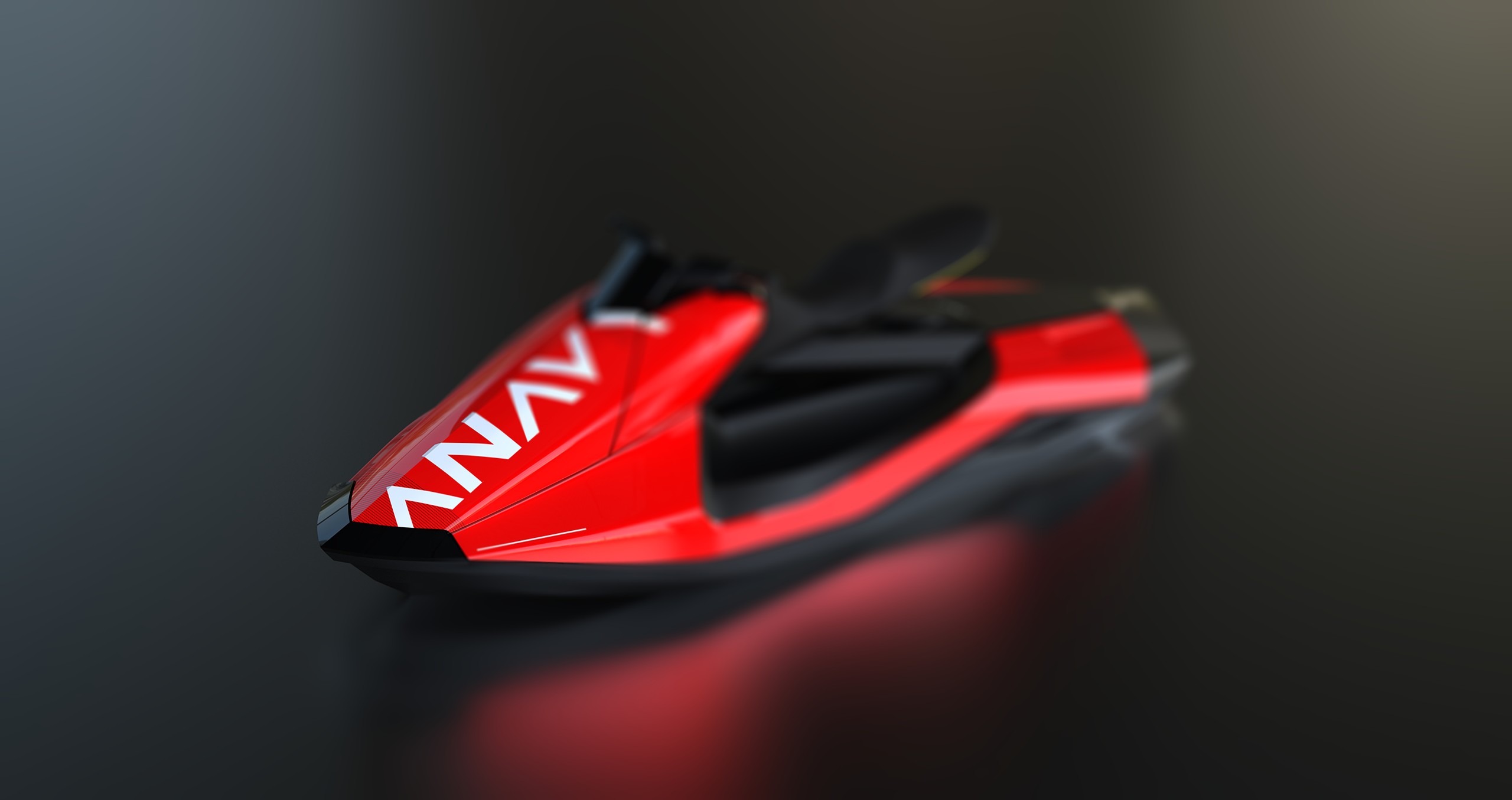
Product design drawing of ANAVI CARBON (Source/Enterprise)
Market Size
According to public data from ICOMIA (International Council of Marine Industry Associations), Statista and other sources, the global leisure boat market was valued between approximately $42 billion and $46 billion from 2023 to 2025, and it is expected to exceed $50 billion by 2030. Among them, the United States, as the largest single market, accounts for more than 40% of the global market size.
Currently, the penetration rate of electric and hybrid boats in mature markets such as the United States has approached 9%. ICOMIA predicts that this proportion will increase to over 20% by 2030, and may even exceed 35% in the mid - to high - end market.
Team Background
Li An, the founder and CEO, has more than 15 years of industry experience in boat design, manufacturing and water sports. He once worked at Yidong Technology, a leading international supplier of electric propulsion equipment for boats. He not only has a profound insight into the leisure boat scenario and market trends, but also has mature international brand operation and channel expansion capabilities. The core team members are from well - known universities at home and abroad, with professional backgrounds covering the design and manufacturing of mass - produced boats and the implementation of electric passenger - car technology, and they have years of practical and R & D experience in robot competitions (RC/RM/Formula Student).
Founder's Thoughts
Yingke: Based on what market judgment did Anlan choose to enter the leisure boat track with the motorboat category?
Li An: There are clear category divisions in the leisure boat industry. We chose the motorboat as the entry point mainly based on several considerations.
Firstly, in the early stage of entrepreneurship, the funds were limited. As an entry - level product for personal water - powered boats, the motorboat is small in size and the R & D and production thresholds are relatively controllable. In terms of market size, the annual global new addition of motorboats is about 200,000, and the inventory is 2.8 million, with a large demand base.
At the product level, it has a high category concentration and a strong standardization degree. Currently, more than 95% of the global market share is occupied by three major brands, Bombardier, Yamaha and Kawasaki. The boat sizes are relatively concentrated, and the perceived product differentiation among users is limited. For new entrants, launching a few main models can meet the needs of mainstream users.
In terms of business model, the C - end consumption attribute can also bring higher profit potential and marginal effects for the brand and channels. Currently, 90% of the sales of such products are to individual users. These users are more willing to pay for the driving experience, brand and design, and are more accepting of value - based pricing, which provides a better business model for the enterprise.
Yingke: The conversion of motorboats from fuel to electric and intelligent transformation require deep integration of software and hardware. What was the biggest collaboration challenge the team faced during the process of integrating these systems onto the boat?
Li An: The challenge of migrating passenger - car - level intelligent technology to boats mainly lies not in hardware computing power, but in the efficiency coupling across systems and the in - depth adaptation to the water scenario. This requires the R & D team to have a deeper understanding of the real water - using environment, product definition ability and product - market fit (PMF), rather than simply stacking hardware.
We are systematically solving the problems of software - hardware coupling, efficiency optimization and intelligent innovation solutions for user interaction through simulation, real - boat testing and closed - loop tuning.
At the software and algorithm level, the R & D difficulties are concentrated in the engineering implementation of scenarios. Due to many special variables in the water environment such as water surface reflection, dynamic obstacles and water flow interference, continuous optimization and robustness improvement of the algorithm through long - term and large - scale real - test experiments and data accumulation are necessary to truly improve consumers' intelligent interaction experience.
Our ultimate goal is to transform engineering technology capabilities into a stable, smooth and user - value - oriented intelligent experience, which requires the team to invest a lot of time in scenario understanding and experience refinement, and to develop core competitiveness through mass - production engineering capabilities.
Yingke: What's the current R & D progress?
Li An: We are mainly focusing on three R & D directions. The first is the joint hardware R & D, which mainly relies on the hardware resources of the automotive supply chain and partly involves embedded development work. The team and supply - chain partners jointly promote it, and conduct targeted development and adaptation on a unified hardware basis. The second is the R & D of perception and algorithms, which involves a large amount of data collection, boat sensor technology and algorithm iteration. The third is the development of interactive software operating systems, including building a self - developed power chassis efficiency optimization system for sustainable optimization, a central domain - control solution with high software - hardware coupling, and a mobile - phone interconnection and user - driving intelligent interaction system.
For large - hardware products like motorboats, in addition to the early product definition and technology integration solutions, the greater challenges often come from the mass - production stage. The core lies in how to overcome the three major difficulties of quality consistency, assembly efficiency and supply - chain management.
Our strategy is to systematically adopt the mature technology solutions and supply - chain systems of the intelligent electric vehicle industry as much as possible. Currently, the company completed the water test of the full - size EVT prototype (functional verification test) in May this year and is in the DVT (design verification test) R & D stage. It is planned to complete the water tests and internal Alpha tests of two prototypes in the first half of next year to verify all functions, performance, reliability and compliance with safety regulations of the product.
On this basis, we expect to start the PVT (production verification test) in the middle of next year. In this stage, small - batch production is planned, and external beta tests will be conducted on selected seed users. The main goal is to expose and optimize all potential problems in real - use scenarios as fully as possible before large - scale production, so as to ensure that the final product delivered to users is highly mature and reliable.