Leading humanoid robot joint company completes Series C+ financing, with top single-product sales and doubled annual revenue | Exclusive report from Yingke
Author | Huang Nan
Editor | Yuan Silai
Yingke learned that Shenzhen Zero Difference Cloud Control Technology Co., Ltd. (hereinafter referred to as "Zero Difference Cloud Control") recently completed a Series C+ financing round. Yuanshi Capital served as the exclusive financial advisor for this round of financing. Zero Difference Cloud Control is an enterprise that Yingke has been continuously following [For details, see the report: Valued at over 1 billion, this robot joint company ranks first in global sales | Hidden Unicorn]. The information about this round of financing and the company's positioning are as follows:
Financing Amount and Investment Institutions
Financing Round: Series C+
Financing Scale: Tens of millions of yuan
Investors: Huakong Fund, Chuangdongfang Investment
Use of Funds: R & D investment, capacity expansion, and market development
Basic Company Information
Establishment Time: December 2016
Registered Address: Bao'an District, Shenzhen City, Guangdong Province
Company Positioning: Zero Difference Cloud Control focuses on the R & D and manufacturing of high - reliability, high - precision, and standardized key core components for robots, serving the global robot and automation industries, and focusing on high - reliability application scenarios that originally relied on manual labor.
Business Progress: Zero Difference Cloud Control has achieved a complete leap from product certification, large - scale consistent mass manufacturing to commercial - scale implementation. Its main products, the eRob series of robot joints and the eCoder series of magnetic encoders, cover numerous industry applications such as humanoid robots, industrial robots, surgical robots, collaborative robots, logistics, and transportation. It has over 2,000 downstream customers, and its long - term customers cover leading enterprises in the global technology consumer goods, robot, automation, and automotive industries. Its sales volume ranks first in the industry.
In the revenue structure, the industrial, medical, and logistics scenarios make prominent contributions, accounting for nearly 50% in total. Relying on its self - owned production base and full - process quality control system, Zero Difference Cloud Control continuously improves product performance and delivery response capabilities.
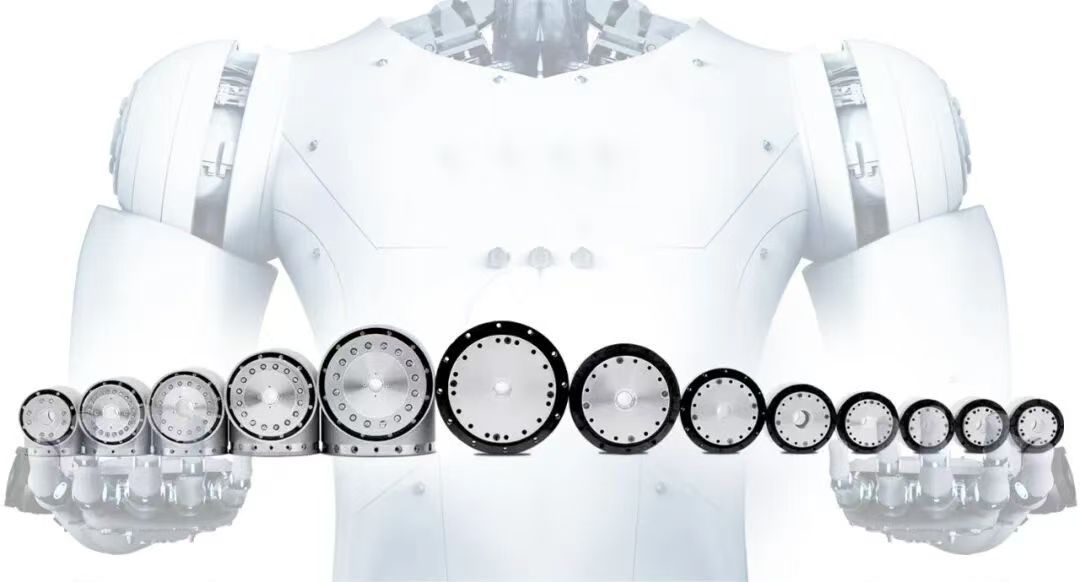
eRob series of robot joints (Source/Enterprise)
Market Size
Data from the "2024 - 2030 China Robot Joint Module Market Survey and Investment Strategy Report" previously released by Gongyan Industry Research Institute shows that the demand for robot joint modules in China reached 2.2417 million sets in 2024 and is expected to soar to 4.8201 million sets by 2030. The market scale is expected to exceed 68.927 billion yuan.
Founder's Thoughts
Yingke: Judging from the revenue structure of Zero Difference Cloud Control, has there been a change in the industry's demand in the market?
Jia Xiqing: In 2025, the company's revenue maintained rapid growth, with a year - on - year increase of over 100%. The traditional business grew steadily and showed good momentum, contributing about 35% of the growth rate; emerging businesses such as humanoid robots and embodied intelligent robots began to gain momentum, contributing about 65% of the growth rate.
Industry and healthcare are the company's two core business directions. In the industrial field, it focuses on replacing repetitive, high - intensity manual labor or jobs harmful to human health through automation, such as spraying, polishing, and welding. In the medical field, it is mainly applied to various surgical robot devices. Through precise cooperation with surgeons, it can reduce the surgical wound, shorten the operation time, reduce bleeding, and accelerate healing, and also provide conditions for remote surgery.
The stable growth of the high - end industrial and medical sectors forms the company's basic revenue. This is highly consistent with the company's positioning of "building a reliable body for the digital world and delegating arduous work to digital control."
Meanwhile, humanoid robots are becoming a new growth driver, currently contributing over 30% of the company's revenue. As the original equipment manufacturers complete the early - stage technology verification and enter the small - batch implementation stage, the downstream commercialization process is accelerating. It is expected that the revenue growth rate brought by humanoid robots in 2026 will be significantly faster than that of other application industries.
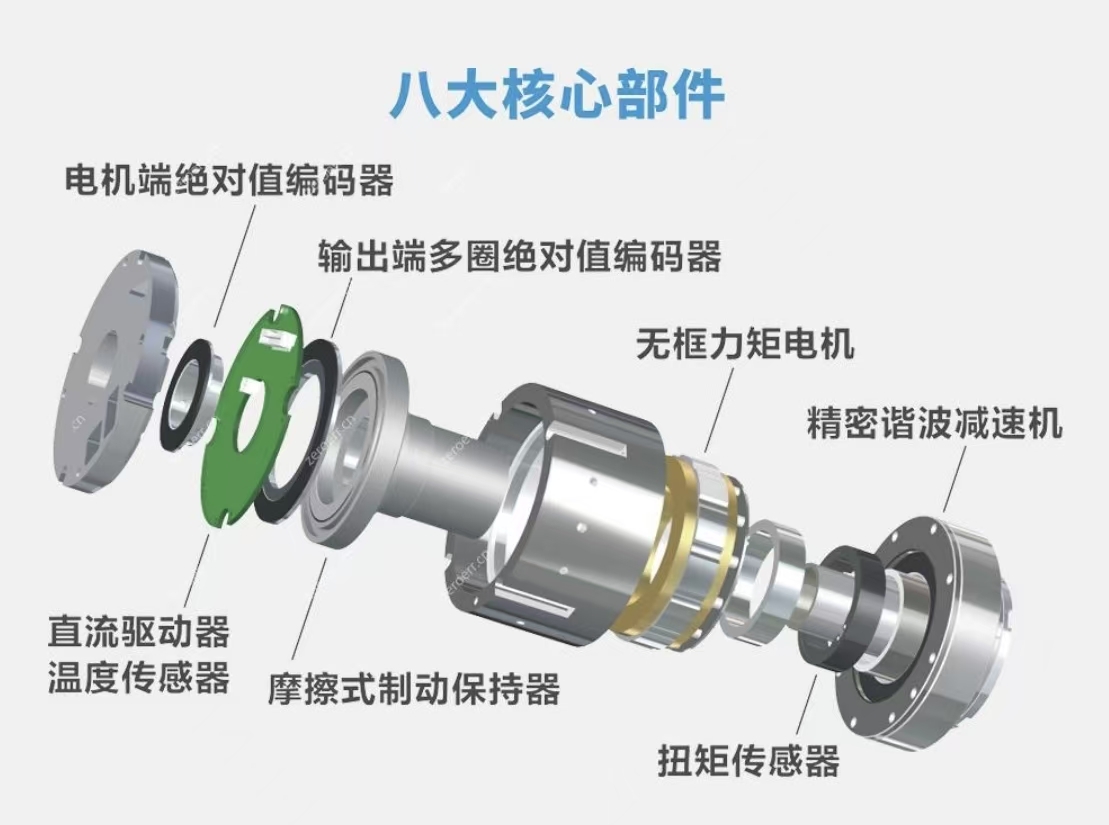
eRob joint with built - in dual absolute encoder (Source/Enterprise)
Yingke: Humanoid robots have clear requirements for indicators such as load, weight, heat generation, efficiency, volume, and cost, but these indicators often restrict each other. Which dimensions does Zero Difference Cloud Control's technology iteration mainly focus on?
Jia Xiqing: From the demand side, the industry generally focuses on increasing the load, reducing the weight, suppressing heat generation, improving energy efficiency to extend the battery life, and compressing the volume to reserve space for the robot's appearance design and integration. At the same time, there are also clear requirements for cost control.
These goals often restrict each other in R & D. For example, reducing the weight may affect the structural strength, reducing the volume will increase heat generation, and introducing special materials to improve performance often increases the cost. Therefore, enterprises need to make a trade - off between the ideal design and the actual conditions.
The parameters of the company's existing standard products are still the result of passive choices by customers with high reliability requirements downstream. From a design perspective, we first ensure reliability and performance. Some of the parameters are approaching the limit values, and other parameters are optimized as much as possible under this premise.
The company's next - step technology iteration mainly focuses on improving accuracy and power density, reducing vibration and noise, increasing rigidity, lifespan, and reliability, and reducing weight.
From a market perspective, we focus not only on the single selling price but also on helping customers reduce the total cost of ownership, including the delivery cycle, management and communication costs, trial - and - error and development learning costs, transportation and installation costs, etc.
Yingke: How to balance these indicators in the product and implementation process?
Jia Xiqing: In terms of product strategy, Zero Difference Cloud Control is committed to establishing an advantage in the high - ground of reliability and accuracy. This choice stems from the application scenarios the company has served for a long time.
In fields such as medical surgery, industrial automation, and power operations, any failure may lead to serious consequences, so the requirements for product performance and reliability are extremely high. This determines that we "do not compromise" on quality and helps the company's products establish competitiveness in terms of performance and reliability.
Different humanoid robot applications have different requirements for performance and reliability. For example, the previously popular robots for interactive performances such as martial arts and dance, which provide emotional value, their cost - control ability determines the potential for mass production, and the requirements for performance and reliability are relatively lenient.
For humanoid robots used in scenarios such as unmanned retail, to truly liberate people from the arduous work of guarding convenience stores and pharmacies in the early morning, they must have the ability to operate continuously and stably, which places higher requirements on the reliability of core components.
For another example, in the assembly line operations in factories, the demand for robot reliability also increases by an order of magnitude. Surgical robots are one of the application scenarios with the highest requirements for reliability.
Depending on the service scenarios and customer differences, different enterprises will make different trade - offs between product performance, reliability, and cost.
There is no right or wrong in this, just a matter of choice.
Yingke: Currently, the technical routes of the core components of robot joints have not converged, and different companies have different definitions. What strategy does Zero Difference Cloud Control adhere to in the selection of technical routes?
Jia Xiqing: Currently, the problem is not only that the technical routes of robot joints have not converged, but they are even continuing to diverge. The industry is still exploring and verifying different solutions around core components such as reducers, motors, and encoders.
Regarding reducers, there are currently a variety of improved solutions. In response to the impact - intolerance of harmonic reducers, there are cycloidal pin - wheel reducers with similar installation dimensions and appearance to harmonic reducers but more impact - resistant; to reduce costs, there are harmonic reducers using injection - molding processes instead of metal processing; some enterprises are also committed to optimizing traditional planetary reducers to improve accuracy, reduce backlash, and increase load - bearing capacity. In addition, the direct - drive joint solution has also entered the application verification stage. There are also various improved solutions for motors. For example, axial flux has also been applied in joint motors.
In this context, Zero Difference Cloud Control adheres to focusing on the mature paths that have been verified by consistent and large - scale mass manufacturing. The company is good at using harmonic reducers but does not involve the reconstruction of underlying technologies such as harmonic reducer materials, heat treatment, tooth profiles, and process manufacturing; instead, it pushes the performance of traditional harmonic solutions to the limit. At the same time, it focuses on improving the joint integration and space utilization under the existing technical architecture and removes as much non - functional material as possible. At the servo control end, we focus on improving accuracy and response frequency.
Yingke: What work has been done in the iteration of robot joint products?
Jia Xiqing: Zero Difference Cloud Control is launching more robot joints with different installation forms to reduce the design and assembly difficulty of robot complete machines.
Our latest modular design can reduce the number of parts of a seven - degree - of - freedom robotic arm from 40 to 10, thereby reducing the complexity of the complete machine system, improving reliability, and reducing assembly costs, paving the way for future large - scale production.
On the other hand, due to the extreme pursuit of reliability and consistency, in the selection of the structural form of core joint components, the company still adheres to full verification over a longer period and on a larger scale before implementation.
For example, in the selection of motor solutions, due to the pre - condition of large - scale, consistent mass manufacturing, the current motor supply chain does not have the stable supply capacity of verified axial - flux or other form motors. Therefore, we have no schedule for other innovative form design products for the time being.
In fields such as medical and industrial applications, the priority of stability is far higher than the improvement of individual parameters. Therefore, in the next two years, we will adhere to the principle of "reliability first, gradual iteration", focus on the current mature structural solutions, and steadily improve product performance parameters and form adaptability. We will always keep an eye on new technologies.