Robot dogs watering flowers, robots off-roading: This competition is even more exciting than variety shows.
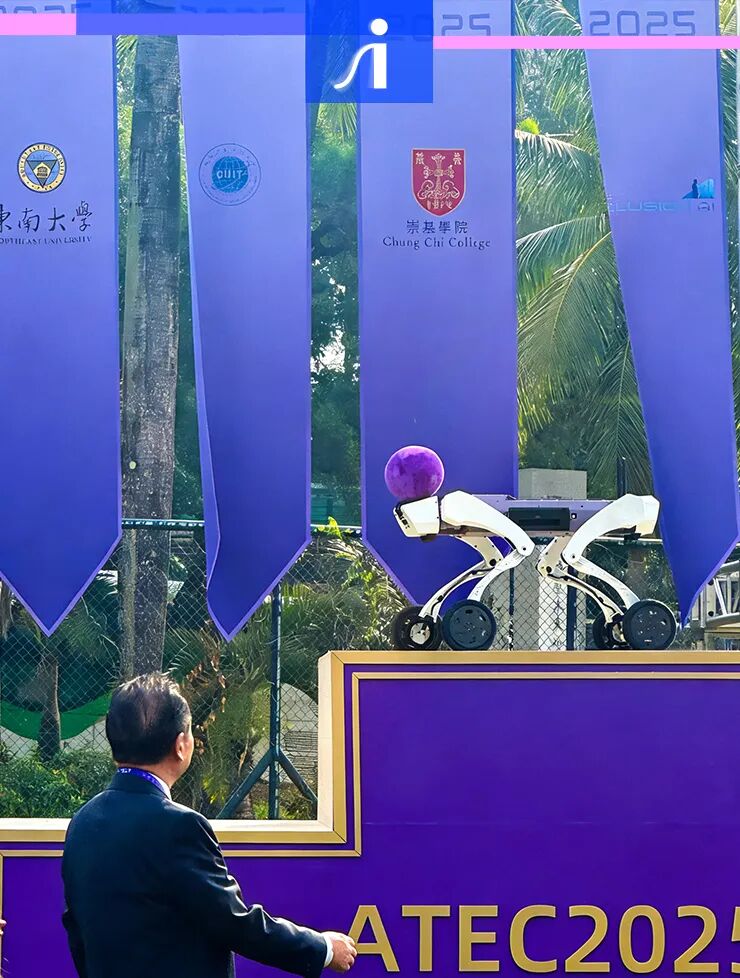
Welcome to the Real Human World.

Last weekend, I watched a robot competition in Hong Kong, and it was so much fun.
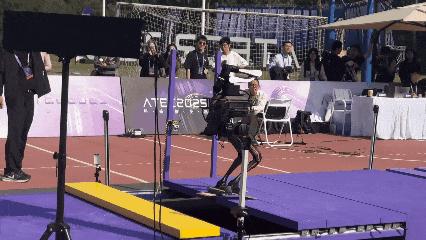
Although there were all kinds of mishaps and falls, unlike previous robot sports events, this competition was set in real-life scenarios—like fetching water to water flowers, picking up and sorting garbage, crossing suspension bridges, and orienteering in the mountains. So it was labeled a "Real World Extreme Challenge."
The participants weren't major robot manufacturers, but 13 university student teams from around the world. It was the 5th ATEC Tech Elite Competition (offline event), hosted by The Chinese University of Hong Kong and co-organized by the ATEC Frontier Technology Exploration Community, Peking University, Beijing Normal University, and Ant Group.
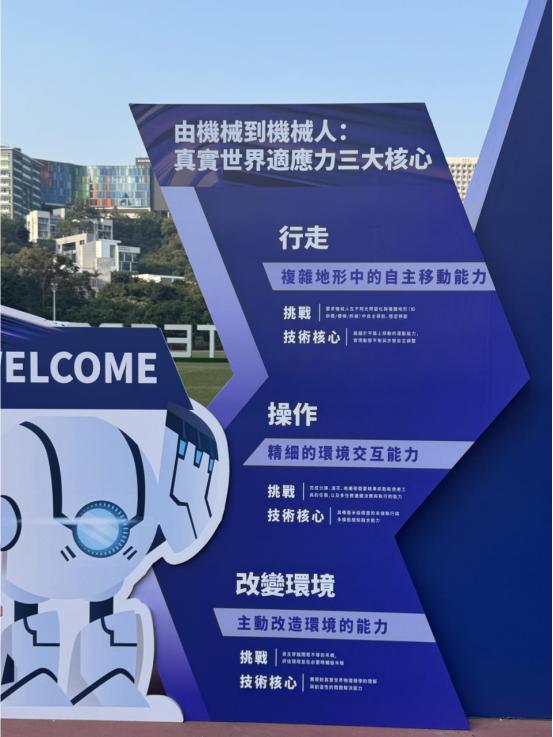
This was also the first time robots were truly put to the test. The competition venue was Lingnan Stadium at The Chinese University of Hong Kong—a pure outdoor natural terrain with grass, slopes, and stones. Orienteering even required going up the mountain to the small bridge and flowing water ecological area. The goal was to see if current robots have the ability to "truly enter the human world," preferably "fully autonomous" without relying on remote control or preset programs. This was extremely difficult.
In dynamic real environments, robots not only need to respond to commands but also have the ability to make real-time reasoning and decisions under uncertain conditions. However, the generalization ability of current algorithms—the ability to draw inferences from one instance and adapt to new scenarios—remains a prominent shortcoming. For example, in 3D scene understanding tasks, the accuracy of state-of-the-art models is only 55% to 60%, far lower than humans' 90.06%.
The participating robots were mainly bipedal, quadrupedal, and a few humanoid forms. Most used purchased finished robot hardware, then loaded with their own algorithms by university teams.
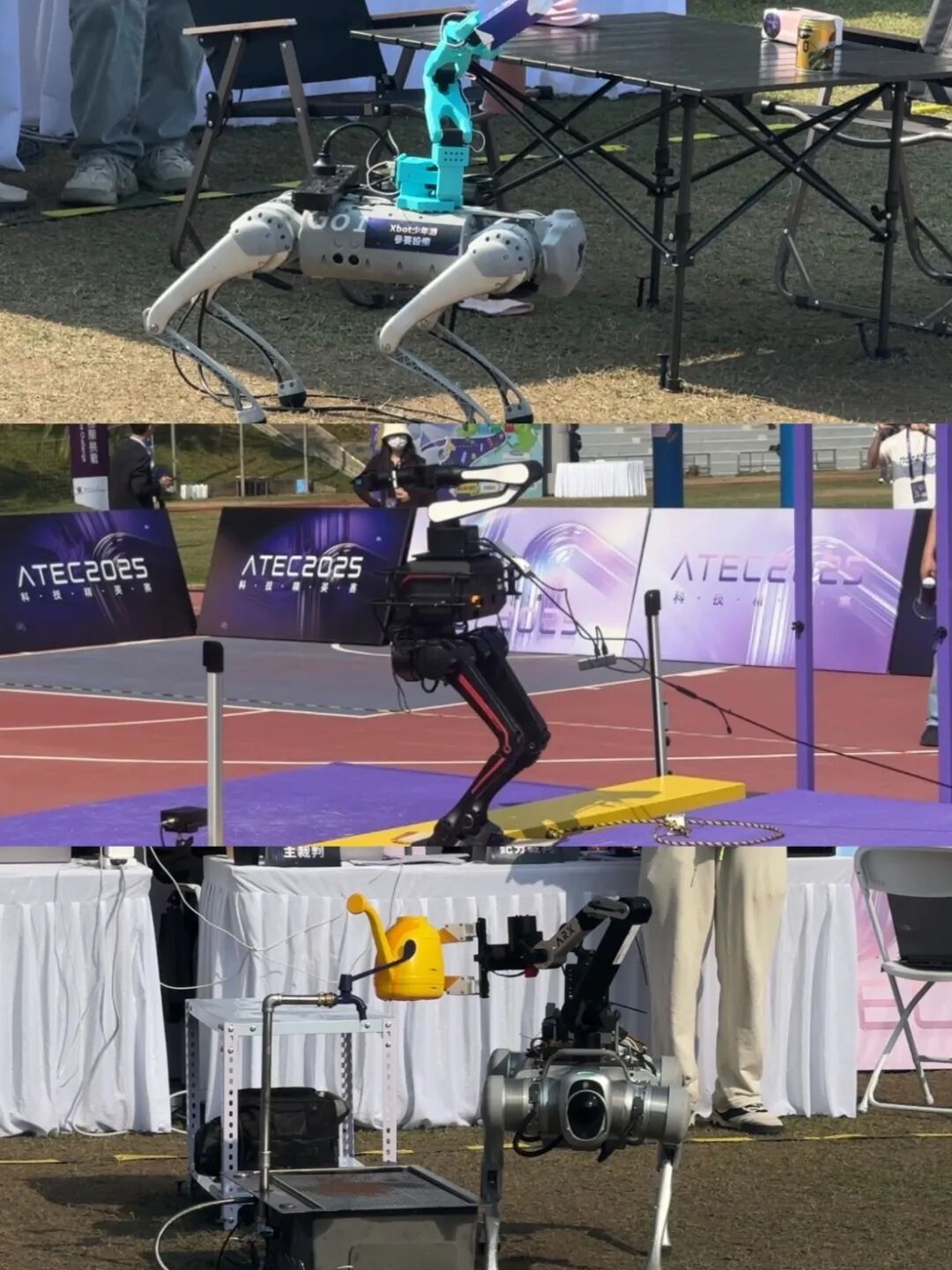
Teams using quadrupedal and bipedal robots basically added a mechanical arm with a gripper to grab objects. When paired with the long legs of a bipedal robot, it looks like a complete "ostrich."
The four competitions were held simultaneously. Each team had 30 minutes to complete one task, during which they could try repeatedly. Points were awarded for each completed segment. Fully autonomous operations without remote control earned the highest points.

The garbage sorting event was the first to draw a crowd.
First up was a quadrupedal robot dog with a long mechanical arm added. Its two front legs bent backward and two hind legs forward—from the side, it looked exactly like an "X-leg" robot.
When the "X-dog" tried to grab a water bottle, the bottle fell over. Even with a camera on the gripper, it couldn't find the bottle again. So it turned to grab a banana. This time it grabbed it accurately, but the cobra-like mechanical arm turned around and dropped the banana on the ground instead of into the box—like it never picked it up.
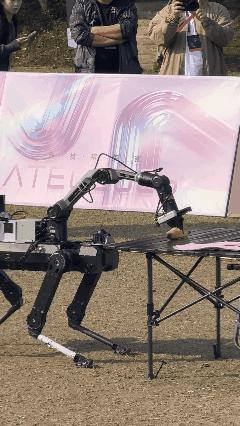
Later, I met the team members outside the competition area. The student was so nervous his hands were shaking, saying all the leaders were watching and the pressure was huge.
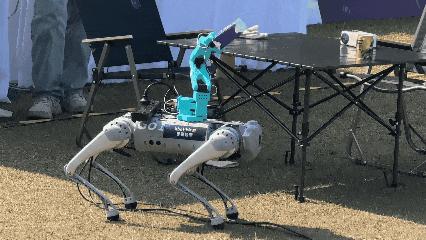
Another smaller robot dog carried a shorter blue mechanical arm—it looked cute and like a silly cobra. It finally grabbed a milk carton, but somehow tilted its head and dropped it.
&