Liu Jingkang of Insta360 rejects the narrative of losers
“Over the past weekend, I believe everyone has seen a deluge of negative articles and discussions about Yingling. Many comment sections were almost one-sided in their criticism.”
This was how Liu Jingkang, the founder of Insta360, characterized the public reaction after the release of the Yingling drone in a recently made public internal letter.
On the evening of December 4th, after five years of preparation, Insta360 launched the world's first 8K panoramic drone, the Yingling A1, with a starting price of 7,999 yuan. After national subsidies, the standard version could cost as low as 6,799 yuan. The scale of the product launch was eye - catching. The new product launch event was initiated at an altitude of 1,500 meters in the clouds. The Douyin blogger Shenqi Ayu took a hot - air balloon to the sky and showcased the product.
However, the day after the launch, Insta360's stock price plunged by more than 6%. As of December 9th, the cumulative decline exceeded 8%. For a while, the media, online communities, and shareholders all began to interpret the situation around the theme of “Yingling's sales falling short of expectations”. The skeptical voices quickly drowned out the high - profile start on the hot - air balloon.
In response, Liu Jingkang addressed this issue head - on in the internal letter, stating that Yingling's “report card” was achieved under the “special attention of certain industry giants”. He divided this “attention” into two aspects: first, the external public opinion was concentrated on predicting poor sales of the new product; second, the supply chain was subject to exclusive suppression.
According to him, in the six months before Yingling's launch, seven lens module suppliers, eight structural component suppliers, three screen suppliers, two battery suppliers, eight chip and component suppliers, and five other types of core suppliers encountered exclusive resistance.
Since this year, there have been continuous commercial frictions between DJI and Insta360 regarding panoramic cameras and drones. The launch of Insta360's panoramic drone has pushed this business war to a climax.
Previously, due to the issue of the “either - or” choice for offline channels, the relationship between Insta360 and DJI had become rather delicate. The person in charge of Insta360's sales in the Chinese market reposted the relevant news on WeChat Moments and said that many friends had reposted the news and asked if they were facing an “either - or” situation.
In the internal letter, Liu Jingkang further clarified the matter: “The report card we've achieved was under the special attention of certain industry giants. The recent news about the exclusive agreement of Changsha dealers is just the tip of the iceberg of the challenges we face at different levels.”
Interestingly, although Liu Jingkang did not name DJI in the internal letter, at the end of the letter, he attached the list of best - selling drones on Tmall on December 8th. According to the statistics of sales volume and transaction amount within seven days, the Insta360 Yingling panoramic drone sold more than 500 units in a week, surpassing the 100 units of DJI's Neo 2, which is positioned as a high - cost - performance product.
This internal letter was just one specific naming away from being a declaration of war against DJI.
01 Hot - selling or Cold - reception?
Insta360 had high hopes for Yingling's market performance.
On the night of the product launch, Liu Jingkang posted on Weibo, describing it as a new category that would change the way humans do aerial photography and travel. In his view, Insta360 had solved a demand that no one had addressed before in the consumer electronics industry, leaving a small mark in the history of technology.
For Insta360, panoramic drones compared to traditional drones are like cars compared to carriages. When being interviewed by GeekPark, Liu Jingkang said that when Insta360 developed panoramic drones, it was like offering a car in a world of carriages. The drone can fly wherever the user points and shoot wherever the user looks, without the need to learn complex camera movements, and the view is panoramic everywhere.
This idea came from Liu Jingkang. According to him, he came up with an excellent plan to revolutionize drones after 40 minutes of thinking while taking a shower.
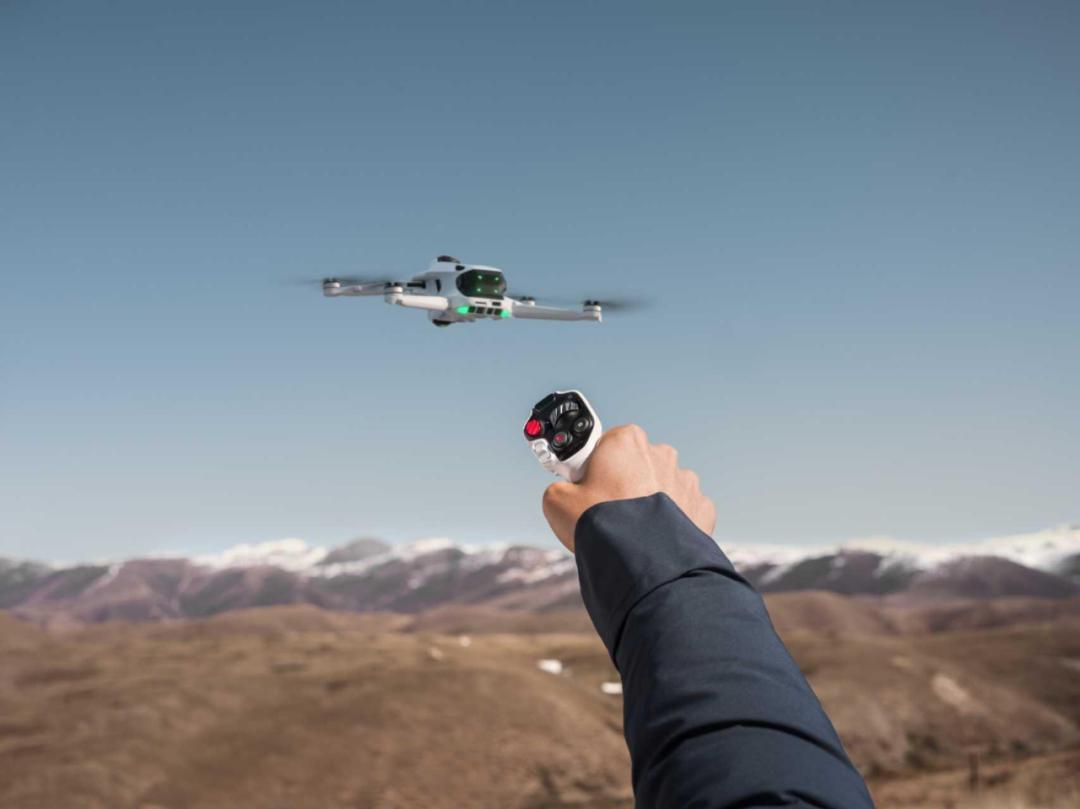
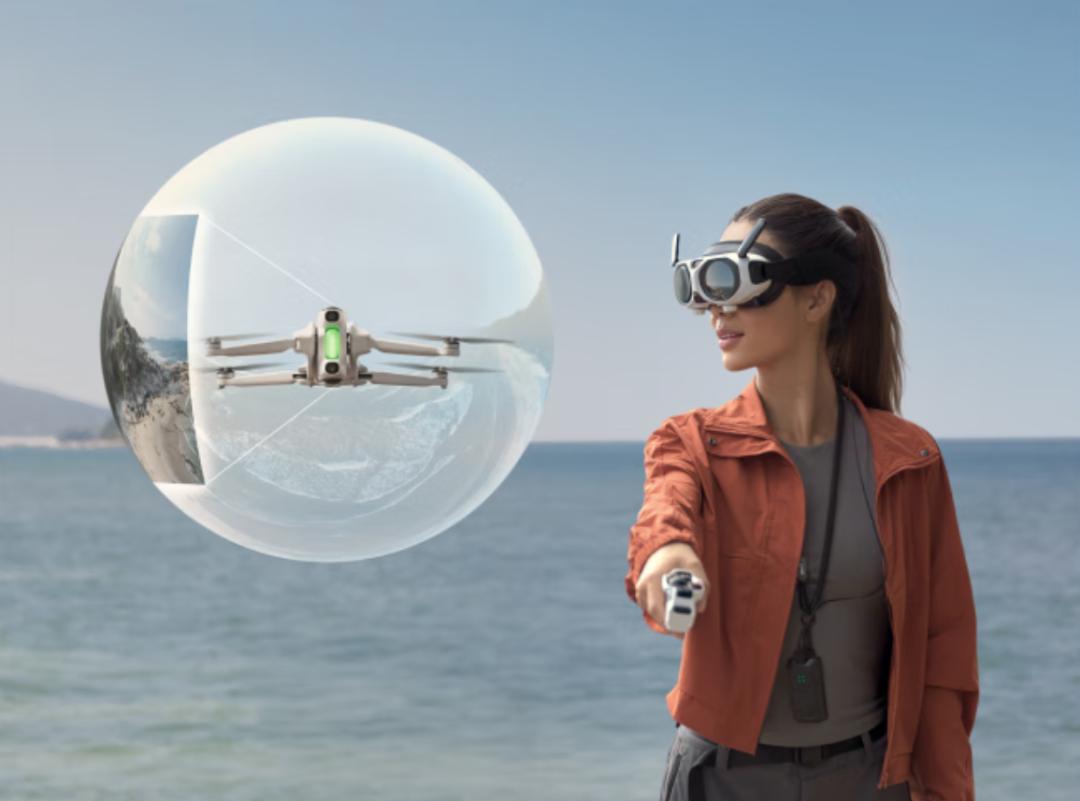
In the past, drones required two joysticks to operate, resulting in a very high threshold for beginners. If a VR headset is used to operate the drone, with real - time image transmission and 360 - degree non - dead - angle shooting, the human eye replaces the drone as the most natural viewfinder, and it can shoot wherever the user looks.
At the same time, Yingling has also shifted flight control from joysticks to a handle. Users only need to operate the handle, and the drone will respond automatically. Liu Jingkang compared this operation method to Steve Jobs' development of the iPhone: “The human finger is the most natural mouse. Similarly, with our drone, you just point the handle where you want it to fly, just like a bird.”
However, this panoramic drone with an innovative operation method has been questioned about its sales volume after its launch. Public reports show that in the first three days after the launch (as of December 7th), the cumulative sales volume of Yingling on JD.com, Taobao, and Douyin was more than 1,500 units, corresponding to a revenue of about 10 million yuan. Compared with the annual sales target of 300,000 units previously revealed by Insta360's supply chain, this performance was significantly below expectations.
Subsequently, Liu Jingkang reposted a report from Cailian Press titled “Insta360's Panoramic Drone Sold More Than 20 Million Yuan on the First Day” and wrote in his WeChat Moments: “The sales of more than 20 million yuan on the first day in the Chinese market are a bit low.” This was presumably a response to the market's doubts about its poor sales.
Then, in a subsequent public letter, Liu Jingkang added that Yingling had sold more than 30 million yuan in the Chinese market within 48 hours, and the product was about to be launched in multiple overseas markets. In comparison, the average daily sales of Insta360's handheld imaging business line in the first three quarters was more than 24 million yuan. In other words, in the two days after Yingling's launch, its contribution to the group's performance was at least more than 30%. Liu Jingkang said:
“The global market potential shown by Yingling can be compared to a mainstream and mature model of our competitors.”
However, Yingling's performance among users is not without controversy. Some users have reported that the supporting VR flying glasses have a sense of delay during use, which can easily cause dizziness. Other users have reported to Shixiang that the field of view of the current version of the glasses is a bit narrow, and there is still room for improvement in the sense of immersion. Although the overall product direction is promising, users are still looking forward to the optimization of subsequent versions.
In terms of product positioning, the Yingling A1 is not a traditional drone but a new category of “panoramic drone” that attempts to integrate drones and VR headsets. However, this innovation also brings practical challenges: the high cost of VR equipment, combined with two one - inch MicroOLED screens and high - end chips, has led to a significantly higher price for the whole machine compared to traditional drones.
Liu Jingkang also admitted that the average industry cost of Yingling's VR glasses is even higher than that of the drone. In the future, it will depend on the R & D department to further reduce the cost and lower the threshold for panoramic drones.
02 A War That Can't Be Lost
Behind the frictions is a defensive counter - attack war that Insta360 cannot afford to lose.
In terms of revenue structure, in the first half of this year, the revenue from Insta360's consumer - grade imaging products was 3.159 billion yuan, accounting for 86.06% of the total revenue. Among them, panoramic cameras are Insta360's absolute main product.
The problem is that compared with consumer - grade drones, the story of panoramic cameras is not as appealing.
According to data from the China Commercial Industry Research Institute, in 2025, the market size of China's panoramic camera market is expected to be 1.39 billion yuan, with a year - on - year growth rate of about 13%. At the same time, the global panoramic camera market size is about 6.61 billion yuan, with a year - on - year growth rate of about 12.99%.
In contrast, data from CRI China shows that in 2024, the market size of China's consumer - grade drone market alone had reached about 50 billion yuan, with a year - on - year growth rate of more than 20%.
On the other hand, DJI is launching a fierce attack on Insta360's core business.
In July this year, DJI officially entered the panoramic camera market and launched its first product, the Osmo 360, priced at 2,999 yuan, 800 yuan lower than Insta360's flagship product, the X5. Two months later, DJI launched the Osmo Nano, which is a competitor to Insta360's GO Ultra, with a price nearly 500 yuan cheaper than Insta360's product.
This is the background for Liu Jingkang's statement about the price war in the internal letter: “Competition, even a fierce price war, objectively promotes market expansion.”
Entering the panoramic drone market from the panoramic camera market means breaking through the growth bottleneck and opening up a second strategic curve.
To this end, Insta360 has spared no expense. In the third quarter of this year, Insta360's revenue increased by 92.64% year - on - year, and the revenue growth rate in the first three quarters was as high as 67.18%. However, the net profit decreased by 5.95% year - on - year.
Behind this is the high growth rate of R & D expenditure under the pressure of the second strategic curve. In the third quarter of this year, Insta360's R & D expenses reached 524 million yuan, with a year - on - year growth rate of 164.81%, accounting for 17.81% of the revenue. The financial report shows that in the third quarter, Insta360 continued to promote core projects such as panoramic imaging, AI algorithms, and custom chips, and also laid out new drone business.
How high is this data? Comparing with Ecovacs, which is also in the consumer - grade technology product track, the R & D expense ratio of the latter in the third quarter of this year was about 4.86%.
In response, Insta360 had to explain in the financial report that whether it is chip customization, algorithm optimization, or investment in new projects, they are all necessary investments for long - term development. Excluding this part, Insta360's profit level has actually increased.
The high R & D investment has affected Insta360's profit performance in the third quarter and also eroded some of the investors' trust. Insta360 released its financial report on the evening of October 27th, and the company's stock price plunged by more than 4.6% the next day. From October 28th to December 9th, Insta360's stock price had a cumulative decline of more than 15%.
In Liu Jingkang's words, Insta360 is a victim of unfair treatment while challenging the industry. His exact words were: “These (false reports, exclusive agreements with suppliers) non - conventional and intensive attacks precisely show that what we are doing has indeed touched certain existing patterns. I believe that the more intense the attacks we receive, the more it shows the correctness of our direction and the possibility of subverting the existing system.”
Meanwhile, in the market, voices questioning Insta360's marketing strategy of closely following DJI have also emerged. From the price war of panoramic cameras to the “either - or” storm of Changsha dealers, and then to the founder's unnamed accusation of competitors' exclusivity in this internal letter, Insta360's management seems to have a habitual victim mentality.
Even in the text reviewing the development process, Liu Jingkang did not forget the competitor: “We are grateful to our peers for laying the foundation for the consumer - grade drone industry. Even if it is our peers who finally bring panoramic drones to every household, we have no regrets about starting this category five years ago and continuing to contribute to the industry.”
This statement carries a complex and indescribable emotion. It not only recognizes DJI's contribution to market development but also emphasizes Insta360's status as a pioneer in the track and the unwillingness to be suppressed by exclusive means. In fact, this is a microcosm of the product battles between Insta360 and DJI in recent years. Both sides have jointly improved the product penetration rate but are also reluctant to give up the “air superiority”.
Just in November this year, DJI's first panoramic drone, the Avata 360, was exposed by the media and is expected to be launched in the first half of next year. It can be predicted that the aerial photography war between Insta360 and DJI has just begun.
This article is from the WeChat official account “Shixiang”, author: Jingxing. It is reprinted by 36Kr with permission.