The intelligent agent Internet triggers the repositioning of the Internet of Things. How to make a thrilling leap from "intelligent connection of all things" to the "programmable world"?
A few days ago, a friend asked me, "The AI assistants of OpenAI can already directly control smart home devices, and Google's Gemini is taking over cars. Are those of us in the IoT hardware business going to be sidelined?"
I said, on the contrary, the more powerful AI becomes, the more important the Internet of Things (IoT) will be.
Recently, the concept of the "Internet of Agents" has frequently appeared in various discussions. However, most people are focusing on the upper - layer large AI models and ignoring a key fact: Without the IoT, agents are like brains in vats; without agents, the IoT is like a vegetative state.
What we are witnessing is not the IoT being sidelined by AI, but a crucial moment when the IoT is shifting from being a front - stage star to a behind - the - scenes infrastructure. Just as no one talks about the TCP/IP protocol in the Internet era, but it is everywhere, the IoT is undergoing a similar transformation, becoming the embodied digital foundation for the age of agents.
The Internet of Agents essentially enables all things to evolve from passive data terminals into intelligent partners that can think actively, collaborate with each other, and directly deliver results. This is not simply a technological iteration but a daring leap from "observing the world" to "changing the world" for silicon - based intelligence.
From Connection to Intelligence: A Thirty - Year Digital Evolution History
Looking back at the past thirty years, we have experienced five key evolutions, each solving the problems left by the previous one. More interestingly, these seemingly independent technological waves are actually all working towards the same goal: to completely eliminate the boundary between the digital world and the physical world.
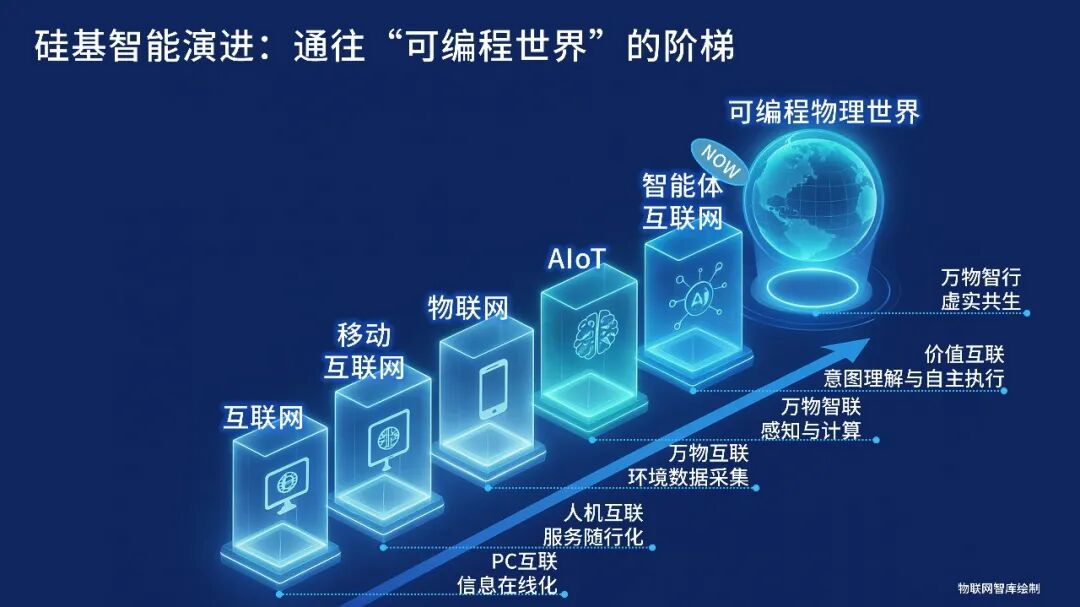
The first act took place in the 1990s when the Internet digitized information.
Back then, computers were connected to computers, and the core task was to move physical - world documents and information online. We solved the millennium - old problem of information asymmetry. Suddenly, a rural child could read papers from the Harvard Library. However, the problem was also obvious: you had to sit in front of a computer, and the world was compressed onto a 15 - inch screen.
In 2007, Steve Jobs released the iPhone, and the era of mobile Internet began.
This time, it was not machines that were connected but people. Mobile phones became people's digital organs, and our location, behavior, and social relationships were all digitized. The emergence of Meituan, Didi, and WeChat solved the problem of inaccessible services. You could order takeout at 3 a.m., and you could video - chat with friends in New York even when you were in Tibet. For the first time, humans achieved constant connectivity. But this was not enough because, apart from humans, the entire physical world remained silent.
Simultaneous with the development of the Internet was the evolution of the IoT. The release of the "ITU Internet Report 2005: The Internet of Things" and the popularization of IPv6 transformed the IoT from a concept into a system and from a dream into reality.
This was the awakening moment of the physical world. Sensors began to be widely deployed. Temperature, humidity, vibration, light... All things started to "speak," but in the language of data. A refrigerator knew its internal temperature, and a bridge could sense its deformation. For the first time, the physical world had a digital twin. However, these devices were like newborns, only able to cry but not speak. They generated a large amount of data but did not understand the meaning of this data.
In 2016, AlphaGo defeated Lee Sedol, announcing the arrival of the AIoT era.
AI began to inject "intelligence" into the IoT. Cameras were no longer just for recording; they could recognize who you are. Speakers were no longer just players; they could understand what you said. Devices were upgraded from sensors to devices with a certain level of cognitive intelligence. However, even so, they were still passive. You had to explicitly tell Siri to turn on the living - room light; it would not actively think about why you needed light.
In 2025, GPT opened its plugin ecosystem, officially kicking off the era of the Internet of Agents.
This was a moment of qualitative change. Based on the general reasoning ability of large models, devices evolved from understanding instructions to understanding intentions. When you say, "I'm tired," the system will not only dim the lights and play soothing music but may also actively ask if you need to book a massage service for tomorrow. More importantly, agents from different brands and with different functions began to collaborate with each other, forming a network that could plan and execute autonomously.
In the future, we may see other new terms, and the evolution has no end... Five evolutions, five stages, but if you observe carefully, you will find that they are all doing the same thing: eliminating the boundary between the digital world and the physical world.
The Internet digitized information, the mobile Internet digitized services, the IoT digitized the environment, AIoT digitized cognition, and the Internet of Agents digitizes "actions" themselves.
Seeing this trend, I proposed the concept of "Intelligent Mobility of All Things" at the 2026 China AIoT Industry Annual Conference. This leads to a key question: What is the ultimate outcome of all this?
This ultimate outcome can be understood from three dimensions.
The ultimate outcome of interaction is "intention equals result."
Over the past thirty years, humans have been learning the language of machines, from DOS commands to graphical interfaces, from keyboard - mouse operations to touch - screen gestures. Now, machines are finally starting to understand human natural language and vague intentions. But the real ultimate outcome is that all operation interfaces will disappear, and the environment itself will become the interface. When you have an intention, the physical world will automatically reorganize to meet it, and the intermediate operation process will be completely eliminated.
The ultimate outcome of space is "the disappearance of the boundary between the virtual and the real."
The Internet was initially just a digital archive of the physical world, and later, the IoT made it the sensory nerve of the physical world. Digital avatars are no longer just physical mappings but directly drive the physical world. Bits can reorganize atoms, and the physical world acquires all the attributes of the digital world, being searchable, computable, upgradable, and programmable. The world becomes a huge operating system, and all things are peripherals.
The ultimate outcome of intelligence is the "super - agent."
Each application and each device used to be an information island. Now, agents are starting to collaborate with each other. Eventually, the global computing power, data, energy, manufacturing, and service capabilities will be connected into a whole, forming a distributed brain with self - perception, self - repair, and self - evolution capabilities. Humans will no longer be the operators of this system but its nerve center, only responsible for defining goals and values.
In a nutshell: We will live in an intelligent ecosystem where the digital and the physical are completely integrated. The physical world will be as fluid and malleable as software, and every human intention can be instantly understood and directly realized in reality.
The Sinking of the IoT: The Digital Foundation for AI to Enter the Physical World
Facing the ultimate outcome described above, I have a judgment: The IoT will further sink and become the foundation and infrastructure of the entire digital world. This is not a speculation about technological trends but a reality that has already occurred. I would like to prove the inevitability of this sinking from three dimensions.
First, from the data dimension, the IoT is sinking to become a data supply base for AI.
According to IDC research, by the end of 2025, the global total data volume will reach 213.56 ZB and 527.47 ZB in 2029. China will generate 51.78 ZB in 2025 and increase to 136.12 ZB in 2029, with a compound annual growth rate (CAGR) of 26.9%, of which nearly 30% is real - time data. Where does this real - time data come from? The vast majority comes from IoT devices, such as industrial sensors, video surveillance, medical equipment, and in - vehicle terminals. The analysis by Thales Group and IoT Analytics is more specific. The massive IoT terminals distributed in scenarios such as production, transportation, healthcare, and cities will provide more than two - thirds of the original data sources for AI applications. The IoT has sunk to become the infrastructure of the data layer, silently and continuously supplying data to the upper - layer AI applications.
Second, from the value dimension, the value of the IoT is being released through AI, presenting an iceberg model.
McKinsey pointed out in its IoT value research report that B2B applications will contribute approximately 65% of the total IoT value. This means that the real value is not in the smart speakers or watches that consumers can see (the part above the water), but in places such as factory workshops, logistics warehouses, and urban pipe networks (the part below the water). The IoT is sinking into these invisible underlying scenarios. More importantly, it is the mechanism of value release. Both SAS and Deloitte's research mentioned an astonishing figure: 99% of unanalyzed IoT data is wasted. It is easy for IoT devices to collect data, but extracting value from it depends on AI. From this perspective, more than 70% of the value created by "Artificial Intelligence +" relies on the data foundation provided by the IoT. The IoT no longer pursues front - stage visibility but sinks to become an invisible driving force for value creation.
Finally, from the architecture dimension, the IoT is sinking from the connection layer to the base layer.
The IoT is becoming invisible, which is exactly a sign of it becoming infrastructure. Just as we don't sense the existence of the power grid and the water supply system, but we use them all the time. Gartner's survey shows that by 2023, one - third of enterprises implementing the IoT also implemented AI projects. This is not a coincidence but an inevitable result of technological integration. AI needs data, and the IoT generates data; the IoT needs intelligence, and AI provides it. The two are accelerating the process of merging into one. At the same time, the computing architecture is also being reorganized to support this sinking. IDC predicts that by 2025, more than 50% of enterprise data will be created and processed at the edge, outside of data centers or the cloud. This means that IoT devices are no longer just data collectors; they are becoming computing nodes. A camera can not only take pictures but also directly identify abnormalities; a sensor can not only measure but also immediately judge trends. The IoT sinks to become the digital foundation that supports AI to enter the entire physical world.
This sinking is irreversible. In the near future, we may not mention the term "IoT" frequently, not because it is unimportant, but because it is so important that it is like electricity and air, completely integrated into the environment and sinking to become an invisible basic layer. It will become the operating system kernel of the programmable physical world, an invisible but ubiquitous digital foundation.
Intelligent Mobility of All Things: The Transition from the APP Economy to the Intention Economy
At 2:37 a.m., Grandpa Zhang suddenly fell when getting up at night.
At 2:38 a.m., the smart bracelet on his wrist detected abnormal acceleration changes and a sudden change in heart rate. However, this was just a device of Brand A, and all it could do was vibrate and emit an alarm sound. If the story ended here, Grandpa Zhang might have to lie on the cold floor until dawn.
But in the world of agents, the story has just begun. The data from the bracelet triggered Grandpa Zhang's personal agent. This AI assistant running in the cloud immediately started an emergency cross - brand and cross - device collaboration. At 2:39 a.m., the camera of Brand B in the living room received an instruction, and the lens turned to the coordinates of the incident. The visual recognition model confirmed within 300 milliseconds that the old man had fallen and was unconscious. At 2:40 a.m., the agent made a judgment that it was a high - risk emergency and started the rescue procedure.
In the next 12 minutes, a temporary "super - APP" was compiled on the fly: the smart lock of Brand C received an instruction, generated a temporary password, and sent it to the 120 emergency center; the smart speaker of Brand D started to call the emergency number and notified Grandpa Zhang's children at the same time; the lights in the whole house began to flash rhythmically to mark the location for the upcoming ambulance; the gas stove in the kitchen was remotely turned off to prevent possible secondary disasters.
At 2:52 a.m., the ambulance arrived. The doctor said, "If it had been 10 minutes later, the consequences would have been unimaginable."
This case reveals a possible transformation. In the era of agents, the services provided by physical devices are changing from being static to dynamic, and the walls between different brands, different protocols, and different APPs are collapsing.
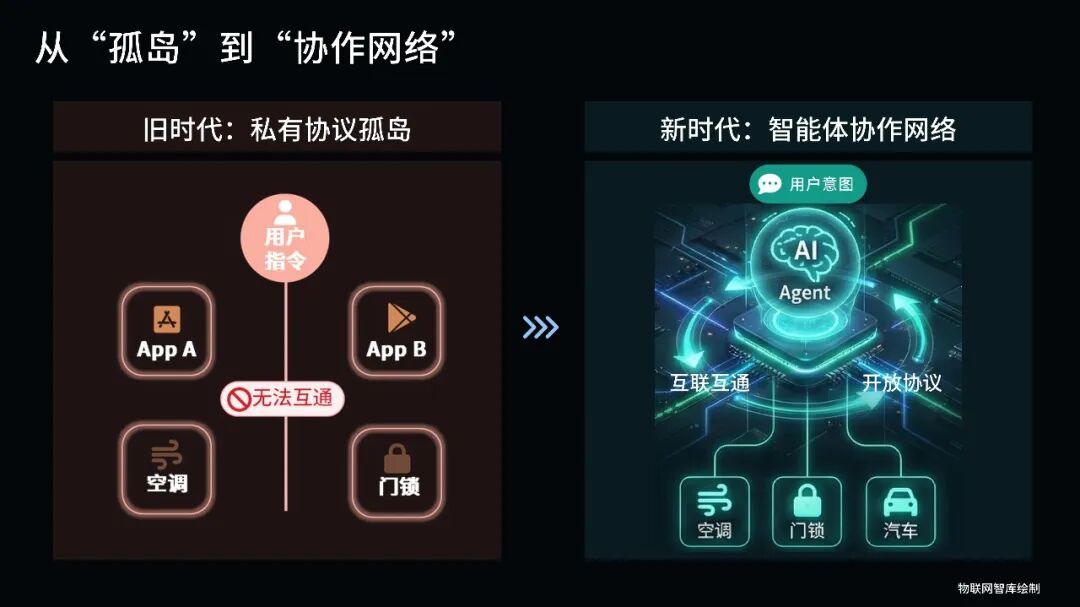
The economic meaning of the "Intelligent Mobility of All Things" I proposed is the "liquefaction of physical capabilities."
That is, all service capabilities, such as hailing a taxi, ordering food, turning on the lights, and adjusting the temperature, are no longer locked in specific APPs but are broken down into individual atomic capabilities that can be freely combined. When a user has an intention, such as "arrange a romantic wedding anniversary," the agent will, within milliseconds, capture the "atomic capabilities" of restaurant reservation, flower delivery, home lighting control, and speaker playback, and instantly compile a unique "super - APP," a solution dynamically generated according to the user's intention.
IoT enterprises no longer compete for the so - called "entry points" in the past but for the probability of being called by agents. Those with more standardized interfaces and more intelligent responses will gain the greatest liquidity in this liquefied service market.
But there is a cruel truth: in the era of agents, the private - protocol moats that enterprises were once proud of are becoming prisons that trap themselves.
In the past, Apple, Siemens, Xiaomi... all built walled - garden ecosystems. If you bought Xiaomi's lights, it was best to also buy Xiaomi's speakers because they worked best together. This exclusive inter - connectivity was once the deepest moat. But now, the rules of the game have changed.
Agents are cross - platform entities. They may not belong to any hardware manufacturer, and their only purpose is to mobilize all available resources to solve users' problems. If an IoT enterprise's device requires an agent to download a special plugin or crack a private protocol to be called, the agent will calculate a very high interaction friction cost. As a result, the agent will bypass this device and call those with open protocols.
Therefore, in the world of "Intelligent Mobility of All Things," the subject of "mobility" is no longer just humans but a social network of robots. In the future, every IoT enterprise has to think about a new question: How to do SEO (Search Engine Optimization) for agents? How to make their devices the first to be discovered, called, and trusted when agents need to solve problems? In this new world, being closed means death, and being open means survival.
Conclusion
Twenty years ago, we tried hard to connect devices to the Internet. Five years ago, we were busy making devices intelligent. Today, we need to make devices learn to collaborate.
This evolutionary path reveals a fundamental change: the competition logic of IoT enterprises is being rewritten. In the past, everyone was vying for entry points to control users. But now, the entry points have changed. IoT enterprises no longer need to compete for any entry points but should focus on building infrastructure well. Those with the most standard, stable interfaces and the richest data will be the indispensable "water, electricity, and gas" in this ecosystem. This is the essence of the "liquefaction of physical capabilities."
When the IoT truly becomes the digital foundation of this intelligent world, it will be like the power grid today. No one talks about it, but everyone depends on it. That will be the greatest success of the IoT.