Das Internet der Agenten löst eine Neupositionierung des Internets der Dinge aus. Wie kann man den spannenden Sprung von der "intelligenten Vernetzung aller Dinge" zur "programmierbaren Welt" schaffen?
A few days ago, a friend asked me: "OpenAI's AI assistants can already directly control smart home devices, and Google's Gemini is also taking over cars. Will our Internet of Things (IoT) hardware field be short - circuited?"
I said: On the contrary, the stronger AI becomes, the more important IoT will be.
The concept of the "Internet of Agents" has recently appeared more and more frequently in various discussions. However, most people focus on the large - scale AI models at the upper level and overlook a crucial fact: Without IoT, agents are brains in a tank; without agents, IoT is a vegetative person.
What we are currently experiencing is not that IoT is being short - circuited by AI, but the crucial moment when IoT steps back from the spotlight to the back - end infrastructure. Just as in the era of the Internet, no one talks about the TCP/IP protocol anymore, although it is everywhere, IoT is also experiencing such a decline and is becoming the physical digital foundation of the agent era.
The Internet of Agents essentially allows all things to evolve from passive data terminals to intelligent partners that can actively think, cooperate with each other, and directly deliver results. This is not a simple technological iteration but a spectacular leap of silicon - based intelligence from "observing the world" to "changing the world".
From Networking to Intelligence: A Thirty - Year History of Digital Evolution
If we look back at the past thirty years, we have witnessed five key expansions, each of which has addressed the shortcomings of the previous one. Interestingly, all these seemingly independent technological waves are moving in the same direction, namely the complete disappearance of the boundary between the digital and the physical world.
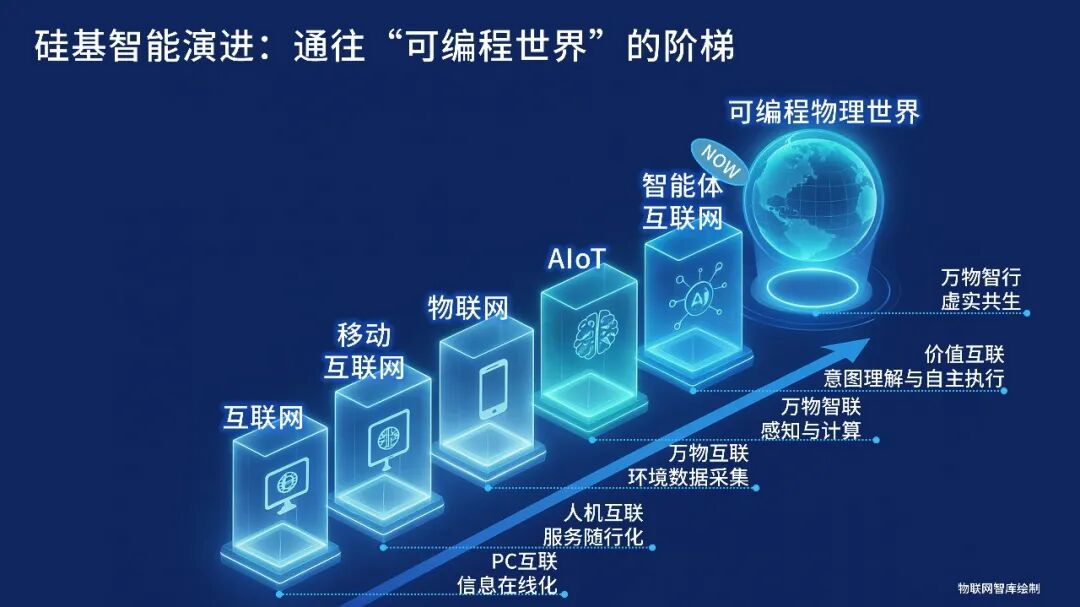
The first chapter took place in the 1990s when the Internet completed the digitization of information.
At that time, computers were connected to each other, and the core task was to bring documents and information from the physical world to the Internet. We solved the millennium problem of information asymmetry. Suddenly, even a rural child in the province could access dissertations from the Harvard Library. But the problem was also obvious: one had to sit in front of a computer, and the world was limited to a 15 - inch screen.
In 2007, Steve Jobs released the iPhone, and the curtain of the mobile Internet era rose.
This time, it was not machines but people that were networked. The smartphone became the digital organ of humans, and our position, behavior, and social relationships were all digitized. The emergence of services such as Meituan, Didi, and WeChat solved the problem of the inaccessibility of services. Even at 3 a.m., one can order a take - out meal, and one can also communicate with friends in New York via video chat while in Tibet. People had constant access to the Internet for the first time. However, this was still not enough because apart from humans, the entire physical world was still silent.
Parallel to the Internet, IoT has also developed. The release of the report "ITU Internet Report 2005: Internet of Things" and the spread of IPv6 made it possible for IoT to transform from a concept to a system and from a dream to reality.
This was the moment when the physical world woke up. Sensors were installed on a large scale. Temperature, humidity, vibration, lighting... Everything began to speak, but only in the language of data. A refrigerator knew how warm it was inside, and a bridge could sense its own deformation. The physical world had a digital counterpart for the first time. But these devices were like newborns who could only cry but not speak. They generated a huge amount of data but did not understand what these data meant.
In 2016, AlphaGo defeated Lee Sedol, announcing the era of AIoT.
AI began to endow IoT with "intelligence". A camera was no longer just a video recorder but could recognize who you are; a speaker was no longer just a music player but could understand what you say. The devices evolved from simple sensors to devices with certain cognitive intelligence. But even so, they were still passive. You had to explicitly tell Siri to turn on the light in the living room. It would not actively think about why you need the light.
In 2025, GPT launched the plug - in ecosystem, and the era of the Internet of Agents officially began.
This was the moment of qualitative change. Due to the general inference ability of large models, devices have evolved from following instructions to understanding intentions. If you say, "I'm tired", the system will not only dim the light and play soothing music but may also actively ask if you want to make a massage appointment for tomorrow. More importantly, agents of different brands and functions begin to cooperate with each other and form a network that can autonomously plan and execute.
In the future, we may hear other new concepts. Evolution never ends... Five evolutions, five phases. But if you look closely, you will find that they all do the same thing: The boundary between the digital and the physical world is eliminated.
The Internet enabled the digitization of information, the mobile Internet enabled the digitization of services, IoT enabled the digitization of the environment, AIoT enabled the digitization of cognition, and the Internet of Agents has achieved the digitization of "action" itself.
After recognizing this trend, I proposed the concept of "Intelligent Action of All Things" at the China AIoT Industry Annual Conference 2026. This leads to a crucial question: What is the end of all this?
This end can be understood from three dimensions.
The end of interaction is "Intention is result".
In the past thirty years, humans have constantly learned the language of machines, from DOS commands to graphical user interfaces, from keyboard and mouse operations to touch gestures. Now, the machine finally begins to understand human natural language and vague intentions. But the real end is that all operating interfaces will disappear, and the environment itself will become the operating interface. If you have an intention, the physical world will automatically reorganize itself to fulfill it, and the intermediate operating process will be completely eliminated.
The end of space is "The disappearance of the boundary between reality and virtuality".
The Internet was initially just a digital archive of the physical world. Later, IoT made it the sensory nerve of the physical world. The digital twin is no longer just an image of physics but directly drives the physical world. Bits can reorganize atoms, and the physical world acquires all the properties of the digital world, such as searchability, computability, updatability, and programmability. The world becomes a huge operating system, and everything is an external device.
The end of intelligence is the "Super - Agent".
Each app and device was once an information island. Now, agents begin to cooperate with each other. Eventually, the computing power, data, energy, manufacturing, and service capabilities of the world will be connected into a whole and form a distributed brain with self - awareness, self - repair, and self - development. Humans are no longer the operators of this system but its nerve center. We only define the goals and values.
In summary: We will live in an intelligent ecosystem where the digital and the physical world are completely merged. The physical world is like software, fluid and malleable. Every human intention can be immediately understood and directly implemented in reality.
The Decline of IoT: The Digital Foundation for Integrating AI into the Physical World
In view of the end described above, I have an assessment: IoT will continue to decline and become the foundation and infrastructure of the entire digital world. This is not a speculation about technological trends but an already - happened reality. I would like to argue the necessity of this decline from three dimensions.
First, from the data perspective: IoT will become the data supply base for AI.
According to a study by IDC, the global data volume will reach 213.56 ZB by the end of 2025 and 527.47 ZB in 2029. China will generate 51.78 ZB of data in 2025 and increase to 136.12 ZB in 2029, corresponding to an average annual growth rate of 26.9%. Nearly 30% of it is real - time data. Where do these real - time data come from? The majority comes from IoT devices such as industrial sensors, video surveillance systems, medical devices, and vehicle end - devices. The analyses of Thales Group and IoT Analytics go into more details. The massive IoT end - devices in production, transportation, medical, and urban scenarios will supply more than two - thirds of the original data sources for AI applications. IoT has already become the infrastructure at the data level and silently and continuously supplies the data "blood" for upper - level AI applications.
Second, from the value perspective: The value of IoT is released by AI and shows an iceberg pattern.
McKinsey found in its report on the value of IoT that B2B applications will account for about 65% of the total IoT value. This means that the real value does not lie in the smart speakers or watches that consumers can see (above the water surface) but in factory halls, logistics warehouses, and urban utility networks (below the water surface). IoT retreats to these invisible lower - level scenarios. More importantly, it is the mechanism of value release. Both SAS and Deloitte mentioned a surprising figure in their studies: 99% of unanalyzed IoT data is wasted. It is easy to collect data with IoT devices, but to extract value from it, AI is required. From this perspective, more than 70% of the value created by "Artificial Intelligence +" depends on the data base supplied by IoT. IoT no longer aims for visibility on the surface but becomes the invisible driver of value creation.
Finally, from the architecture perspective: IoT retreats from the connection level to the basic level.
IoT is becoming increasingly invisible, which is exactly the sign that it is becoming infrastructure. Just as we don't feel the existence of the power grid and the water system, although we use them constantly. A survey by Gartner showed that by 2023, one - third of the companies that had implemented IoT had also carried out AI projects. This is not a coincidence but the necessary result of technological fusion. AI needs data, and IoT generates data; IoT needs intelligence, and AI provides intelligence. The two are merging into a whole at an increasingly fast pace. At the same time, the computing architecture is being restructured to support this decline. IDC predicts that by 2025, more than 50% of enterprise data will be created and processed at the edge outside the data center or the cloud. This means that IoT devices are no longer just data collectors but become computing nodes. A camera can not only record but also directly detect anomalies; a sensor can not only measure but also immediately judge trends. IoT retreats and becomes the digital foundation that allows AI to be integrated into the entire physical world.
This decline is irreversible. In the not - too - distant future, we may not talk about IoT as often, not because it has become less important but because it is so important that it has become completely integrated into the environment like electricity and air and has become the invisible basic level. It will become the core of the operating system of the programmable physical world, an invisible but ubiquitous digital foundation.
Intelligent Action of All Things: The Transition from the APP Economy to the Intention Economy
At 2:37 a.m., Mr. Zhang suddenly fell while walking to the toilet.
At 2:38 a.m., the smart bracelet on his wrist detected an unusual acceleration change and a sudden change in heart rate. But this was just a device of brand A, and all it could do was vibrate and emit an alarm sound. If the story ended here, Mr. Zhang might have remained lying on the cold floor until dawn.
But in the world of agents, the story has just begun. The data on the bracelet triggered Mr. Zhang's personal agent. This AI assistant running in the cloud immediately began an urgent cross - brand and cross - device cooperation. At 2:39 a.m., the camera of brand B in the living room received a command, and the camera frame turned to the coordinates of the incident. The visual recognition model confirmed in 300 milliseconds: The old man has fallen and shows no conscious movements. At 2:40 a.m., the agent decided that it was a high - risk emergency situation and launched the rescue program.
In the next 12 minutes, a temporary "Super - APP" was immediately compiled: The smart lock of brand C received a command to generate a temporary password and send it to the emergency rescue center 120; the smart speaker of brand D began to call the emergency number and at the same time inform Mr. Zhang's children; the lights in the whole house began to blink rhythmically to mark the position for the upcoming ambulance; the gas stove in the kitchen was remotely turned off to avoid possible secondary damage.
At 2:52 a.m., the ambulance arrived. The doctor said, "If it had been 10 minutes later, the consequences would have been unimaginable."
This example shows a possible transition. In the era of agents...