Musk's Optimus had another major blunder. It removed a "non-existent VR headset" before falling. Netizens were in an uproar: Is it being remotely controlled by a human?
If there's any "traffic code" in the tech circle in 2025, humanoid robots definitely count as one.
Capital is pouring in, and PPTs are flying. Companies like Tesla, Agility Robotics, and Figure have all unveiled their "future factory labor forces." No one wants to miss out on this industrial revolution that's considered more revolutionary than autonomous driving.
However, a demonstration by Tesla in Miami last weekend suddenly turned the buzz into controversy:
An Optimus humanoid robot that was handing water to a visitor suddenly lost its balance and fell backward. The hand movement it made in the second before it fell really startled the outside world - it suddenly raised its hands to its head and made the classic VR gesture of "grabbing and removing a headset," but in fact... there was nothing on its head.

This scene was called "removing a non - existent VR headset" by netizens, and it also brought a sensitive issue to the surface again:
Has Optimus really not achieved true autonomous control and is still relying on human remote operation?
The "Autonomy Visualized" event in Miami: It looks lively, but the "autonomy" content is a mystery
The incident took place at an event called "Autonomy Visualized" held at Tesla's Miami store. As the name suggests, this event was supposed to showcase Tesla's autonomous driving capabilities and the autonomous AI functions of the humanoid robot Optimus.
Judging from the various videos released on that day, this event seemed more like a carefully - arranged on - site experience show.
What was Optimus doing on site? Handing water to visitors, taking photos with people, and dancing according to the instructions of the staff... These tasks may seem basic, but it's precisely in such scenarios that robots are most likely to expose problems.
According to a video uploaded to Reddit, Optimus was a bit hasty when handing water, which caused the water bottle to drop, and then it clearly started to lose balance. This was still a normal situation: it's not uncommon for a robot to fall. What really made the incident escalate was the "headset - removing movement" that Optimus made at the moment it fell.
The movement was too precise: it quickly raised its hands in front of its head, with its fingers naturally curved into a grasping shape, just like an operator suddenly needed to remove a heavy headset - those familiar with VR remote - control technology know that this is a very typical movement mapping in a remote - control system.
In other words, it's very likely that a real - life operator in the background (or remotely) stopped controlling at a certain moment and removed the VR headset; and through movement mapping, Optimus "removed a non - existent thing" and then fell.
Industry comments: Falling isn't the problem; the "moment of disillusionment" is
As soon as the video was released, the whole internet went crazy.
Some netizens joked, "Musk estimates that the price of Optimus is $20,000. Does that include the necessary remote operator and supporting equipment? Or do these require additional payment?"
Many others mercilessly criticized Tesla and Musk:
"It's simply shocking news that Musk and Tesla lied about their robot R & D level. But it seems that lying is just a common thing for Musk, which is quite in line with his style."
"Tesla's robot project always seems like a disappointing disaster. When can we declare Musk's failure? Or is it just too much fun to watch him make a fool of himself?"
Regarding this incident, the well - known US media outlet Electrek's comment was also very straightforward: the embarrassment doesn't lie in the robot falling, but in the fact that this scene completely shattered the "illusion of an autonomous demonstration."
In the past, Boston Dynamics has released countless "robot wrestling compilations" without damaging its R & D credibility because those were all real research processes. But Optimus' fall is different because Musk has repeatedly denied the existence of manual control before.
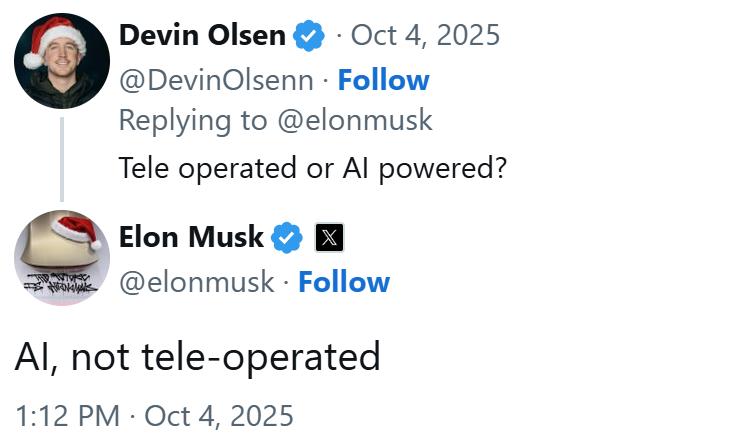
For example, in October this year, Musk released a video of Optimus learning Chinese kung fu. When someone questioned, "Is this remotely controlled or AI - driven?" he personally replied, "This is AI, not remote control."
Even at the October earnings conference, Musk emphasized again, "Optimus performed kung fu with Jared Leto at the premiere of 'Tron: Legacy,' and no one was controlling it at that time. Many people even thought it was a human when they passed by."
All these words point to the same vision: Optimus is autonomous enough to truly become the largest - scale general - purpose robot product in the future. But Optimus' fall incident in Miami has raised a lot of doubts in the industry: the reality is probably far less optimistic than what Musk has been promoting.
If Tesla still needs a one - to - one real - life remote control to complete a low - complexity task like "handing water" now, then the future of Optimus being "widely deployed in factories with millions of units" is still very far away.
Reference link: https://electrek.co/2025/12/07/tesla-optimus-robot-takes-suspicious-tumble-in-new-demo/
This article is from the WeChat public account "CSDN." Arranged by Zheng Liyuan, released by 36Kr with authorization.