The Ideal Practice and Return
AI
In 2023, Li Xiang proposed and implemented the strategic direction of "Learning from Huawei". On the one hand, he promoted the IPD process within the company, and on the other hand, he recruited a large number of senior executives with Huawei backgrounds. At that time, the general speculation from the outside world was that Li Auto was transitioning from an efficiency - centered approach to a scale - centered one.
Looking back at the automotive technology companies in the past two years, there is also a clear underlying thread:
— In September 2022, XPeng launched its then - flagship model, the G9, which was immediately criticized for "confusing configurations" and "unappealing prices". Amid the intense public outcry, XPeng had to urgently revise the configuration list and prices just 48 hours after the launch. Even so, the damage had been done, and the internal chaos and deficiencies at XPeng were pushed to the forefront, plunging the company into a difficult slump.
He Xiaopeng began to make adjustments in 2023. He recruited veterans like Wang Fengying and her husband to join the team one after another, streamlined the internal processes, and tightened control over the supply chain and production. It took him more than a year to return the company to the top position.
When He Xiaopeng was interviewed at the beginning of the year and recalled the crisis, he said that he had called Lei Jun at that time, and the latter said that his problem was that he only wanted to be the chairman and didn't want to be the CEO.
— Tesla's image in the market has completely changed in the past two years. Once, Tesla was an "Apple - like" company with leading product concepts and advanced technological capabilities, undoubtedly leading the trend of intelligent vehicles.
Since initiating a price war at the beginning of 2023, Tesla has become an out - and - out market grabber. The outside world expected it to once again lead the trend with products that would amaze the world, but its actual move was to expand its market share through price cuts. This year, it took this approach to a new level. The long - wheelbase, three - row version of the Model Y Long Range suddenly emerged. Tesla even imitated joint - venture brands by adding a stretched version. What is Elon Musk up to?
Elon Musk is focusing on AI. He is now devoting all his energy to Robotaxi, robots, and large - scale models. The future of Tesla is not as an automotive company but as an AI company.
This underlying thread has now fully emerged:
Elon Musk is fully committed to AI and has left behind the automotive business. Tesla can no longer maintain its product advantages and is now relying solely on its still - unique brand advantage accumulated over the years to capture the market.
Wasn't He Xiaopeng once the same? In the early days, he was completely focused on autonomous driving technology and left the automotive business entirely to the team. As a result, a large number of problems accumulated in the manufacturing process.
We know that in January 2023, Li Xiang sent an all - staff letter to the team, announcing that Li Auto aimed to become a globally leading AI company by 2030. At that time, Li Xiang mainly devoted his energy to AI. After the setback of the MEGA's launch, he didn't talk about automotive topics on social media for several months.
Compared with He Xiaopeng, who has been more focused on autonomous driving technology from the start, and Elon Musk, who later shifted his focus to AI, Li Xiang's strategy is closer to the latter. Like Musk, he first got the company on the right track and then dedicated himself to AI.
At that time, the foundation Li Xiang built for the company included: a methodology centered around intelligent family vehicles, a sales system of about 500 outlets, a company operation foundation based on Huawei's processes, and an ongoing high - voltage charging network for the entry into the pure - electric market, etc.
Li Auto has stated in external communications its attitude towards "self - research": If it's a key technology, even if there is only a six - month window period, it will do it on its own.
The importance of AI is self - evident. Therefore, Li Xiang built the operational foundation for Li Auto and then threw himself into AI. The newly launched AI glasses, Livis, are a sign of this direction.

High - end Strategy
On March 1, 2024, at the spring press conference, Li Auto launched the MEGA.
On the same day and at the same time, Li Xiang said at the press conference that the income of front - line manufacturing employees at Li Auto was more than 30% higher than the local average in the manufacturing industry (including Beijing and Changzhou). Li Auto's goal was to have the blue - collar workers in the factory earn more than their German counterparts within three years.
Among domestic new - energy vehicle startups, NIO was the first to establish a high - end brand. The high income, good welfare, and relatively more human - oriented and less - intense working environment it provided for employees were the foundation for building such a brand image.
Li Auto initially entered the automotive market with the ONE priced at over 300,000 yuan, reaching the entry - level luxury market in terms of price while offering much higher - level dimensions and configurations. At that time, Li Auto was a new - energy vehicle startup that was nominally high - end but actually highly cost - effective. When the company entered the pure - electric market in 2024, it tried to truly become a high - end automotive company.
What really supports a high - end identity for an automotive company is precisely the way it treats its employees: enabling employees to live without anxiety and fear, allowing them to enjoy higher salaries and better welfare, and enabling them to live with more dignity. Only when a company can achieve these can it be truly considered high - end.
Li Xiang's statement of "having workers' income exceed that of Germans in three years" and the MEGA's price of over 500,000 yuan jointly announced the start of Li Auto's high - end strategy, which was also the start of its high - end push in the pure - electric market.
Li Auto suffered a setback at this stage. The MEGA's launch didn't go as expected. Although its monthly sales later increased to around 3,000 units after adjustments (recently dropping due to pure - electric production capacity issues), it still failed to meet the brand's expectations.
One of the important reasons is that the entire market has entered a brutal involution cycle.
In such a cycle, companies like NIO, which focus on cost - cutting and price - reduction strategies, are more likely to gain market recognition. The same goes for XPeng, Leapmotor, Geely, Chery, and BYD. These automotive companies are continuously launching more cost - effective models, which aligns with the overall market trend, so they are progressing smoothly.
Li Auto, however, encountered the market involution cycle during its planned brand - upgrading period. It had to make adjustments in the face of the mismatch between the market environment and its own strategy.
Li Xiang didn't fight against the general environment. After the launch of the i8, seeing the market feedback, he quickly adjusted the SKUs and prices. With the goal of winning market recognition as soon as possible, he accelerated the launch of the i6 and set a highly competitive price from the start.

Setbacks in Practice
Li Xiang underestimated the external pressure on Li Auto.
When the L series was doing well and the pure - electric series was about to be launched, the brutal involution cycle in the overall market didn't end but continued to evolve. Now that the price war has subsided and a series of policies to protect the industrial chain have been implemented, the brutal phase has ended. However, the market environment still requires automotive companies to continue to compete on cost - effectiveness.
The pressure from the competitive landscape has also continued to increase. According to data from the China Passenger Car Association, in October this year, the retail sales of range - extended vehicles decreased by 7.7% year - on - year, and the wholesale volume decreased by 1.9% year - on - year. While the niche market showed signs of decline, it also faced stronger and larger - scale competitors represented by XPeng and Hongmeng.
The market pressure far exceeded the original plan. Li Auto needs to re - evaluate its original strategic steps and change its approach to the market.
Return
Li Xiang previously announced that Li Auto would abandon the manager - led model at this stage and return to the founder - led model. This strategic return is the most fundamental strategic transformation for Li Xiang and Li Auto at this stage.
What are Li Auto's core advantages?
Its product thinking was recognized early on and laid the foundation for concepts in recent years, such as range - extended vehicles, large - sized family cars, and features like refrigerators, color TVs, and large sofas;
Its efficiency - first thinking and operational methods helped it become the first new - energy vehicle startup to achieve profitability and has long been the financially healthiest in the new - energy vehicle camp.
What really made all this possible is management. Since he first got involved in the automotive industry, Li Xiang has expressed in multiple interviews and public statements that the talent pool in the domestic automotive industry is already sufficient, but management has not kept up.
His statements at important stages of Li Auto were actually directed at the team.
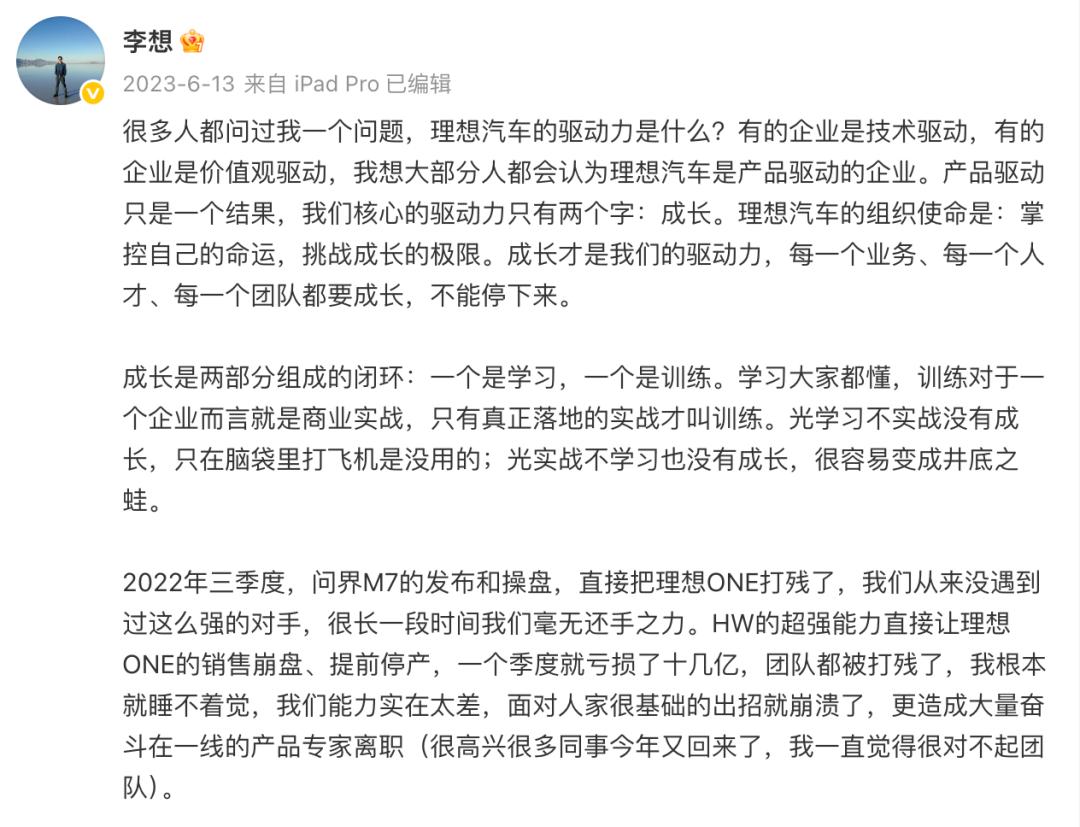
The announcement of the AI transformation was in the form of an internal letter, directly addressed to the team;
When introducing the Huawei model, the content and the target of his Weibo post (which is still his top - pinned post) were also the team: "... The team was severely beaten, and I couldn't sleep at all. Our capabilities are really poor. We collapsed at the most basic moves of our competitors, which also led to a large number of front - line product experts leaving the company (I'm glad that many colleagues have come back this year. I've always felt really sorry for the team).";
When the MEGA was launched and the high - end strategy was quietly initiated, his promise was made to the manufacturing workers: "Li Auto's goal is to have the blue - collar workers in the factory earn more than their German counterparts within three years."
In an early interview when he started in the automotive business, Li Xiang stated his management principle: Let professionals do professional work. Employees can argue with me. If they can convince me, I'll listen to them. This management style, which empowers professionals to do their jobs, actually requires the founder to invest more energy in evaluating talent and also in self - evaluation.
A complete framework process and a manager - based system are rigid and inflexible. The founder - led system requires more energy, but only in this way can the team truly exert its capabilities and potential. This is the most fundamental strategic return for Li Auto.
Return is the theme of all of Li Auto's actions at this stage. Li Xiang, as the founder, is returning. The company is returning to find its own advantages in the pure - electric market and focusing on the manufacturing process to address the insufficient pure - electric production capacity. By enabling the team to regain the fighting spirit of the startup period, the production capacity of the i6 can be resolved as soon as possible, and more resources can be invested to promote both the AI and automotive businesses simultaneously. After all, Li Auto is not Tesla, and Li Xiang needs to invest far more energy than Elon Musk to catch up.
The actions are significant, and the goals are clear. The key lies in the clear goals, which enable a clear path and a simple plan. This means that Li Xiang knows what the most core problems are at present and what to do to solve them.
This article is from the WeChat official account "Cheyun" (ID: cheyunwang), author: Cheyunjun. Republished by 36Kr with permission.