Automobile manufacturers are in a year-end sprint to meet their KPIs: Who is leading, and who is lagging behind?
With the release of November's automobile sales data, the curtain on the final battle of the 2025 auto market has been fully drawn.
As the "penultimate leg" of the annual sales sprint, November's sales performance not only reflects the real temperature of market demand but also directly affects the final results of major automakers' annual targets.
From a holistic perspective, the annual sales of the auto market are expected to maintain steady growth. However, against the backdrop of the reshaping of the new energy and fuel vehicle landscape, the lingering aftermath of price wars, and the strengthened support of the supply chain, the differentiation among automaker camps has reached a peak in recent years.
In this final showdown, the differences between camps are clear: some leading enterprises have locked in victory in advance through forward-looking layouts, staging an "end - of - year carnival"; while many players are still struggling to break through at the edge of the target line, launching a general offensive for the final sprint. The gap between the strong and the weak in the auto market is becoming increasingly clear at the year - end.
Three new - force automakers have completed their KPIs ahead of schedule, intensifying camp differentiation
In 2025, the countdown to the end of the Chinese auto market has begun. Although the overall sales are expected to be stable, the completion rates of the annual targets of mainstream automakers show significant differentiation. Leading independent automakers are making steady progress, and there are "early achievers" in the new - force camp. In contrast, some new - force automakers, as well as joint - venture and state - owned enterprises, are deeply troubled by lagging targets, highlighting the "uneven heat" in the market.
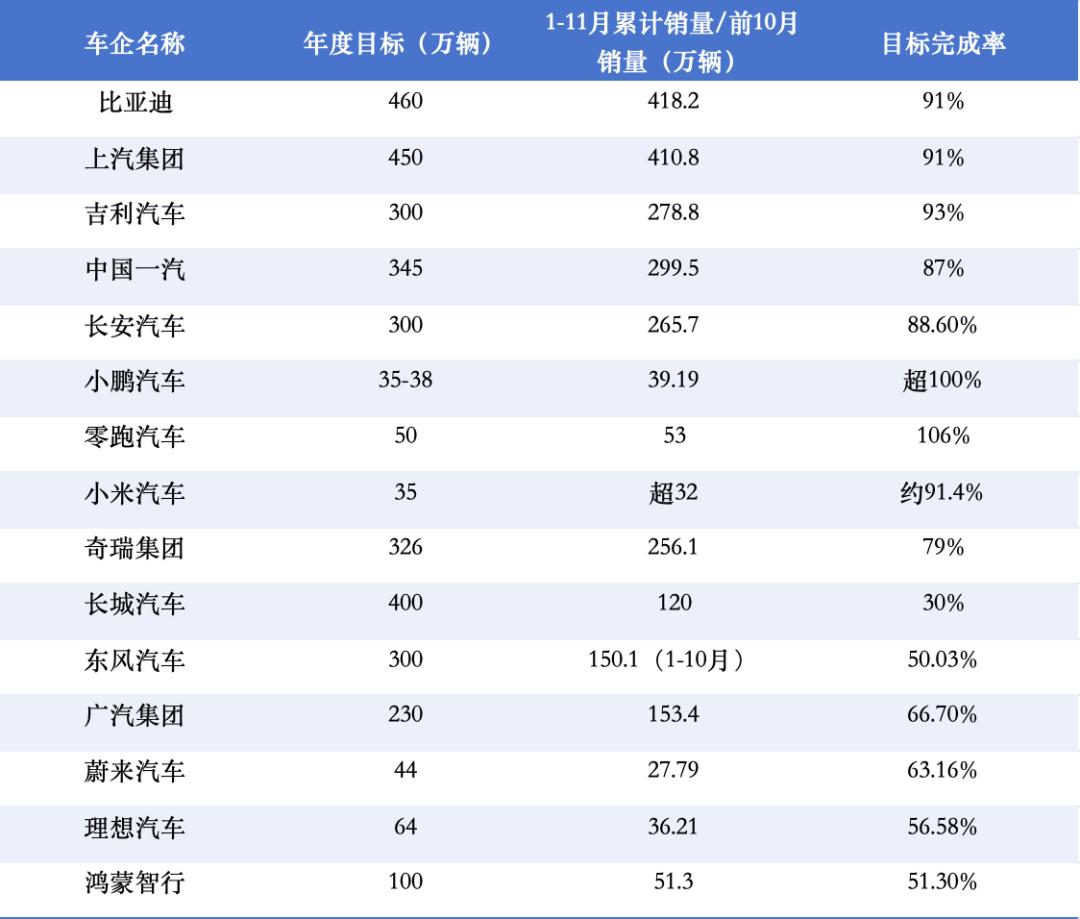
(Comparison of sales of some automobile brands. Charting: Tech Planet)
From January to November, BYD and SAIC Group's cumulative sales both exceeded 4 million vehicles, reaching 4.182 million and 4.108 million respectively, with year - on - year increases of over 10%. Corresponding to their annual targets of 4.6 million and 4.5 million vehicles, their completion rates both reached 91%, and they are likely to meet their targets as scheduled.
Geely Auto performed even more impressively. From January to November, its cumulative sales reached 2.788 million vehicles, a year - on - year increase of 24%. Regarding the annual target of 3 million vehicles set at the mid - year meeting this summer, the completion rate has reached 93%, with relatively little pressure for the final sprint.
FAW Group and Changan Automobile followed closely. From January to November, their cumulative sales were 2.995 million and 2.657 million vehicles respectively. Corresponding to their annual targets of 3.45 million and 3 million vehicles, the completion rates reached 87% and 88.6%. Relying on the traditional year - end sales boost period, they are expected to approach their target lines.
The new - force camp has become the biggest highlight of the year. Leapmotor, XPeng, and Xiaomi were the first to cross the finish line.
XPeng Motors delivered over 390,000 vehicles from January to November, exceeding the previously communicated target of 350,000 - 380,000 vehicles. Leapmotor, with a cumulative sales volume of 530,000 vehicles, exceeded its target of 500,000 vehicles. Xiaomi's cumulative sales from January to November exceeded 320,000 vehicles, approaching the adjusted target of 350,000 vehicles. Currently, its monthly deliveries are stably above 40,000 vehicles, indicating remarkable results in capacity ramping up.
In contrast, the target completion rates of some automakers fell short of expectations.
From January to November, Chery Group's cumulative sales were 2.561 million vehicles, with a completion rate of about 79%. Great Wall Motors faced even greater pressure. During the same period, its cumulative sales were 1.2 million vehicles, among which new energy and overseas sales reached 365,000 and 449,000 vehicles respectively. However, compared with the annual target of 4 million vehicles announced by Great Wall at the 8th Great Wall Motors Technology Festival, the completion rate was only 30%.
Dongfeng Motor has not yet announced its November sales, but its sales in the first 10 months were 1.501 million vehicles. Corresponding to the annual target of 3 million vehicles, the completion rate was only 50.03%. GAC Group's sales in the first 11 months were 1.534 million vehicles. Corresponding to the target of 2.3 million vehicles, the completion rate was 66.7%, and it is basically hopeless to meet the annual target.
NIO and Li Auto also face significant pressure. From January to November, their cumulative deliveries were 277,900 and 362,100 vehicles respectively. Corresponding to the annual targets of 440,000 and 640,000 vehicles, the completion rates were only 63.16% and 56.58%, and it is quite difficult to boost sales at the year - end.
As of November this year, Hongmeng Zhixing had delivered a total of 513,000 vehicles, with a target achievement rate of only 51.3%. It is extremely difficult to boost sales at the year - end.
Overall, the competition in the 2025 auto market has shown fluctuating changes. Automakers with a well - developed product matrix, a thorough transformation to new energy, and precise channel layouts continue to lead the way, while enterprises with a lagging transformation and insufficient core competitiveness are accelerating their decline. The market differentiation has been further magnified in the final stage.
Decisive battle in December: Tax exemption support as a key measure, promotional efforts at full throttle
The year - end auto market sprint has reached a white - hot stage. Multiple market factors have intertwined, leading to a "low - at - first - then - high" trend in the November auto market, and December has become a crucial window period for automakers to lock in orders.
Fan Yu, the deputy secretary - general of the Industrial Coordination Working Committee of the China Automobile Dealers Association, pointed out that in the first half of November, the market performance was a bit dull, mainly due to the consumption overdraft effect of the previous "Golden September and Silver October," which led to the early release of some potential demand.
Meanwhile, many new energy automakers launched in advance the policy of covering the vehicle purchase tax in early next year, which to some extent delayed consumers' car - buying decisions. Coupled with the tightening of trade - in and scrappage update subsidies in some regions, consumers' wait - and - see attitude has been further intensified.
The turning point came in the second half of November. The "Double 11" car - buying promotion activities were fully launched, the opening of the Guangzhou International Automobile Exhibition brought in more traffic, and the intensive release of multiple new energy models injected a shot in the arm into the market.
The continuous decline in terminal transaction prices has also effectively stimulated consumer potential, leading to a significant rebound in the auto market's popularity at the end of the month.
A car salesperson revealed to Tech Planet that policy nodes have become the core variables driving December's consumption. At the end of December 2025, the exemption policy for the purchase tax of new energy vehicles will end, and in 2026, it will be adjusted to a 50% reduction. At the same time, the 2025 trade - in subsidy policy is also coming to an end.
"To achieve their annual sales targets, dealers are increasing promotional efforts and accelerating the sales pace, striving to seize the last orders."
Meanwhile, as the Spring Festival approaches, consumers' travel needs during the festival have driven up their willingness to buy cars, and this trend has begun to accelerate in December. The dual catalysts of the expiration of the purchase tax exemption and trade - in subsidies, combined with dealers' year - end discounts, are expected to drive the concentrated release of car - buying demand in December.
Facing this crucial window period, major automakers have unveiled their "killer moves." On December 2nd, Leapmotor launched special car - buying benefits, including cash discounts, optional equipment fee waivers, repeat - purchase incentives, and down - payment installment plan discounts. Tesla also launched December car - buying benefits for all models such as Model 3 and Model Y to enhance its terminal competitiveness.
Xiaomi Auto's actions have attracted particular attention. On December 1st, Lei Jun announced through social media that the Xiaomi Auto APP would launch an in - stock car selection function on December 3rd, covering new in - stock cars, official exhibition cars, and nearly new cars. As long as customers lock in their orders before 24:00 on December 26th, they are expected to pick up their cars before the end of the year. Moreover, official exhibition cars and nearly new cars have all passed strict quality inspections and enjoy full original factory warranties and after - sales services, and some models can also enjoy additional discounts.
Covering the purchase tax has also become a core strategy for automakers to lock in orders.
On December 4th, Deepal upgraded its policy. If customers lock in orders for all models before December 31, 2025, and due to non - customer reasons such as production and transportation, the vehicles are invoiced and delivered in 2026 and picked up before February 14, 2026, consumers can receive a subsidy for the difference in the cross - year purchase tax.
Hongmeng Zhixing has launched a purchase tax subsidy plan for all models under its brands such as AITO and JI JIE. Customers who complete major orders and lock in before December 31, 2025, can enjoy a maximum cross - year purchase tax difference subsidy of 15,000 yuan.
GAC Group has also extended the cross - year purchase tax subsidy for its three major brands, Hyper, Trumpchi, and Aion, to the end of the year. Similarly, with the deadline of invoicing and delivery before February 14, 2026, the maximum subsidy is 15,000 yuan.
According to incomplete statistics by Tech Planet, as of early December, nearly 20 automakers, including GAC Toyota, ZEEKR, NIO, Li Auto, and Chery, have joined the camp of covering the purchase tax.
The intensive policy support and promotional discounts have made the competition in the 2025 auto market's final battle even more intense and injected new impetus into automakers' annual sales sprint.
The 2026 auto market: Winning with "internal strength," accelerating reshuffle
In 2025, the scale of the Chinese passenger car market remained at a high level, but the pains of transformation characterized by "high penetration and low growth" have fully emerged. Beneath the surface of stability, the industry is facing the concentrated release of multiple deep - seated pressures.
The most direct pressure comes from the two - way squeeze in the market. In November, the national retail sales of passenger cars were approximately 2.225 million vehicles, a year - on - year decrease of 8.1%, and the decline has significantly widened, completely shattering the expectation of a year - end upswing. Meanwhile, the dealer inventory warning index climbed to 55.6%, and the national total inventory exceeded 3.3 million vehicles.
The market slowdown has also impacted the industry's confidence. A survey by the China Automobile Dealers Association shows that over 80% of industry practitioners are pessimistic about the market outlook. The long - standing price war has begun to show obvious backlash effects. The model of simply seizing market share through low prices is not only unsustainable but also further squeezes the industry's profit margin, causing the industry's confidence index to continue to decline.
Behind the rapid penetration of new energy vehicles, the problem of product homogeneity has become increasingly serious.
An industry insider said bluntly that the current technological innovation has fallen into a "homogeneous involution" dilemma. Most products lack breakthrough differentiated advantages and are difficult to create new consumption stimulation points.
Changes in the policy level have further magnified the industry's pressure. Salespeople of multiple automobile brands revealed to Tech Planet that after the adjustment of the national subsidy strategy in the second half of 2025, consumers' wait - and - see attitude has intensified, and the expected sales peak has not arrived as scheduled.
More importantly, it has been clearly stated that the new energy vehicle purchase tax policy will "phase out" in 2026, which may make the already fierce price war even worse.
Li Bin, the founder of NIO, also admitted in a closed - door meeting on the third - quarter financial report that the impact of the reduction of trade - in subsidies on the market has exceeded the industry's expectations.
The superposition of multiple pressures may directly push the industry reshuffle into an accelerated phase.
In a mature automobile industry ecosystem, after over - capacity reaches a certain stage, capacity clearance will inevitably be achieved through enterprise closures, acquisitions, and integrations. Currently, the reshuffle rhythm of the Chinese auto market is significantly accelerating, and the industry pattern will undergo in - depth reconstruction.
The above - mentioned insider said that this means that the competition in the 2026 auto market will completely bid farewell to the old logic of "winning by scale" and shift to "value - based competition."
In his view, "Only enterprises that accurately grasp consumers' real needs, continuously invest in core technological innovation, and optimize the layout of their product matrix can take the initiative in the more intense market game in 2026."
This article is from the WeChat public account "Tech Planet" (ID: tech618), author: Ren Xueyun, published by 36Kr with authorization.