Million-yuan “Cancer-killing Injections” and Long-acting Cholesterol-lowering Injections: Real Price Cuts | Focus Analysis
This year, multiple "blockbuster new drugs" have been included in the medical insurance catalog for innovative drugs.
On the morning of December 9th, the National Healthcare Security Administration held a communication meeting in Beijing, providing a detailed interpretation of the new version of the National Basic Medical Insurance Catalog announced at the "2025 High - quality Development Conference for Innovative Drugs" in Guangzhou two days ago, and the list of the first "Commercial Health Insurance Innovative Drug Catalog" (the "commercial insurance catalog").
The National Healthcare Security Administration mentioned at the communication meeting that 114 new drugs have been added to this year's medical insurance catalog, covering many fields such as oncology, anti - infection, and chronic diseases.
Among them, there are new products in the chronic disease field that have undergone a "renewal": Tirzepatide, a GLP - 1 drug for diabetes treatment and weight loss; Inclisiran, a cholesterol - lowering drug that needs to be injected only once every six months; and Dotinorle tablets for treating gout, a so - called "rich man's disease", have all been included. In addition, Spesolimab, known as the "savior for allergies", Mashulashavir tablets, a domestic new influenza drug, and Yipei Growth Hormone, a long - acting growth hormone product, have also been accepted by the medical insurance.
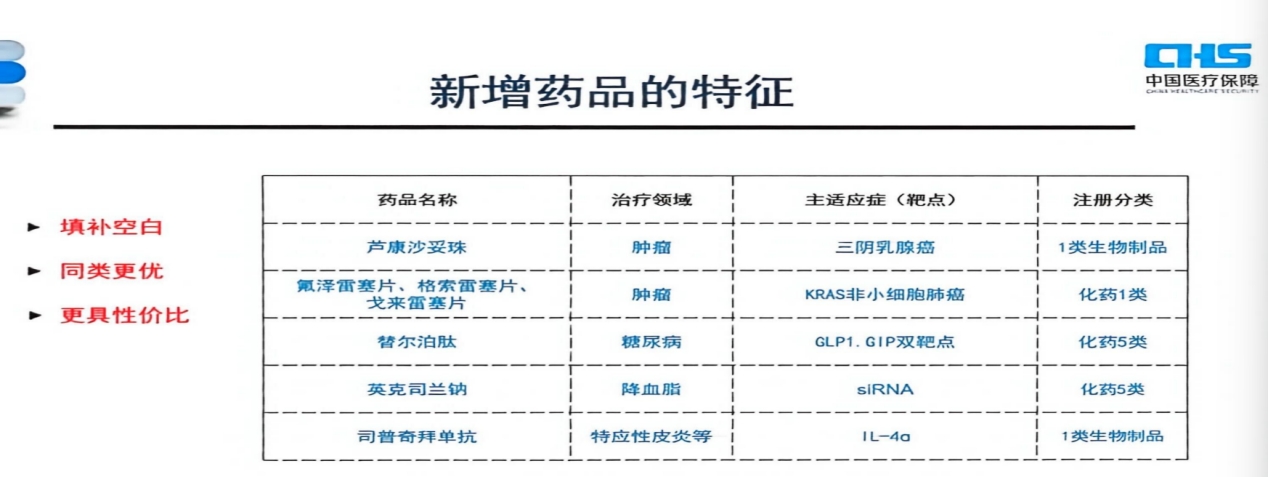
Illustration of some newly added products in the National Basic Medical Insurance Catalog (Source: National Healthcare Security Administration)
In terms of price, the National Healthcare Security Administration did not disclose the average price reduction. However, it can be inferred from some public channels that the price - cutting intensity this year may be similar to the previous years' 50% - 60%. For example, according to Yangcheng Evening News, after Yipei Injection, a long - acting growth hormone, was included in the new drug catalog, the price of each commonly used vial is about 850 yuan, with a reduction of nearly 50%.
In addition, the addition of the commercial insurance catalog for the first time, which aims to solve the payment dilemma of high - priced innovative drugs and is connected with the medical insurance catalog, has become an important highlight of this year's "national negotiation".
This time, a total of 19 products have been included in the commercial insurance catalog, including 5 CAR - T therapies, which are sold at one million yuan per dose and are called "anti - cancer injections" by netizens, 2 new drugs for Alzheimer's disease, and multiple drugs for treating tumors and rare diseases. Among them, rare - disease drugs account for nearly one - third of the catalog.
36Kr learned that the "price reductions" of the 19 products range from 15% to 50% (in increments of 5%, depending on the product characteristics), slightly higher than the previous industry expectation of a price - reduction range within 30%, but overall lower than the price reductions in previous medical insurance catalogs. A person from a company whose product was included in the commercial insurance catalog mentioned that the negotiation process was relatively friendly, and there were no extreme or unbearable situations, and "the product value can be reflected".
What does a 15% - 50% price reduction of new drugs in the commercial insurance catalog mean?
It is understood that the requirements for being included in this year's commercial insurance catalog are strict, and products need to meet four characteristics: "high innovation, great clinical value, non - substitutability by the basic medical insurance catalog, and recommended diversified payment". Therefore, the overall acceptance rate is not high.
Taking the initial 121 products that passed the formal review as a reference, the success rate of the negotiation for the first - batch commercial insurance catalog is only 15%.
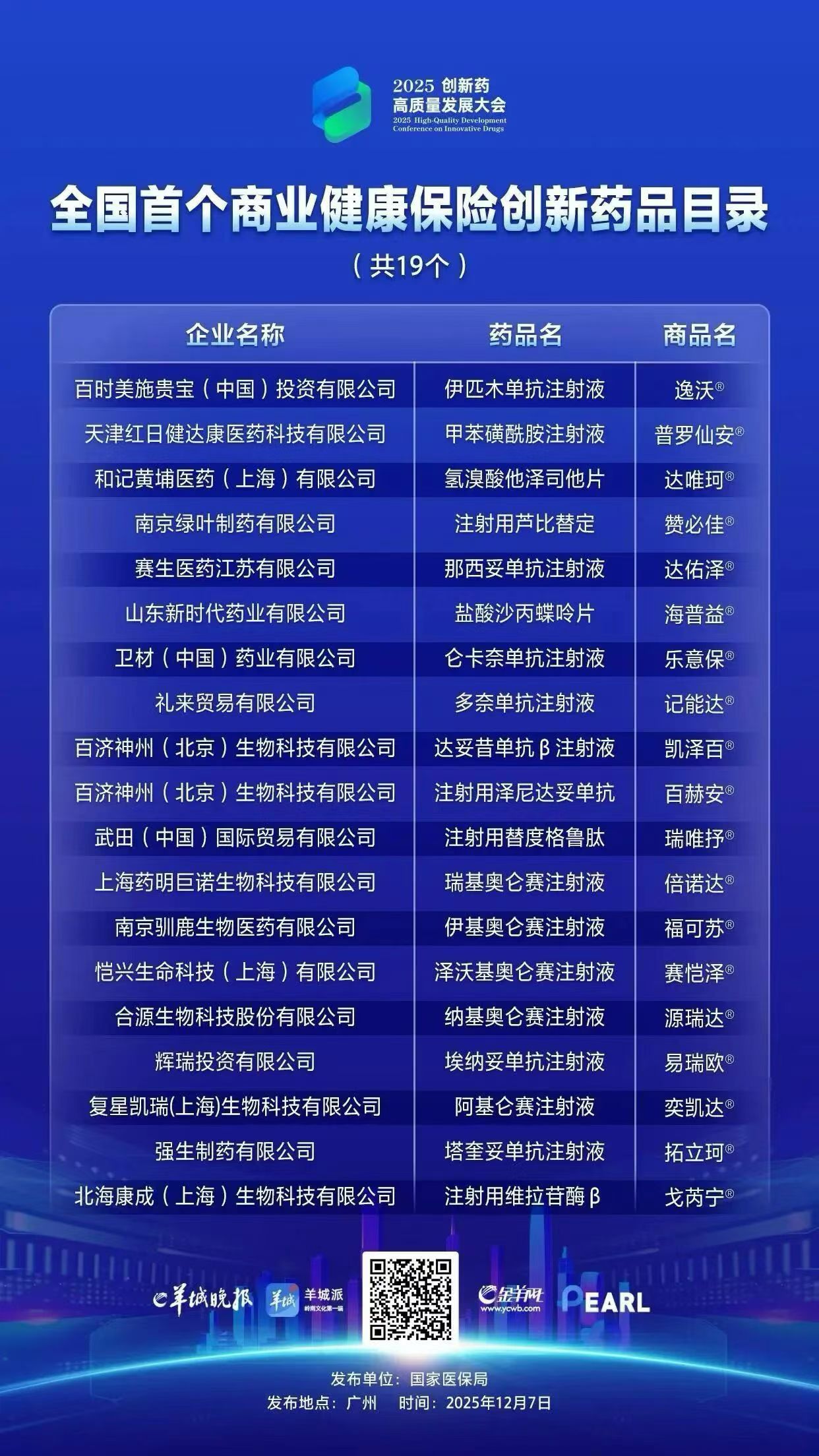
The 19 products in the commercial insurance catalog (Source: National Healthcare Security Administration)
On social media, CAR - T, known as the "anti - cancer injection" by netizens, is a representative product included in this commercial insurance catalog. All 5 applied CAR - T products were selected, accounting for one - third of the total catalog list. This is also the first time that CAR - T has had its own reimbursement path at the national level.
In previous national medical insurance catalog negotiations, there was an invisible rule in the industry that "products with an annual treatment cost of over 500,000 yuan will not be negotiated, and those over 300,000 yuan will not be included". Therefore, CAR - T, which is sold at over one million yuan per dose, has "accompanied the negotiation" for many years. Now it has finally had its own reimbursement path at the national level.
For pharmaceutical companies, this means that they no longer need to negotiate with different commercial insurance products "province by province" as in the past.
In addition, products in the commercial insurance catalog can enjoy the preferential policy of "three exclusions", that is, they are not included in the self - payment rate indicator of the basic medical insurance, not included in the detection of substitutable drugs selected in the centralized procurement, and not included in the scope of disease - based payment.
This is equivalent to opening a gap in the DRG/DIP cost - control system that pharmaceutical companies are most concerned about, which has strong practical significance for breaking the dilemma of "difficulty for high - priced drugs to enter hospitals".
As we all know, due to the problem of personalized customization, the production cost of CAR - T is high, and it is difficult to reduce the terminal price, resulting in great sales pressure on the products.
Among them, Axicabtagene Ciloleucel Injection of Fosun Kite, which was approved and launched earliest in 2021, now has an annual sales scale of 300 - 500 million yuan; the cumulative sales of Relma-cel Injection of Wuxi Biologics are only about 500 million yuan.
Therefore, getting included in the commercial insurance catalog, opening up the channels for entering hospitals and increasing sales volume, is a crucial battle for CAR - T companies now.
From the perspective of insurance companies, forming a unified national catalog system can not only save the costs and resources they invest in drug price calculation, negotiation and other links when designing their own products, but also obtain greater concessions.
Because the 15% - 50% price reduction of the products in the commercial insurance catalog is not a direct price cut by pharmaceutical companies, but a direct discount on the drugs given to insurance companies, which is equivalent to providing them with preferential policies in terms of underwriting (the specific settlement method between the two parties is not yet determined).
Simply put, it means that insurance companies and pharmaceutical companies settle at a privately agreed discounted price to achieve cost control. That is, insurance companies do not need to settle the full amount of the publicly announced drug price or claim amount with pharmaceutical companies, thus reducing their actual expenditure.
For example, if the original price of a new drug is one million yuan, and the commercial insurance promises to pay 50%, with the rest paid by the patient. In the negotiation of the commercial insurance catalog, if the pharmaceutical company and the insurance company reach a 30% discount, it means that the insurance company's direct payment for the drug to the pharmaceutical company will be reduced from 500,000 yuan to 350,000 yuan, saving a considerable amount of claim expenses.
However, this is a simplified price calculation based on rules. The claim rules of commercial insurance are complex, and the specific triggering conditions and scope of reimbursement are highly individualized, so the actual implementation may be different.
Some experts also mentioned at the communication meeting that theoretically, the saved costs can be included in the price of insurance products to reduce premiums and attract more people to buy insurance; or they can be directly regarded as profits to improve the profit margin of products.
"It is difficult for insurance companies to get the discount range in the catalog if they negotiate directly with pharmaceutical companies, so this part of the concession is meaningful. But to be honest, insurance companies also maintain their rights through various product designs and supply - demand relationships. So it's hard to judge how much value this money has and how much enthusiasm it can arouse. Because insurance companies are more concerned about whether this policy can help them attract customers, and their customer - acquisition costs are too high now." a person from a pharmaceutical company said.
Are there new opportunities for commercial insurance such as Huimin Insurance?
Many people from pharmaceutical companies believe that the introduction of the commercial insurance catalog is only the first step, and the key lies in how it will be implemented in the future. Currently, although both pharmaceutical companies and insurance companies still have concerns about the actual implementation of the catalog, they have reached a consensus that in the future, it is most likely that Huimin Insurance, million - yuan medical insurance, and group insurance will undertake the products in the commercial insurance catalog. In addition, it is not excluded that insurance companies will design new commercial insurance products for the catalog.
As an insurance product with both inclusive attributes and market - oriented operation characteristics, "Huimin Insurance" has become an important claim outlet for some high - priced drugs in the past few years.
Taking CAR - T as an example. A previous statistics from the International Society for Pharmacoeconomics and Outcomes Research showed that in 2024, among the 145 Huimin Insurance products launched across the country, 90 products provided CAR - T protection. Among them, for healthy people, nearly 40% of the products had a reimbursement ratio between 50% and 75%.
Therefore, some experts who participated in the catalog design believe that the commercial insurance catalog has shown a preference for products already included in local Huimin Insurance and commercial health insurance during its formulation, aiming to "prevent patients from running out of drugs".
However, the characteristics of low premiums, high claim ratios, and the continuously increasing participation rates of people with pre - existing conditions and the elderly have triggered the "death spiral" of Huimin Insurance. In order to cope with the claim pressure, some local Huimin Insurance products often choose to lower the claim limit for high - priced drugs, resulting in a lower welfare level of the products and a less - than - satisfactory claim experience for the insured.
Therefore, formulating the commercial insurance catalog, using policy support to improve the service ability of Huimin Insurance, enhance the experience of the insured, and then increase the participation willingness of more healthy people to maintain the healthy operation of the products has become one of the implicit expectations of the industry for this commercial insurance catalog.
Recently, the upgrading actions of Huimin Insurance products in various places have also strengthened the industry's recognition of this path.
For example, recently, the Huimin Insurance in Shantou, Guangdong has taken the lead in announcing its connection with the commercial insurance catalog, and stipulated that starting from 2026, the reimbursement ratio for the expenses incurred by insured people using drugs in the "Commercial Health Insurance Innovative Drug Catalog" during hospitalization will be increased by ten percentage points.
In addition, the Anhui Provincial Healthcare Security Administration also mentioned in the solicitation of opinions on the "Several Measures to Support the High - quality Development of Innovative Medicine" that it will actively promote the inclusion of innovative commercial insurance drugs in the "Anhui Huimin Insurance" system, and support it by increasing the reimbursement ratio of innovative commercial insurance drugs and opening a claim channel for outpatient drug purchases.
Relevant data shows that in 2024, the basic medical insurance bore 3 trillion yuan in fund expenditures; in the same period, the premium income of commercial health insurance reached 977.4 billion yuan. This shows that commercial insurance is gradually becoming an important part of the multi - level medical security system in China, and its role in meeting the diverse health needs of the public is becoming increasingly prominent.
"Collaboration rather than involution, complementarity rather than substitution." The relevant person in charge of the National Healthcare Security Administration has the above expectations for the future pattern of the basic medical insurance and commercial insurance markets.