In 2025, MNC spent over $10 billion more on acquisitions in this sector.
In the past, the key to developing small-molecule drugs was to find protein targets. However, there are approximately 19,000 proteins in the human body, and the vast majority of them are considered undruggable targets. According to the "Human Protein Atlas", there are currently 5,068 known disease-related proteins. Around 700 of these proteins serve as targets for approved small-molecule drugs, and approximately 1,200 are potential druggable targets. More than 3,000 proteins are referred to as "undruggable" targets.
Currently, the market for inhibitor-targeted drugs generated annually, targeting only a small number of druggable targets, exceeds tens of billions of dollars. If the remaining more than 3,000 undruggable targets can be utilized for drug development, the market potential is immeasurable. Molecular glue drugs are precisely the key to unlocking this "Pandora's Box" with huge market potential.
As an emerging therapeutic strategy capable of "gluing" proteins and regulating their functions, molecular glue drugs enable drug development by making undruggable targets druggable through targeted protein degradation (TPD). Since the beginning of this year, many pharmaceutical companies at home and abroad, such as Dage Biotech, Kangpu Biotech, Jingfang Pharmaceutical, Jiayue Pharmaceutical, Wanchun Hongji, Renfu Likang, BMS, C4 Therapeutics, Monte Rosa, Nurix Therapeutics, Pin Therapeutics, and Revolution Medicines, have achieved remarkable progress in the fields of hematological tumors, solid tumors, and inflammation through their molecular glue clinical pipelines.
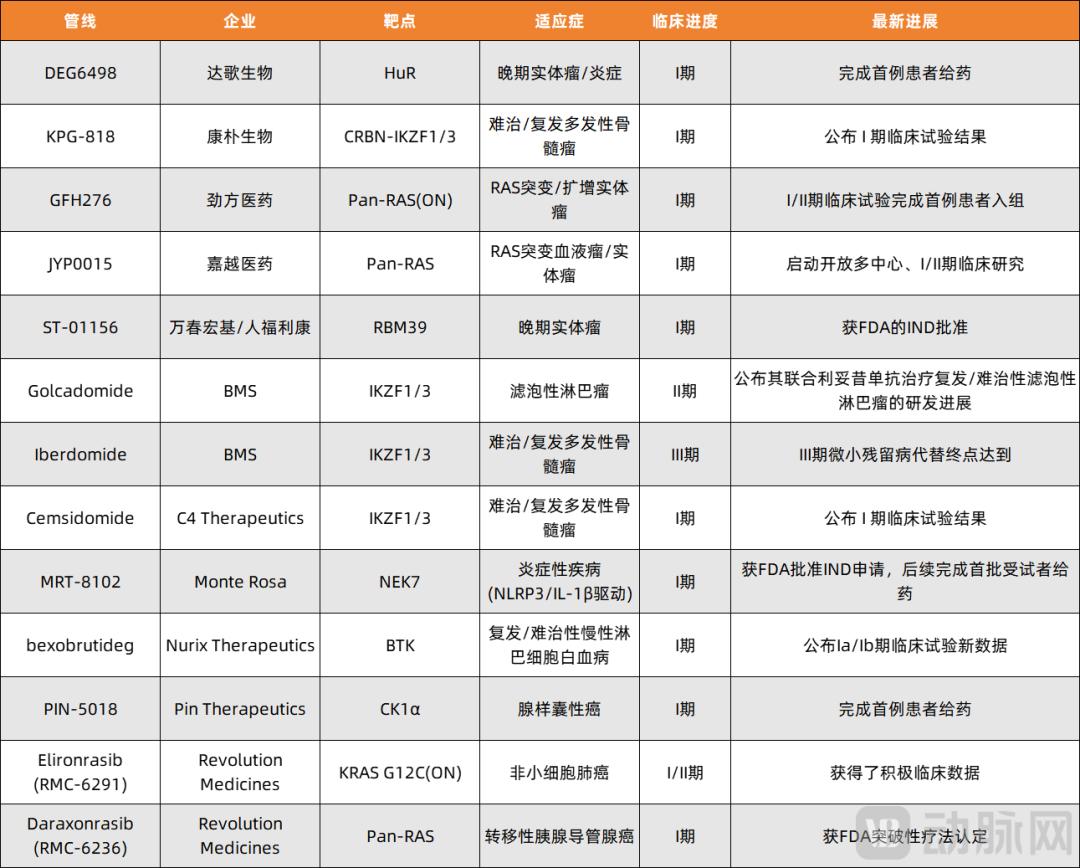
Incomplete statistics from Arterial Network show the molecular glue pipelines that have made progress in the clinical field in 2025.
Obviously, from inducing protein degradation to regulating signaling pathways, and from hematological tumors to solid tumors, molecular glue is reshaping the boundaries of drug research and development from multiple dimensions, including different technical paths and different disease areas.
01 In 2025, Molecular Glue Enters the Development Stage of "Multiple Targets, Multiple Indications"
The explosion of molecular glue R & D in 2025 is far more profound than a simple increase in the number of pipelines. It marks a strategic leap from "marginal innovation" to the "mainstream narrative", fundamentally reshaping the industry's logic of target selection and investment value judgment.
In terms of target selection, the target landscape of molecular glue has rapidly expanded from traditional transcription factors (such as IKZF1/3) to kinases (CK1α), RNA-binding proteins (HuR), GTPases (RAS), and translation termination factors (GSPT1). This diversity is not accidental. It reveals the universality of the core of molecular glue technology: rewriting the intracellular protein interaction network by designing or discovering small molecules.
More strategically, the breakthrough progress made by companies such as Revolution (RMC - 6291, target: KRAS), Dage Biotech (DEG6498, target: HuR), and Seed (ST - 01156, target: RBM39) in the field of emerging targets has gone beyond individual case success. Together, they form a powerful "proof-of-concept chain", announcing to the entire industry that the "molecular glue logic" based on protein interface regulation is a feasible, and perhaps the optimal, path to unlock the treasure trove of targets lacking traditional active pockets.
These emerging targets correspond to the expansion of emerging indications. Molecular glue drugs have gradually extended from the initial hematological tumor field to multiple fields such as solid tumors, autoimmune diseases, and neurological diseases. The progress of molecular glue drugs in the expansion of targets and indications not only directly stimulates the R & D projects targeting more undruggable targets but also indirectly attracts MNCs such as AbbVie, Lilly, Roche, Gilead, and Novartis to quickly layout this track through BD. Just this year, several major cooperation agreements have been reached in this field, with a cumulative cooperation amount exceeding $11 billion.
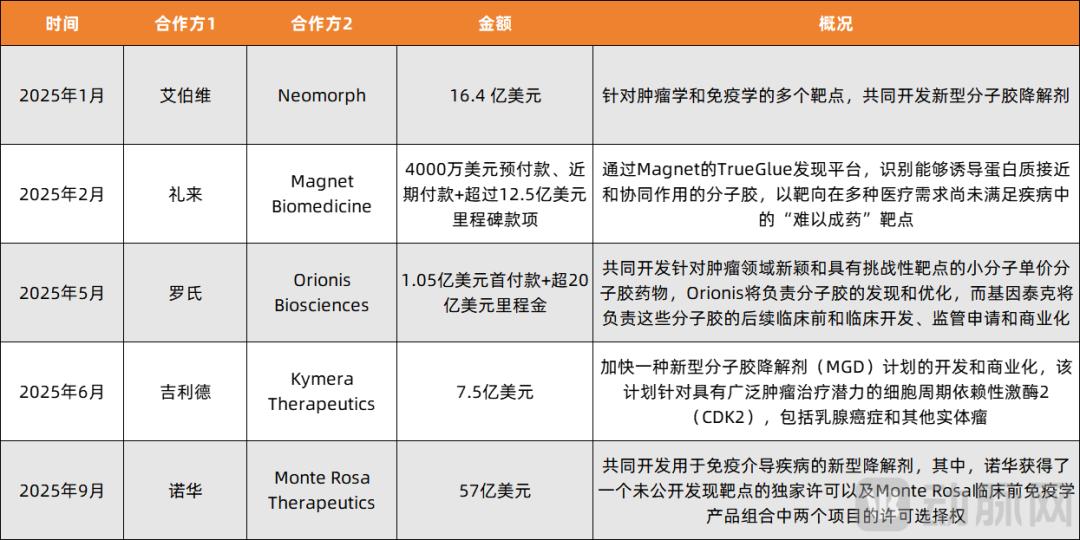
Incomplete statistics from Arterial Network show the BD agreements reached in the molecular glue field in 2025.
In summary, in 2025, the BD boom in the molecular glue field that started in 2024 continues, showing a development trend of "multiple targets, multiple diseases" breakthroughs. The core driving force lies in its systematic demonstration that it is not a "skillful" tool limited to a specific target (such as CRBN-dependent degradation). Instead, as a universal drug action paradigm, it can provide new solutions for different types of protein functions and disease mechanisms.
Therefore, the panoramic picture of 2025 depicts a scenario of niche migration: molecular glue is accelerating its transformation from an "emerging technology" that needs to prove its value to one of the "standard options" that must be considered when evaluating any important disease target. This is not only a milestone in its technological maturity but also the starting point for it to profoundly affect the underlying logic of global new drug R & D.
02 Multidimensional Technology Integration Enables Molecular Glue R & D to Enter the Engineering Development Stage
The underlying source driving the rapid development of molecular glue is the breakthrough and application of drug screening technologies.
The traditional drug screening model is similar to searching for a specific target in an unknown space. Its core strategy is to pursue high-affinity single-target binding, which can be compared to finding a key that can precisely fit a specific lock cylinder. However, the mechanism of action of molecular glue requires it to interact weakly with two proteins simultaneously and effectively induce them to approach each other. This process can be regarded as finding two keys simultaneously to open two seemingly unrelated locks, thereby constructing a new mode of molecular interaction.
This fundamental difference makes traditional screening methods ineffective in molecular glue R & D, just like using a hammer instead of tweezers, completely unable to meet the needs of molecular glue R & D. The existence of this key contradiction has urgently promoted the birth of new screening concepts and technology combinations, becoming an important obstacle that must be overcome in the molecular glue R & D process.
In this technological transformation, the "breadth - depth" dual-track strategy emerged as a key solution.
In terms of breadth, the DNA-encoded compound library (DEL) can efficiently encode, store, and screen a vast number of compounds by covalently linking small-molecule compounds with unique DNA sequences. DEL technology has become an important tool in the field of drug discovery, especially showing unique advantages in finding novel lead compounds and exploring undruggable targets (such as membrane proteins and protein - protein interaction interfaces). It is widely used in molecular glue new drug R & D projects.
For example, the diverse DEL library constructed by WuXi AppTec currently contains more than 50 billion small molecules with different structures. Each small molecule is marked with a unique DNA barcode, like a unique individual in the chemical space, facilitating rapid identification and in - depth research by scientific researchers. In the process of exploring new molecular glue targets, the DEL library can search for initial clues about the ternary relationship between E3 - ligand - target protein in this vast chemical space with extremely low cost and without bias, expanding the broad possibilities for the discovery of molecular glue.
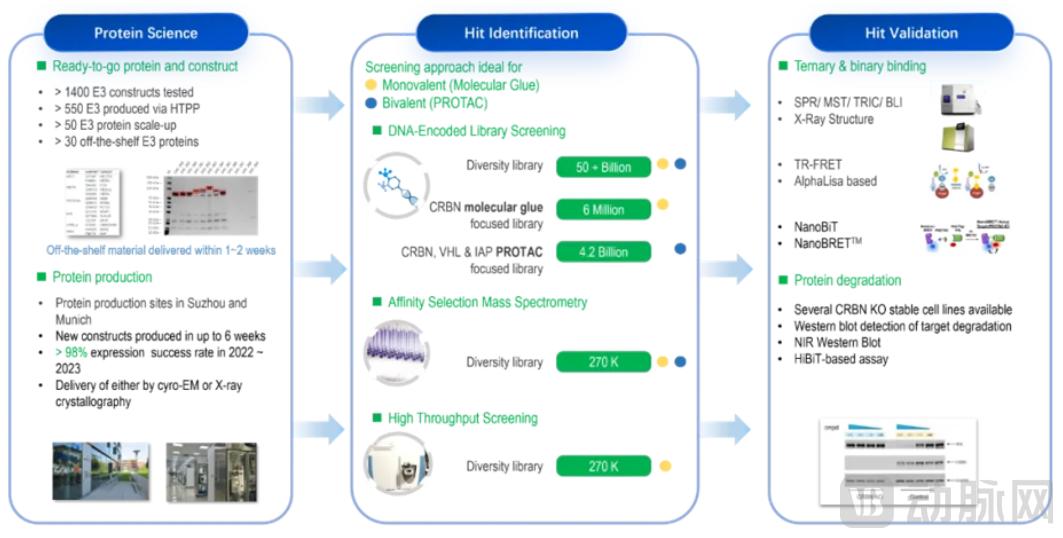
WuXi AppTec's molecular glue technology platform, image source: reference article
In the in - depth exploration of known molecular glue systems, the focused compound library makes full use of existing molecular glue structure knowledge for targeted design. For example, the immunomodulatory drug (IMiDs) compound library targeting the E3 ligase cereblon (CRBN) is a typical case. Through systematic chemical modification of the CRBN protein interaction region, WuXi AppTec has constructed approximately 6 million refined compounds. These compounds are designed and optimized based on existing molecular glue structure knowledge, significantly increasing the probability of finding high - affinity and high - specificity molecular glue and improving the screening efficiency for targets with clear structure - activity relationships.
In addition to the dual-track strategy, multi - technology integration has become an indispensable part of molecular glue R & D, constructing a complete technology closed - loop from "clue discovery" to "candidate optimization". Affinity screening mass spectrometry (ASMS), as a label - free screening technology, can accurately identify potential molecular glue candidates that can promote protein - protein interactions by comparing the mass spectrometry signal differences of molecules in single - protein and double - protein environments, screening out potentially valuable molecular glue from a vast number of compounds.
The high - throughput screening (HTS) technology, with an automated operation mode of "one compound per well" and combined with functional experiments such as protein binding ability or degradation ability, can quickly screen out candidate molecules with biological activity, greatly improving the screening efficiency and accuracy and ensuring that only the most promising molecules enter the subsequent optimization stage.
Structural biology provides key structural information for the optimization of molecular glue by analyzing the three - dimensional structure of the protein - molecular glue complex, helping scientific researchers to deeply understand the interaction mode between molecular glue and proteins and thus optimize the structure of molecular glue in a targeted manner, providing an important basis for improving the performance of molecular glue.
The in - depth integration of these technologies marks that molecular glue R & D has entered the engineering development stage of "multidimensional collaboration". In this stage, various technologies cooperate with each other, complementing each other's advantages, and jointly promoting the transformation of molecular glue from basic laboratory research to clinical application, laying a solid technical foundation for the R & D and application of molecular glue drugs.
03 Molecular Glue Enables a 100% Six - Month Survival Rate for Cancer Patients
In the R & D of many new molecular glue drugs in 2025, pharmaceutical companies at home and abroad have made breakthrough progress in different targets and different disease fields. Their clinical data and mechanism of action provide strong evidence for the potential of molecular glue therapy.
Overseas, star molecular glue companies such as Pin Therapeutics, Revolution Medicines, Monte Rosa Therapeutics, and C4 Therapeutics have all made positive progress this year. Take Elironrasib (RMC - 6291) and Daraxonrasib (RMC - 6236) of Revolution Medicines as examples.
In June, Revolution Medicines announced that the FDA granted the Breakthrough Therapy Designation (BTD) to Daraxonrasib (RMC - 6236), a novel multi - selective inhibitor targeting RAS(ON), for the treatment of previously treated pancreatic cancer with KRAS G12 mutations. This BTD is based on the positive early clinical evidence observed in patients with PDAC (pancreatic ductal adenocarcinoma): the median progression - free survival (PFS) reached 8.8 months (far exceeding the 3 - 5 months of traditional chemotherapy); the six - month survival rate was as high as 100% (only about 60% in the control group); the objective response rate (ORR) was 36% (the tumors of some patients were significantly reduced); the safety was good, and no serious adverse reactions occurred. Currently, the Phase 3 clinical trial of RMC - 6236 is underway, and patient enrollment is expected to be completed in 2026.
Elironrasib (RMC - 6291) is a selective inhibitor of RAS(ON) G12C developed by Revolution Medicines and belongs to non - degradable molecular glue. In October, Revolution Medicines announced that elironrasib achieved positive clinical data in patients with KRAS G12C - mutated non - small cell lung cancer (NSCLC) who had previously received KRAS(OFF) G12C inhibitors: the objective response rate (ORR) was 42%, the disease control rate (DCR) was 79%, the median duration of response was 11.2 months, the median progression - free survival (mPFS) was 6.2 months, and the 12 - month overall survival rate was 62%. Currently, elironrasib is exploring combination regimens with immunotherapy (such as pembrolizumab) and other targeted drugs (such as SHP2 inhibitors) to further improve the efficacy and is also planning to advance to Phase 2 and Phase 3 clinical trials to verify its application value in first - line treatment and more tumor types.
In China, many innovative pharmaceutical companies have also made breakthrough progress in the molecular glue field recently.
For example, in December, Dage Biotech announced that DEG6498, the world's first molecular glue degrader targeting the first - in - class target HuR (Human antigen R), completed the dosing of the first clinical trial subject in China on November 25. HuR is an RNA - binding protein that plays a crucial role in the progression of diseases such as cancer, inflammation, and metabolism and was previously considered an undruggable target in the industry. Dage Biotech successfully overcame this problem with its independently established specific molecular glue drug discovery platform and innovative technology. DEG6498 is a potent, orally bioavailable small - molecule molecular glue degrader that can induce the interaction between the E3 ubiquitin - ligase Cereblon (CRBN) and HuR, thereby promoting the targeted degradation of HuR protein. As the world's first molecular glue degrader targeting HuR, DEG6498 is expected to meet the urgent medical needs in multiple indication fields that have not been met.
In November, Kangpu Biotech announced the results of the Phase I clinical trial of the molecular glue degrader epaldeudomide (KPG - 818) for the treatment of hematological tumors. KPG - 818 belongs to the CRL4 - CRBN regulator of the E3 ubiquitin - ligase complex and has high affinity for the target CRBN. In patients with refractory or relapsed multiple myeloma who had previously received two lenalidomide - based drugs, at least one protease inhibitor, and one anti - CD38 monoclonal antibody, the combination of KPG - 818 and dexamethasone achieved an objective response rate (ORR) of 50% and a disease control rate (DCR) of 94%. It exerts broad - spectrum immunomodulatory, anti - angiogenic, and anti - tumor effects by efficiently degrading the zinc - finger transcription factors Aiolos (IKZF3) and Ikaros (IKZF1).
In addition, Chinese pharmaceutical companies such as Jingfang Pharmaceutical, Jiayue Pharmaceutical, Wanchun Hongji, and Renfu Likang have all made good progress in the molecular glue field this year.
Pharmaceutical companies at home and abroad are all deploying molecular glue pipelines because the molecular glue track has high technical barriers, relatively less competition, and is penetrating from tumors to a broader range of disease fields. More importantly, in the molecular glue field, only three drugs, thalidomide, lenalidomide, and pomalidomide, have entered the commercialization stage. High technical barriers + a large market gap provide a stage for China's start - up pharmaceutical companies to compete with international star pharmaceutical companies and a strategic window for domestic pharmaceutical companies with innovation capabilities to overtake on the curve. In the future, with the continuous emergence of clinical trial data, some promising domestic molecular glue pipelines are expected to stand out, winning more voice for Chinese pharmaceutical companies in the global market.
04 Future Outlook: What Are the Challenges for Molecular Glue in the Next Decade?
Although molecular glue has made remarkable progress in 2025, it still faces many severe challenges on the future development path.
Target selectivity is one of the primary challenges faced by molecular glue. In a complex biological system, ensuring that molecular glue can precisely act on the target while avoiding unnecessary interactions with other non - target proteins is the key to achieving safe and effective treatment. However, the current molecular glue technology still has certain limitations in target selectivity, which may lead to off - target effects and a series of adverse reactions. For example, while degrading the target protein, some molecular glue may unexpectedly affect the stability of other proteins related to normal physiological functions, causing potential harm to the body.
Off - target toxicity is also a problem that cannot be ignored. Even if molecular glue can relatively accurately target the protein of interest, its mechanism of action involves inducing interactions between proteins, which may trigger a series of chain reactions within cells, leading to unpredictable toxicity. This off - target toxicity not only limits the dosage and efficacy of molecular glue drugs but also may hinder their further clinical application. How to minimize off -