Is the iPhone Air doomed?
"The thinnest iPhone to date," the iPhone Air, with a thickness of only 5.6 millimeters and weighing 165 grams, attracted plenty of attention even before its release.
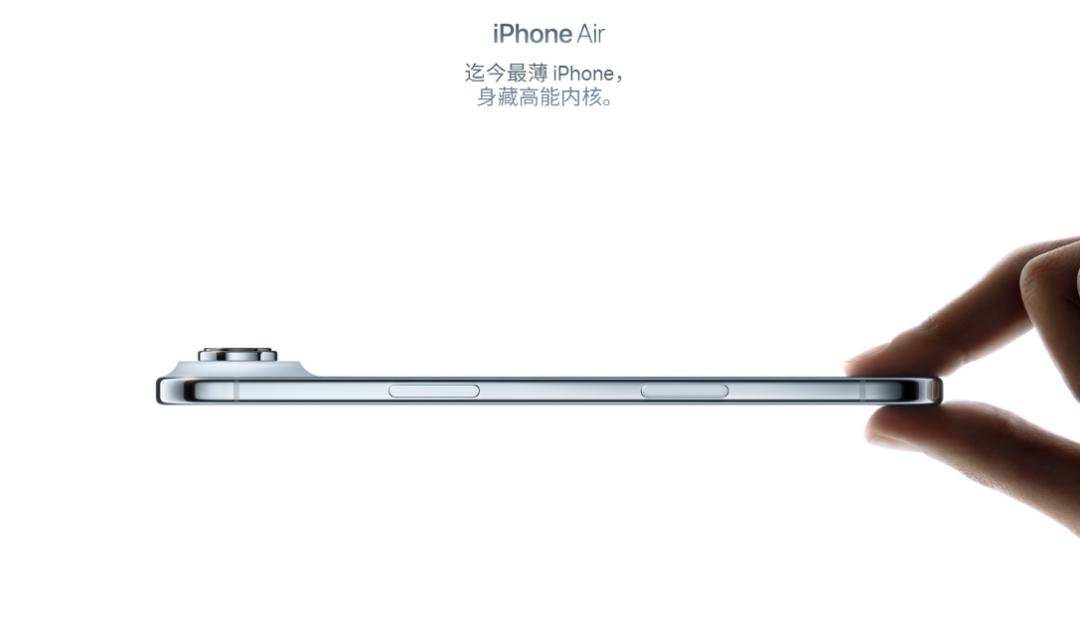
Image/Screenshot from Apple's official website
However, since its official release on October 22, 2025, its market performance has fallen far short of expectations.
There's hardly any need to prove its poor sales as the production side has already given feedback. Reports say that Apple's suppliers have dismantled several iPhone Air production lines. Even several mobile phone manufacturers such as Xiaomi, OPPO, and vivo have recently announced the cancellation of projects related to thin and light models.
Why hasn't this phone, once regarded as the biggest highlight of Apple's 2025 autumn press conference, made more people really want to own it?
Is no one "in love" with the iPhone Air?
Li Chen (pseudonym) is a tech-savvy guy. His requirements for a phone are so simple that they seem a bit "outdated": he doesn't play games, doesn't like taking photos, rarely uses the phone's external speaker, and just needs the battery to last barely half a day. Most importantly, it has to be light. For this, he's willing to sacrifice some features and choose the iPhone Air.
But people like him aren't the mainstream in today's smartphone market. This directly leads to the iPhone Air's awkward situation: it satisfies a small group's desire for thinness and lightness, but can't meet the needs of the majority.
Judging from the actual market feedback, thinness and lightness aren't a must-have. In fact, they don't even rank on many people's decision-making lists. This year, Apple's iPhone 17 series has sold quite well. On the JD.com mobile phone sales ranking list during the recent "Double 11" event, the iPhone 17 series occupied the top three spots on the cumulative single-product list, while the iPhone Air, released at the same time, was nowhere to be found.
Guo Mingji, a well-known Apple analyst and an analyst at Tianfeng International Securities, once said that the iPhone Air is a product that may arouse the motivation to buy after actual hands-on experience. Li Chen, who was very used to his iPhone 15 Pro, only started thinking about changing his phone after "feeling" the iPhone Air several times at an Apple offline store.
To achieve the "thin and light" goal of 5.6 millimeters in thickness and 165 grams in weight, the iPhone Air made concessions in key configurations such as the battery, camera, and speaker. The battery with a capacity of only 3149 mAh takes up a large part of the body. There's also a single camera and a single speaker, which are quite rare in today's mainstream smartphones. Even the SIM card slot has been removed.
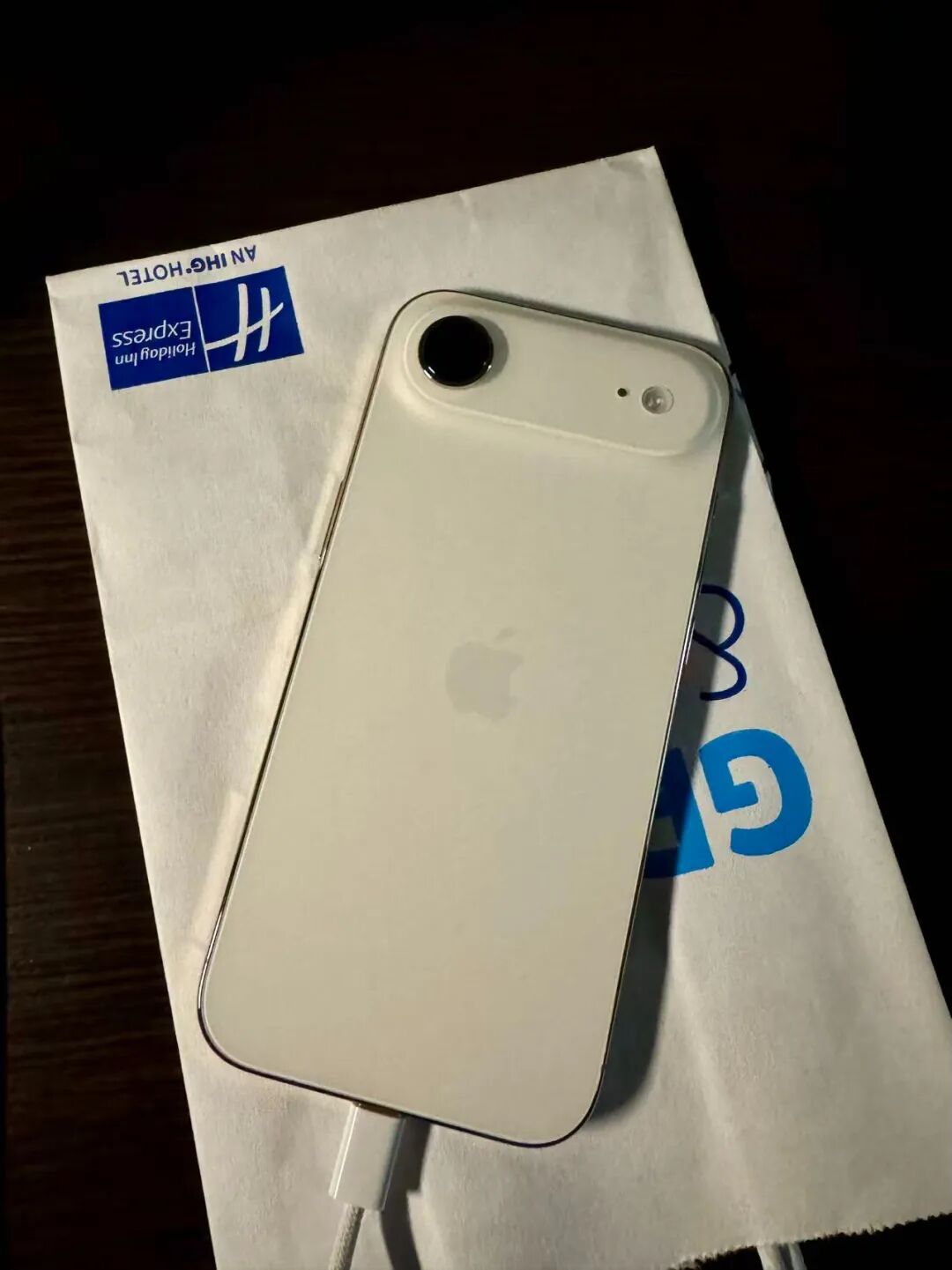
Image/Provided by the interviewee
When a mobile phone is no longer just a communication tool but has to undertake various functions such as taking photos, shooting videos, video editing, playing audio and video, and gaming, the iPhone Air's "thinnest to date" is directly replaced by "reduced configuration" in the eyes of many consumers.
More importantly, it's the price.
The starting price of the iPhone Air is 7,999 yuan, higher than most Android flagship phones. Although it's the same price as the 512GB iPhone 17, its storage capacity is only half of the latter. Facing the iPhone 17, which is hailed as the most cost - effective standard - version iPhone this year, the iPhone Air seems even more inadequate. Moreover, consumers have to go to the business hall specifically to change to an eSIM card.
GfK found in its monitoring of the "Double 11" mobile phone market this year that high - end models priced above 6,000 yuan have witnessed explosive growth, accounting for up to 50% of the sales volume in this price range. Its analysis believes that flagship phones accurately address users' pain points and also provide emotional value beyond basic functions. They are no longer just productivity tools.
In other words, consumers aren't reluctant to spend a lot of money on a phone. They need a reason to pay for "high - end". So many people have to start thinking before buying the iPhone Air: "Why spend the same amount of money on a phone with reduced configuration?"
Zhong Xiaolei, an analyst at the technology research and consulting firm Omdia, told the Interesting Report that the Samsung Galaxy S25 edge, which was released earlier, also faced the same situation of not being recognized by the market. "In today's highly competitive mobile phone market, consumers are already used to high - configuration phones. Most people can't accept paying the price of a flagship phone for just the selling point of thinness and lightness, especially when several configurations have been 'cut'."
As industry analyst Zhang Shule mentioned, consumers do have a demand for thinner phones, but compared with pain points such as performance and battery life, this is always just an "itch". The actions of the industry confirm this.
Apple's supply chain was reported to have dismantled some Air production lines, and Android manufacturers reached the conclusion earlier. There are reports that Xiaomi, OPPO, and vivo have canceled projects related to thin and light models, and the eSIM technology originally prepared for Air - like models has directly returned to regular flagship phones.
With consumers not buying in, it seems that the entire industry can't find a reason for "thin and light phones" to enter the mainstream for the time being.
Will the Air disappear?
However, Zhong Xiaolei also said that Apple may not care that much about the demand for thin and light models.
Previously, Apple's mid - range models such as the mini and Plus series didn't meet market expectations. Especially for Chinese consumers, they still care more about the balance between size and cost - effectiveness, and the iPhone Air is no exception.
"The iPhone Air doesn't have the '17' in its name, which shows that Apple may not have intended to make it a model updated annually, and it's obviously not a phone that can achieve high sales volume." As early as the press conference, Zhong Xiaolei mentioned that the iPhone Air is more of a preliminary pilot for the foldable model that may be launched next year, accumulating more engineering experience in stacking more components in a limited space.
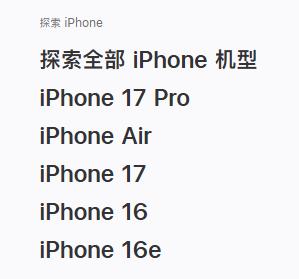
The iPhone Air, independent of the digital series. Image/Screenshot from Apple's official website
He also added that Apple has always emphasized the importance of design. The innovative attempt of the iPhone Air in terms of form is also conducive to further strengthening its brand image centered on design.
Zhang Shule agrees with this. Although he thinks that the iPhone Air lost its product memory point because the eSIM couldn't be implemented smoothly at the beginning, and the general consumers don't have a strong enough understanding of the "ultra - thin" concept, Apple has always had the tradition of making innovative trials and errors in all directions, including form. "In this sense, the iPhone Air is still very 'Apple'."
When someone makes frequent trials and errors, there are many followers. In the past, the industry often joked that Apple felt its way across the river, and other manufacturers felt their way across the river by following Apple. But this time, the Android manufacturers that were just about to "cross the river" withdrew even faster.
As soon as the iPhone Air was launched in the domestic market, Guo Mingji publicly stated that the supply chain had started to reduce shipments and production capacity. The production capacity will generally be reduced by more than 80% by the first quarter of next year. Just over a month later, several Android manufacturers announced the cancellation of their Air model projects. According to Jiemian News, Honor still has a thin and light phone project, and Lenovo and Transsion still retain their Air models.
Zhong Xiaolei pointed out that Android manufacturers are always sensitive to consumers' needs. On the one hand, they think there is an objective market demand for thin and light phones, so they choose to follow up. On the other hand, they will respond quickly after getting market feedback and make flexible adjustments.
The "flexibility" of Android manufacturers may also be reflected in the fact that their attempts at thinness and lightness don't try to go to the so - called "extreme" like Apple.
For example, the Huawei Mate 70 Air, released in early November, is called "Air", but it's 6.6 millimeters thick and weighs 208 grams. It's also equipped with a 6500 mAh battery, and the starting price is 4,199 yuan. Just looking at the sales of this model in Huawei's JD.com official flagship store, this Air model with a relatively balanced performance and price has won the favor of many people.
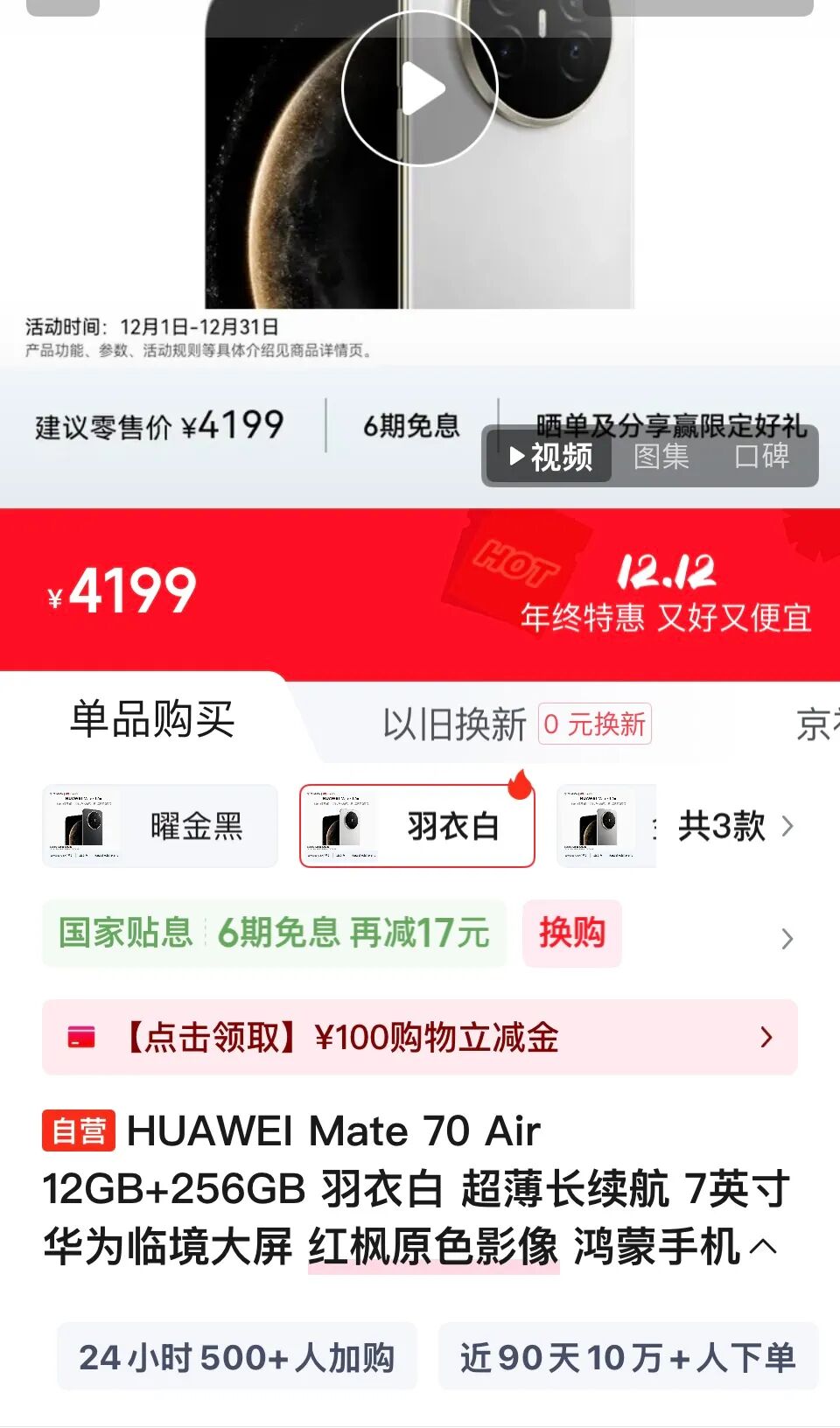
Image/Screenshot from the e - commerce page
As for the Lenovo moto X70 Air, which is also on sale, it's very close to the iPhone in terms of thickness, only 5.9 millimeters. Thanks to its plastic body, it weighs less than 160 grams and has a 4800 mAh battery. More importantly, the official price of this thin and light smartphone is only 2,599 yuan. After platform discounts and subsidies, it only costs about 2,000 yuan, which is quite affordable.
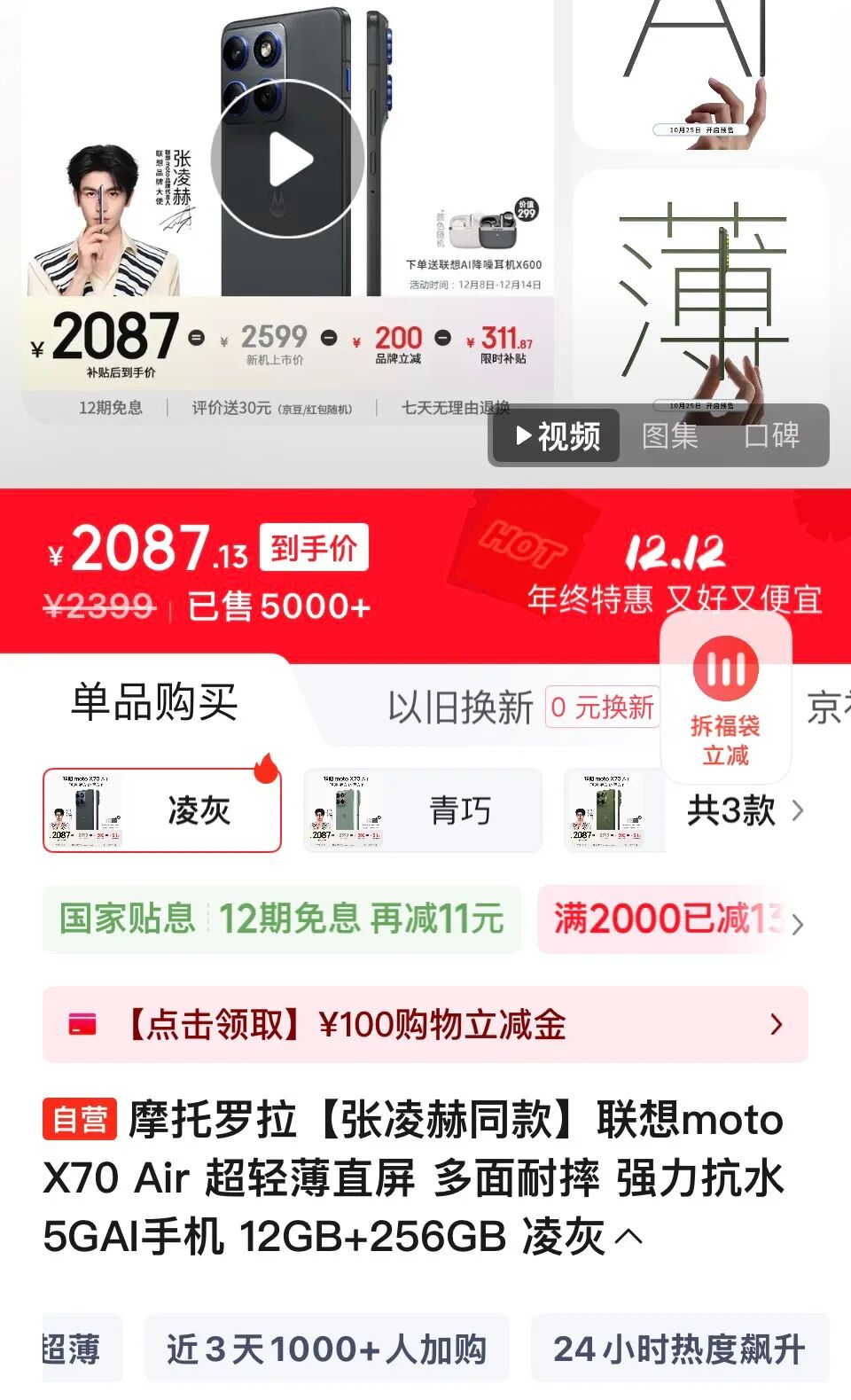
Image/Screenshot from the e - commerce page
Regarding this, Zhong Xiaolei commented that the overall strategy of Android manufacturers is relatively conservative. They don't "slash" the configurations like Apple and have also made certain distinctions in the price range, which can improve consumers' acceptance of thin and light models to a certain extent.
Therefore, although the iPhone Air may not be successful in terms of sales, it doesn't mean that making phones thin and light is a failed attempt.
"Thinness and lightness are more of a development direction than a specific model." Zhang Shule said that although thinness and lightness aren't a must - have, they are still a relatively basic need. Especially for the foldable screen, which has always attracted much attention and which Apple is also testing the waters with the iPhone Air, it also needs to become thinner and lighter in the future.
Zhong Xiaolei said that Apple's integration of software and hardware may be its greatest advantage when developing foldable screen products, that is, how to truly bring out the advantages of the large screen of the foldable screen through software. He also reminded that whether it's thin and light models or foldable screens, innovation in form mainly determines the success or failure of a certain product. In the future, the competition in the mobile phone industry will still return to a higher - level AI.
This article is from the WeChat official account "Interesting Report", author: Liang Tingting, published by 36Kr with authorization.