Why can't the strong sales of AITO stop the decline of Seres' shares on the Hong Kong Stock Exchange?
Screenshot from the official WeChat account of SERES Group |
Why has the capital lost patience with SERES, which went public in Hong Kong with many halos?
On November 5th, SERES was listed on the Hong Kong Stock Exchange at an issue price of HK$131.50. The net proceeds of up to HK$14.016 billion have given SERES three halos: the largest IPO of a complete vehicle enterprise globally since 2025, the largest IPO of a Chinese automaker to date, and the first luxury new energy automaker to achieve dual - listing in both the A - share and H - share markets.
In addition, with a price discount of about 24% compared to its A - shares, SERES received 133 times over - subscription during the public offering stage of this IPO, and as many as 22 well - known investment institutions participated in this cornerstone investment.
However, the trading performance on the listing day did not match the previous enthusiasm: On the listing day, the opening price was lower than the issue price, and the stock price dropped to a minimum of HK$118 during the session, a decline of more than 10%.
On November 6th, Citigroup released its latest rating report, downgrading SERES' A - share rating from "Neutral" to "Sell", and significantly reducing the target price by about 20% to RMB 129.1 compared to the previous trading day; for the H - shares, it gave a "Neutral" view. Almost at the same time, many foreign investment banks also tightened their judgments synchronously.
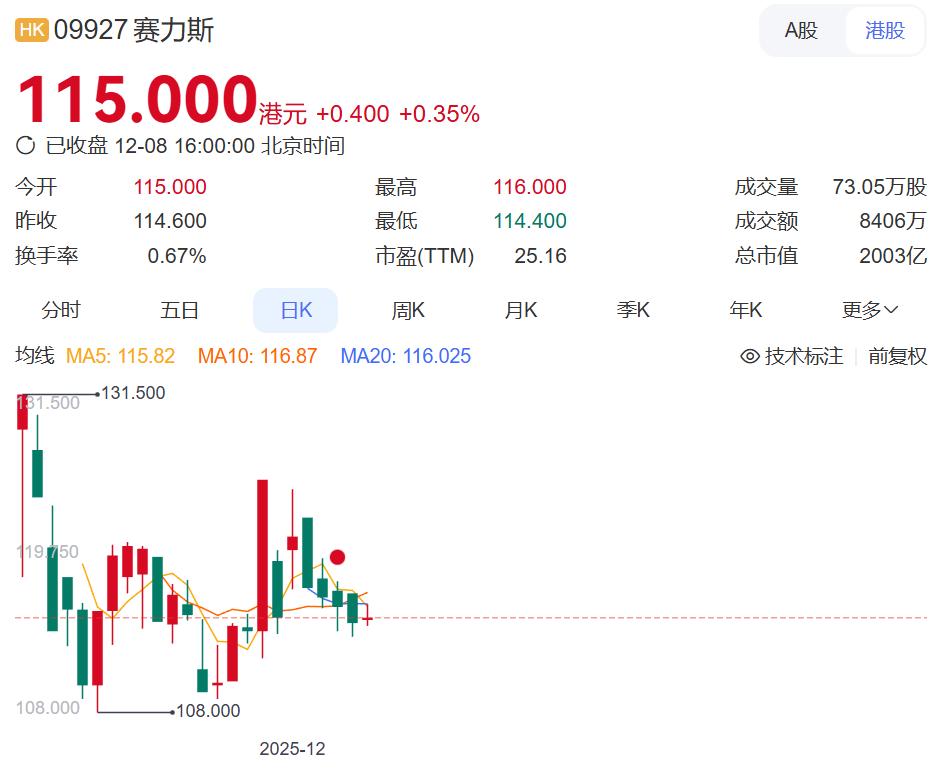
As of the close on December 8th, SERES' H - shares were quoted at HK$115 per share, and its market value shrank by 12.5%.
In the view of Yilan Business, the market's re - evaluation of SERES' growth quality stems from both the concerns behind its high - speed growth and the fact that its business model deeply bound to Huawei has been put on the table again.
The Wenjie series sells well, but the costs are hard to control
If only looking at sales volume and revenue, SERES seems to be at the top of the growth curve.
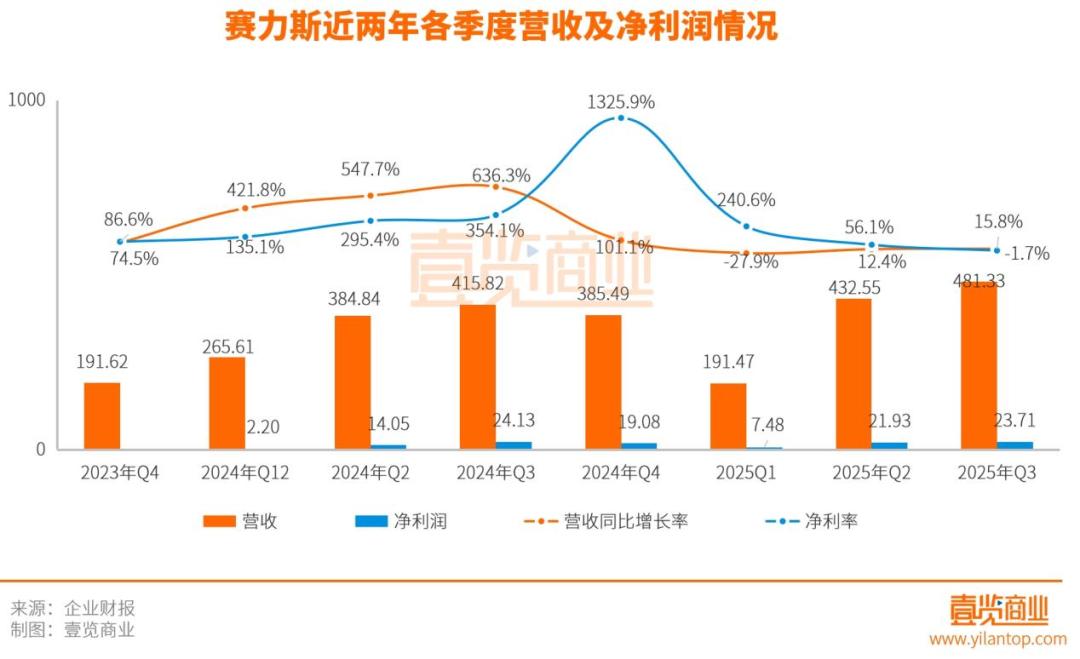
The Wenjie series has almost single - handedly boosted the company's expansion speed in the past two years: In 2024, SERES' operating revenue reached RMB 145.176 billion, a year - on - year increase of 305.04%. The sales volume of new energy vehicles exceeded 420,000 for the first time, and the net profit turned positive, achieving a record high of RMB 5.946 billion.
In 2025, this trend continued: The revenue in the first three quarters reached RMB 110.5 billion, a slight year - on - year increase of 3.67%; the net profit was RMB 5.312 billion, a year - on - year increase of 31.56%. In the first half of 2025, the cumulative sales volume of the Wenjie brand accounted for 76.5% of SERES' total sales volume, and the corresponding revenue accounted for 90.3%.
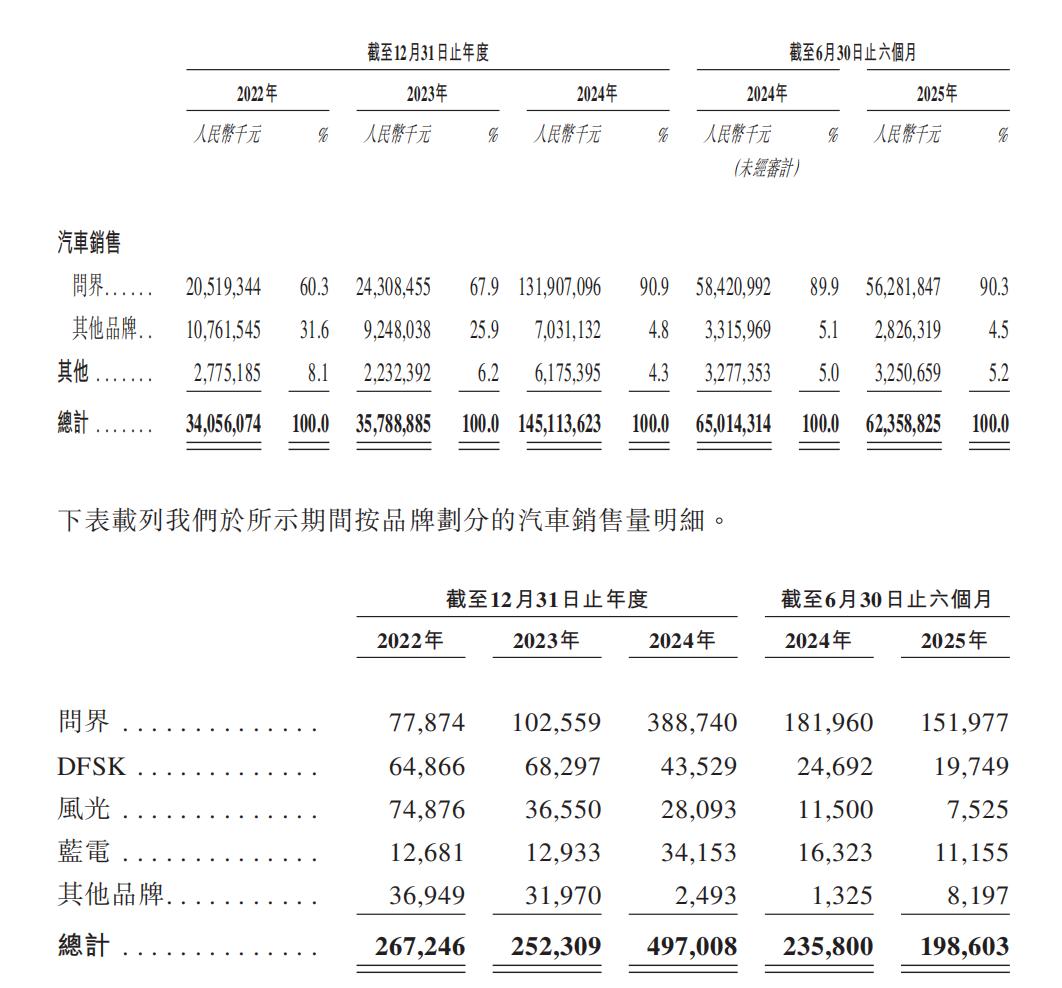
Looking at SERES' financial performance in the past eight quarters, the main reason for the profit growth being greater than the revenue growth this year lies in the change in the sales volume composition of the Wenjie series in the first half of the year.
From January to June last year, the best - selling model of the Wenjie series was the M7, priced at RMB 249,800 - 329,800. The cumulative sales volume in the first half of the year exceeded 100,000, making it the absolute mainstay of the brand. In the same period this year, the sales focus of the Wenjie series has shifted to the higher - priced M9 and M8, with 67,000 and 35,000 units delivered respectively, directly pushing the average price of the brand above RMB 400,000. Although the overall sales volume declined slightly, the selling price per vehicle increased significantly, resulting in a better revenue structure. At the same time, the co - production of the M8 and M9 effectively diluted the manufacturing cost during the capacity expansion period.
Therefore, on the premise of ensuring positive revenue growth, SERES can increase profits by reducing operating costs. However, it is also worth noting that this trend is waning. In the first quarter of 2025, SERES' operating costs decreased by 33.52% year - on - year, 10.22% in the second quarter, and only 2.08% in the third quarter.
It is worth noting that even though there has been a reduction in operating costs, the saved money is difficult to cover the increase in sales expenses. SERES' sales expense ratio has been maintained at around 13% from the fourth quarter of 2023 to the third quarter of 2025, but it has been steadily rising since the fourth quarter of last year.
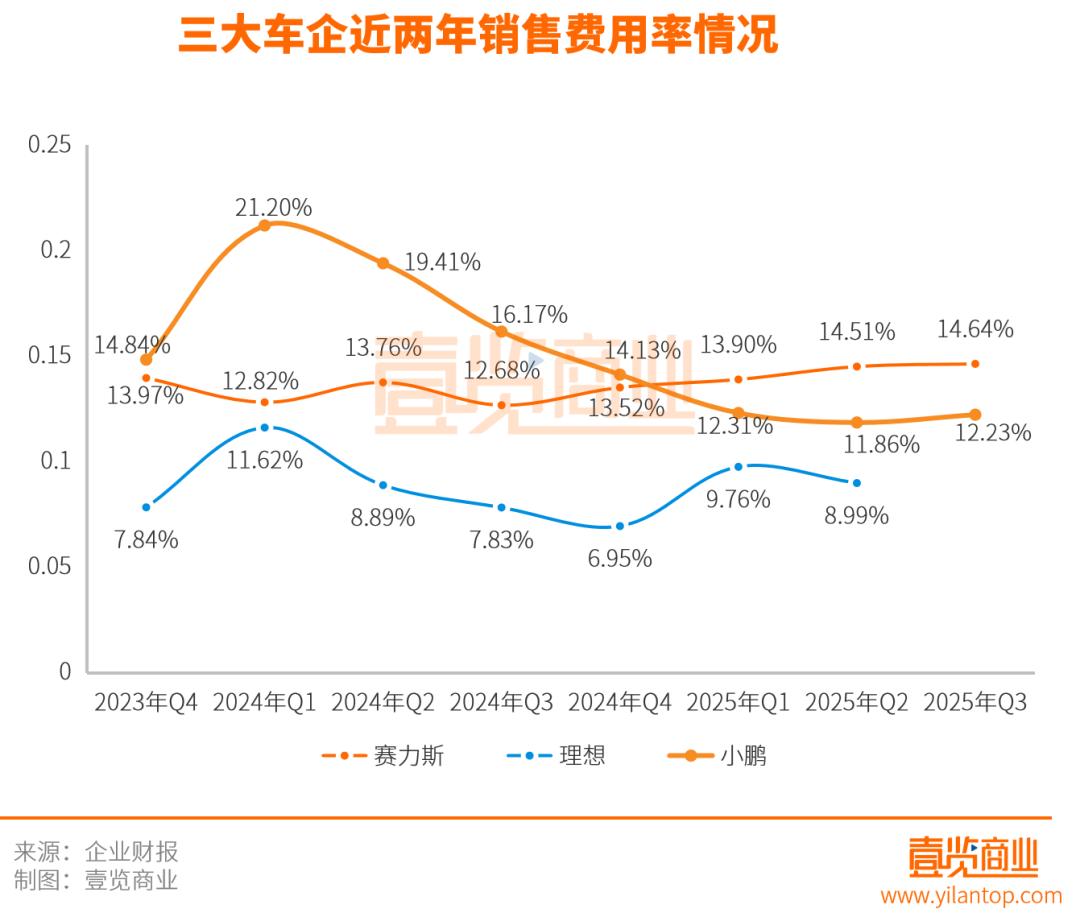
Compared with its profitable peers, Li Auto's sales expense ratio has always been kept below 10%. Although XPeng's sales expense ratio was much higher than SERES' before this year, it has been gradually decreasing this year and is now far lower than SERES'.
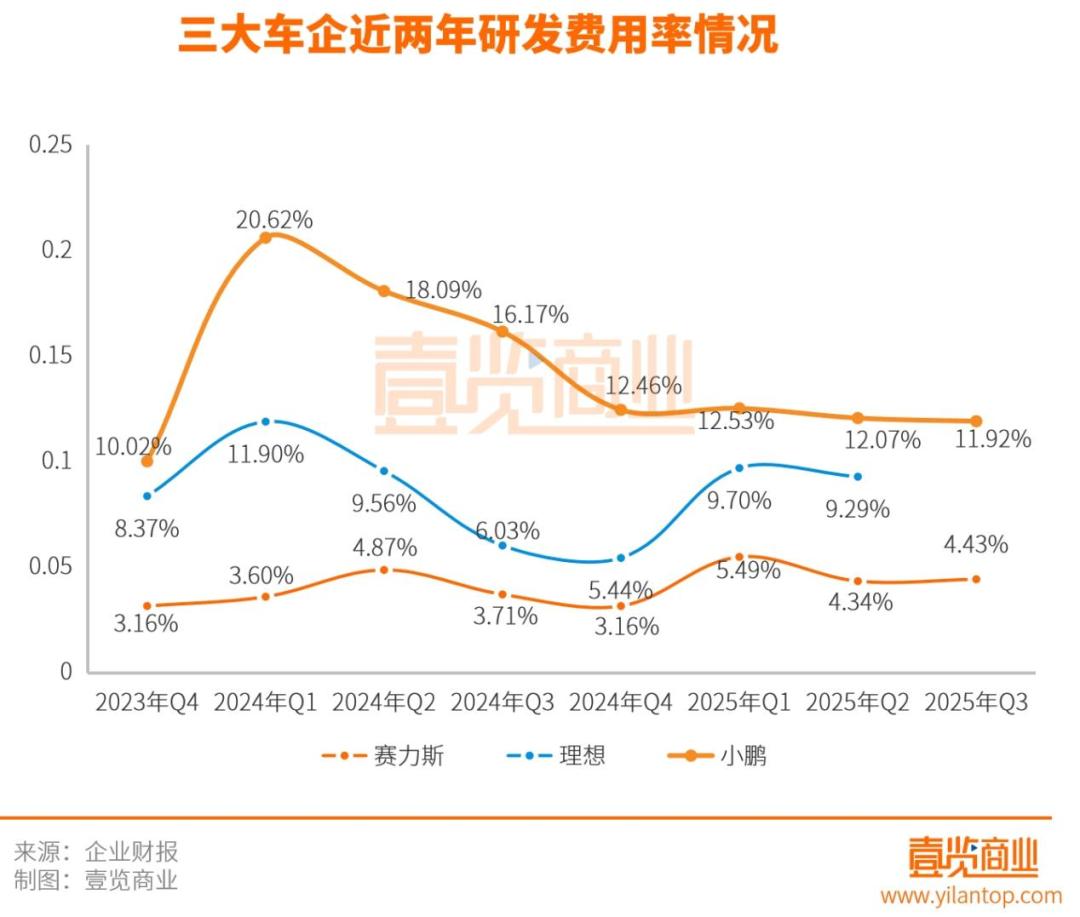
In terms of R & D expense ratio, XPeng is the most aggressive, reaching as high as 20.62% in the first quarter of 2024 and gradually falling back to around 12% in 2025. Li Auto maintains a medium - level range, with 11.90% in the first quarter of 2024 and remaining between 9% - 10% in 2025. SERES is the most cautious, with only 3.16% in the fourth quarter of 2023, and basically fluctuating between 3% - 5% in each quarter from 2024 - 2025, significantly lower than Li Auto and XPeng.
Overall, the trend of SERES' cost side lacks sufficient flexibility. Under normal circumstances, when revenue growth starts to slow down, enterprises will correspondingly reduce marketing, human resources or channel investment to maintain the profit structure; however, SERES' sales expense ratio has not been significantly adjusted with business fluctuations, which may be the result of the company's exogenous fixed expenses.
This exogeneity largely comes from the Hongmeng Smart Mobility model. The store system, brand marketing, intelligent driving experience, channel services and other aspects of the Wenjie series highly depend on the system construction led by Huawei. The costs borne by SERES will not be significantly reduced due to changes in its own sales volume. The lack of "downward space" for expenses means that after the industry enters the stage of in - depth competition, SERES' ability to adjust prices and optimize costs will be limited, which is exactly what investors are most vigilant about.
Capacity has expanded, and the sales pressure has also increased
In addition to the pressure on the cost side, SERES' expansion on the asset side is also worthy of attention.
At the end of 2024, the scale of the company's "Property, plant and equipment" just exceeded 10 billion, but it had risen to 15.6 billion in the first half of 2025; during the same period, the construction in progress soared from 203 million to 1.002 billion. These increments mainly come from the production line investment of the Wenjie M7/M8/M9 and the consolidation of the Longsheng New Energy Super Factory, which means that the company is betting on the large - scale capacity and high - end manufacturing capabilities in advance for its growth in the next few years.
Currently, SERES owns three smart factories, namely the Longsheng Super Factory, the Phoenix Super Factory and the Longxing Super Factory. As of the last practicable date, SERES' total annual production capacity is approximately 600,000 vehicles. For reference, in 2024, SERES sold nearly 390,000 vehicles of the Wenjie series throughout the year.
The advantage of this model lies in the improvement of production efficiency and supply - chain controllability, but it also brings higher depreciation, higher fixed costs and stronger dependence on sales volume. Once the sales volume fluctuates, the pressure on the gross profit margin will increase faster than that of automakers with a light - asset model.
At present, SERES still needs to face two major sales challenges:
Firstly, although the improvement of the product structure has achieved results, the sinking and mass - market models are still weak. Although high - end models have high unit prices and strong gross profits, the price strategy itself limits the expansion of sales volume on a larger scale; secondly, the competition in the entire niche market has intensified. Models such as the LeDao L90 and the NIO ES8 have frequently achieved sales of over 10,000 units in the mid - to - large - sized new energy SUV market. If SERES cannot timely launch a richer price range and a stronger product matrix, there will be a risk of not fulfilling its "one - million - vehicle" capacity plan.
Meanwhile, SERES' liquidity situation is not ideal. In the third quarter of 2025, the company's current ratio was 0.91 and the quick ratio was 0.87, both lower than the safety line of 1 and also lower than those of Li Auto and XPeng, two new - energy vehicle startups that have entered the stable operation stage. Li Auto's current ratio reached 1.73 during the same period, and XPeng's was 1.12. In terms of solvency, the assets on SERES' books that can be quickly realized are still insufficient to cover short - term liabilities. The operating cash flow must be maintained at a high level to support daily capital turnover, which means that the company's dependence on sales volume, payment collection and business rhythm is much higher than that of its peers.
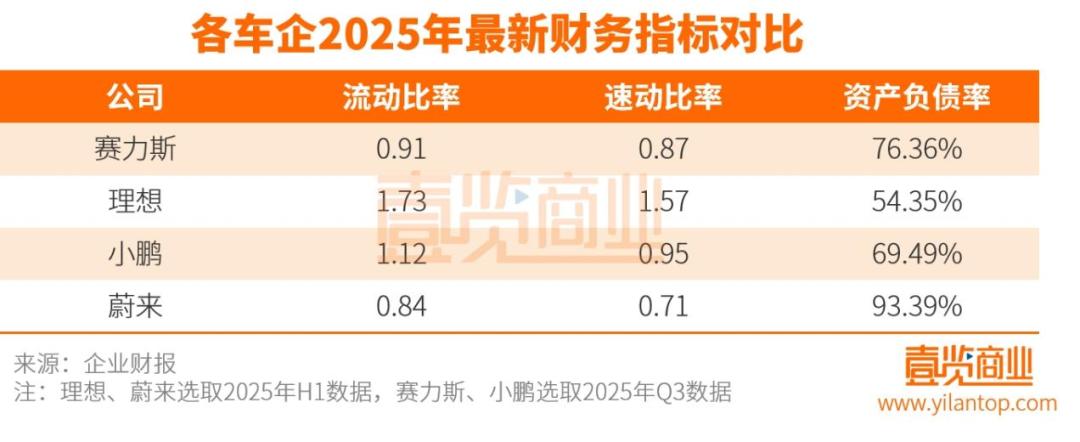
The comparison of asset - liability ratios also confirms this point. In the third quarter of 2025, SERES' asset - liability ratio was 76.36%, higher than that of Li Auto (54.35%) and XPeng (69.49%), and only lower than that of NIO (93.39%), which has been in a high - leverage state for a long time. Against the background of continuous expansion of fixed assets, this asset - liability ratio means that the company will still need to rely on financing and operating cash flow to support capacity construction in the future.
Heavy - asset expansion increases the operating leverage, low liquidity compresses the safety margin, and a high debt ratio weakens the ability to resist cyclical fluctuations. In the valuation system, such a structure often cannot obtain a higher risk premium.
Overall, what SERES' balance sheet shows is not only "efficiency brought by scale" but also "pressure brought by scale": The larger the production capacity, the higher the requirement for sales volume; the higher the debt, the more sensitive it is to cash - flow fluctuations. This also explains why the market is cautious about its short - term profit improvement.
The crisis behind the "Huawei factor"
When growth is based on an external ecosystem, the valuation system becomes fragile. SERES has made the market smell the hidden risks behind it due to its overly high "Huawei factor".
In its prospectus, SERES spent a lot of space explaining Huawei's role and importance in its business system. The growth path of this enterprise is embedded in the intelligent vehicle ecosystem led by Huawei. Whether it is the market recognition of the Wenjie brand, the technical capabilities of the in - vehicle system, or the reach mode of the sales channels, Huawei runs through almost the entire R & D, production, sales and service chain of SERES. The prospectus clearly states that the company's business development, financial condition and operating performance largely depend on maintaining a stable cooperative relationship with Huawei.
From the perspective of the business structure, the core technologies of the Wenjie models, such as the intelligent cockpit, the Hongmeng in - vehicle system, the ADS high - level intelligent driving, the OTA upgrade ability, and the user operation system, all come from Huawei. At the marketing level, Huawei not only provides online shopping malls and offline experience stores but also deeply participates in the pricing strategy, user experience and delivery process. Even the post - purchase operation and management rely on the AITO operation system managed by Huawei. This means that SERES controls the manufacturing end, while Huawei controls the technology end and the user end of the value chain.
In 2024, SERES acquired a 10% stake in Shenzhen Yinwang held by Huawei for 1.15 billion yuan, further strengthening its tie with Huawei. Yinwang is the platform for Huawei's core systems such as intelligent driving and intelligent cockpit, and controls software authorization, algorithm systems and technical interfaces. By holding shares, SERES has obtained the stability of partial resource investment.
This cooperation model has obvious advantages. For example, the brand potential under Huawei's narrative has enabled SERES to quickly cross the cold - start stage and directly enter the high - end new energy vehicle market. After the launch of the Wenjie M9, it quickly benchmarked against Mercedes - Benz, BMW and Li L9, achieving a leap - forward improvement in brand status. However, it also means that once Huawei allocates more resources to other partners such as Chery (JieJie), BAIC (XiangJie) or Dongfeng, SERES' exclusivity in channels, traffic and intelligent driving resources will be weakened.
Therefore, the market's doubts about SERES are not a denial of its current achievements, but a concern that its core capabilities are overly dependent on Huawei, resulting in insufficient controllability in the future.
To put it simply, the core pressures SERES is currently facing are concentrated in three points: Its growth mainly depends on the short - term optimization of the product structure; the balance sheet is becoming heavier due to continuous capacity expansion; and its key competitiveness is deeply embedded in the Huawei ecosystem, lacking autonomy. In the Hong Kong stock market, which values profit quality and sustainability