In 2026, the first year of mass production, where are the opportunities for humanoid robots?
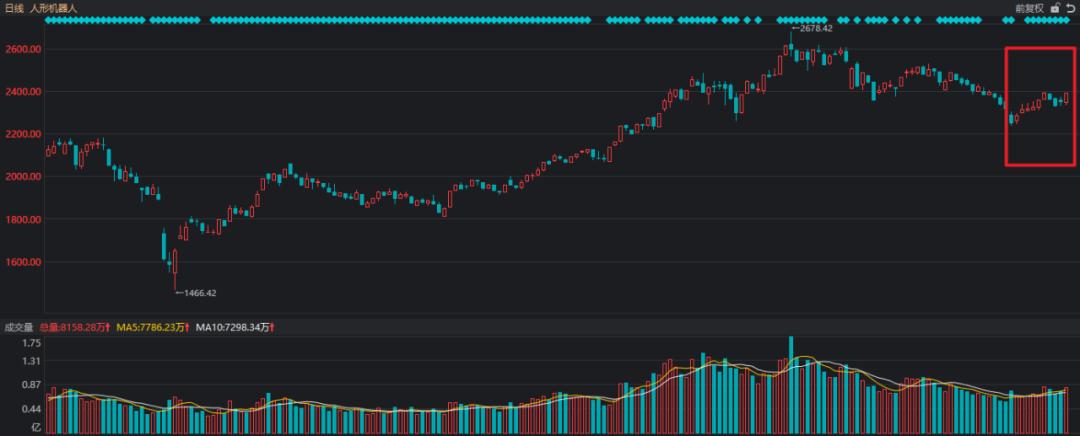
Recently, there has been a "hot wave" of humanoid robots in the global capital market: the humanoid robot sector in the A-share market has rebounded from the bottom, and the trading volume has also increased synchronously. On Friday, Lixing Co., Ltd. hit the 20% daily limit, and stocks such as Hengli Hydraulics and Haozhi Electromechanical showed strong performance.
Source: Flush
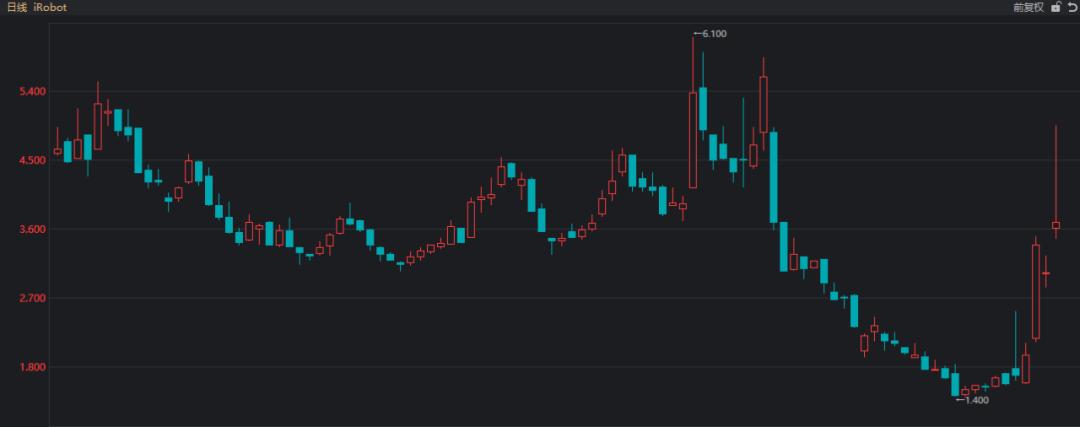
The US stock market has also been agitated. After the US government signaled "full support" for the robot industry, the stock prices of related listed companies soared collectively. The stock price of iRobot Corp (IRBT) rose by 133% in five trading days, creating a cross - market resonance.
Source: Flush
This market trend is by no means accidental. The core reason is that the year 2026, the first year of mass production, is approaching. Policy support, confirmed orders, and technological breakthroughs have created multiple catalysts. The market's expectation for the industry to shift from "concept speculation" to "performance realization" has fully heated up, and the positive changes in the fundamentals are attracting funds to flow back.
01 Global Race: Mass Production is Counting Down
First of all, the overseas market has entered the "countdown to mass production". As an industry benchmark, Tesla is leading the global mass - production wave.
In Q1 2026, Tesla will release the Gen3 mass - production model and start a production line with a capacity of 1 million units at the Fremont factory in California before the end of the year. Subsequently, the Austin factory in Texas will build a production base with a capacity of 10 million units, and the long - term planned capacity is even aimed at the 100 - million - unit level.
In Musk's "trillion - dollar compensation plan", delivering 1 million humanoid robots has become the core assessment target for the market value to exceed $3 trillion, further binding the long - term strategic progress.
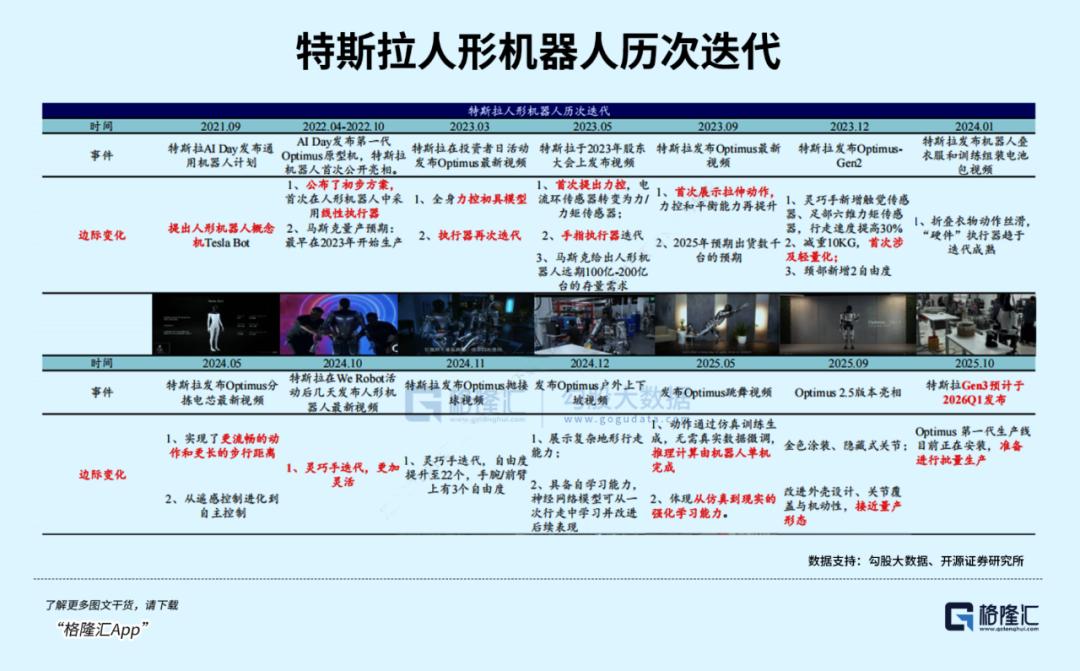
Continuous breakthroughs at the technical level have also laid the foundation for commercial popularization. The running speed of Optimus Gen2.5, the optimization of the end - to - end neural network and hardware design have all verified the technological maturity.
Tesla has a clear rhythm of technological iteration. From the concept proposal to the mass - production finalization, each step defines the industry direction.
Other overseas companies have also been very active. Figure AI completed a Series C financing of $39 billion. The annual production capacity of the BotQ factory reaches 12,000 units, and it plans to expand the production to 100,000 units in 2026. It has promoted the implementation of warehousing and manufacturing scenarios with customers such as BMW.
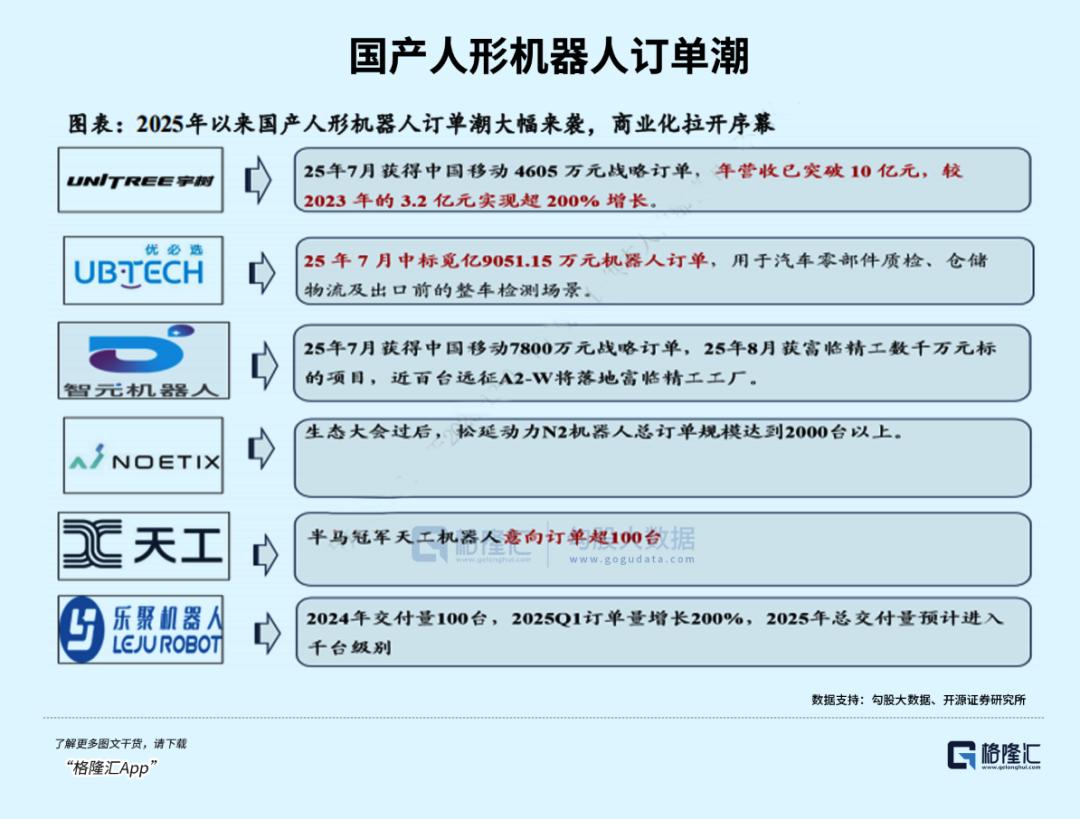
Different from the "single - point sprint" of overseas giants, the domestic humanoid robot industry presents an ecological pattern of coordinated efforts among "complete machines + components + policies", and the speed of order confirmation has exceeded market expectations. Since 2025, domestic enterprises have witnessed a concentrated explosion of orders, and the commercialization process has accelerated comprehensively.
Yushu Technology completed the IPO counseling and invested in building a super factory worth 1.24 billion yuan, with an annual revenue exceeding 1 billion yuan. UBTECH's cumulative orders for humanoid robots in 2025 exceeded 1.3 billion yuan, and the delivery target in 2026 is 2,000 - 3,000 units.
02 Breaking the Deadlock: Triple Resonance Brings Industrial Opportunities
Humanoid robots have become the core arena of the Sino - US technological competition. The United States is increasing its support for the industry, lowering the R & D and commercialization thresholds for domestic enterprises, and activating the North American market demand at the same time.
China has a three - dimensional system of "national - level policies + local support + industrial rectification". Through the "Robot +" initiative, it expands application scenarios and provides financial support. At the same time, it curbs low - level homogeneous competition, guides resources to focus on core technologies, and accelerates the process of domestic substitution.
The comprehensive breakthrough at the technical level has cleared the core obstacles for the mass production of humanoid robots. At present, significant achievements have been made in the domestic substitution of core components. The market share of key links such as reducers and servo motors has exceeded 50%. Enterprises such as Green Harmonic and Coliy Sensor have broken the overseas monopoly, providing solid support for the mass production of complete machines.
In terms of software, the Sim to Real technology has significantly shortened the R & D cycle. The training time for a single action of Tesla's Optimus has been compressed from 48 hours to 2.5 hours. The embodied large model has achieved a closed - loop of "perception - decision - execution". The large models such as Huawei's Pangu and Tesla's XAI Grok have given robots the ability to adapt to complex scenarios independently, with a voice - command completion rate of over 95%.
The rigid gap on the demand side constitutes the core driving force for the industry's growth. In the industrial field, the problems of "difficulty in recruiting workers" and "high labor costs" are becoming increasingly prominent. The gaps in high - risk and repetitive positions such as welding, warehousing, and quality inspection continue to expand. A single humanoid robot can replace 5 skilled workers and work continuously for 8 hours, becoming the core market in the early stage of mass production.
Currently, many industrial enterprises have started large - scale procurement. The Zhiyuan G2 robot has been deployed on the production line of Longcheer Technology, and automobile enterprises such as Baosteel and Geely have introduced robots to complete welding and parts inspection tasks.
As the cost decreases, the consumer - grade market will gradually open up. IDC predicts that the compound annual growth rate of the humanoid robot market in industrial scenarios will reach 48% from 2026 to 2030, and 52% in medical rehabilitation scenarios. The overall market scale is expected to explode. The global market scale of humanoid robots is expected to reach 6.339 billion yuan in 2025, exceed 64 billion yuan in 2030, and is more likely to exceed 400 billion yuan in 2035. The Chinese market will become the global core demand engine.
03 Focus on Three Core Directions to Seize the Dividends of the Mass - Production Cycle
Combining the industry's technological convergence trend, the process of domestic substitution, and the rhythm of scenario implementation, investment should focus on three core directions: "key links in the industrial chain, the main line of technological upgrading, and the ecosystem of scenario implementation" to seize the long - term opportunities driven by the industry's fundamentals.
Direction 1: Core Components and Assemblies - The Core Beneficiaries of Mass - Production Dividends
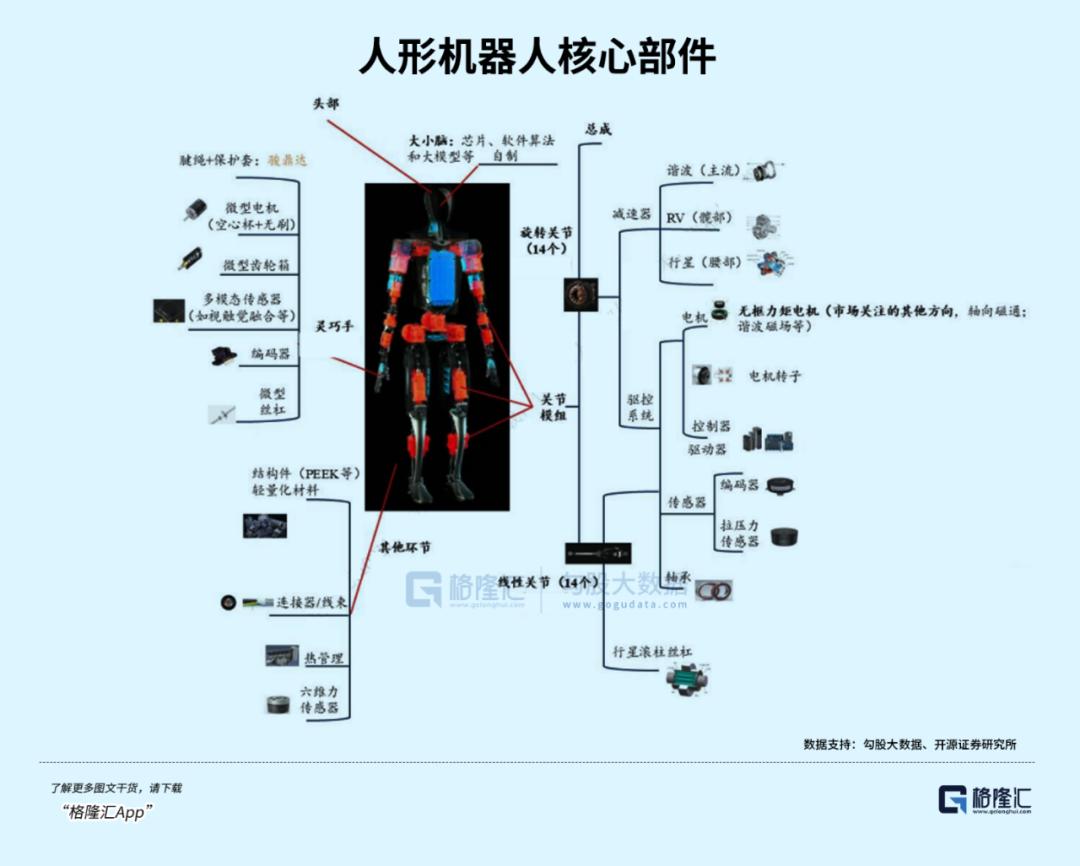
With the mass production of models such as Tesla's Gen3 and XPeng's IRON, the technological routes of core components have clearly converged, and the domestic substitution has entered an accelerated period. These links will directly benefit from the large - scale procurement demand brought by the capacity increase from 10,000 units to 1 million units, with the highest certainty of performance.
It is recommended to focus on the links with established technological routes: linear actuators (frameless torque motors + planetary roller screws), rotary actuators (dominated by harmonic reducers), core components of dexterous hands (micro - screws, tendon rope protection sleeves), high - precision bearings, etc. These links have high technological barriers and a clear supply - demand pattern, and domestic manufacturers have achieved technological breakthroughs and entered the supply chains of leading enterprises.
Direction 2: Technological Upgrading and Software Ecosystem - The Core Increment for Long - Term Growth
Technological upgrading directions such as embodied intelligence, data collection, and lightweight materials are the keys to promoting robots from "usable" to "user - friendly" and also the core to distinguish enterprises' competitiveness, with prominent long - term growth potential.
1. Embodied intelligence and data - collection tools: Embodied large models solve the pain point of the insufficient generalization ability of robots, and data - collection tools (flexible motion - capture suits, tactile sensing devices) break through the bottleneck of high costs for obtaining real - machine data. These fields are the core battlefields for the industry to shift from "hardware competition" to "software - hardware collaboration".
2. Sub - sectors of technological upgrading: Lightweight materials (aluminum - magnesium alloys, PEEK, liquid metals) improve the endurance and motion performance of robots. The technological iteration of components such as micro - frameless torque motors and high - precision screws directly reduces the cost of complete machines and improves performance. These technological upgrading directions will continue to contribute to growth elasticity.
It is recommended to focus on "technological implementation ability + ecological synergy effect" and give priority to targets that have in - depth cooperation with leading complete - machine manufacturers and AI large - model enterprises to seize the inflection - point opportunities from "technological R & D" to "large - scale application".
Direction 3: Scenario Implementation and Ecosystem Collaboration - The Long - Term Beneficiaries of Industry Maturity
Vertical scenarios such as industry, logistics, environmental sanitation, and clothing manufacturing are the core implementation fields in the early stage of robot mass production. These scenarios have the characteristics of "sufficient data accumulation, rigid demand, and clear return on investment". At the same time, ecological collaboration can lower the implementation threshold and accelerate the commercialization process.
It is advisable to give priority to targets with "deep understanding of scenarios" and "sufficient data accumulation". Pay attention to enterprises that can provide integrated services of "hardware + software + solutions" and avoid targets that rely solely on a single scenario and lack reusability.
04 Conclusion
From the callback shock in September to the capital inflow at the end of November, the market performance of the A - share humanoid robot sector is essentially a rational return of the industry from "expectation speculation" to "value re - evaluation".
As the curtain of mass production in 2026 is about to open, the industry will enter a period of high - speed growth, and the structural opportunities are worthy of long - term attention. For investors, the current is a crucial window for long - term industry layout.
This article is from the WeChat public account "Gelonghui Financial Hotspots" (ID: glh_finance). Author: Editor of Gelonghui. Republished by 36Kr with permission.