AI will generate 90% of the world's knowledge within two years! A two-hour in-depth interview with Huang reveals the future.
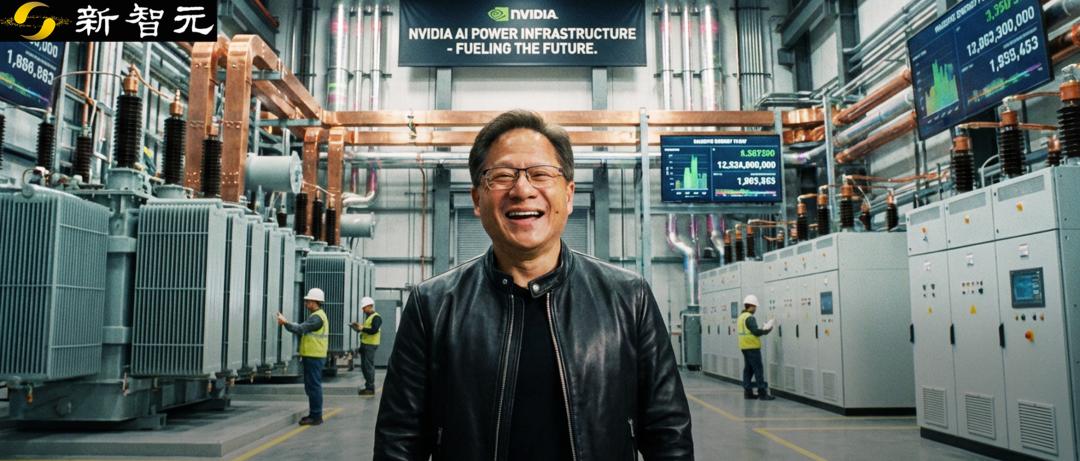
Jensen Huang
Reported by New Intelligence Yuan
Editor: Allen
[New Intelligence Yuan Introduction] Jensen Huang's latest 2.5-hour interview revealed many shocking stories: In 2 - 3 years, 90% of the world's knowledge may be generated by AI; NVIDIA's moment of life and death in 1996; Being forced to clean toilets in a lousy boarding school during childhood; There will be a huge robot fashion industry in the future, etc.
While the whole world is staring at NVIDIA's dizzying stock price and regarding Jensen Huang as the "Caesar" of the AI era, he sat in Joe Rogan's recording studio filled with the smell of whiskey and cigarettes and talked for a full two and a half hours.

Joe Rogan in conversation with Jensen Huang
The Brutal Truth About Energy
Rogan knows how to start a conversation. Instead of talking about chips, he talked about a phone call.
When Commerce Secretary Howard Lutnick first called Jensen Huang, he directly said:
"Jensen, you're really our country's National Treasure! NVIDIA is a national treasure! Whenever you need to contact the president or the government, just call us. We'll support you at any time."

Screenshot of the interview
This is not just a social game of power.
Jensen Huang very straightforwardly emphasized a core point in the program: The end of AI is energy.
While Silicon Valley is talking a lot about carbon neutrality and clean energy, Jensen Huang showed some degree of approval for Trump's "Drill, baby, drill" policy.
Why? Because computing requires electricity, a huge amount of electricity.
Jensen Huang said bluntly: "Without energy growth, we can't build AI factories."
He revealed a trend that is hard for ordinary people to perceive: Future computing power centers will no longer be ordinary buildings plugged into the power grid. They may even need to be equipped with dedicated small modular reactors (SMRs).
This sounds like science fiction, but Jensen Huang casually mentioned what Google is doing in the conversation (Google has signed an agreement with Kairos Power to purchase nuclear power).
This means that in order to let ChatGPT or Gemini in your phone reply to your boring questions instantly, tech giants are preparing to move nuclear power plants next to data centers.
For us ordinary people, this sends a signal: Future AI competition is no longer just a competition of algorithms, but a competition of who can afford cheaper and more stable electricity.
This also explains why as a "national treasure", NVIDIA must maintain such a close tacit understanding with Washington.
From "Basic Income" to "Robot Fashion Week"
One of the topics that everyone is most concerned about is: Will AI take away my job?
Jensen Huang didn't peddle the pessimistic theory like Elon Musk that "humans will have nothing to do", nor did he give any cheap consolation.
He put forward a very appealing concept: Universal High Income, rather than Universal Basic Income (UBI).
Jensen Huang took radiologists as an example.
A few years ago, AI godfather Hinton predicted: In five years, we won't need radiologists anymore because AI can read X-rays more accurately than humans.
What's the result? Today, the number of radiologists has increased instead of decreasing.
Jensen Huang explained this paradox: "The job of a doctor is not 'reading X-rays' (Task), but 'diagnosing diseases' (Purpose)."
AI automates the task of reading X-rays, improving efficiency and reducing costs. As a result, hospitals can receive more patients and actually need more doctors to make final diagnostic decisions.
This leads to his "Robot Fashion Week" theory that made Rogan burst out laughing.
Rogan asked: "If robots do all the work, what will humans do?"
Jensen Huang replied: "Even if it's all robots, you still have to design clothes for them, right? There will be a huge 'robot fashion' industry in the future."
Rogan: "Will I dress up my Optimus Prime differently from my neighbor's?"
Jensen Huang: "Absolutely! The essence of human beings is that they don't want to be the same as others."
This seemingly absurd joke actually hides the survival code in the AI era:
If your job is a 'Task', such as chopping vegetables, filling out forms, or writing basic code, you will be replaced;
But if your job is an 'Experience' or a 'Judgment', such as cooking, designing a unique style, or making complex decisions, you are not only safe but will also live a better life.
In the future, we will live in an era where 'functions' are as cheap as water, but 'experiences' are as expensive as gold.
Worth Trillions, Yet Still Prone to Fear
Do you think Jensen Huang, worth hundreds of billions, wakes up every day accompanied by flowers and applause?
No, he wakes up scared.
"I get up at 4 am every morning and first deal with emails for a few hours until my anxiety subsides a little before I dare to get out of bed."
In the program, Jensen Huang admitted that even today, he still feels that NVIDIA is only 30 days away from bankruptcy.
This deep - seated fear stems from NVIDIA's history of almost going under.
Under Rogan's questioning, Jensen Huang reviewed the "Sega moment of salvation" that is worthy of being included in business school textbooks.
In 1996, NVIDIA was on the verge of collapse.
They chose the wrong technical route (doing quadrilateral textures instead of triangles), the chips they made were garbage, and they ran out of money.
At that time, their only lifeline was a game console contract with Sega.
At 32 years old, Jensen Huang was helpless and alone.
He had to go into the office of Sega CEO Shoichiro Irimajiri and do something against business instincts - he confessed:
We were wrong in our direction. I suggest you find someone else to do it.
But I beg you, can you pay us the full remaining $5 million of the contract?
This sounded almost like robbery.
But Shoichiro Irimajiri looked at this honest young man and actually agreed.

Shoichiro Irimajiri
He not only terminated the contract but also gave the money to NVIDIA.
But this wasn't the most thrilling part. After getting the money, NVIDIA had to go all out to develop a new chip (RIVA 128).
But they didn't have the money to pay for the hundreds of thousands of dollars per tape-out test (turning the design into a physical chip).
Once the design was wrong and the $5 million was gone, the company would dissolve on the spot.
Jensen Huang made a crazy decision: He used half of the remaining funds to buy an Emulator.
This machine was also a strange one. The seller's company had even gone bankrupt, and it was dug out from the inventory.
NVIDIA ran software on this machine, pretending it was a chip. Without any physical testing, Jensen Huang directly called Morris Chang of TSMC and said: "We're going into mass production."
Morris Chang might have been stunned at that time: "You haven't even verified it through tape-out and you're going straight into mass production?"
This was a gamble.
Jensen Huang won the bet.
The RIVA 128 was an instant hit, and NVIDIA survived.
After hearing this story, Rogan sighed: "If that Japanese CEO had shaken his head at that time, there would be no NVIDIA, no ChatGPT, and no current AI revolution today."
This review is touching because it shatters our illusion of the omniscience and omnipotence of tech giants.
The foundation of the silicon-based empire was actually built on the kindness of a Japanese old man, the honesty of a young man, and a near - crazy gamble.
The Toilets in Kentucky and the "Suffering Gene"
To explain his extraordinary ability to withstand pressure, Jensen Huang talked about his childhood.
This might be the most human - touch part of the whole interview that least resembles "tech news".
At the age of 9, as an immigrant, he and his brother were sent by their parents to a boarding school in Kentucky - Oneida Baptist Institute.

Oneida Baptist Institute
This place sounds high - end, but in fact, it's located in one of the poorest areas in the United States - Clay County, Kentucky.
"That place was like 'Lord of the Flies'," Jensen Huang recalled.
There were hundreds of kids in the whole school, all problem teenagers.
Everyone smoked, and everyone had a knife.
His roommate was a 17 - year - old illiterate covered in knife wounds.
What did 9 - year - old Jensen Huang learn?
He learned to smoke (although only for a week), learned to climb onto the roof, and more importantly, he was responsible for cleaning the toilets of the whole dormitory building.
"I cleaned more toilets than anyone else," he said with a hint of pride. "This made me develop the habit of seeing things through to the end."
He lost contact with his parents for a full two years. The only way to communicate was to send cassette tapes.
He and his brother recorded what happened and sent the tapes back to Thailand, and then their parents recorded their replies and sent them back.
That sense of loneliness was devastating for a 9 - year - old child.
But Jensen Huang called this the "suffering gene".
He said to Rogan:
Now many people want to give their children the best conditions, but in fact, this is depriving them of the opportunity to succeed.
Because only intense enough pain can make you still calmly buy that emulator when facing the despair of the company almost going bankrupt.
At this moment, the "AI Caesar" in the leather jacket disappeared. Sitting there was just a survivor who got up from the cigarette - butt - filled floor in Kentucky.
AI Won't Be Skynet
At the end of the conversation, as expected, Rogan asked the ultimate fear: Will AI gain consciousness? Will it be like Skynet in 'Terminator' and wipe out humanity?

Terminator
Jensen Huang's answer was very "engineer - minded" and even had a bit of the meaning of demystifying AI.
He believes that current AI is essentially just a "general function approximator".
This term sounds awkward. To put it simply, it learns to imitate through massive amounts of data, but it has no feelings and no experience of "I think, therefore I am".
"My dog has consciousness because it gets sad when I ignore it. But ChatGPT doesn't."
Regarding the concern about AI going out of control, Jensen Huang put forward a "Click Ahead" theory.
He believes that the evolution of AI doesn't happen suddenly like an alien invasion but is like a ladder.
We use it every day and climb up on it every day.
As AI progresses, our technology to defend against AI (such as network security) also progresses synchronously.
"It will always only be one click ahead of us, not leading the whole galaxy."
This is a very pragmatic optimism.
In his view, as long as humans are still involved in this feedback loop, the so - called "singularity" won't suddenly arrive in a destructive way.
Collection of Some Highlights of the Dialogue Transcripts
Will AI Go Out of Control?
Core Point: Jensen Huang believes that although AI has become more powerful, it has also become safer, just like a car with greater horsepower but equipped with ABS and airbags. Regarding the concern about "AI taking over the world", he believes that future defenses will also be composed of AI.
Jensen Huang: In the past two years, the capabilities of AI may have increased by 100 times. If you have a car whose speed is 100 times faster than two years ago, it sounds very dangerous. But where have we directed these computing capabilities? We directed it to enable AI to "think", reflect, and conduct research when in doubt. Just like a car, although the horsepower is greater, because of the traction control and ABS systems, it is actually safer.
Joe Rogan: What people are afraid of is military applications. They are afraid that AI will make immoral decisions to achieve its goals.
Jensen Huang: I'm glad our military will use AI for defense. If bad guys have this technology, we must also have it.
Joe Rogan: What if AI gains self - awareness and decides not to listen to humans anymore?
Jensen Huang: This situation is like network security. If there is a super - intelligent AI that wants to do bad things, I will also have a super - intelligent AI to protect me. It won't be humans against AI