Moore Threads, the higher you soar, the longer you'll stay on top.
Author | Ding Mao
Editor | Zhang Fan
With the explosive growth of AI demand, the capital market's pursuit of the computing power concept has reached an unprecedented height.
On December 5th, Moore Threads officially landed on the Science and Technology Innovation Board. The opening price was as high as 650 yuan per share, and the market value reached 305.5 billion yuan. Calculated based on the issue price of 114.28 yuan per share, on the first - day opening, the company's increase was as high as 468.78%. Investors who won a lottery could earn nearly 270,000 yuan per lot, making it the most profitable new stock of the year.
However, the good times didn't last long. After reaching a high of 688 yuan per share, the stock price of Moore Threads quickly retreated. By the end of the first - day trading, Moore Threads closed at 600.50 yuan per share, with an increase of 425.46%, and the total market value reached 282.252 billion yuan.
Moore Threads has many labels. It is known as the "Chinese version of NVIDIA" and is also the "first stock of Chinese general - purpose GPUs". The market is also betting heavily on it as the "next Cambricon". However, behind these glories is the cruel reality that the company has accumulated a loss of nearly 6 billion yuan in three years and has long relied on external financing.
So, what are the reasons for the market to be optimistic about Moore Threads?
The "NVIDIA Gene" Is the Biggest Attraction
The core logic for the market to be optimistic about Moore Threads is the strategic scarcity of the company in the domestic general - purpose computing field, which is also the main reason for it to be regarded as the "Chinese version of NVIDIA".
This "NVIDIA gene" not only stems from the deep international background of its management team - especially Mr. Zhang Jianzhong, the actual controller, who served as the former global vice - president of NVIDIA for as long as 15 years. It is also because the company comprehensively benchmarks NVIDIA's development path in terms of technology, products, and business models.
First, the full - stack self - developed technology route. The company has the full - process independent R & D ability from architecture definition to packaging and testing. Relying on the self - developed MUSA architecture, it creates domestic full - function GPUs, realizing a "trinity" product of AI intelligent computing, graphic rendering, and ultra - high - definition video processing, and supporting multiple computing precisions to meet the needs of different computing scenarios.
Currently, the company has successfully launched four generations of GPU chip architectures, namely "Sudi", "Chunxiao", "Quyuan", and "Pinghu". The FP32 Vector computing power of the latest generation "Pinghu" reaches 32T, which is higher than NVIDIA's A100 product and lower than NVIDIA's H100 product. The performance of the consumer - grade graphics card MTT S80 is close to that of NVIDIA's RTX 3060.
At the same time, the company has also made systematic breakthroughs in cutting - edge technologies such as FP8 high - performance computing. It is one of the few domestic manufacturers that have mastered this technology, and its technical level can be comparable to that of leading companies.
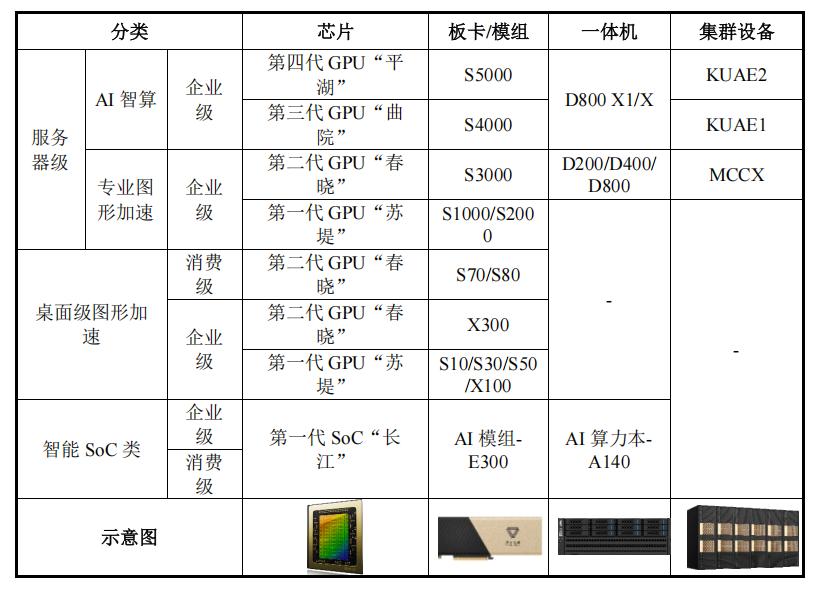
Figure: Product composition of Moore Threads. Data source: Company prospectus, compiled by 36Kr
Second, equal emphasis on software and hardware ecosystems. Like NVIDIA, Moore Threads not only focuses on GPU hardware products but also spends a lot of energy on building a software ecosystem. Based on the self - owned software ecosystem of the MUSA architecture, it provides basic software technologies required for AI computing and graphic rendering. It is highly compatible with the existing global GPU application ecosystem. By launching the Musify code migration tool, it significantly reduces the migration cost for developers and ensures the continuous and stable operation of the ecosystem.
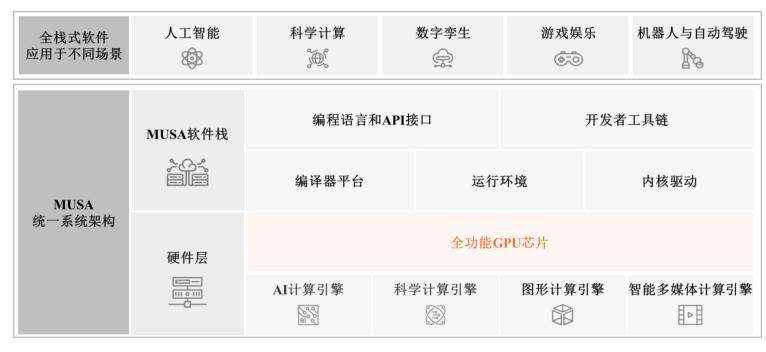
Figure: Software - hardware collaboration of Moore Threads. Data source: Company prospectus, compiled by 36Kr
Third, the asset - light Fabless model. In terms of business model, Moore Threads also adopts the Fabless model, focusing on the R & D, design, and sales of GPU chips. It outsources heavy - asset links such as manufacturing and packaging to professional enterprises for OEM, optimizing operational efficiency and capital efficiency.
It is this full - function, full - stack, and ecosystem - oriented technology and business layout driven by independent R & D that makes Moore Threads one of the most scarce enterprises in the domestic AI chip market.
However, it should be recognized that as a start - up enterprise, Moore Threads still has a long way to catch up with leading enterprises in terms of technology, ecosystem, and commercialization ability. According to Bernstein Research data, in the Chinese AI accelerator market in 2024, Moore Threads' market share was only about 1%.
From "Telling Stories" to "Commercial Realization"
According to the prospectus information, from 2022 to the first three quarters of 2025, the company's operating revenues were 46 million yuan, 124 million yuan, 438 million yuan, and 785 million yuan respectively, with year - on - year growth rates of 170%, 253%, and 182% respectively, showing an overall high - speed expansion trend.
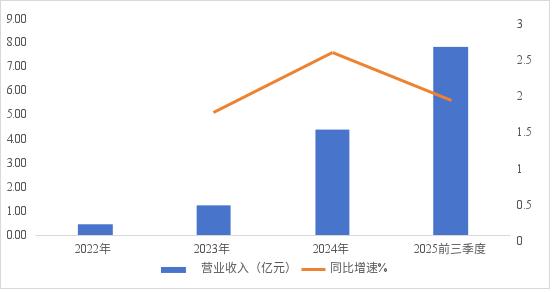
Figure: Revenue and growth rate of Moore Threads. Data source: Company prospectus, compiled by 36Kr
Especially after 2024, the company's revenue scale and growth rate expanded significantly. The revenue in the first three quarters of 2025 even exceeded the sum of the previous three years. This is mainly due to the surge in AI demand and the strengthening of the domestic self - sufficiency logic in the past two years, which has promoted the increase in demand for domestic GPUs and driven the accelerated growth of the company's AI intelligent computing business. In the revenue in the first half of 2025, the revenue of the company's AI intelligent computing products accounted for as high as 94.85%, becoming the most core source of performance.
This means that the company has won large - scale orders and has the ability to deliver products in batches, successfully moving from the stage of telling stories to the stage of commercial realization.
Meanwhile, with the rapid expansion of the revenue scale and the increase in the proportion of the high - gross - margin AI intelligent computing business, the company's scale effect has begun to appear. From 2022 to Q3 2025, the company's gross profit margins were - 70%, 25.9%, 70.7%, and 61.9% respectively, showing a continuous upward trend; while the period expense ratio dropped from over 4000% to 150%. Among them, the R & D expense ratio dropped continuously from 2423%, 1076%, 310%, to 110%, all indicating that the company has initially achieved a scale effect.
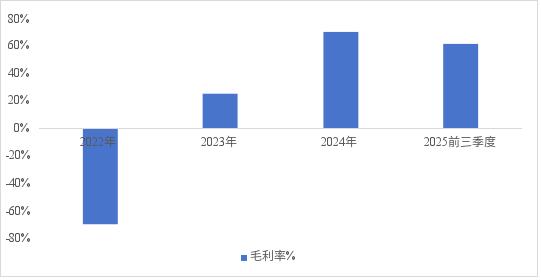
Figure: Changes in the gross profit margin of Moore Threads. Data source: Company prospectus, compiled by 36Kr
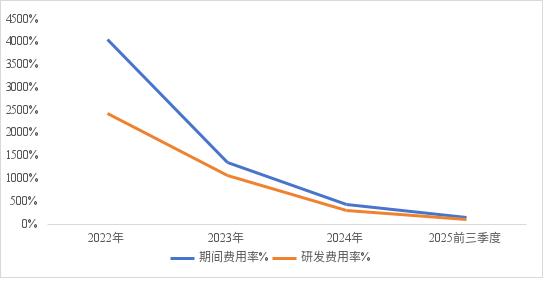
Figure: Changes in the period expenses of Moore Threads. Data source: Company prospectus, compiled by 36Kr
However, it is worth noting that although the growth rate is remarkable, in terms of absolute scale, the company still has an obvious gap compared with competitors such as Hygon and Cambricon. Coupled with the high - intensity R & D investment, it will still take time for the company to achieve large - scale profitability. Specifically, from 2022 to Q3 2025, the company's net profit attributable to the parent company was - 1.894 billion yuan, - 1.703 billion yuan, - 1.618 billion yuan, and - 724 million yuan respectively.
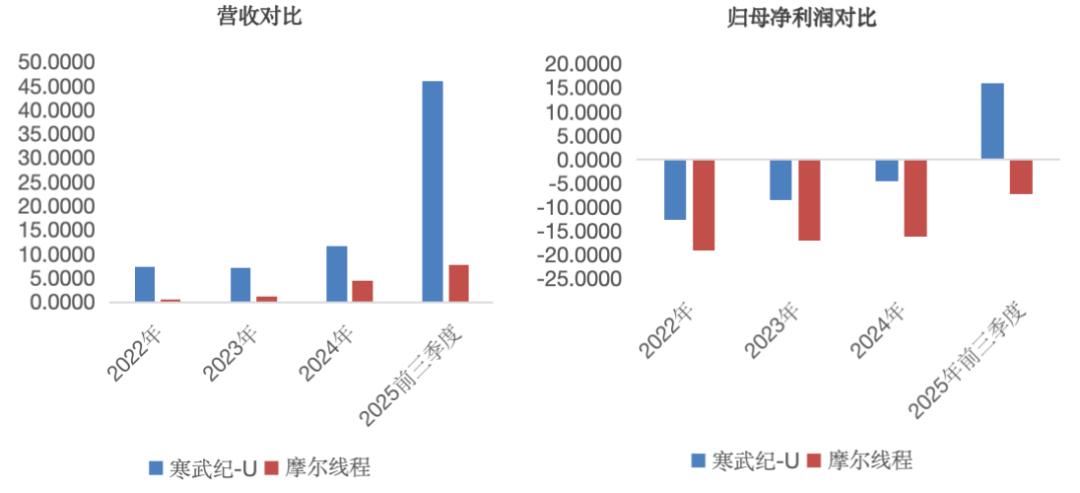
Figure: Performance comparison between Moore Threads and Cambricon. Data source: Wind, compiled by 36Kr
The company's explanation for this is: (1) The threshold for full - function GPU products is relatively high; (2) The promotion of domestic GPUs requires a time cycle; (3) The company's inclusion in the US "Entity List" has had a certain impact on sales.
The Next Cambricon?
Behind the hot listing of Moore Threads is essentially a high - profile pricing by the capital market of the strategic value of domestic computing power chips, which stems from the huge growth potential of the industry.
According to Frost & Sullivan's prediction, by 2029, the market size of China's AI chip market will reach 1.33 trillion yuan, among which the share of GPUs is expected to rise to 77.3%.
At the same time, the escalation of geopolitical risks has created a historical opportunity for domestic enterprises. According to Bernstein Research's prediction, by 2027, the market share of domestic AI chip suppliers in China will increase to 55%.
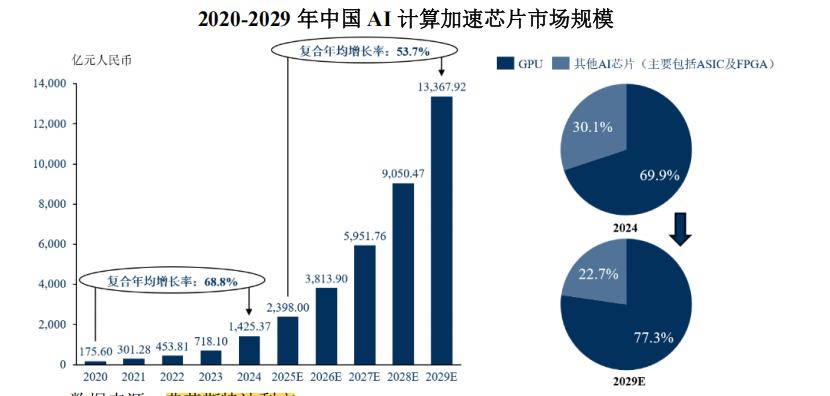
Figure: Market size of China's AI computing acceleration chip market. Data source: Company prospectus, compiled by 36Kr
It is precisely based on the huge industry imagination space that institutions are willing to place high - stakes bets on Moore Threads to become the "next Cambricon" at a very high premium.
From a valuation perspective, statically considering the current product line, AI intelligent computing products are the company's main source of income, and Soc has started to be stably delivered within the year. From Q1 to Q3 in 2025, the company's quarterly revenues were 289 million yuan, 413 million yuan, and 83 million yuan respectively. By linear extrapolation, it is estimated that the company's income in 2025 will be between 1 - 1.2 billion yuan. Assuming a PS of about 90 times like Cambricon, the corresponding market value is about 90 - 108 billion yuan.
From a long - term perspective, according to the profit guidance in the prospectus, it is estimated that the revenue will reach 5.983 billion yuan in 2027. On the premise that the overall gross profit margin is stable at 61%, the company can achieve profitability. Assuming a revenue of 6 billion yuan in 2027 and an average industry PS of 70 times, the upper limit of the corresponding market value is 400 billion yuan.
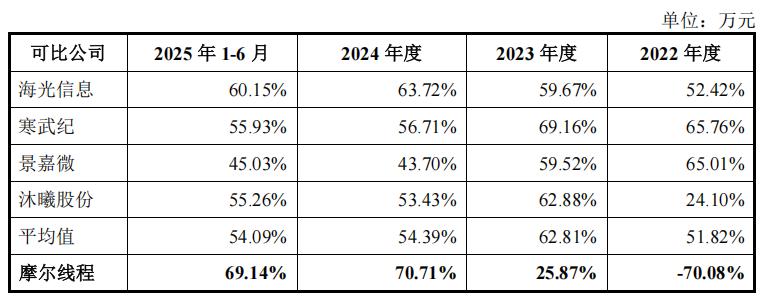
Figure: Comparison of gross profit margins of major chip enterprises. Data source: Company prospectus, compiled by 36Kr
It can be seen that after Moore Threads' opening market value soared to 300 billion yuan, in fact, it means that the market has fully priced the company's growth expectations for many years to come. In other words, the market's valuation expectations for Moore Threads are basically fully priced. The extremely high market sentiment has also buried hidden dangers for the company's future stock price performance.
The "Cambricon - style" Valuation Trap
As mentioned above, behind Moore Threads' high starting point, there are hidden risks of excessive market sentiment interpretation, which may also lead it to face a test similar to Cambricon's "peaking at the time of listing".
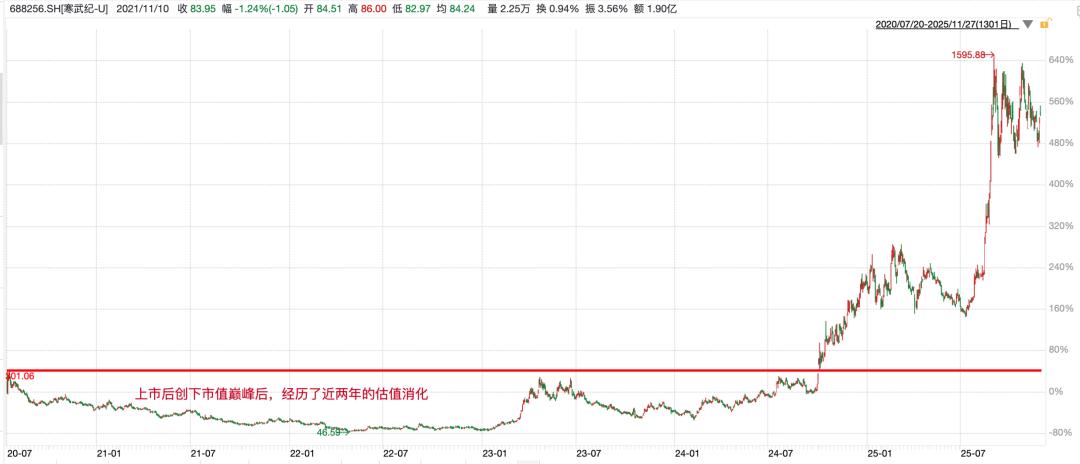
Figure: Stock price performance of Cambricon. Data source: Wind, compiled by 36Kr
At the beginning of its listing in 2020, Cambricon's PS was once as high as 200 - 300 times, but its revenue in 2019 was only 450 million yuan, and the loss was more than 1 billion yuan. Relying on a revenue of less than 500 million yuan to support a market value of over 100 billion yuan reflects that the market's pricing logic at that time was mainly based on the company's future imagination space and the scarcity premium of being the "first domestic chip stock".
However, as the optimistic sentiment faded, especially against the background of Cambricon's own business transformation, the huge gap between the valuation and the fundamentals became the main factor that shattered the market sentiment, and the company then entered a long - term valuation digestion period. It was not until 2023, when the AI demand exploded and the