Silver prices skyrocket: Is the blame on photovoltaics?
Author | Dingmao, Huang Yida
Editor | Zhang Fan
Recently, the London silver price has been active. On December 3rd, the spot silver price in London hit a new record high again, breaking through $58.97 per ounce for the first time during intraday trading. Since the beginning of this year, the international silver price has risen by more than 100%, far outperforming the gold price.
As the two main categories of precious metals, silver and gold are generally considered to move in the same direction. However, due to the greater volatility of silver, it is regarded as an amplifier of gold.
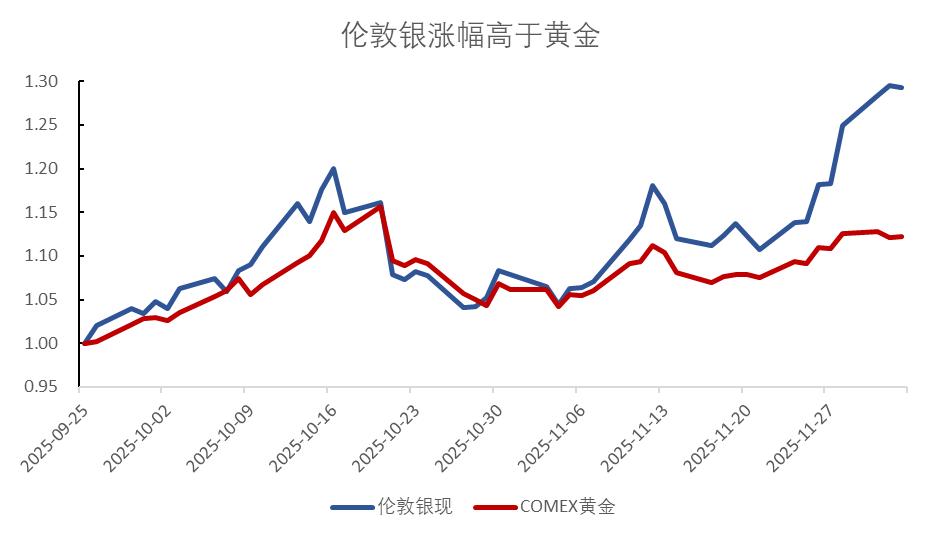
Chart: Trends of London spot silver price and COMEX gold price; Source: Wind, 36Kr
Behind this round of sharp rise in the silver price, apart from the major driving factors such as the release of safe - haven demand and loose liquidity, are there any other key variables worthy of attention?
The warehouse - squeezing effect is the direct fuse
The direct fuse for the rise in the silver price this year is the warehouse - squeezing effect brought about by the cross - border flow of silver spot triggered by the safe - haven demand. In February this year, Trump signed a presidential memorandum at the White House, announcing the imposition of "reciprocal tariffs" on other countries and implementing the "fair and reciprocal plan" trade policy. After entering June, the White House further announced that the steel and aluminum tariffs would be raised from 25% to 50%.
Therefore, traders generally expected that the US government might take similar high - tariff measures on other major metals such as silver, which triggered market panic. To avoid potential future tariff costs, a large amount of silver began to be transported from London, one of the world's major storage locations, to New York. This cross - border flow for safe - haven purposes directly led to a supply crisis in the London market. Data shows that at the beginning of this year, the silver inventory of the London Bullion Market Association (LBMA) decreased significantly.
Meanwhile, the structural problems on the supply side of London silver have become more prominent. Since most of the silver inventory is stored in the vaults that back ETF funds, acting like a margin, it cannot be directly bought, sold or lent in the market, further leading to an extreme shortage of tradable inventory. The sudden depletion of the silver supply side quickly spread to the trading side, directly pushing up the borrowing cost of silver. The one - month borrowing cost of London silver soared to an annualized 35%, setting a new record.
More importantly, the silver supply crisis also caused sharp fluctuations in the price difference between London silver spot and COMEX silver futures. Usually, the COMEX futures price only has a premium of a few dozen cents over the London spot price. However, on October 10th, there was a rare phenomenon where the COMEX futures price was at a discount of more than $3 per ounce to the London spot price.
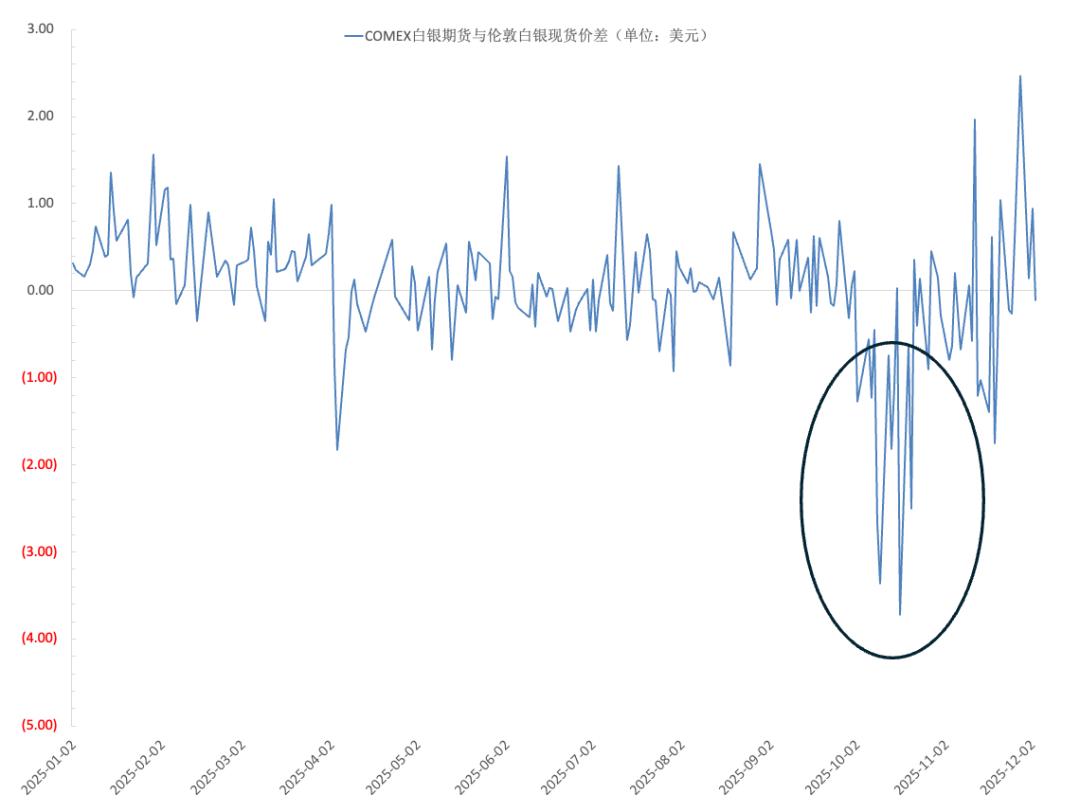
Chart: Price difference between COMEX silver futures and London silver spot; Source: Wind, 36Kr
As the price difference between London and New York widened rapidly in the short term, it immediately triggered a round of short - term arbitrage activities. That is, traders tend to buy at a relatively low price in New York and then transport it to London to sell at a high price, which further intensified the cross - border flow of silver and the price increase. Due to the continuous negative price difference between COMEX silver futures and London silver spot in the short term, the London silver spot price once reached a record high of $53.8 per ounce during intraday trading on October 17th, and the market panic reached its peak.
After entering November, the warehouse - squeezing effect of silver reappeared. On November 6th, the Trump administration officially included silver in the "Critical Minerals List". This move means that silver may face a Section 232 tariff review in the future. Market concerns about the uncertainty of trade policies have increased significantly, which in turn triggered a similar structural adjustment of silver inventory between the New York and London markets in October, except that this time the main location changed from London to Shanghai.
The transfer of Shanghai silver spot to COMEX warehouses led to a significant decline in Shanghai's silver inventory. As of the end of November 2025, the silver inventory of the Shanghai Futures Exchange once fell below 446 tons, hitting the lowest level since 2016. In October alone, the silver inventory of the Shanghai Futures Exchange decreased by more than 300 tons. Meanwhile, according to customs data, China's silver exports increased significantly in September and October this year, confirming that silver has been continuously flowing out due to the existence of the arbitrage window.
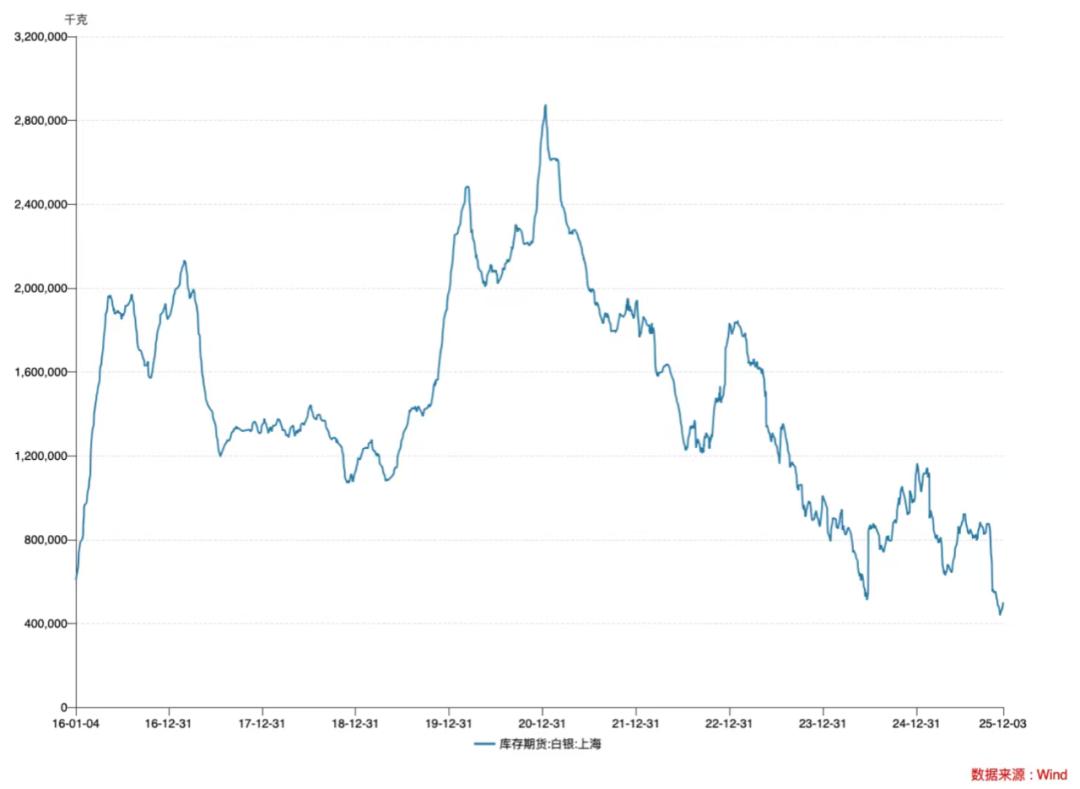
Chart: Silver inventory of the Shanghai Futures Exchange, unit: kilograms; Source: Wind, 36Kr
With the continuous cross - border transfer of silver inventory between the Shanghai and London markets, it not only led to the rapid depletion of tradable inventory in the Shanghai market, but also further provided upward momentum for the silver price. As of the time of publication, since November 24th, the maximum increase of Shanghai silver has been close to 14%, and the maximum increase of COMEX silver futures has exceeded 18%.
The surge in photovoltaic demand exacerbates the silver shortage
Although the surge in safe - haven demand and cross - border arbitrage trading have caused the structural shortage of silver inventory this year and are the short - term core catalysts for the rise in the silver price, from a global and long - term perspective, the underlying logic supporting the long - term upward trend of the silver price is the structural imbalance of long - term supply falling short of demand for silver.
The supply falling short of demand for silver has persisted for 5 years, mainly due to the significant increase in the weight of its industrial attributes. In recent years, the global energy transition and the rapid development of AI have accelerated the iteration of industries such as photovoltaics, new energy vehicles, and energy storage. Since silver is an indispensable key material in these fields, its industrial attributes have been significantly strengthened, becoming the core driving force for demand growth.
According to data from the World Silver Association, in 2024, industrial demand accounted for as high as 58% of the downstream demand for silver, far exceeding the demand for jewelry (18%) and investment (16%) in the same period. In specific demand scenarios, the combined proportion of the electrical and photovoltaic fields has exceeded 40%. The association also predicts that by 2030, the industrial demand for silver will increase by more than 40% compared with 2020. It can be seen that the long - term outlook for the industrial demand for silver is positive.
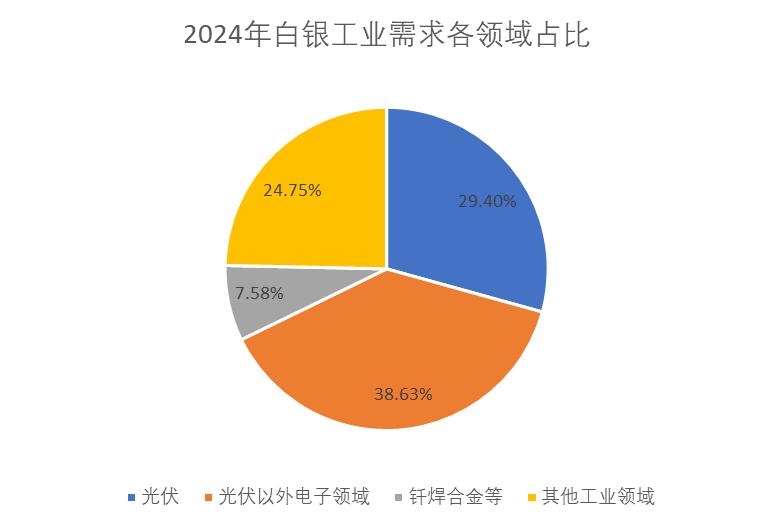
Chart: Distribution of industrial silver use; Data source: World Silver Association, compiled by 36Kr
In 2025, the growth of photovoltaic installed capacity has further triggered an explosive growth in silver demand. Affected by Document No. 136, there has been a rush to install photovoltaic equipment in the domestic photovoltaic industry this year. The strong domestic installation demand combined with the positive situation in Europe and other regions have jointly driven the global photovoltaic installed capacity to a new high. According to Bloomberg New Energy Finance, the global photovoltaic installed capacity is expected to reach 694GW this year, a year - on - year increase of 16%.
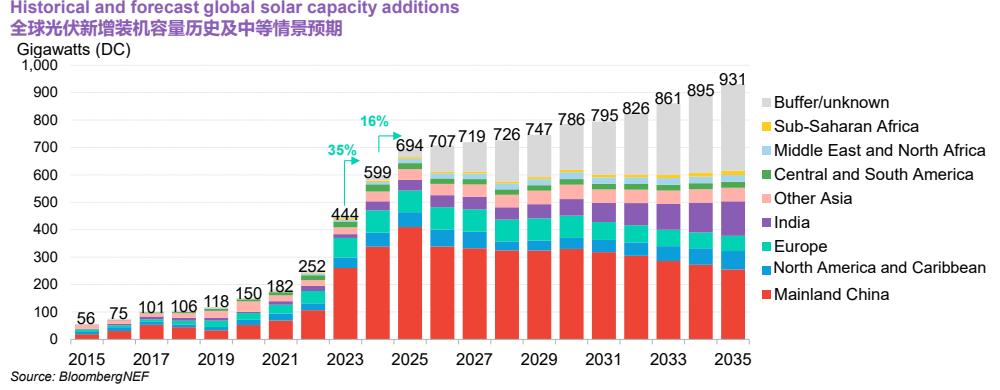
Chart: Global new photovoltaic installed capacity and expected values; Source: Bloomberg New Energy Finance, 36Kr
Silver paste accounts for about 12% of the total cost of photovoltaic modules and more than 50% of the non - silicon cost of solar cells. Benefiting from the increase in photovoltaic installed capacity, the consumption of industrial silver has increased significantly. It is predicted that the global silver consumption for photovoltaics is expected to exceed 5200 tons in 2025. In addition, new energy vehicles (about 50 grams of silver per vehicle) and the construction of AI computing power centers (about 1.2 kg of silver per cabinet) have also become important drivers for the surge in industrial demand for silver this year.
However, the supply side of silver is facing severe constraints, in sharp contrast to the continuous surge in demand.
In recent years, the annual growth of both mined silver and recycled silver has been extremely limited, especially the output from mines, which has hardly increased in the past decade. The main reason behind this is that silver rarely exists in its elemental state in nature and mostly exists as sulfides associated or co - existing with lead, zinc, and copper ores. In other words, currently about 70% of silver mines globally are associated mines, which makes the supply side of silver less sensitive to price changes. The rise in the silver price cannot effectively stimulate the supply side to accelerate mining, thus exacerbating the supply shortage.
Under the combined effect of the continuous explosion of industrial demand and the rigid supply constraints, silver has been facing a supply - demand imbalance this year, and the probability of this trend continuing is extremely high, which undoubtedly provides stable support for the long - term upward trend of the silver price. According to the forecast of Dongxing Securities, from 2025 to 2027, the supply - demand structure of silver will remain tight, and the supply gap will gradually widen from 6,003 tons in 2024 to 7,248 tons in 2027. The widening of the supply - demand gap mainly comes from the increase in photovoltaic demand.
The sharp rise in the silver price has crushed the shorts
Back to the silver price, in the precious metals investment circle, there is a saying that "silver is controlled by shorts". According to data from the US Commodity Futures Trading Commission (CFTC), among the top eight traders in the silver market, the concentration of shorts has reached 52%, while the concentration of longs is only 26%, and the concentration of shorts is still gradually increasing. Among them, a group of large Wall Street investment banks represented by JPMorgan Chase are the core big shorts in the silver market.
For these big shorts, the most prominent problem they currently face is the lack of sufficient spot silver. Therefore, when the silver price soars and the delivery demand increases, the big shorts have to borrow spot silver in the silver leasing market to complete the delivery. Public data shows that the recent silver leasing rate has risen significantly, which confirms that the big shorts' demand for borrowing silver to complete contract delivery has increased significantly, thereby pushing up the silver leasing cost.
Looking ahead, as the silver market continues, institutions and retail investors will continue to flow into the silver market, which will form stable support for the silver price. The holdings of silver ETFs are a key observation point. As for those Wall Street big shorts, the surge in delivery demand has led to a rapid increase in the cost of short - selling silver. Based on the current supply - demand pattern of silver, especially the inventory level, under the pressure of long - squeeze, the Wall Street big shorts face a certain risk of forced liquidation.
*Disclaimer:
The content of this article only represents the author's views.
The market is risky, and investment should be cautious. Under no circumstances does the information in this article or the opinions expressed constitute investment advice to anyone. Before making an investment decision, if necessary, investors must consult professionals and make decisions carefully. We have no intention of providing underwriting services or any services that require specific qualifications or licenses for the trading parties.