The battery controversy of Li Auto i6: Is the 3,999-yuan "bait" buying your "exemption" from risks?
Ideal Auto has presented a multiple - choice question to prospective car owners, but in the process, it has exposed its deep - seated problems.
Recently, Ideal Auto sent a "battery selection intention survey" to prospective owners of the Ideal i6. Simply put, previously, the Ideal i6 only used CATL batteries, but now a new option, Sunwoda batteries, has been added. If prospective owners insist on choosing CATL batteries, they will have to wait a bit longer. However, if they switch to Sunwoda batteries, they can get their cars earlier and also receive a power battery extended warranty worth 3,999 yuan.
When prospective owners received this survey, a complex game of value officially began.
This may seem like a "multiple - choice question" that gives consumers autonomy, but in fact, it has turned into a "compulsory question" filled with anxiety about getting the car, the temptation of compensation, and the hidden downgrade of core components. It also hides a fundamental logical paradox - if the two types of batteries are truly "identical" in performance, safety, and long - term reliability as the promotion claims, why is this special "compensation" needed?
When an automaker tries to define "peace of mind" with the simple equation "CATL = Sunwoda + 3,999 yuan", they are surprised to find that this generation of consumers is not so easy to take advantage of.
Because most prospective owners gave a simple and direct response to the salesperson: "No intention."
1. A Carefully Planned 'Anxiety Marketing'
The design of the entire selection process is a precise manipulation of consumer psychology.
When the sales consultant starts with the line "Choosing the Sunwoda version means getting the car faster", a subtle psychological game begins. The company's cost and other pressures are cleverly transformed into a catalyst to prompt consumers to make decisions that are beneficial to the manufacturer.
This strategy is vividly called "persuasive PUA" by many users. Some sharp - eyed car owners have pointed out that Ideal is actually guiding users towards the lower - cost Sunwoda option by controlling the delivery rhythm of the CATL version.
The extended warranty service priced at 3,999 yuan is the core tool of this combination of strategies. It attempts to achieve a seemingly fair "value exchange" - using a conditional future guarantee commitment to balance consumers' doubts about the current "downgrade" of the core component brand.
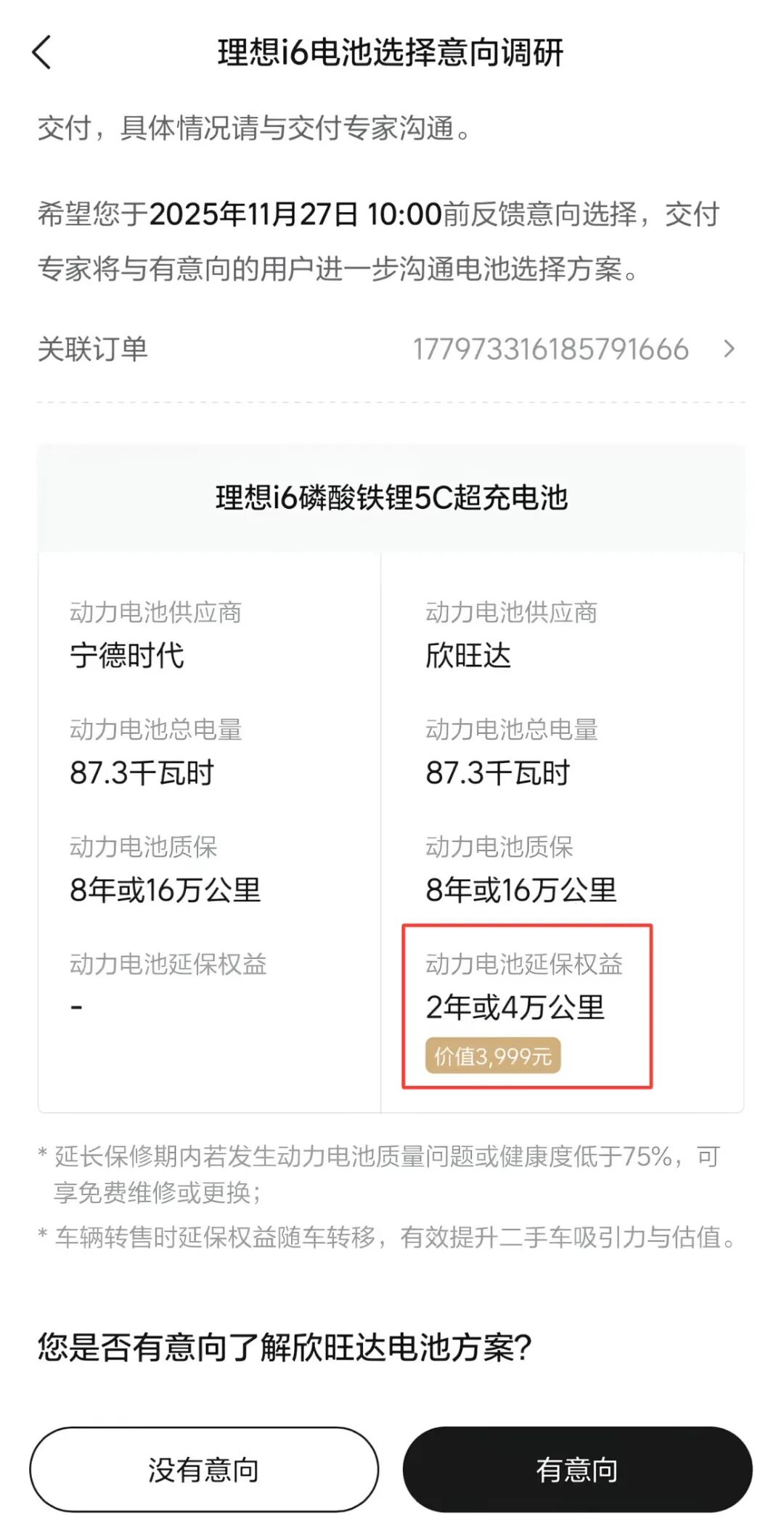
Picture/ Ideal i6 battery selection intention survey. Source/ Internet, Screenshot from New Energy Outlook
But when you calculate carefully, problems arise. For a car priced at two or three hundred thousand yuan, can 3,999 yuan really cover all the hidden costs? The potential losses that consumers may face in the next five to ten years, such as range anxiety, safety concerns, and the possible depreciation of the car's residual value in the second - hand car market, far exceed what 3,999 yuan can compensate for.
Comments from netizens on social platforms are incisive: "I've spent two or three hundred thousand yuan. Why not choose the world's number - one battery?" This mindset is widespread. The brand trust that CATL has accumulated through long - term market verification has become a powerful consumer inertia.
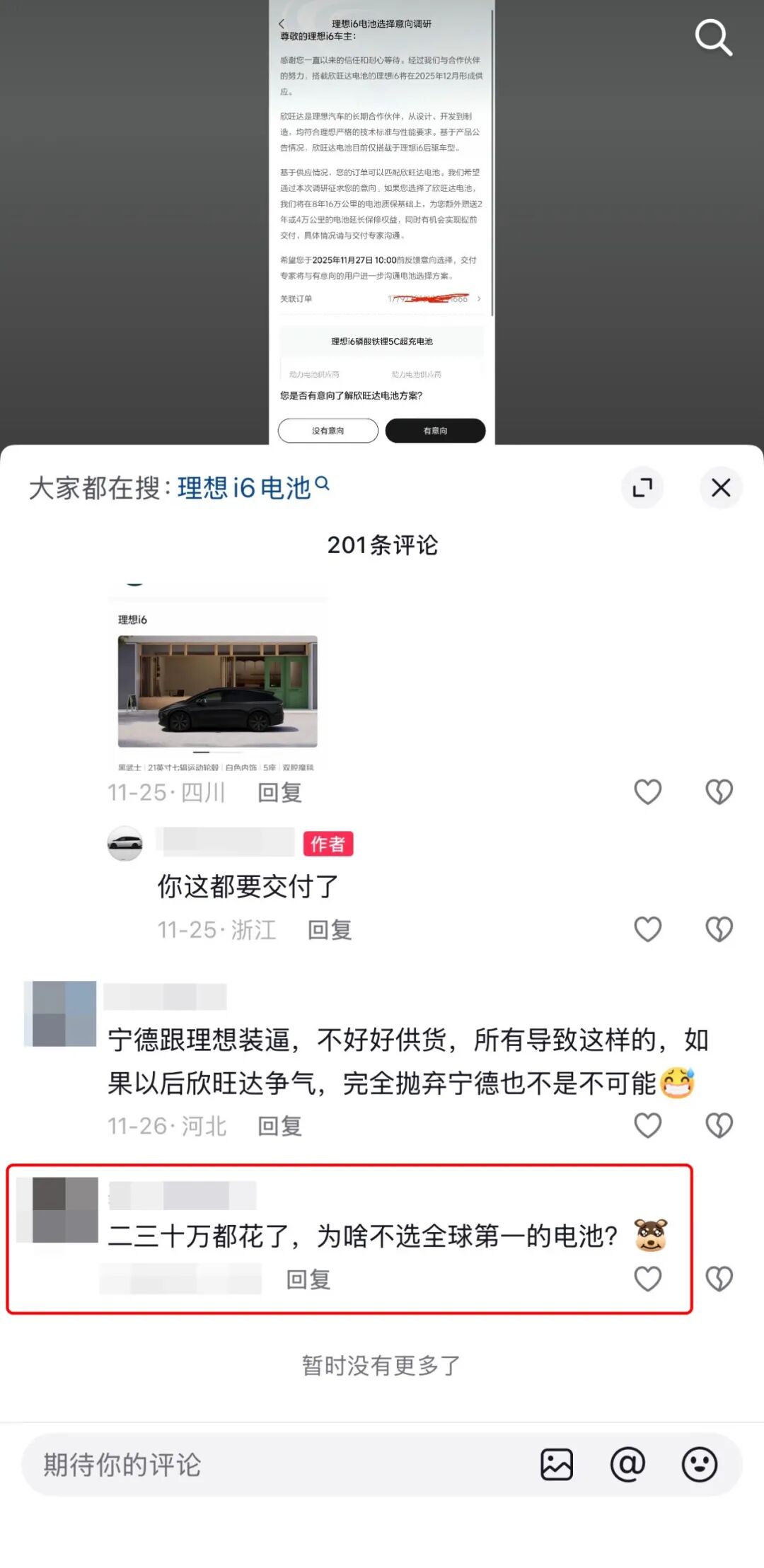
Picture/ Netizen comments. Source/ Internet, Screenshot from New Energy Outlook
This trust doesn't come out of thin air. The order of anxiety for electric vehicle users is quite clear: safety > range > lifespan > cost. The extended warranty tries to address the "lifespan" anxiety, but users' deeper unease comes from the hidden concerns about "safety" and "long - term stability". As a compensatory benefit, the extended warranty may sometimes remind consumers in reverse that "there may be risks here that you need to worry about".
What's even more thought - provoking is the change in Ideal's attitude towards this matter. Li Xiang, the founder of the company, has repeatedly praised CATL as "undoubtedly the absolute leader and number one" in public, establishing an image of a top - level supply chain for the brand. However, when facing actual operational pressures, the company is guiding users towards a second - tier supplier in the market's perception.
This wavering from "long - term technological commitment" to "cost - first" makes people wonder: when the focus of the game is on the "battery", the heart of an electric vehicle, does any attempt to reduce costs mean a departure from the original intention of the product?
2. Lessons from the Past That Should Not Be Forgotten
Ideal's decision to include Sunwoda in its core supply chain means it will bear greater responsibility for quality control and terminal risks. The market is generally cautious about whether Ideal's in - house quality control system can handle this task. This concern is not unfounded but is based on the company's past records.
Previously, an internal investigation into the fire accident of the MEGA model showed that one of the reasons was the use of relatively low - specification coolant. This is an open record of Ideal's "cost optimization" in the core supply chain related to safety. Now, repeating a similar strategy in the more critical battery system naturally raises consumers' doubts: does this mean that Ideal has formed a systematic cost - reduction logic?
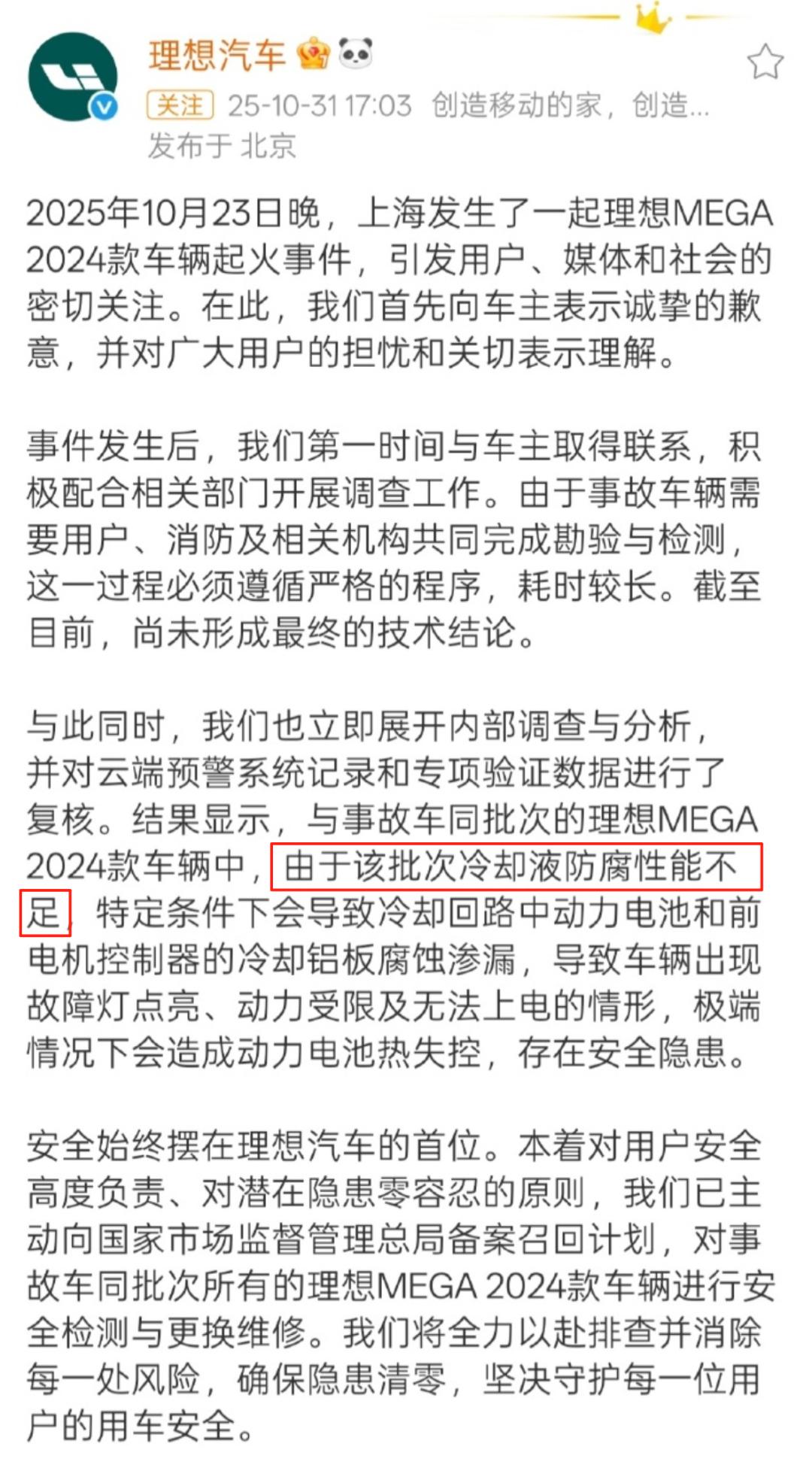
Picture/ Ideal Auto's investigation results of the MEGA fire incident. Source/ Internet, Screenshot from New Energy Outlook
On the other hand, Sunwoda's power battery products are not without controversy. In 2024, several ZEEKR 001 cars caught fire. Subsequently, some car owners received official notices to have their vehicle battery packs tested in cooperation with the "Ministry of Industry and Information Technology's random inspection", and some cars were even replaced with CATL batteries for free when they were required to go to the store for testing.
This action has sparked discussions in the industry about the reliability of Sunwoda batteries. Even recently, a ZEEKR 001 in Dongguan exploded in a residential area, and some residents believe it's the same old problem. This "unresolved issue" makes Ideal's extended warranty commitment for Sunwoda batteries seem a bit weak.

Picture/ A ZEEKR 001 caught fire in Shenzhen on December 4, 2025. Source/ Internet, Screenshot from New Energy Outlook
We can say that the extended warranty may cover the repair costs after a malfunction, but can it eliminate the car owners' hidden worries about potential safety risks during daily driving?
The complexity of the public opinion field is making the situation more delicate. On various car owner communities and social platforms, a group of so - called "key opinion consumers" who are considered to be "paid" are vigorously promoting the Sunwoda option. Their words are highly consistent: "The technological difference is not significant" and "Get the car earlier and enjoy it earlier."
These promotions often deliberately avoid key issues such as insufficient long - term reliability data, potential safety hazards, and possible damage to the future residual value of the second - hand car. This selective information dissemination creates an echo - chamber effect that interferes with the judgment of ordinary consumers.
But in our communication, there are still many smart consumers.
Li Kai (a pseudonym) from Beijing shared his "conversation" with an Ideal salesperson with us. The salesperson called to guide him, saying that the normal delivery time for CATL batteries is in March, but choosing Sunwoda batteries would bring the delivery date forward significantly. The salesperson also mentioned that Sunwoda's batteries have a ten - year warranty and asked him to search for a comparison between the two batteries on Xiaohongshu.
Li Kai simply replied, "I know quite a lot about batteries. Sunwoda can't compare with CATL." The salesperson then said, "If you know so much, then choose CATL. You'll just have to wait longer."
3. The Soul - Corroding Short - Sighted Strategy
Ideal's battery strategy, which has sparked extensive discussions, is closely related to the operational pressures it is currently facing. The financial report for the third quarter of 2024 showed that the company's revenue decreased by more than one - third compared to the same period last year, and its net profit turned from positive to negative. In particular, the under - performance of the MEGA model in the market and the related recall event alone led to the provision of about 1.1 billion yuan for warranty reserves, significantly affecting the company's financial situation.
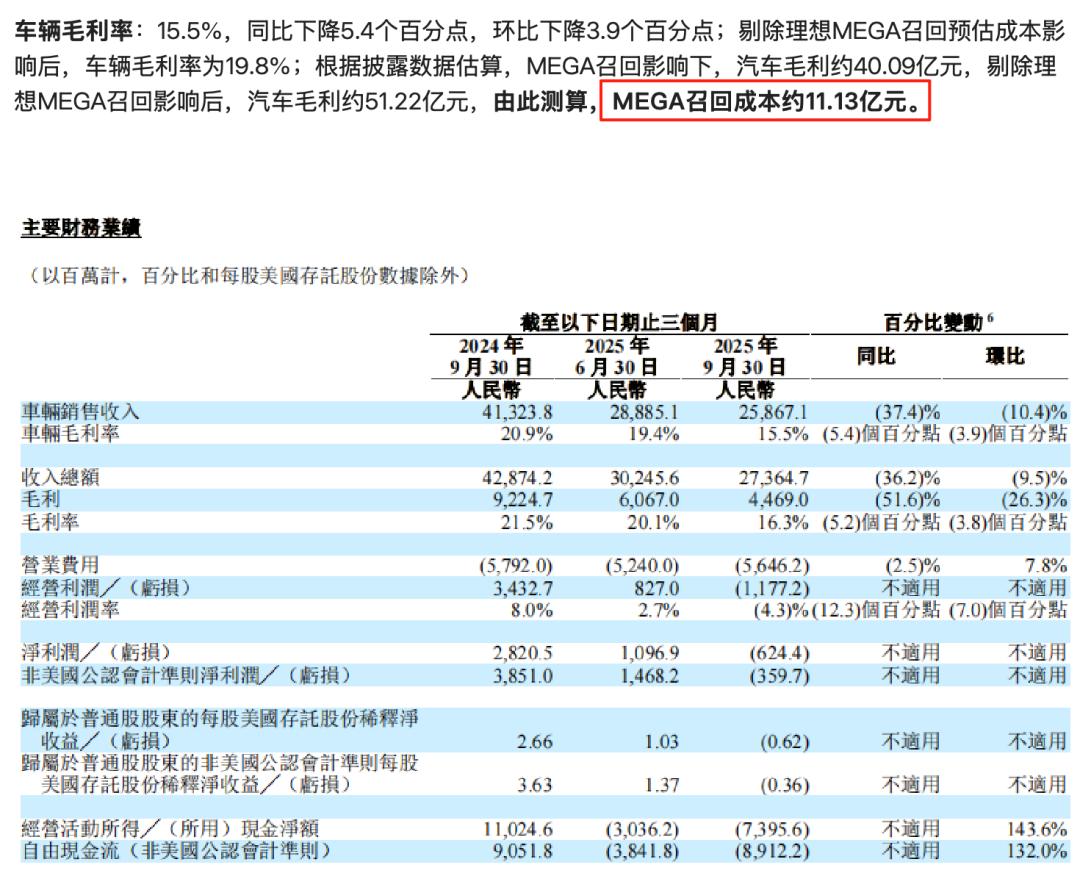
Picture/ Mega recall costs and some financial data of Ideal Auto. Source/ Internet, Screenshot from New Energy Outlook
Facing the real - world pressure of having only completed half of the annual sales target, the i6 model, regarded as a "lifesaver", has shouldered too many expectations. However, expecting consumers to accept the "hidden downgrade" of core components is undoubtedly a short - sighted strategy that the market interprets as "grasping at straws in desperation".
What's even more ironic is the change in the market comparison. In the past, some more affordable competing brands were often jokingly called "half - price Ideal". Now, these brands are working hard to improve their product image by partnering with top - tier supply chain companies like CATL to show their pursuit of quality.
In contrast, Ideal is introducing a second - tier supplier for the core components of its key new model. This contrast of "others advancing while we retreat" creates a strong contrast in consumers' minds: Is the once - industry benchmark quietly "lowering the standards" for short - term sales?
A company that truly respects consumers could have adopted a more transparent and decent strategy. For example, it could have clearly listed different battery brands as configuration options and directly associated them with corresponding price gradients, allowing consumers to make truly independent choices with full and symmetric information. Instead, it uses vague words, unequal benefit designs, and carefully created anxiety to complete a value exchange wrapped in the guise of "choice freedom".
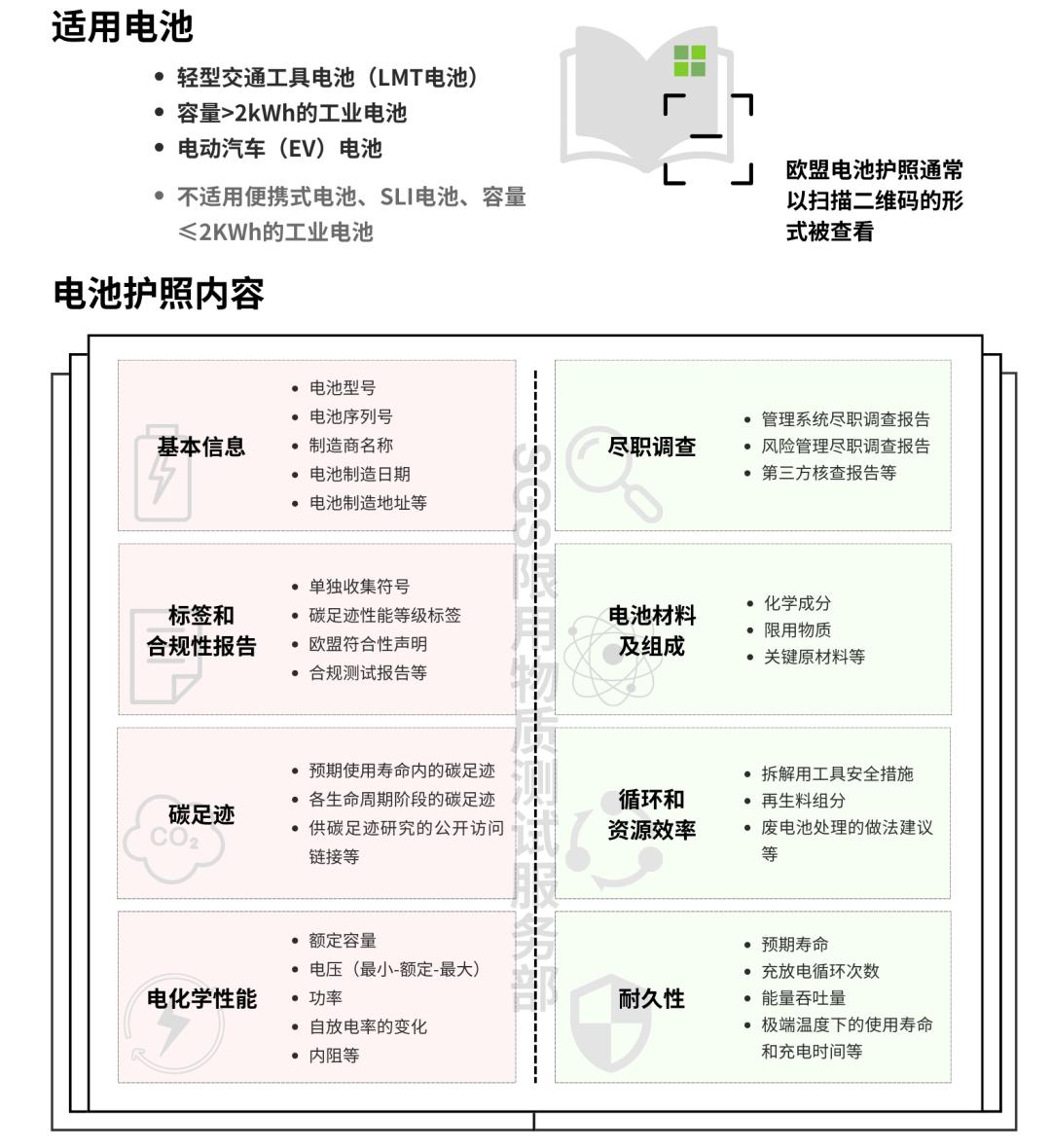
Picture/ The EU launches a "battery passport" to enhance battery usage transparency. Source/ Internet, Screenshot from New Energy Outlook
The market is responding to this strategy in the most real way. A message from a prospective owner of the i6 on a social platform resonated with many: During the next few years of using the car, they don't want to have a single thought like "I should have chosen CATL" when charging, when the range is reduced in winter, or even when selling the car.
More and more consumers are approaching this "risk contract" with caution. Their hesitation or refusal is not just a choice of battery brand but also a vote on business integrity and brand commitment. Ideal's current move may aim to relieve the immediate sales and revenue pressures, but it is shaking the trust foundation, which is the very essence of the company's long - term development.
Finally, here's a thought - provoking question circulating in the car owner community: If your Ideal i6, which costs two or three hundred thousand yuan, is equipped with Sunwoda batteries, and you are given the option to upgrade to CATL batteries for 3,999 yuan, what would you choose?
This article is from the WeChat official account "New Energy Outlook", author: Youjian Editorial Department. It is published by 36Kr with authorization.