Zheng Xuanle, Founder of LightSpeed Capital: From Silicon-based Intelligence to Silicon-carbon Integration, Embrace the New Era of All AI Elements | WISE 2025 King of Business
Zheng Xuanle, Founder of LightSpeed Capital: From Silicon-based Intelligence to Silicon-carbon Integration, Embrace the New Era of All AI Elements | WISE 2025 King of Business
The business world in 2025 is standing at the crossroads of old and new transitions. At present, with the reconstruction of business narratives and the sweeping of technological tides, the WISE 2025 King of Business Conference, with the theme of "The Scenery Here is Exceptionally Beautiful", attempts to anchor the definite future of Chinese business in the face of uncertainties. Here, we record the opening of this intellectual feast and capture the voices of those who still move forward firmly in the changing situation.
From November 27th to 28th, the 36Kr WISE 2025 King of Business Conference, known as the "annual technology and business trend indicator", was held at the Conduction Space in the 798 Art District in Beijing.
This year's WISE is no longer a traditional industry summit, but an immersive experience carried by "technology-based short dramas with exciting plots". From AI reshaping the boundaries of hardware to embodied intelligence knocking on the door of the real world; from the globalization of brands in the wave of going overseas to traditional industries equipping with "cyber prosthetics" - what we restore is not only the trends, but also the insights honed in numerous business practices.
In the following content, we will dissect the real logic behind these "exciting dramas" frame by frame and enjoy the "exceptionally beautiful scenery" of business in 2025 together.
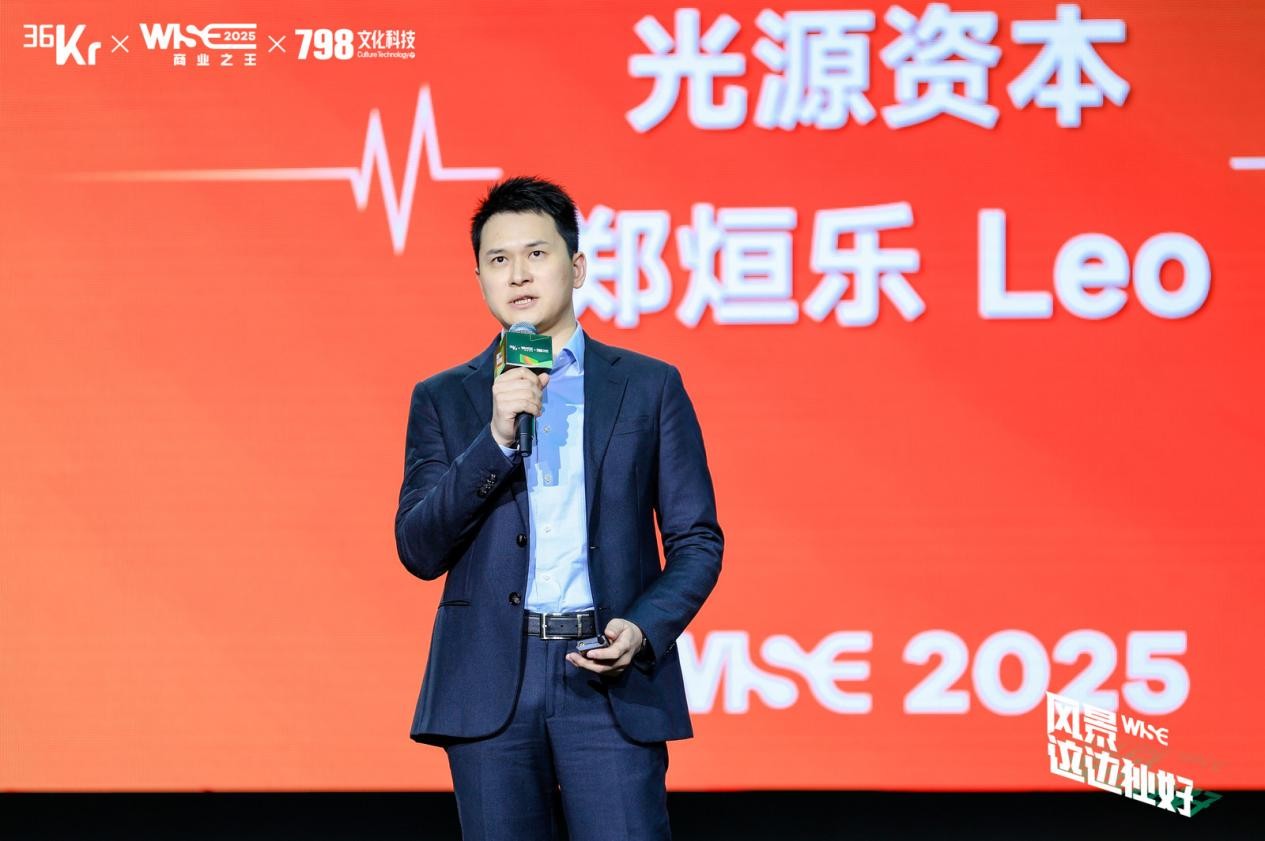
Zheng Xuanle, Founder & CEO of LightSpeed Capital
The following is the speech by Zheng Xuanle, Founder & CEO of LightSpeed Capital, sorted out by 36Kr -
Hello, everyone. I'm Zheng Xuanle, the founder of LightSpeed Capital. I'm very glad to come to the 36Kr WISE Conference again and meet old friends on this familiar stage to discuss new topics. The theme I want to share this year is "From Silicon-based Intelligence to Silicon-carbon Integration, Embrace the New Era of All AI Elements".
As an investment bank, investment, and incubation platform in the primary market, we closely monitor the changes in the investment enthusiasm in the primary market dominated by AI. The market enthusiasm has significantly increased this year, with the financing amount increasing by 54.3% year-on-year, and the number of financing events increasing even more significantly. This is not a short-term phenomenon that will disappear quickly, but an important sign that the AI industry wave has steadily entered the early growth stage from the early exploration stage.
In terms of the distribution of tracks, the overall pattern remains stable, but the number of investments in the field of embodied intelligence has increased significantly. At the same time, the in-depth integration of AI with industrial and industrial scenarios, the implementation of various To B and To C applications, and the combination of AI and biomedicine together constitute the popular directions this year. In terms of investment stages, the industry is still in the early development stage, with the highest proportion of investments in Series A, angel rounds, and seed rounds. Although the number of growth-stage projects has increased, no large-scale turning point has been formed yet. We also closely follow the dynamics of AI investment in the United States, hoping to gain inspiration from the specific practices of the two major artificial intelligence countries, China and the United States. At present, even if we exclude the single financing of hundreds of billions of dollars by OpenAI, there is still an order-of-magnitude gap in the total amount of funds in the primary markets of China and the United States. This reflects that the capital supply in the Chinese AI field is still insufficient, but it also means that the valuations of high-quality enterprises are generally underestimated, with significant upward potential in the future.
In the investment industry structure, the differences between China and the United States are becoming increasingly obvious. In China, 64.1% of the funds are invested in embodied intelligence, which is the hottest track in the current general AI field, and a large number of unicorns have emerged. Another 31.3% of the funds flow to the general application layer. In the United States, 43% of the funds are invested in the model layer, 28% in the application layer, and the investment in AI infrastructure (Infra) is extremely active. In the past three years, more than 50 unicorns have been born in the AI application layer in the United States, while in China, unicorns are currently mainly concentrated in the model layer and the field of embodied intelligence, with less than 10 unicorn enterprises. This comparison clearly shows that there is still huge growth potential in Chinese AI investment, especially in the in-depth incubation and value release of the application layer.
Behind this difference are the different advantages of the two countries. China's core advantages lie in an abundant dividend of hardware and software engineers, the world's leading integrity of the industrial chain, and complete industrial scenarios. This enables China to have a leading edge in the implementation elements of AI + industry, AI + industry, hardware, and embodied intelligence. The United States continues to lead in the fields of models and infrastructure, and this pattern is difficult to change in the next two or three years.
From the 14th Five-Year Plan to the 15th Five-Year Plan, the country has put forward the overall policy of positioning AI as a key production factor. Different from the mobile Internet, which is a connection factor for production relations, AI for the first time connects data, computing power, energy, scenarios, and the supply chain to form a chain linkage. Finally, through the closed loop of "data accumulation - technological maturity - scenario transformation - generation of new data", it builds a circular flywheel of AI element chains to promote the leap of industrial value. It can be said that AI truly connects these isolated elements into new elements, opening the "era of all elements" and entering all industries to promote industrial upgrading.
Looking forward to the future, the era of all AI elements will move towards "silicon-carbon integration". This process is accompanied by the evolution of PMF (Product-Market Fit) of scenarios or paradigms: PMF 1.0 is AI reconstructing information, where large language models understand the world through text; PMF 2.0 is AI reconstructing expression, including text-to-image, text-to-video, and exploration of world models; PMF 3.0 is AI reconstructing processes and organizations, forming a new generation of enterprise organizational forms through agents and intelligent employees and directly delivering productivity results; PMF 4.0 is AI penetrating the physical world, entering production and living scenarios through hardware, industry, and embodied intelligence; PMF 5.0 is AI based on AI for Science, penetrating the element chain in aspects such as energy, computing power, materials, and biomedicine.
This evolution will ultimately create an era of all AI elements with silicon-carbon integration. Just like the industrial revolution, AI will enter all industries, scenarios, and living spaces, providing all-round value in production, consumption, emotions, organization, and society. In the next 30 years, humanity will enter the civilization of silicon-carbon integrated intelligent agents, from individual enhancement and human-machine symbiosis to the AI upgrade of the industrial chain and the silicon-carbon integration at the city level, and finally build an empowered society where humans and AI coexist.
Back to the present, entrepreneurship and investment must face up to the four major structural contradictions in the AI era: First, the contradiction between the rapid technological iteration and the slow industrial implementation. Although the generalization ability of models is strong, many industries have not found effective scenarios for large-scale use of AI or tokens. Second, the contradiction between the demand for computing power and the computing power industrial chain (density, cost) and energy supply (stability, cost). Third, the contradiction between the concentration of platform resources and the dispersion of innovation. Fourth, the contradiction between the global necessity and geopolitical games. Enterprises going overseas face geopolitical fluctuations.
Based on these contradictions, we have observed several entrepreneurship and investment paradigms: First, focus on marginal innovation in large tracks. For example, ByteDance and Kuaishou in the mobile Internet era started from marginal products and gradually grew into mainstream ones. Second, use AI to achieve the leap from handicrafts to industry. For example, in fields such as video production, 3D generation, and AI prospecting, the transition from manual work to large-scale industrial production is realized. Third, look for opportunities to be the "ships" rather than the "reefs" in the intelligent ocean, become the beneficiaries of the decline in computing power costs and the rise in the level of intelligence, and avoid being submerged by the water level. Fourth, seize the opportunities brought by the mismatch of elements in the AI industrial chain, find business opportunities in the mismatch of scenarios, computing power, electricity, data, and other links. The elements of the industrial chain will be in a state of dynamic imbalance for a long time, and we should look for opportunities in the fluctuations.
Looking at different industries, the core opportunity in AI To B lies in the compression of the value chain. AI has the opportunity to achieve end-to-end instant response from demand to delivery, and even directly deliver business results, replacing traditional labor outsourcing or solutions. At the same time, AI promotes the transformation of enterprise organizational forms. Intelligent employees participate in business operations, promoting the flattening of enterprises. In the future, there may be "one-person unicorns". In addition, enterprise-level capabilities are accelerating their spillover. By encapsulating and compressing the capabilities of large enterprises, these capabilities can flow to small and medium-sized enterprises, driving the improvement of social productivity density.
The AI To C field brings a new wave of opportunities. In essence, it evolves from a tool to a personal intelligent agent, and from a content connector to an intelligent service factory. The key competitive dimensions include: a closer personal entrance to people, the accumulation of a large amount of context assets (Context), and a closed-loop scenario. Achieving a closed loop of "decision - execution - feedback" above L3 in a single or high-value scenario will generate huge value. The entrepreneurship opportunities in AI To C lie in the change of the cost structure and the revolution of the interaction mode brought about by the AI transformation of the original supply, as well as the solution of high-risk, long-cycle, and high-trust issues that the mobile Internet cannot solve.
AI + industry transforms handicrafts into industry through three paradigms: First, transform the scattered and easily lost human experience into replicable prior wisdom. Second, solve the contradiction between large-scale replication and personalization that traditional technologies cannot solve. Third, change the industrial organizational form from relying on organizational collaboration to relying on model execution. In fields such as industrial design, energy, and medical care, AI will greatly improve efficiency.
AI + hardware is a hot investment area this year. The opportunities come from the interaction revolution (screenless + physicalization), the personalized experience brought by the data flywheel, and the upgrade of the business model (from simply selling hardware to "hardware + subscription service"). Large enterprises can neither cover a large number of vertical scenarios nor have the hardware gene. Coupled with China's strong supply chain and talent accumulation, this leaves a vast space for startups.
Although AI + embodied intelligence is very popular, it is still in the early stage. It will take time for data expansion, model convergence, and ontology convergence. We believe that the primary factor in this track lies in the generalization ability (the data cost required for unit generalization ability) and the density of large-scale scenario implementation. It is expected that in 2026, some leading enterprises will achieve breakthroughs, and a number of robot companies with scenario endowments will emerge. With China's engineer density, supply chain strength, and scenario breadth, we are expected to lead this field in global competition.
In terms of AI computing power, the explosion of generative AI has brought the demand for increased computing power density and decreased costs. The increase in computing power density depends on the evolution of the architecture, advanced packaging, and dedicated acceleration systems (such as ASIC). The decrease in costs focuses on chips, liquid cooling, and computing power scheduling operations. Frontier computing power such as quantum computing (especially the neutral atom route) is expected to achieve industrial breakthroughs in the next two or three years, forming an "AI × quantum" collaborative computing power acceleration engine.
In the aspect of AI + energy, the expansion of computing power makes energy a new bottleneck and growth point. Clean energy (such as perovskite), nuclear fusion (engineering opportunities), and AI intelligent energy (virtual power plants, smart grids) are the main incremental directions. AI not only benefits from energy but also feeds back to the energy system.
Regarding entrepreneurship opportunities, I think the core logic is that "large enterprises build infrastructure, and startups seek differentiation". Large enterprises have obvious advantages in the infrastructure level of heavy assets, high talent density, and high data barriers. Startups should focus on "going vertical" (vertical scenario supply chain), "going deep" (scenario closed loop and flywheel), and "seeking mismatch" (finding dynamic mismatches of industrial chain elements).
Currently, the main challenges faced by startups in the general AI field include: the mismatch between the technology cycle and the capital cycle; insufficient capital supply in the growth stage; the pre - placement of commercialization pressure; the choice of ecological niche under the blurred boundaries of large enterprises; and the geopolitical uncertainty against the background of the increasing global demand. This has led to changes in the service needs of entrepreneurs in the capital market. They need more the ability to tell industrial stories across cycles, the perspective of the element chain, the ability to plan and schedule capital paths, the ability to introduce industrial resources, and the ability to accompany in strategy and governance.
Therefore, LightSpeed Capital has built a new industrial investment banking system based on the AI productivity era, including financial advisory, the 3i Industrial Innovation Incubator, the L2F LightSpeed Entrepreneurs Fund, the growth - stage fund, government landing, mergers and acquisitions, and other tool lines, providing integrated services of investment, incubation, and financing. In the past three years, we have helped enterprises complete a total financing transaction volume of more than 130 billion RMB. After 11 years of development, we have ranked first in the overall market and in multiple frontier tracks such as artificial intelligence, embodied intelligence, and semiconductors for three consecutive years. The 3i Industrial Innovation Incubator established in 2024 has participated in the incubation of leading enterprises in the industry such as Aishi Technology and Galaxy Universal Robotics. The newly launched L2F LightSpeed Entrepreneurs Fund this year has brought together many leading industrial LPs and successful entrepreneurs, aiming to accurately empower early - stage AI entrepreneurs with industrial resources and entrepreneurial experience, and be the most helpful ultra - early - stage investment fund for AI entrepreneurs and the best co - investment partner for early - stage investors.
We always hope to build LightSpeed as a bridge connecting innovative elements and industrial development. We are committed to integrating our capital network and industrial resource network to empower two types of core partners: On the one hand, we help early - stage entrepreneurs efficiently realize the industrialization and capitalization of technological achievements. On the other hand, we provide capital support for industrial groups, using capital as the driving engine to accelerate their industrial innovation and upgrading process.
Here, I also want to share our mission with you - I believe this is also the common pursuit of many peers in the primary market and entrepreneurs: In the current era of deep silicon - carbon integration, we will continue to promote the resonance of innovative elements, industrial development, and capital power, and join hands with all partners to embrace the new era empowered by all AI elements.
I believe that as long as we persevere in doing the "right thing" - creating real value with technology, the world will become a better place because of our efforts.
That's all for my sharing. Thank you!