Behind the launch of the Zhuque rocket, who is reshaping China's commercial space landscape?
The Vermilion Bird soars, chasing dreams in the stars and rivers.
On December 3rd, the Zhuque-3 Y1 carrier rocket of LandSpace Technology successfully made its maiden flight into orbit, but failed to complete the first-stage rocket recovery verification mission as expected.
As China's first orbital launch verification of a reusable rocket in the commercial space industry, this mission was "bittersweet." However, it accumulated experience and valuable data, still marking an important and memorable step.
Currently, the commercial space industry has become a new focus of competition among major powers. China's commercial space industry started in 2015 and is now approaching a double inflection point of "technological breakthrough" and "scale explosion."
Not long ago, the National Space Administration released the "Action Plan for Promoting the High - quality and Safe Development of the Commercial Space Industry (2025 - 2027)", incorporating the commercial space industry into the overall layout of the country's space development. Recently, the National Space Administration also established the Commercial Space Department, marking that China's commercial space industry has welcomed a dedicated regulatory agency. In the future, it will continuously promote the high - quality development of China's commercial space industry, and the industrial chain is expected to benefit comprehensively.
The acceleration period of industrial expansion is approaching, and local regions are also stepping up their layouts. According to incomplete statistics, at least 20 provinces across the country have introduced support policies to compete in the commercial space industry. From the construction of low - cost, highly reliable, fast - response, and reusable commercial carrier rockets to fields such as satellite manufacturing, rocket launch, and satellite application, who can break through first?
01 Collective "Breakthrough"
The strength of the space industry is an important indicator of a country's economic, technological, and national defense capabilities. As a new force in the space industry, commercial space, which is market - oriented and profit - driven, covers fields such as rocket launch, satellite application, and space tourism.
In the view of Huang Chaofeng, a professor at Shanghai Jiao Tong University and the deputy dean of the National Strategy Research Institute, the commercial space industry is not only a "new engine" to activate economic growth but also a key variable to reshape the global competition pattern.
Globally, orbits and spectra are the core strategic resources of the space economy. The "first - come, first - served" principle of the International Telecommunication Union (ITU) has triggered fierce competition and contention worldwide. Currently, China has planned and deployed constellation projects such as the "Qianfan Constellation" and the "State Grid Constellation." However, as of November 2025, only 230 satellites of these two constellations had been launched in total.
The prominent bottleneck is "more satellites, fewer rockets, and insufficient launch capacity." According to a research report by Huatai Securities, from the perspective of the planned number of satellites in the constellations and the launch situation, insufficient launch capacity is one of the core factors for the slow progress of satellite networking. As China's reusable rockets gradually mature, reusable rockets are expected to shorten the launch cycle, increase the launch density, and thus accelerate the process of satellite internet networking.
On the other hand, data shows that the engine and the rocket body structure of a carrier rocket account for the largest proportion of the total hardware cost, with the first - stage thruster accounting for about 77.8%. Recovery will also generate considerable economic benefits to meet the "high - density, low - cost" launch requirements of low - Earth orbit constellations.

Currently, domestic commercial rocket companies are collectively "breaking through" in the development of large - capacity liquid reusable rockets, striving to accelerate the breakthrough of the bottleneck. Among them, LandSpace Technology is one of the companies closest to the goal of reusable rockets.
On December 3rd, after the maiden flight of the Zhuque - 3, LandSpace Technology issued a statement saying that according to the flight measurement data, an abnormality occurred after the first - stage rocket was ignited during the landing phase, and it failed to make a soft landing at the recovery site. The wreckage landed at the edge of the recovery site, and the recovery test failed. The specific cause is being further investigated. However, five technologies in this mission achieved "firsts in China" -
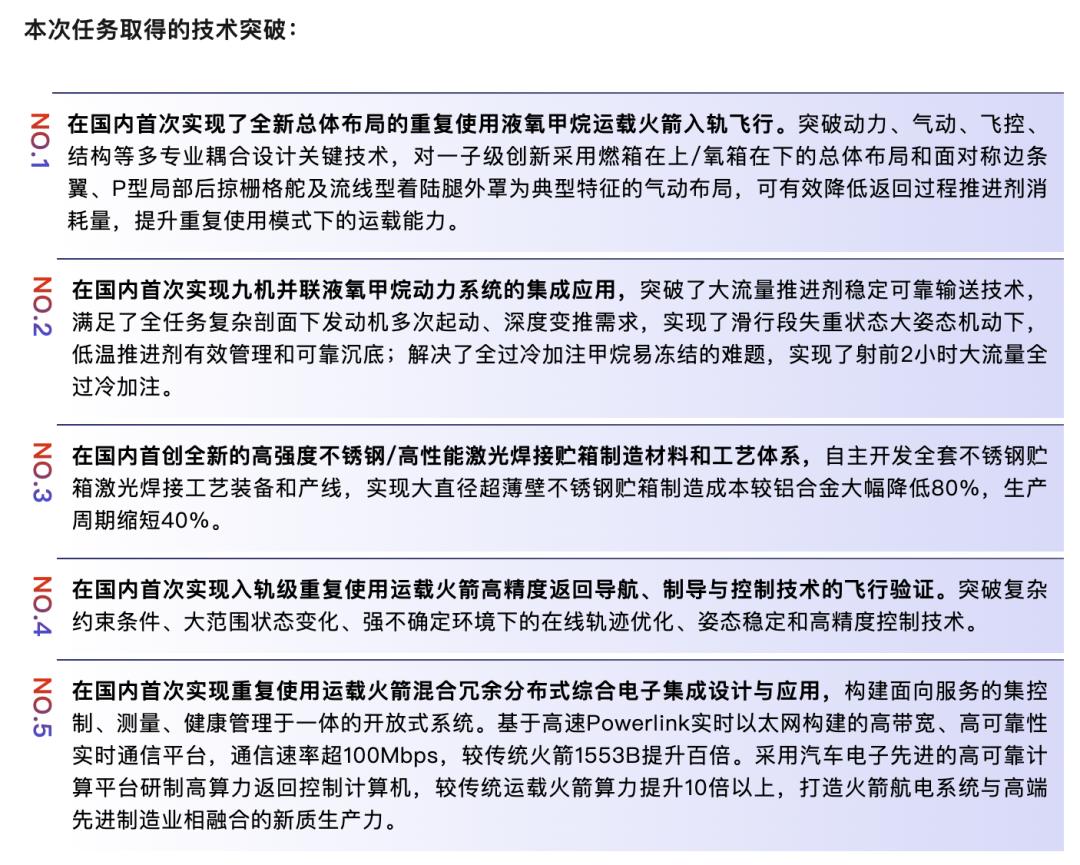
Image source: LandSpace Technology
This also represents an important step in the development of China's reusable rockets.
According to statistics from Founder Securities, in addition to LandSpace Technology, currently, the Zhishenxing - 1 of Galaxy Power, the Tianlong - 3 of Tianbing Technology, the Hyperbola - 3 of Interstellar Glory, the Gravity - 2 and Gravity - 3 of Orient Space, the Nebula - 1 and Nebula - 2 of Deep Blue Aerospace, and the Lijian - 3 of CAS Space all regard reusability as an important goal. Among them, the goal of the Lijian - 3 is to be reused 100 times, and the goal of the Gravity - 3 is to recover the entire rocket.
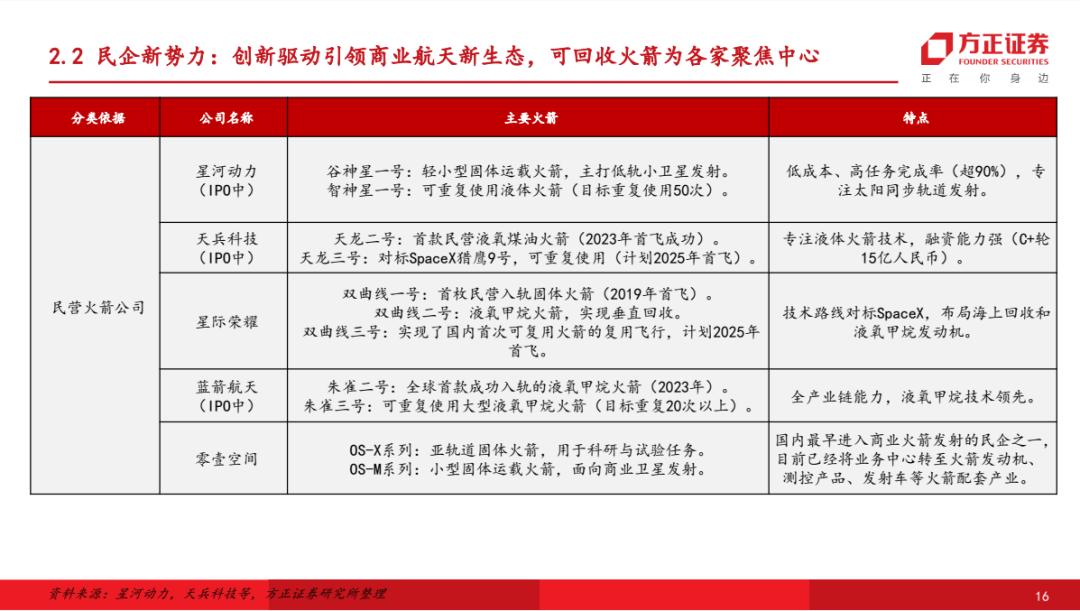

It is reported that the Tianlong - 3 and the Lijian - 2 also plan to make their maiden flights this year. However, different from the Zhuque - 3, the maiden flights of these two rocket models will not fully verify recovery. In addition, the Long March 12A rocket of the commercial rocket company of China Aerospace Science and Technology Corporation is also aiming for its maiden flight this year.
The new breakthrough in China's commercial space industry has just "ignited."
02 Rise of the "Engine"
Back in 2015, when SpaceX's Falcon 9 rocket completed its first recovery, China's commercial space industry was just starting.
In this year, the National Development and Reform Commission and other departments jointly released the "Medium - and Long - Term Development Plan for the National Civil Space Infrastructure (2015 - 2025)", which "encouraged social capital to enter the space field" and was regarded as the "Year One of China's Commercial Space Industry."
With the policy breakthrough, private enterprises such as LandSpace Technology and OneSpace Technology have entered the market one after another, supporting China's commercial space industry to enter a stage of high - speed development. Ten years ago, there were less than 10 commercial space companies in China. As of now, the number of commercial space companies in China has exceeded 600.
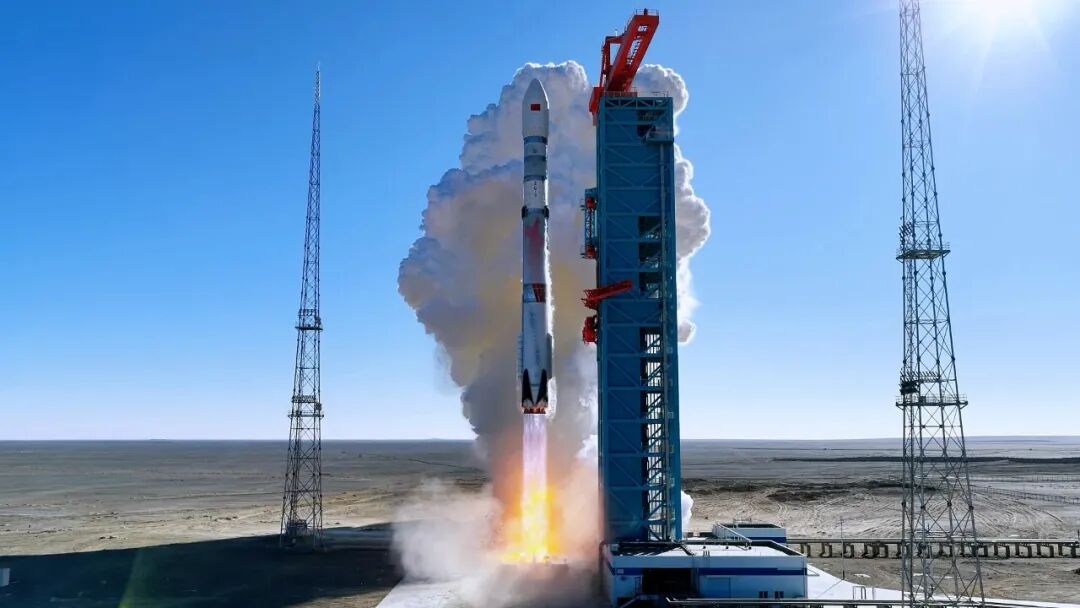
Image source: LandSpace Technology
In the view of Tian Qingfeng, a professor and the deputy director of the Military - Civilian Integration Development Strategy Research Center at Northwestern Polytechnical University, the commercial space industry promotes the transformation of space activities from "national projects" to "market - driven." Traditional space activities are government - led and focus on national strategies, while the commercial space industry is market - oriented and pursues commercial profits. These two aspects promote and complement each other in terms of technology, talent, and industry.
With the rapid growth of the industrial scale, China's commercial space industry has formed a full - chain ecosystem covering upstream manufacturing, mid - stream launch and operation, and downstream application services.
In terms of upstream spacecraft and their supporting manufacturing, private enterprises such as LandSpace Technology, Interstellar Glory, and Deep Blue Aerospace, which focus on liquid rockets, and Galaxy Power, CAS Space, and Orient Space, which focus on solid rockets, jointly form the private forces in the R & D and manufacturing of carrier rockets. Tianbing Technology and Jiuzhou Yunjian continue to focus on the design of carrier rocket engines.
Meanwhile, Tianyi Research Institute and Micro - Nano Star Technology mainly focus on microsatellites. GalaxySpace and Changguang Satellite aim at constellation satellites. The Innovation Center for Microsatellites of the Chinese Academy of Sciences, SpaceYee, Aotian Technology, and Ziwei Technology focus on core satellite components such as satellite payloads and propulsion systems, forming a close - knit cooperation and division of labor.
According to an analysis by Huaxi Securities, the market scale of China's commercial space industry increased from about 3.8 trillion yuan in 2015 to 23 trillion yuan in 2024, with an average annual compound growth rate of about 22%. If calculated at a growth rate of 25%, the market scale of China's commercial space industry is expected to approach 100 trillion yuan in 2030, showing huge growth potential.
The recently released "15th Five - Year Plan" proposal of the country puts forward the construction of a modern industrial system and the acceleration of building a space - power country. This is also the first time that "building a space - power country" has been written into the key tasks of the national five - year plan. It is not difficult to foresee that China's commercial space industry is entering a new round of high - speed development.
In Tian Qingfeng's view, by deepening industrial chain collaboration, expanding the global layout, and exploring emerging application scenarios, the industry is expected to achieve a "civilian - oriented space economy" before 2030.
However, he also pointed out that China's commercial space industry still faces problems such as high costs, great profit - making pressure, technological gaps, and insufficient international discourse power. It is necessary to optimize mechanisms and policies, systematically promote the construction of the commercial space system, and create new models and formats for the commercial space industry.
03 Local Competition
Currently, the development of the commercial space industry has risen to a strategic task related to a country's new competitive advantages. Local regions are also reshaping new competitive advantages in the industry through policy guidance, capital empowerment, and project - driven approaches.
On the day when the Zhuque - 3 was launched, the 2025 Commercial Space Forum, hosted by the Wuhan Municipal Government and China Aerospace Science and Industry Corporation, opened in Wuhan. As one of the birthplaces of the commercial space industry, Hubei has gradually formed a "one - main, two - wing" (Wuhan National Space Industry Base, Xiaogan Space Industrial Park, and Yichang Space Power Industrial Park) pattern. It plans to build a nationally influential innovation and development high - ground for the commercial space industry by 2028, aiming to exceed 100 billion yuan in the scale of the provincial commercial space and related industries.
Hubei is one of the representatives challenging the national strength pattern of the commercial space industry.
Currently, China has formed three major commercial space industry clusters in the Beijing - Tianjin - Hebei region, the Yangtze River Delta region, and the Pearl River Delta region, with a first - mover advantage in fields such as rocket R & D and manufacturing and satellite manufacturing. For example, the Beijing Economic - Technological Development Area (Yizhuang) and Daxing District have gathered more than 70% of the private rocket - building enterprises in the country.
The strength of these regions can also be seen from their relevant planning goals. According to the "Action Plan for Promoting the Development of the Commercial Space Industry and Building a High - ground for the Space Information Industry in Shanghai (2023 - 2025)", Shanghai aims to produce 50 commercial rockets and 600 commercial satellites annually and achieve a space information industry scale of over 200 billion yuan by 2025.
Beijing also proposed in the "Action Plan for Accelerating the Innovation and Development of the Commercial Space Industry in Beijing (2024 - 2028)" to deepen the industrial spatial pattern of "rockets in the south, satellites in the north" and strengthen the commercial space industry cluster worth hundreds of billions of yuan.
Guangdong proposed in its relevant plan that by 2026, the scale of the provincial commercial space and related industries is expected to reach 300 billion yuan, and the industrial development level will be significantly improved.
There are certain differences in the statistical caliber of these output value targets, but reaching the scale of hundreds of billions of yuan is already the threshold for competing in the "first echelon" of the commercial space industry.
In terms of financing, regions such as Beijing and Shanghai are also key areas. At the beginning of this year, the "Review and Outlook of China's Commercial Space Industry Development in 2024" published in the magazine "China Space" revealed that in 2024, there were 52 financing events in China's commercial space industry, with a total disclosed financing amount of 15 billion yuan. Among them, the financing amounts in the satellite operation, rocket manufacturing, and satellite manufacturing fields accounted for 43%, 30%, and 16% respectively.
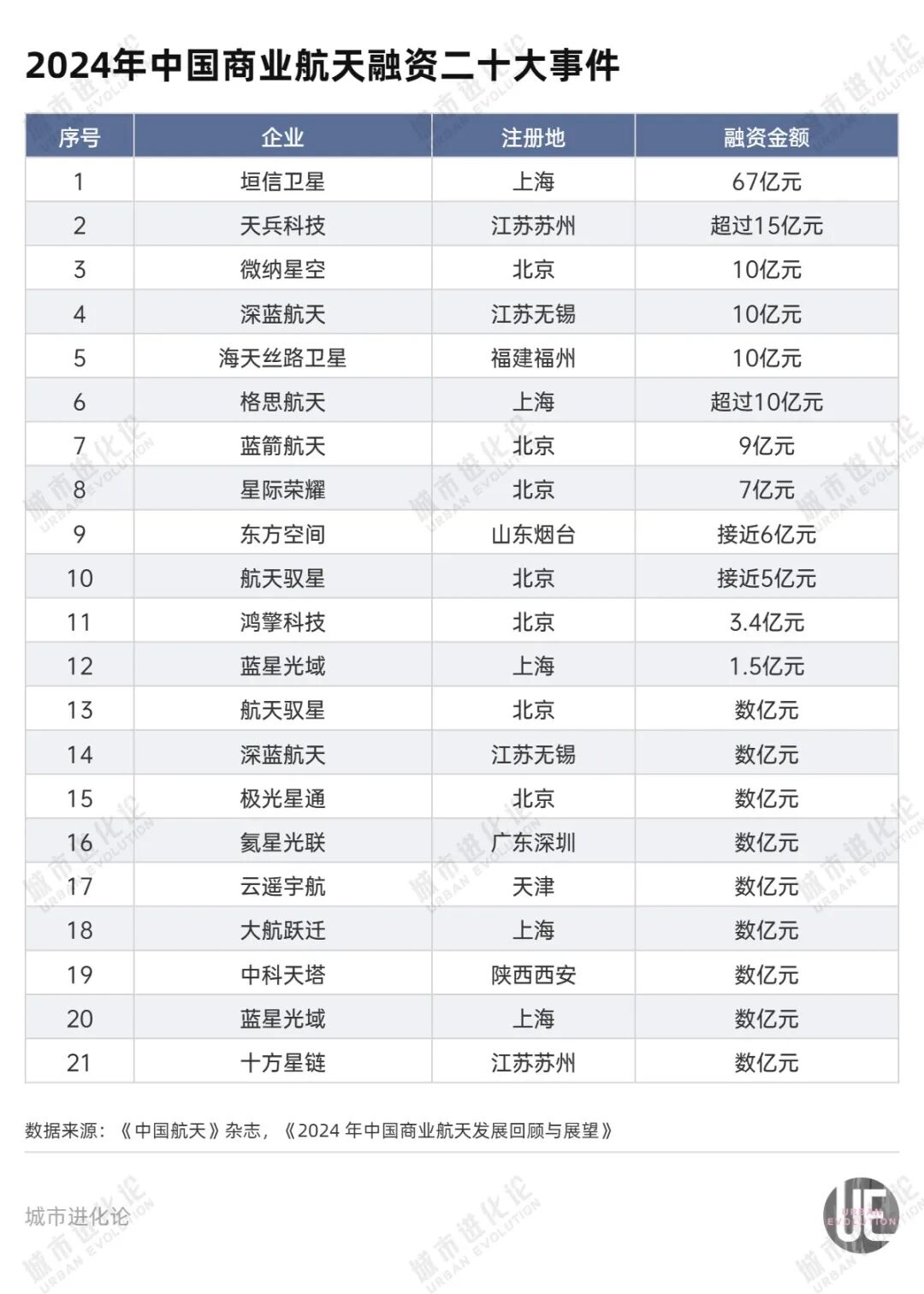
Among the top 20 financing events, Beijing had 7, Shanghai had 5, Jiangsu had 3, and Guangdong, Shandong, Fujian, Tianjin, and Shaanxi each had 1. To a certain extent, this also reflects the development potential of commercial space companies in these regions.
Behind Beijing, Shanghai, and Guangdong, regions such as Hubei, Shaanxi, and Sichuan have also introduced support policies, aiming to build commercial space industry clusters worth hundreds of billions of yuan.
According to incomplete statistics, at least 20 provinces across the country have introduced support policies for the commercial space industry. Among them, Beijing, Hubei, Shaanxi, Guangdong, and Hainan have introduced the most local regulations for the commercial space industry, with 125, 99, 56, 52, and 47 respectively.

Situation of local regulations for the commercial space industry in each province in China. Image source: "Journal of the Chinese Academy of Sciences", Issue 11, 2025, "The Situation and Challenges Faced by China's Commercial Space Industry Development"
This kind of competition will, to a certain extent, promote the accelerated development of the commercial space industry, but we