Rationally Examine RedCap: From an 800% Surge to a $40 Billion Future, Opportunity or Embarrassment?
Let's first take a look at two sets of data.
According to a report by Counterpoint Research, the shipments of 5G RedCap modules witnessed an astonishing year - on - year surge of nearly 800% in the second quarter of 2025. This data is like a thunderclap, announcing that the curtain of RedCap commercialization has already been raised.
However, this remarkable growth is not an isolated numerical frenzy but the beginning of a grand prologue. According to the research and analysis of the Internet of Things Think Tank, the shipments of 5G Redcap will exceed 10 million by the end of 2025. The scale of multiple fields such as wearables, in - vehicle devices, MiFi, and CPE will increase, and new terminals like AI companion devices are being incubated.
Looking ahead, according to the prediction of Transforma Insights, by 2034, the total number of global IoT connections will exceed 40 billion, among which the number of cellular IoT connections will more than triple, reaching 6.7 billion.
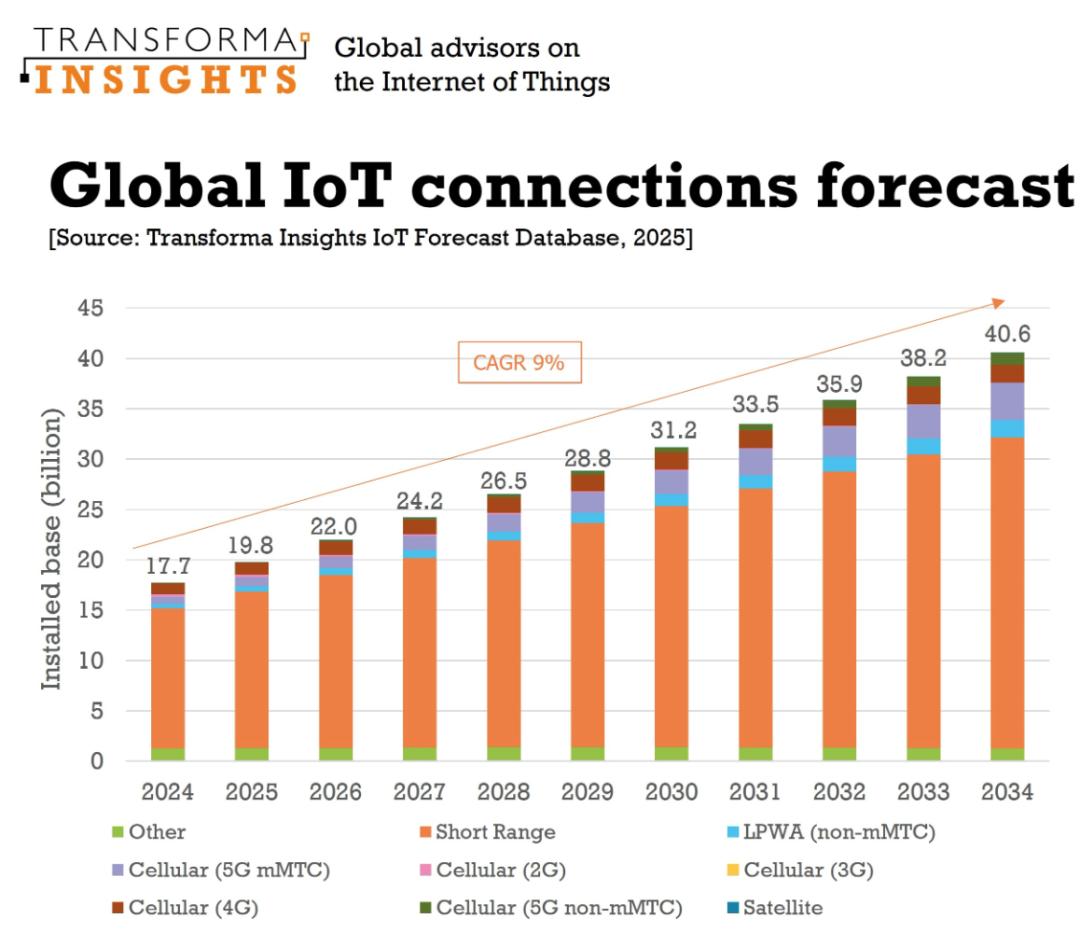
In this grand journey towards 40 billion connections, we need a more sober review.
This astonishing percentage growth largely stems from the almost negligible base in the same period last year. It is more like a signal from 0 to 1 rather than a mature explosion from 1 to 100.
The real situation of RedCap is not all smooth sailing. It is both a key piece to fill the gap in the 5G IoT landscape and is facing multiple challenges in terms of cost, ecosystem, and market positioning. This article aims to dispel the fog of the growth rate, objectively evaluate the real role of RedCap, sharply point out the core problems in its development, and explore the way to break the deadlock.
Reconstruction of Value: RedCap's Mission is to be "Just Right"
First of all, we must clearly recognize that RedCap is not a disruptive revolutionary technology but an extremely practical "subtraction" project. Its birth is to solve an obvious structural gap in the early stage of 5G commercialization.
In the 5G family, eMBB technology pursues extreme bandwidth, and URLLC technology pursues extreme reliability and low latency. Together, they form the pinnacle of 5G. However, the high cost and power consumption limit their application scenarios to a few high - end fields. At the bottom of the pyramid are low - power wide - area network technologies such as NB - IoT. Although they are cost - effective, their performance is limited, making it difficult to meet the growing medium - rate IoT requirements.
It is in this vast "neither here nor there" middle ground - such as industrial sensing, smart wearables, video surveillance, and smart grids - that RedCap has found its ecological niche. By trimming some of the 5G capabilities (such as bandwidth and the number of antennas), it seeks a delicate balance between cost, power consumption, and performance. Therefore, the essential role of RedCap is "filling the gap rather than replacing".
It is to fill this huge market gap that RedCap (Reduced Capability) came into being. Its core mission is not simply "cost reduction" but to achieve an unprecedented "value match".
Through precise "trimming" of 5G capabilities, such as reducing bandwidth, simplifying antenna configuration, and reducing transceiver links, RedCap has found an excellent balance between cost, power consumption, and performance. It marks an important shift in the design philosophy of cellular communication: from "technology - driven" to "scenario - driven" comprehensively. RedCap no longer blindly pursues peak rates but provides "just right" connection capabilities for specific application scenarios, ensuring that technological investment can be accurately translated into commercial value.
The far - reaching significance of this concept becomes particularly clear when examining the value chain of the entire IoT market.
Analysis by Transforma Insights points out that the value of connection goes far beyond the connection itself. Predictions show that by 2034, connection services and module hardware will only account for about 12% of the total IoT market revenue of up to $908 billion. The remaining 88% of the huge value is hidden in data processing, platform services, application development, and final business insights.
RedCap's real mission is to use the precise optimization of this "12%" cost to leverage and unlock the up to "88%", that is, nearly $80 billion of application and service value. By providing an economically viable medium - high - speed connection, it makes applications that were not commercially feasible in the past become feasible, thus creating a brand - new incremental market out of thin air.
The Harsh Reality: Three Major Challenges Lie Ahead
Despite its clear positioning, RedCap faces at least three mountains that must be overcome on the road from ideal to reality.
First, the "chicken - and - egg" dilemma between cost and scale.
This is a common problem in the early stage of commercialization of all new technologies. At present, there is still an obvious price gap between RedCap modules and the extremely mature 4G Cat.1/1bis modules. For IoT projects that are highly sensitive to cost, this slight difference may be the decisive factor.
This forms a vicious circle: without a large enough application scale, upstream chip and module manufacturers cannot spread the cost through economies of scale; and if the cost cannot be reduced, downstream application parties lack the motivation to replace 4G on a large scale. Although the 800% growth sounds promising, its absolute shipment volume is still a drop in the bucket compared with the hundreds of millions of 4G Cat.1 modules shipped annually, far from reaching the critical scale to leverage the cost.
Second, the "inertial gravity" of the mature 4G ecosystem.
RedCap's positioning makes it awkwardly become a "sandwich". Below it is 4G Cat.1/1bis, which has reached rock - bottom prices, an extremely mature ecosystem, and comprehensive coverage; above it is full - featured 5G with powerful performance. For most medium - speed IoT applications, Cat.1 "is already sufficient", and developers are very familiar with its technology stack, and the supply chain is stable and reliable.
In the face of this strong "inertial gravity", convincing customers to pay additional hardware costs, R & D costs, and migration risks for the "performance improvement" (such as lower latency and network slicing capabilities) brought by RedCap is a highly challenging marketing task. Unless it can be proven that this improvement can bring disproportionate commercial returns, "good enough" will be the practical choice for most customers.
Third, the "time difference" between network coverage and ecosystem maturity.
Although operators are actively deploying RedCap, it will still take time to achieve the same level of wide - area and in - depth coverage as 4G. For IoT terminals deployed in remote areas or complex indoor environments, the stability and reliability of the network are the top priorities.
In addition, a mature technology ecosystem includes not only chips and modules but also stable network software versions, rich development tools, an active developer community, and a large number of mature reference cases. RedCap is still in the "beginner's stage" in this regard, and there is an obvious "time difference" between its ecosystem maturity and robustness and the 4G ecosystem that has been developed for nearly a decade.
The Way to Break the Deadlock: From "Usable" to "Good to Use" and Then to "Must - Use"
Facing the above challenges, RedCap's future is not bleak, but its success is by no means a foregone conclusion. It requires the joint efforts of the entire industry chain to complete the difficult leap from "usable" to "good to use" and finally to "must - use".
First, breaking the cost deadlock requires "strategic investment" rather than "market - based waiting".
Expecting the market to spontaneously form a scale to reduce costs will be a very long process. The key to breaking the deadlock lies in the "artificial promotion" of the core forces in the industry chain. Operators need to provide more attractive RedCap traffic tariff packages and even subsidize early adopters to reduce their operating costs. Chip and module manufacturers need to set strategic prices, temporarily sacrificing some profits to gain market share and accelerate the scaling - up process.
More importantly, it is necessary to find and cooperate with leading enterprises in fields such as electricity, industry, and security to create several "benchmark projects" with a scale of tens of millions, using the artificially created scale to forcibly start the flywheel of cost reduction.
Second, getting rid of the "sandwich" embarrassment requires focusing on "value creation" rather than "parameter comparison".
The promotion of RedCap must break out of the low - dimensional competition of "cost - performance" comparison with Cat.1. The marketing focus should shift from "I'm a little faster than it" to "I can do what it can't do".
For example, in the field of industrial automation, highlight how RedCap's lower latency can improve the efficiency and safety of production line collaboration; in the field of smart grids, emphasize how its 5G network slicing capabilities can provide financial - grade communication guarantees for control instructions; in the field of AI cameras, demonstrate how its higher uplink bandwidth can support more complex edge - side intelligent algorithms. Only when RedCap becomes the "only solution" or the "optimal solution" for achieving certain key business innovations can it truly get rid of the "sandwich" positioning and become the "must - use" choice for customers.
Finally, bridging the ecosystem gap requires "openness and empowerment".
The leaders in the industry chain, especially operators and leading equipment manufacturers, need to release a clear, transparent, and stable RedCap network evolution roadmap (including the subsequent eRedCap deployment plan) to the market to give downstream developers clear expectations. At the same time, they should invest heavily in building an open developer ecosystem, providing easy - to - use SDKs, detailed development documents, and efficient technical support to significantly lower the entry threshold for small and medium - sized enterprises and individual developers. By holding developer competitions and establishing open laboratories, etc., to encourage the birth of innovative applications and use rich "software" to make up for the deficiencies in the early stage of the "hardware" ecosystem.
Returning to the Business Essence, RedCap's Future is a "Long - Distance Run" Rather Than a "Sprint"
In summary, 5G RedCap is a technology evolution that conforms to market demand and has a precise positioning. It is of great strategic significance for the integrity of the 5G IoT landscape. However, the impressive initial growth rate cannot cover up the severe challenges it faces in terms of cost, market competition, and ecosystem maturity.
Its success is not determined by technical parameters but depends on whether the entire industry chain can work together to pragmatically solve every specific problem in business implementation.
RedCap's future is a "long - distance run" that requires patience and wisdom, rather than a one - time "sprint".
Only by returning to the business essence, focusing on creating irreplaceable value for customers, and cultivating the ecosystem with strategic investment and an open attitude can RedCap truly transform its technological potential into market advantages and firmly occupy its own place on the road to the intelligent interconnection of all things.
This article is from the WeChat official account "Internet of Things Think Tank" (ID: iot101), author: Yuandian. It is published by 36Kr with authorization.