Chu Jian, founder of SUPCON and founder and dean of Ningbo Institute of Industrial Internet: The vast potential of AI in empowering process industries. A 3% increase in efficiency can unlock trillions in profits.
From November 27th to 28th, the 36Kr WISE 2025 King of Business Conference, hailed as the "annual technology and business trendsetter", was held at the Conduction Space in the 798 Art District in Beijing.
This year's WISE is no longer a traditional industry summit, but an immersive experience centered around "tech-driven drama shorts". From AI reshaping the boundaries of hardware to embodied intelligence opening the door to the real world; from brand globalization in the wave of going global to traditional industries equipping with "cyber prosthetics" - what we present is not just trends, but also the insights honed through numerous business practices.
In the following content, we will dissect the real logic behind these "drama shorts" frame by frame and explore the unique business landscape of 2025 together.
Against the backdrop of China's manufacturing industry facing the dual pressures of overcapacity and energy conservation and emission reduction, how can the high-energy-consuming and high-risk process industry achieve qualitative change?
Chu Jian, the founder of SUPCON and the founder and dean of the Ningbo Institute of Industrial Internet, believes that AI can be used to reshape industrial production.
At the conference, Chu Jian put forward three core arguments for SUPCON Technology:
Firstly, the fundamental contradiction in the current process industry lies in the "chef's dilemma" between experience dependence and system optimization. Production in the process industry is like cooking. Although the raw materials and equipment are the same, the results highly depend on manual experience, leading to unstable quality and energy consumption. Chu Jian believes that true industrial intelligence needs to go beyond personal experience and achieve stable and replicable systematic optimal control.
Secondly, regarding the solution path, Chu Jian believes that it is necessary to integrate industrial data, scientific mechanisms, and large AI models to move from "perception" to "optimization". The time-series large model TPT (Time-series Pre-trained Transformer) developed by SUPCON can not only "understand" the production status and "comprehend" the reaction process but also actively recommend optimization strategies, promoting industrial control to move from automation to autonomous intelligence.
Thirdly, regarding the value created after AI is applied to industrial scenarios, Chu Jian said that AI must create measurable real benefits for the industry and unlock trillions of profit margins. The vitality of industrial AI lies in solving core pain points such as safety, quality, cost, and emissions. Just a 3% increase in efficiency means generating two trillion yuan in profits in the process industry; a 1% reduction in emissions means reducing one hundred million tons of carbon emissions - this is the most convincing value answer for AI empowering industry.
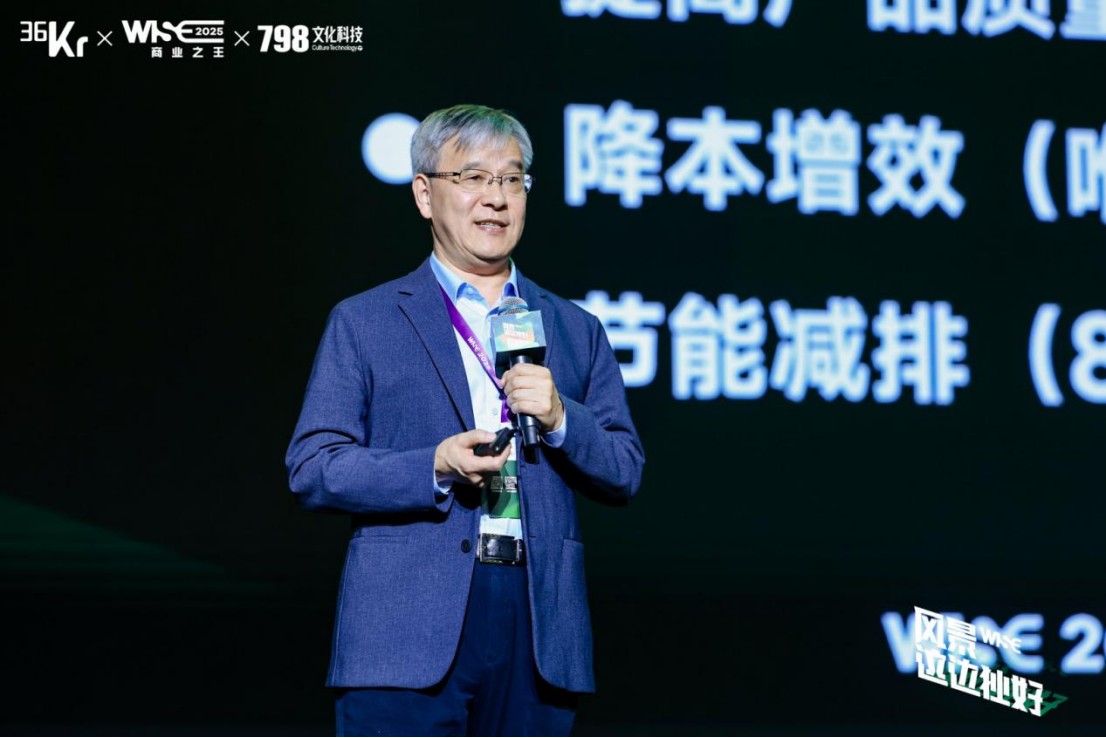
Chu Jian, the founder of SUPCON and the founder and dean of the Ningbo Institute of Industrial Internet
The following is the edited transcript of the speech by Chu Jian, the founder of SUPCON and the founder and dean of the Ningbo Institute of Industrial Internet:
Hello, everyone! Thank you to 36Kr for providing this communication platform.
The industrial-style venue of today's event reminds me of the bygone industrial history. The industry today has undergone earth-shaking changes compared to the past. Here, I'd like to share my thoughts on the future of the industry - especially in today's era of rapid AI development, what will the future of the industry look like? You know, all our daily necessities, such as rice and flour, come from industry and have gone through professional industrial processing. Therefore, the industry is very important.
Last year, Jensen Huang said something that impressed me deeply. He said that this wave of AI will make the global manufacturing industry worth 50 trillion US dollars more automated. The core question is how to use AI technology to transform the industry. China's total industrial revenue is about 20 trillion US dollars, accounting for one-third of the global total. We mainly focus on and serve the process industry, which has a scale of about 60 trillion yuan. Among the 500,000 above-scale manufacturing enterprises in China, the process industry accounts for about one-ninth, that is, 55,000. Although the number is not large, the output value is very high, covering industries such as the "Three Big Oil Companies", non-ferrous metals, steel, rare earths, pharmaceuticals, pesticides, and building materials. In addition, the carbon emissions of the process industry account for about 80% of the national total. Since it is essentially a chemical reaction process, for example, iron ore is transformed into steel and then made into automobile panels and steel structure venues, these are all high-energy-consuming processes; and crude oil and petroleum are processed into clothes and bags around us, which are all petrochemical products.
The process industry is characterized by high temperature, high pressure, flammability, and explosiveness. Therefore, it has a high level of automation and a good digital foundation. In the AI era, without data, nothing can be achieved. How to efficiently use this data is the key issue we need to think about.
Precisely because the process industry has high safety risks and is prone to accidents, we should face these pain points and challenges head-on, which are exactly our opportunities. Based on the characteristics of the process industry, we need to focus on solving three major problems: First, ensure production safety; second, improve product quality; third, reduce costs and increase efficiency. Currently, many industries in China are facing the problem of overcapacity, such as steel and refining, and rely on large-scale exports. Once exports are blocked, the problem of overcapacity will become more prominent. Therefore, reducing costs and increasing efficiency to enhance industrial competitiveness is of utmost importance. In addition, energy conservation and emission reduction are not only a national strategy but also a key concern for every enterprise. For example, the pipeline equipment at the 798 venue today used to be a symbol of high energy consumption. Even today, high energy consumption and environmental protection issues still exist in many places.
I'll use cooking as an example to illustrate how to use AI to solve problems in the industrial field. I believe everyone can cook, but becoming a chef is another matter. It's easy to cook scrambled eggs with tomatoes, but the taste varies. For complex dishes like West Lake Vinegar Fish and Smelly Mandarin Fish, it's already difficult to cook them well, let alone opening a restaurant and winning the market. There are many Chinese cuisines, and it's already rare to be proficient in one area, and it's almost impossible to master all dishes.
The same goes for the process industry. Industries such as petroleum, chemical, pharmaceutical, pesticide, and building materials are like cooking, involving thousands of "dishes". Different combinations of raw materials, processes, and additives result in the final products. Even if the raw materials and equipment are the same, the quality and competitiveness of products produced by different enterprises vary. Our goal is to produce the most competitive products with the lowest energy consumption, material consumption, and cost and sell them globally. Cooking relies on experience, while the industry needs data support.
For the process industry, we not only need data but also scientific principles and experience. For SUPCON, we have a solid foundation in this field. Over the past 32 years, we have accumulated a wealth of application experience in control systems. In 2024, SUPCON's DCS control system had a market share of over 40% in China and was close to 62% in the chemical industry. Among the 55,000 process industry enterprises in the country, 37,000 are our customers, and there are more than one hundred thousand operating control systems, accumulating a vast amount of data. Just like cooking, we have both experience and data.
Continuing with the cooking analogy, we need parameters such as temperature, pressure, and flow. Just like using an air fryer to roast a steak, you set the time and temperature. If you want to adjust the process, you can change the temperature or time. For example, a thick steak needs to be roasted for half a minute longer, and a thin steak for half a minute less - this is experience. However, if you have complete data on temperature, pressure, and flow, you can achieve more precise control. Of course, you also need to check the product quality and monitor the equipment status, such as whether the stove is damaged, whether there is enough gas, and the reaction depth and conversion rate in the reactor.
These data are all time-series data. Based on this, we developed the time-series large model TPT (Time-series Pre-trained Transformer). Although TPT is based on the Transformer architecture, it is different from large language models. It processes multiple sets of interrelated time-series data and is based on scientific evidence, that is, the basic chemical reaction process and mechanism.
Since its release last year, TPT has solved many practical problems. This year, we released an iterative version. We hope that in the future, user engineers can directly ask professional questions in the process industry, such as "what to do about high energy consumption" and "how to solve unstable quality", just like using ChatGPT. By uploading data, the model can make predictions and provide solutions.
On this basis, we have many successful cases. For example, in a million-ton ethane-to-ethylene enterprise, we helped the user solve the problem of ethylene yield, optimized the operation of the cracking furnace, and realized the automatic detection and analysis of abnormal parameters. By uploading various data, the model provided a comprehensive solution, and finally achieved an annual benefit of more than 20 million yuan.
The revenue of the process industry is as high as more than 60 trillion yuan. If we can create certain value in it, the opportunities are huge. AI has broad prospects in transforming the industry and enhancing industrial competitiveness. Human life not only creates a large market, but the industry itself is also a huge market. The core value of the combination of the process industry and AI is to create real benefits for the industry. China's carbon emissions exceed one billion tons. If we reduce it by one percentage point, it means reducing one hundred million tons of carbon emissions; if we increase the efficiency by 3%, it means two trillion yuan in profits, with infinite potential.
In the future, AI has broad prospects in the industry, but this cannot be achieved by one company alone. It requires the joint efforts of all parties. The market space for SUPCON is huge, not only in control systems but also in using AI technology to solve practical problems in industrial scenarios. As mentioned earlier, the two trillion yuan in profit corresponds to a market scale of tens of trillions, which is a huge volume. We look forward to more partners paying attention to and participating in this industry. Holding this conference in the 798 Industrial Museum today is not only a look back at the old history but also a look forward to a brand-new future.