Luo Qi, Chief Client Officer of Nielsen IQ in China: "Experience" has become an important driving force for consumption in the future, and consumers of different generations are willing to pay for "living better" | WISE2025 King of Business Conference
The business world in 2025 stands at a crossroads of transformation. Amid the reconstruction of business narratives and the sweeping wave of technology, the WISE2025 Business Leaders Conference, with the theme of "The Scenery Here is Uniquely Charming", aims to identify the certain future of Chinese business in the face of uncertainties. Here, we record the opening chapter of this intellectual feast and capture the voices of those who remain steadfast in the changing landscape.
From November 27th to 28th, the 36Kr WISE2025 Business Leaders Conference, hailed as the "annual technology and business barometer", was held at the Conduction Space in the 798 Art District in Beijing.
This year's WISE is no longer a traditional industry summit but an immersive experience in the form of "technology-themed drama series". From AI reshaping the boundaries of hardware to embodied intelligence opening the door to the real world; from the globalization of brands in the wave of going overseas to traditional industries embracing digital transformation - what we present is not only trends but also the insights gained from numerous business practices.
In the following content, we will dissect the real logic behind these "drama series" frame by frame and explore the "uniquely charming scenery" of business in 2025.
On the afternoon of November 28th, Luo Qi, the Chief Client Officer of NielsenIQ in China, gave a speech.
What changes have taken place among global consumers? According to Luo Qi's speech, globally, consumer confidence has declined, but in China, it has generally increased. However, the ability to sustain consumption is still hindered. Different from previous years, consumers now consider promotions and price factors less important. On the one hand, Chinese consumers are worried about the impact of the economic slowdown on their families. On the other hand, they are concerned about their own development, such as job security and health issues, which are all related to their personal interests, including product quality, health, convenience, and experience. In particular, experience will become the most crucial factor driving consumption. Currently, merchants and service providers lack the ability to meet the demand for experiential consumption.
The composition of Chinese consumers is complex, especially across different generations, each with different needs and new changes. NielsenIQ divides the population into four groups, ranked by age: the Baby Boomers, Generation X, Generation Y, and Generation Z. Among them, the elderly and Generation Y are the two groups most willing to consume. In fact, the younger Generation Z and the wealthier Generation X are relatively more cautious in their consumption. Different generations also have different consumption needs. The Baby Boomers enjoy life, Generation X is more practical and in control, Generation Y values experience, and Generation Z focuses on self-expression.
Take the elderly as an example. The older generation in China has changed from fearing old age to becoming charming seniors, exploring the joys of old age, and redefining what it means to grow old. This has become a new business opportunity. Luo Qi used data to show that they are actually a generation more willing to try new products. They even use AI to assist in shopping and have a more open attitude towards private-label brands. This breaks many common stereotypes and reminds merchants to help these seniors explore more life experiences, discover more consumption scenarios, and build a platform of trust through high-quality products and good communication to maintain a long-term relationship with them.
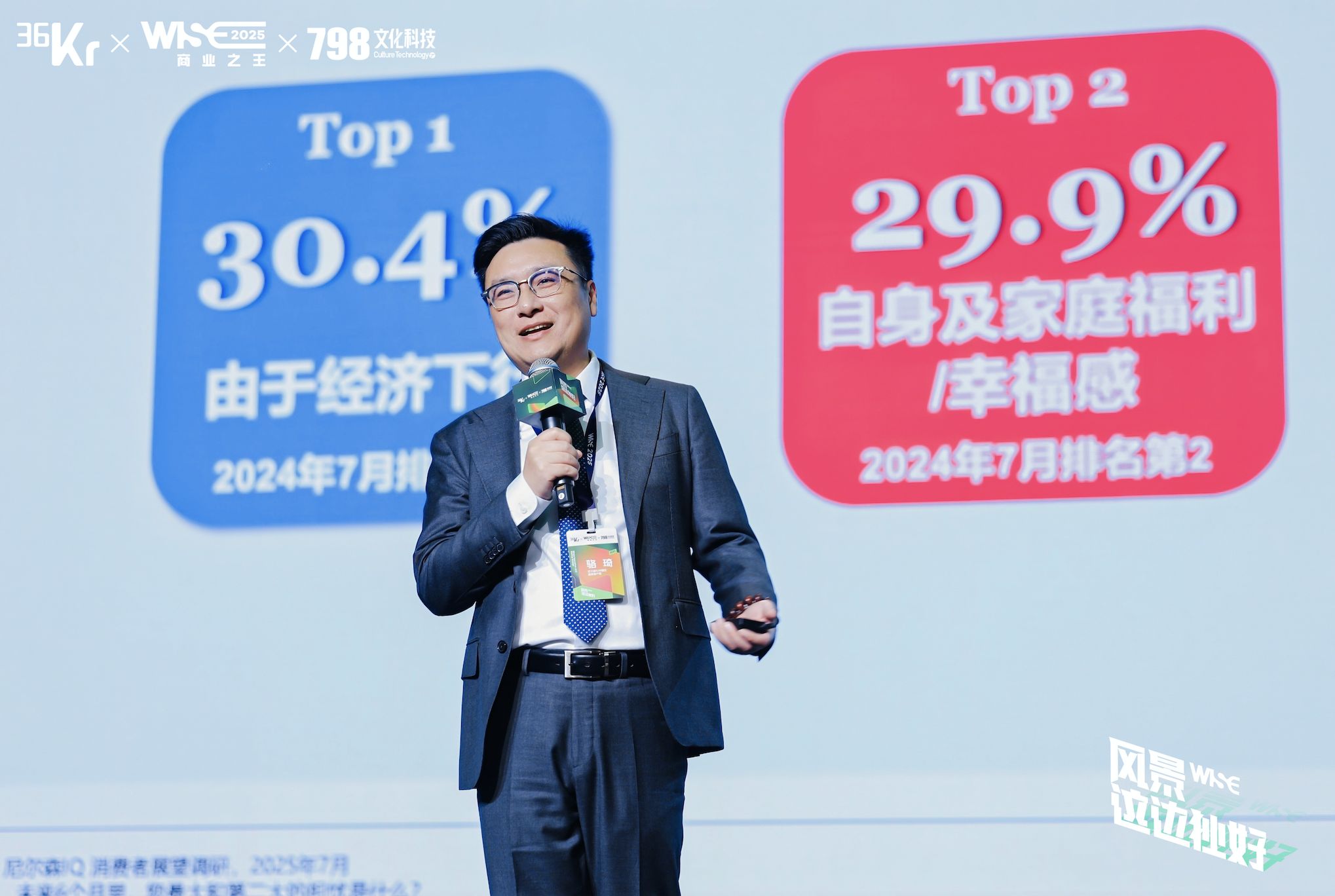
Luo Qi, Chief Client Officer of NielsenIQ in China
The following is the edited transcript of the speech by Luo Qi, Chief Client Officer of NielsenIQ in China:
Luo Qi: Good afternoon, ladies and gentlemen!
I'm Luo Qi from NielsenIQ. NielsenIQ mainly conducts retail and consumer research. In July this year, we launched an annual global survey, including in China, to see what new changes have taken place among consumers in various markets around the world. Today, I'd like to take this opportunity to share the results of this research with you. Let's imagine together what changes Chinese consumers will experience in 2026.
Let's start with some macroeconomic figures. You are familiar with these figures. In Q3 this year, the country's GDP growth rate remained very stable at 5.2%. The growth of social retail sales showed a relatively stable but slightly declining curve. If we look at overall consumer confidence, it actually increased slightly.
So far, these figures are quite ordinary, and you've seen them before. The contradiction is that if consumer confidence is increasing, why is the growth rate of social retail sales slowing down? Shouldn't these two trends be in sync? What exactly is going on?
We'll answer this question later. First, let's talk about why consumption increased in the first half of the year but has recently slowed down. The main reason is that the previous growth was largely due to consumption subsidies, which did have an effect. A total of 370 billion yuan was invested in four rounds of subsidies, which promoted consumption. However, by the third quarter, as the subsidies ended, the growth rate of consumption slowed down again, putting pressure back on consumers. The real question we need to answer is whether consumers can maintain their consumption momentum after the removal of consumption stimuli.
Now, let's move on to NielsenIQ's consumer research. Comparing the latest data from July this year with that from July last year, the blue line represents a more optimistic outlook, and the orange line represents a worse one. Globally, the blue line is flat and slightly declining, but in China, the proportion of people who think things will get better has increased from 34% to 41%. So, Chinese consumers believe that the situation will improve.
If we divide consumers into five types, in the chart on the right, the blue color indicates that consumers will either maintain or increase their spending. Compared with the same period last year, the number of such consumers has actually increased.
The following two figures represent the monitoring data for fast-moving consumer goods and durable consumer goods, one for technology consumer products and the other for fast-moving consumer goods. Both have shown very good growth. This shows that consumers' actual purchasing behavior reflects their greater confidence in consumption.
The question is, what are the main obstacles for consumers who are willing to spend, or what do they hope to get? Consumers are worried that the economic slowdown will affect themselves and their families and reduce their sense of well-being.
Looking at the chart on the right, we can see that many factors reflect consumers' concerns, such as job security and health issues. All these indicators are related to themselves. On the contrary, the concern about rising food prices is lower than the same period last year.
Consumers have a strong demand for improving their quality of life, which is a major driving force for them to spend money.
Moreover, different from previous years, consumers have become more cautious. Will they still pursue a lot of promotions? As we can see on the left, consumers actually think this factor is less important. Whether it's buying discounted products or more affordable ones, Chinese consumers are not actively seeking promotional products.
So, where do they want to spend their money? The chart on the right shows the main factors influencing consumers' spending. First and foremost, product quality is the foundation of all consumption. Next, health and convenience are also important, as they are beneficial to themselves and save time. What is the latest factor that consumers are willing to pay a premium for? The most important one is experience. Experience will become a very important driving force for future consumption. This is also an area where many product providers and service providers are lacking. Many of them only focus on the first two aspects, thinking that as long as they do a good job in product functions and quality, it's enough for consumers. However, if they want to stand out, providing a good experience for consumers and building a connection with them will become a very important part of gaining a competitive advantage in the future.
That's what I want to say about the overall differences among Chinese consumers.
Chinese consumers are complex, especially across different generations, each with different needs. With the development of the economy and the influence of a series of external factors such as an aging population, a declining birth rate, and urbanization, the needs of different generations will also change. So, next, I'll discuss in detail the characteristics of different generations of Chinese consumers and introduce some new features of each generation.
Overall, we can divide consumers into four groups:
1. The Baby Boomers, people over 60 years old, accounting for 19% of the total population;
2. Generation X, people aged 45 to 59, an important group, accounting for 24%;
3. Generation Y, the younger group, from 29 years old (the age when one should establish oneself in society) to 44 years old;
4. Generation Z, young people aged 18 to 28.
First, look at the two colored blocks, red and blue. The red block represents the group that is more willing to consume, and the blue block represents the more cautious group. There are significant differences among generations. The elderly and Generation Y are actually the two groups most willing to consume, not the young people as we usually think. Generally, we assume that Generation Z and the wealthy Generation X are more willing to spend, but in fact, they are more cautious compared to the other two groups.
At the same time, different generations have different characteristics. For example, the Baby Boomers enjoy life, Generation X is more practical and in control, Generation Y values experience, and Generation Z focuses on self-expression. What do these mean?
Let's start with the Baby Boomers. They are willing to pay for new experiences. When we talk about the elderly, there are often stereotypes that they are frugal, conservative, and only focus on taking care of their grandchildren. In fact, this group is the most willing to accept new things. 83% of the Baby Boomers are willing to use AI to assist in shopping. Surprising, right? This is 8% higher than the overall level in the Chinese market. At the same time, 55% of the elderly are willing to pay for new products. The new generation of the elderly wants to lead an active life after retirement and is most willing to try new products. For manufacturers, when launching new products, they can't just target young people.
Second, do the elderly always save money for their children? Actually, no. 73% of the elderly are willing to spend more on products that are good for their health, whether it's specific nutrients or high-end ingredients, in order to enjoy their later years better.
Finally, this point is both in line with and goes against public perception. On the one hand, the elderly prefer familiar brands. On the other hand, they have a very open attitude towards private-label brands, and this open attitude is much higher than the overall level in China. So, the elderly are also a very savvy generation.
Based on these new characteristics, manufacturers need to change their previous models. In the past, people always thought that getting old was a sad thing. Now, the elderly want to explore more different life experiences. What manufacturers need to do is to help these seniors discover more consumption scenarios while they are exploring more life experiences. At the same time, they should build a platform of trust with the elderly through high-quality products and good communication to maintain a long-term relationship with them.
Let me give you two examples. In 2024, Yue Sai transformed into a skincare brand specifically targeting mature women over 50 years old. This is a very significant change. The annual growth rate of the middle-aged and elderly skincare market is 10 - 15%. If we look at the benchmark growth rate of the entire skincare market, it's only 5%. This shows that the skincare needs of the elderly are very high. This represents the transformation of the older generation in China from simply getting old to exploring the joys of old age. From fearing old age to becoming charming seniors, redefining old age has become a new business opportunity.
On the right, we can see that because the elderly have become more important, some manufacturers have started to pay more attention to this segmented group and are willing to design customized products for them. For example, why don't the elderly just buy an Apple smartwatch? The smartwatch for the elderly emphasizes four key design features that the elderly care most about. The most important one is that it can send an alarm immediately in case of a fall or an emergency and notify the family members. This is something the elderly really need. It also has various functions for monitoring vital signs. These functions can be made simple, and the price can be kept low while still meeting the needs of the elderly, thus opening up a new market.
Whether in the skincare or technology industry, new business opportunities have emerged from the transformation of the new generation of the Baby Boomers as they start to enjoy their later years.
The second group is Generation X, people aged 45 to 59. This group is very wealthy and is the backbone of society. What do they need most? They need practicality and minimalism. You might not expect that 37% of this wealthy group are very frugal.
How do they be frugal? On the left, 33% of them only focus on their core needs, and 48% only buy things they are sure they will use and don't buy anything else.
Second, this group is very opinionated. So, live broadcasts and influencer recommendations may be a waste of time. Only 22% of them trust recommendations from acquaintances, and only 11% trust online influencers. We need to influence their opinions and let them realize that a product has good functions and can solve real problems to impress them.
Of course, this group also has some weaknesses. First, they are the middle generation in society, like a sandwich generation. So, they attach great importance to their physical health and want to stay energetic so that they can continue to pursue their careers. Therefore, they are willing to spend money to maintain their vitality. Second, they actually prefer domestic brand products.
For example, Pechoin is a well-known and simple skincare brand. It offers minimalistic skincare products at an affordable price, without any fancy high-tech ingredients. Just simple herbal products, and its small blue jar has always sold well. Of course, Pechoin is also starting to develop new products. It promotes its original simple products in the offline market, which meet the needs of most consumers. At the same time, its new online products are also selling very well. It has made some upgrades on the basis of minimalism to maintain the company's vitality and has a strong appeal to Generation X.
Haier is also a good example. Throwing all the clothes into one washing machine will make your wife angry and tell you that you can't wash underwear and socks together. So, what should you do? You have to run the washing machine once and then wash some clothes by hand, which is very troublesome. Now, there is a washing machine that can handle three separate tubs at once, simplifying the process for Generation X and making things more practical. Moreover, since they are domestic brands, they really hit the spot with this group of people.
Generation X is a very rational and long-term-oriented group. So, we must provide high-quality products and simplify the procedures to meet their experience and needs.
Next, let's take a look at the Millennials, Generation Y, people aged 29 to 44, who have just reached the age of establishing themselves in society. This group has the strongest consumption power and is willing to pay for experience.
First, according to NielsenIQ's research, 70% of Generation Y is willing to pay for a better experience rather than a better product. In addition, apart from the product itself, 81% of this group is willing to pay for a 30-minute delivery service, which means "I don't want to wait." This shows that they attach great importance to experience.
What supports their experience? They attach great importance to product quality. So, 85% of consumers in this group pay great attention to excellent quality, and 64% are willing to buy more from trustworthy brands.
At the same time, this group also has some idealistic tendencies. If a product is harmful to the environment, it will have a very negative impact on this group. At the same time, if a brand can incorporate some green, sustainable, and environmental elements while maintaining the product's experience and quality, it can better attract this group of consumers.
What are some examples of this group of consumers? For example, DJI has a "man-machine integration" technology that can provide a great experience. Wearing a good helmet, the camera can follow the movement of your head, providing a great shooting experience.
You can see the keyboard on the right. It's very popular among gamers. It looks like an ordinary mechanical keyboard, but every part, from the materials to the manufacturing processes, is carefully designed and can be disassembled. This makes the gaming experience very good. It's like the brand has redesigned the keyboard, and this group of consumers can easily feel the difference. For Generation Y, we need to start from their experience and re-engineer the product to create an ultimate experience to win their hearts. If we can also add an environmental protection concept, it will make them feel that their lifestyle has been redefined, and we can better attract them.
Okay, finally, I