Wang Fei, Senior Vice President of Nielsen IQ in China: Brands need to resonate emotionally with consumers. Generation Z is the key to brand development in the next five years | WISE2025 Business King Conference
The business world in 2025 stands at the crossroads of old and new. Amid the reconstruction of business narratives and the sweeping wave of technology, the WISE2025 Business King Conference, with the theme of "The Scenery Here is Exceptionally Beautiful", aims to anchor the certain future of Chinese business amidst uncertainties. Here, we record the opening of this intellectual feast and capture the voices of those who still march forward firmly in the changing situation.
From November 27th to 28th, the 36Kr WISE2025 Business King Conference, hailed as the "annual technology and business trendsetter", was held at the Conduction Space in the 798 Art District in Beijing.
This year's WISE is no longer a traditional industry summit but an immersive experience in the form of "technology hit short dramas". From AI reshaping the boundaries of hardware to embodied intelligence knocking on the door of the real world; from the globalization of brands in the wave of going overseas to traditional industries equipping with "cyber prosthetics" - what we restore is not only the trends but also the genuine knowledge honed in numerous business practices.
In the following content, we will dissect the real logic behind these "hit dramas" frame by frame and witness the "exceptionally beautiful scenery" of business in 2025.
On the morning of November 28th, Wang Fei, the Senior Vice President of Nielsen IQ in China, gave a speech.
In the current macro - environment, the consumption structure has undergone drastic changes. What opportunities will this bring? Wang Fei, the Senior Vice President of Nielsen IQ in China, believes that according to the qualitative method, the current new consumption structure can be divided into three segments: rational consumption, emotional consumption, and the middle "vacuum zone". Rational consumption is the easiest to be recognized by consumers, so it is the most likely to be compressed and reconsidered. After being compressed, part of rational consumption may transform into the "vacuum zone", becoming long - term savings and educational investment; another part will transform into emotional consumption, which is also one of the main reasons why emotional value is highly valued.
This change means that many new brands can find opportunities. Against this background, Nielsen IQ has identified three major trends: brand influence remains the most important factor; brands no longer pursue comprehensive coverage but start from a small niche and iterate rapidly to achieve segmented functional value; in addition to being useful, brands also need to have emotional resonance. Nielsen IQ believes that Generation Z is the key to a brand's development in the next five years, and brands need to provide them with sufficient emotional value and form cultural resonance.
To this end, Nielsen IQ combined its data modeling capabilities accumulated in China over the past 40 years, surveyed nearly 9,000 consumers from 29 different provinces, municipalities, and regions, and 13 experts participated in the co - creation. A new set of lists was designed to respond to the three emerging trends. In particular, three new lists were developed for emotional consumption to evaluate brands from the perspectives of existence value, functional value, and experience value.
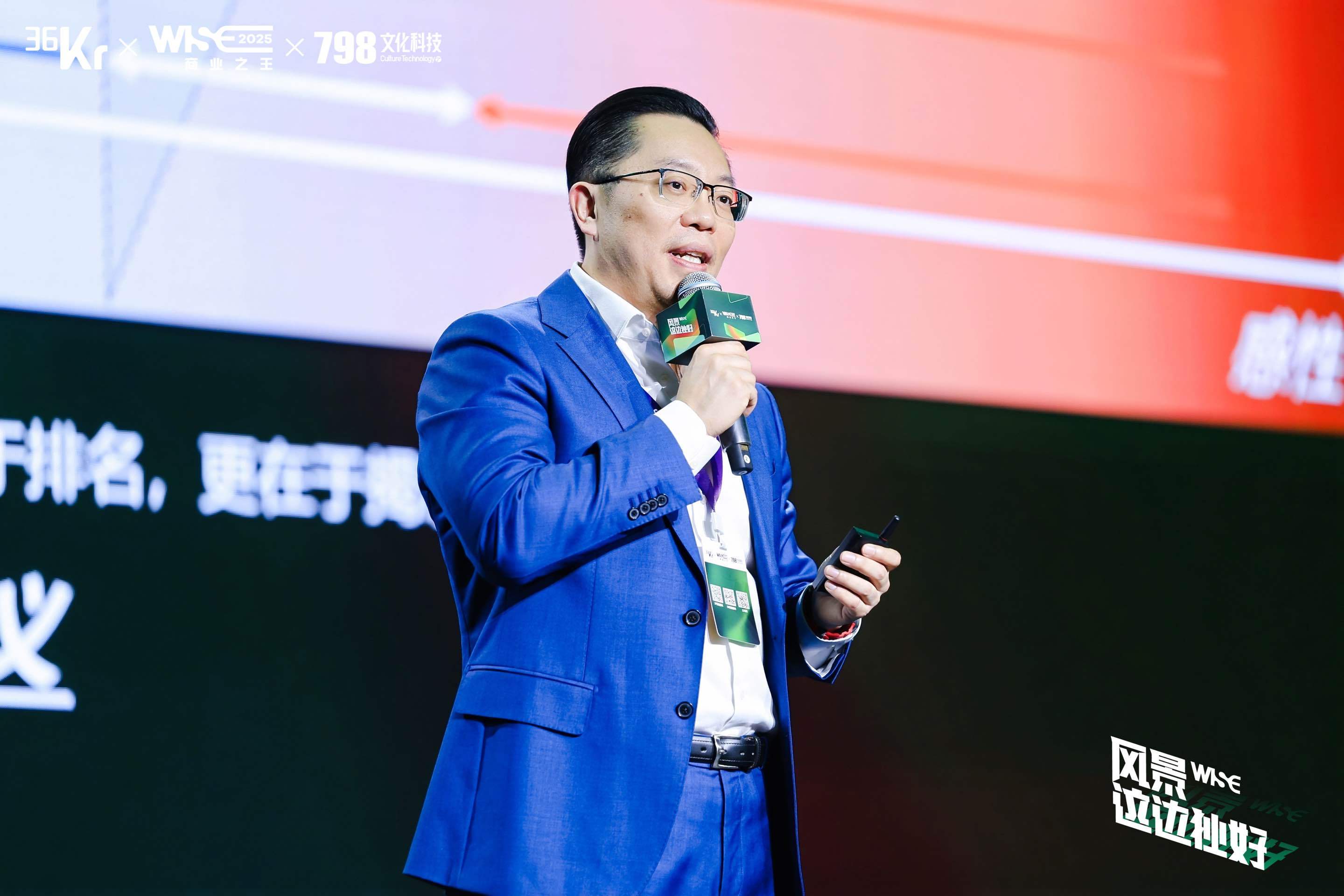
Wang Fei, the Senior Vice President of Nielsen IQ in China
The following is the edited transcript of the speech by Wang Fei, the Senior Vice President of Nielsen IQ in China:
Wang Fei: Good morning, ladies and gentlemen! I'm Wang Fei from Nielsen IQ, and my English name is George.
As the person in charge of Nielsen IQ's consulting analysis and consumer insight business in China, I'm very glad to have this opportunity to share with you some of the background behind this list. I can't say it's the calculation logic; I think it's more about the changes in the macro - environment and our considerations.
Today, I'd like to start with a broad topic that everyone is involved in. In the context of the past economic slowdown and relatively low consumer confidence in the future, why are there so many changes in the consumption structure, and what opportunities will these changes bring? This is the big background.
I'll try to explain it with this chart. If we look at it qualitatively, we can divide the entire consumption into three segments. On the left is rational consumption, on the right is emotional consumption, and in the middle is a relatively "vacuum" period. In such a structure, when the economic growth slows down and consumer confidence is insufficient, consumers often reconsider rational consumption first. Why? Because rational consumption is the easiest to recognize.
At the same time, when rational consumption is compressed, part of it will be redirected to long - term savings or long - term educational investment, that is, the "vacuum zone", which is out of the consumption scope. Meanwhile, part of it will transform into more emotional consumption. This is why emotional value is becoming more and more important. In this relatively less optimistic era, if we save money, we will reward ourselves in terms of emotions to some extent.
There is a very popular saying recently, especially among young people, which well illustrates this point. Many young people still go to bars and hotels, but they go there by bike. This is how Nielsen IQ has observed consumers' re - distribution of the consumption structure in the overall environment.
Among these changes, it's very important that when the consumption structure changes, it means that many new brands have the opportunity to rank higher. This is the opportunity for brands in the overall environment.
We've identified three major trends:
The first trend is brand influence. How is a brand seen and chosen? The degree of being seen and chosen remains the main reason for all brands to make it onto the list. So influence is the most important factor.
The second trend is that in the past 30 years, we've observed that many brands hoped to have comprehensive coverage. However, as the rational component increases and the emotional component also needs to be echoed, we've noticed two trends. Firstly, many brands start from a small niche, make rapid iterations, and achieve growth in a small segmented market. So the functional value is no longer a broad one but many segmented functional values.
The third trend is that a brand is not only useful but also needs to have a very good emotional resonance effect. So the trend from being useful to being likable is obvious in terms of emotional value.
Based on these trends, when we conduct research, we often build an indicator system and calculate scores. I won't go into the specific process. I'll just give you a general introduction. In the past three to four months, Nielsen IQ gathered 13 experts, including data model experts, brand experts, and consumer research experts, to participate in the co - creation. Combining Nielsen IQ's modeling capabilities in China over the past 30 years, we surveyed nearly 9,000 consumers from 29 different provinces, municipalities, and regions. We can see that the following can respond to these three trends:
First, there is an influence list to prove the existence value of a brand;
Second, there is a growth list to maintain the brand's growth momentum in terms of functionality;
Third, and very importantly, three lists are designed for emotional value:
1. Can a brand generate cultural resonance with consumers' inner values?
2. On the basis of cultural resonance, can it establish a long - term loyalty relationship with users?
3. In fact, in the next five years in China, Generation Z will be the largest consumer group in terms of both population and consumption ability. So once a brand captures this group, it basically seizes the growth in the next five years. That's why a special list is designed for Generation Z.
This is the origin of Nielsen IQ's lists, from existence value to functional value and then to experience value.
In a nutshell, the overall influence represents the external energy of a brand, which determines how many people can see the brand, remember it, and are willing to pay for it. Our growth list doesn't represent the brand's potential but the future growth speed. The cultural resonance list represents the brand's soul and whether it can establish an emotional connection with consumers. The loyalty list shows whether the relationship between the brand and consumers in the future is strong. Finally, Generation Z is the key to a brand's development in the next five years. So these are the corresponding contents of our five lists.
Next, I'll talk about the more data - oriented part and try to make it as easy to understand as possible. These two charts show the criteria for the influence list. If a brand wants to stand out in the influence index, what indicators and aspects should it lead in? Here, it's divided into fast - moving consumer goods (FMCG) and durable consumer goods, and there are significant differences.
Let me explain. This is called a radar chart in the industry. The green line represents the average performance of the top five brands on the influence list. The black line represents the performance of all the other brands that didn't make it onto the list. These performances are divided into five indicators: brand awareness, brand recommendation, brand likability, brand premium ability, and purchase expenditure.
In the FMCG category, to achieve a higher level of influence, the biggest difference between the top five brands and the non - listed brands lies in the purchase expenditure. Simply put, in the FMCG category, in addition to increasing brand awareness, the target consumers also need to keep spending money on your products to reach the peak of influence to the greatest extent.
On the right side of this chart is the durable consumer goods category, and there is a difference. Purchase expenditure is not the main point for improvement. For durable consumer goods, to achieve the highest influence, there are two points:
1. Achieve a very high brand likability;
2. Achieve a very high brand recommendation power. Only then can the influence on the brand be maximized. So the influence list reveals the underlying code.
If a brand wants to rank at the top of the growth list, what different things should it do in the FMCG and durable consumer goods fields respectively?
For the growth list, if it's to show a brand's rapid growth, for FMCG, the willingness to pay a premium is very important. Because FMCG has a very high purchase frequency and many repurchase opportunities. If we want to see the brand's future growth, not only fast and frequent repurchases are needed, but also the willingness to pay more money, so that the brand can rank relatively high in the growth index. However, in the durable consumer goods field, it's not so straightforwardly about money. In fact, it's the change from high likability to high recommendation power.
Cultural resonance is a very important list that establishes a corresponding connection with consumers. For FMCG, it's difficult to create differentiation. So the difference in emotional and cultural connection between the brand and consumers is the main reason why FMCG brands can rank high on the cultural resonance list. For durable consumer goods, there are more means. Firstly, there needs to be a relatively strong brand cultural identity, and at the same time, there should be a specific purchase intention not only for the brand itself but also for the brand's peripheral products. By doing these two things well, durable consumer goods can rank well on the cultural resonance brand list. For example, now many car companies are selling car peripherals while selling cars, which can achieve a better effect in terms of cultural resonance.
The structure of user loyalty is very simple, and there are still differences between FMCG and durable consumer goods. If an FMCG brand wants to achieve high user loyalty, it may need to increase media investment to keep consumers thinking about the brand all the time, so that they will consume the brand more in daily purchases. For durable consumer goods, in addition to media activity, there is also the brand's wallet share. But everyone must note that the brand's wallet share is not necessarily limited to a single category. It doesn't mean that a car - selling brand only needs to sell more cars. It also needs to interact with other manufacturers and other categories. That's why the leading new - energy car companies in China actually try to cover more categories to achieve brand linkage for durable consumer goods and rank higher in terms of user loyalty.
Finally, Generation Z is the key to a brand's growth in the next five years. If a brand wants to gain higher favorability among Generation Z, in the FMCG category, it needs to find Generation Z faster, better, and more accurately in the media for more targeted communication. For durable consumer goods, a brand must pay attention to its trendiness among Generation Z and the degree of fit between the brand's values and Generation Z's values and outlook on life, so that the brand can meet the preferences of more Generation Z consumers in the durable consumer goods category.
All the listed brands have four relatively prominent performances:
First, influence remains the foundation and moat.
Second, loyalty is the moat for durable consumer goods. Although it's difficult for FMCG brands to maintain high loyalty, they can enhance brand loyalty to some extent through media exposure.
Third, most classic brands are starting to transform towards youthfulness, so Generation Z will also pay for these influential brands.
Fourth, cultural resonance is definitely the most crucial point for a brand to survive the economic cycle. How to establish an emotional connection and cultural resonance with consumers is the most crucial common point among the listed brands.
What different things has a brand that makes it onto the list multiple times done? If we look horizontally, regardless of whether it's in the FMCG or durable consumer goods field, in addition to the most basic influence and user loyalty, if a brand wants to make it onto the list, it must do a good job in cultural resonance and meeting the preferences of Generation Z.
Finally, Nielsen IQ is a company with a history of over 100 years and has been in China for over 40 years. In the past 100 - plus years, we've created a relatively advanced brand measurement model at that time. However, the model has also been constantly evolving in China. So we have the most basic brand premium indicator, but now in China, we've added more indicators and finally added many emotional brand connections. This innovation has also received very good results.
If we use Nielsen IQ's indicators to measure the overall brand index, it actually has a highly relevant relationship with market share, as shown in the chart on the far right. This is Nielsen IQ's research experience over the past 100 - plus years and the continuous innovation in brand evaluation in China over the past 40 years. I hope Nielsen IQ's model and brand suggestions can help more brands achieve greater success in the future.
Thank you all!