Hardcore Breakthrough - The Global Moment and Future Imagination of Chinese Hardware | 36Kr WISE2025 King of Business Conference
From November 27th to 28th, the 36Kr WISE 2025 Business King Conference, hailed as the "annual technology and business trendsetter", was held at the Conduction Space in the 798 Art District in Beijing.
This year's WISE is no longer a traditional industry summit but an immersive experience centered around "tech-infused short dramas". From AI reshaping the boundaries of hardware to embodied intelligence opening the door to the real world; from the globalization of brands in the wave of going overseas to traditional industries equipping with "cyber prosthetics" - what we present is not just trends but also the insights honed through numerous business practices.
In the following content, we will dissect the real logic behind these "thrilling dramas" frame by frame and explore the unique business landscape of 2025.
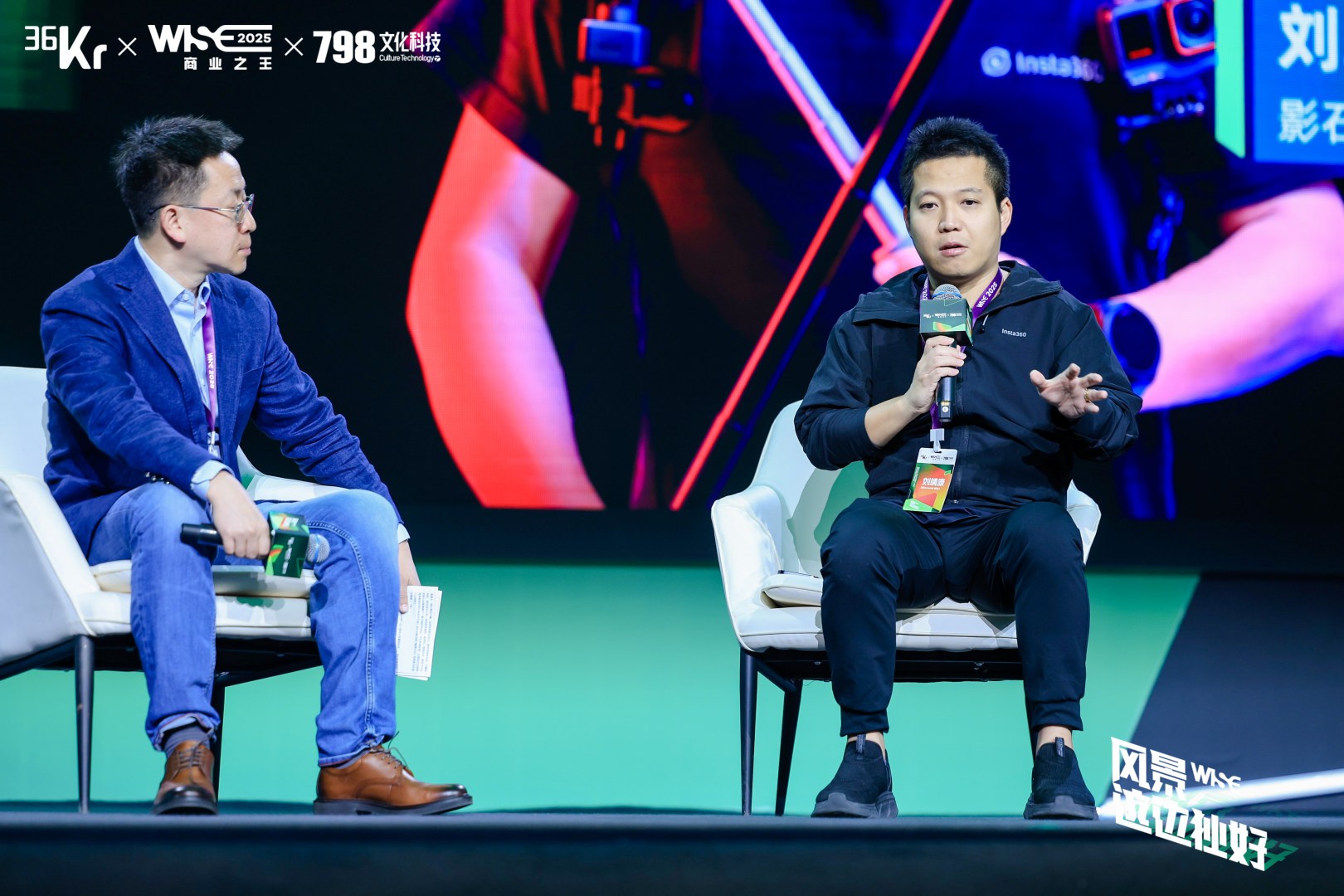
Adults: "Hardcore Breakthrough - The Global Moment and Future Imagination of Chinese Hardware"
The following is the content of the dialogue, edited by 36Kr:
Feng Dagang: JK (Liu Jingkang) is my good friend. In my opinion, he is not only the boss of a company with a market value of over 100 billion but also a trendsetter of an era. Let me first explain why we invited Jingkang to be our opening guest. In fact, we hold such a dialogue every year and invite someone who we believe can represent the business trends and mainstream of that year. And Jingkang is the one who can represent the business trends of 2025 in my mind.
Why do I say so? I'd like to share with you that in June this year, we had a meeting in Hangzhou. I remember it was the day when Insta360 went public. At around 10 a.m., all the investors and entrepreneurs were excited because when we saw the market value, it exceeded 3 or 4 times, reaching about 70 billion. At that moment, everyone was very excited. Of course, many people who had invested in Insta360 made a lot of money and were happy. But there were also many who didn't invest, and they were also happy because they thought that the Chinese venture capital industry finally had a chance to recover.
I want to tell you, especially those in the venture capital industry, you know what has happened in the past few years. I think the Chinese industry has been in a dormant state for too long, and the Chinese venture capital industry has also been dormant. Chinese venture capitalists, the Chinese industry, Chinese brands, and Chinese young people have all been dormant for several years. At that moment, I felt that everyone found an outlet. They thought that if Insta360 could achieve such great success, so could they. At that moment, everyone felt relieved. So in this sense, I think we should all thank JK. Thank you, JK!
If Insta360 can have a market value of 100 billion and it is a company with a profit of about 1 billion, then we can ask, what about other companies? For example, what about Dreame Robotics? What about TENLOG? There are many companies that can achieve great success like Insta360. So we can clearly see that we have entered a new era, which is a very clear golden age, at least for the consumer electronics and intelligent hardware industries. My first question for JK is, why is this golden age happening now and why in China?
Liu Jingkang: We see many excellent companies today. As Mr. Feng mentioned, companies like TENLOG, AfterShokz, Anker, and our competitor DJI have not been established in recent years. In fact, they have been developing for about ten years or even more than a decade. In my opinion, they share several key factors. Actually, not only these companies but also many others in the intelligent hardware industry are doing well, and we can find some common factors. One is what we often call the Chinese supply chain. In the Pearl River Delta and the Yangtze River Delta, due to the development of the mobile phone industry, the cost of many components has been reduced, and many new processes have been developed and widely applied. Then, these cost - reduced technologies are applied to other industries. For example, the surface treatment processes of our products are actually brought over by the mobile phone industry.
There is also an often - overlooked advantage of this supply chain, which is the talent supply chain. Our country has a long - term compulsory education system and has established many universities. In fact, we have trained a large number of engineers, probably tens of millions of engineers in various industries. This is a very large number and is unique in the world.
Another very important and common factor is the change in the marketing method. For example, today we see many intelligent hardware companies, and they also have a common business feature. Many of them are going global. The reason why there are more Chinese companies going global today compared to before is largely related to the change in the marketing method. For example, from 2010 to 2015, the popularity of YouTube influencers, or what we call KOLs today, and the trend of promoting products on Instagram, or the traffic from these platforms, were rising rapidly. Many consumers would trust the product reviews they saw on YouTube and then increase their understanding and trust in a brand and product, thus choosing to buy the product. This is a very important driving factor. In the past, if you wanted to sell your products overseas, you had to do traditional advertising, such as TV advertising, which was very scattered and inefficient. Today, influencers or YouTube are very important common denominators.
From 2020 to 2025, it is also closely related to online marketing, but there are also significant differences. The difference lies in its fragmentation. We see platforms like Douyin and TikTok, as well as many in - stream ads. The most important feature of fragmented ads is that the information can be very scattered. It is content finding people instead of people looking for content. So when you see a product on TikTok, for example, after you finish watching a few related videos, you will keep receiving information related to this product and brand, which strengthens the product promotion.
However, in the field of intelligent hardware, from product definition to R & D methods to marketing, many companies use very similar methods. A very important feature is that in many industries, for example, when I first met Mr. Feng 10 years ago, we called it the mobile Internet era. People developed mobile apps, and the business models and forms of each app were very different. But today, the business models, product definitions, and R & D methods of many intelligent hardware companies, such as the IPD process, GTM process, and IPMS process, are actually very similar, that is, the internal processes and methods. And we can say that there are more common methods for success in this industry, which is also a very important factor for the collective emergence of many new companies in this industry.
In summary, these factors have jointly contributed to the relatively rapid development of intelligent hardware companies in the past decade.
Feng Dagang: Well, actually, I've known JK for 10 years. 10 years ago, I was doing investment at Matrix Partners. At that time, I reviewed about 2,000 intelligent hardware projects and invested in about a dozen of them. I can share with you that among the intelligent hardware projects we invested in 10 years ago, how many have succeeded today? None. So in a sense, I think it was really difficult to succeed at that time. But today, the environment has changed greatly. As Jingkang said, the changes in the supply chain, technology, the global market, and the marketing method, as well as the support of AI, all these factors have contributed to what we call the golden age today. I think this golden age is much more certain than the past, and it must be in China and at this time.
Let's move on to the second question. We can see that an important topic in the industry today is diversification or competition. Many companies are starting to diversify. DJI is starting to produce imaging products that Insta360 was good at, and Insta360 is starting to produce drones that DJI was good at. Dreame Robotics, which used to focus on floor - cleaning robots, is now starting to make mobile phones and even cars. So I want to ask Jingkang, how do you view this diversification? Do you core players have a universal methodology so that you can succeed in anything? Or is the threshold of this industry not high for you? How do you view the real competitive barriers and the threshold of this industry? And how do you define good diversification?
Liu Jingkang: Well, actually, when a company achieves certain success, expanding into other fields is a very common practice. The examples you mentioned were even more common among Internet companies, especially large Internet companies, in the past. But in the intelligent hardware industry, there is a very important factor. As I mentioned before, when we develop a product, for example, if we make a camera today and are asked to make headphones, although we don't have any expertise in the audio field, the methods of product definition, demand exploration, and the entire process from product definition to R & D, delivery, quality inspection, and integrated marketing of Insta360 can actually be applied to many product categories. If we really spend a lot of time researching, there is a chance to develop a good product. So many companies' methods are quite similar.
However, different product categories obviously have different requirements for the depth of capabilities. We have to mention DJI. When DJI makes cameras, it can make various types of cameras by removing some unnecessary capabilities and supplementing a small number of others because it has been making various cameras, including those on drones. But for our company to make drones, it is an upgrade of capabilities. We have to supplement a lot of new capabilities to have a chance to succeed. So we had to spend 5 years accumulating the various capabilities required for drones. For Dreame Robotics to make unmanned vehicles or mobile phones, I believe it is also a business choice for capability upgrade.
I think in the intelligent hardware industry, companies with a wider and deeper capability stack can do things at a lower - level dimension, but the opposite is not true. So from the perspective of a company's survival and development, it is necessary to consciously make such choices. In fact, many companies choose these businesses not only because they think they can make money but also because they want to expand their company's capability stack and deepen some important capabilities through these businesses. Of course, some companies, like Anker, want to make money from many things. But for some companies, including ours, in an extreme case, if we stop doing imaging business today, we can still do something else and survive. It is also a backup option.
Of course, what is the mainstream choice? Although we are involved in many product categories, we can see that we have a relatively focused direction. Whether we are making action cameras, drones, or video conferencing equipment, we are all centered around the imaging field. What are the advantages of this? Our capabilities are constantly expanding. Compared with just making cameras or drones, we have gained many new capabilities. Moreover, our customer groups, marketing methods, and supply chains are similar, and many things can be reused. In this process, the company's survival ability in a certain field is enhanced.
So it seems easy to cross - industry in this field, but it is actually very difficult to do well. For example, in the case of 360 - degree cameras, there were many challengers before DJI, but none of them could produce good products. Similarly, there were many companies that challenged DJI in the drone field, but most of them failed. Only a few companies like ours have achieved good results. Behind this, a company needs to have a strong and persistent belief in a certain direction. It seems that you can develop a product, but to make it good, you need to spend a long time.
What can support a company to continuously invest in a relatively focused direction, expand its capability boundaries, and develop more complex and upgraded product categories? Generally, there are two driving forces. One is that we want to solve user problems that others have not solved. For example, when we developed the 360 - degree drone, it was a problem that DJI had not solved for a long time, and we really wanted to solve it. The other is that if our company can develop good drone products, our company's comprehensive capabilities will be much stronger than if we can't. Our ability to withstand setbacks will also be much greater. We thought the same way 5 years ago. When we developed good drones, our company's capability stack was completely different from 5 years ago. Although DJI is still much larger than us today, it is much more difficult for DJI to eliminate us than it was 5 years ago.
Feng Dagang: Very well said. We need capabilities to achieve diversification, and diversification is also to a large extent for the growth of capabilities. Last night, Insta360 officially announced its drone. When will it be launched on the market?
Liu Jingkang: It will be officially launched and available for sale next Thursday.
Feng Dagang: Can you predict the market?
Liu Jingkang: It depends on how aggressively DJI will attack.
Feng Dagang: Okay. The slogan of 36Kr is "Let some people see the future first". We are a group of people who are very obsessed with the future. In fact, I want to ask JK, what kind of future do you see? As we all know, JK is very young. I want to know what the future looks like in your eyes. Especially in such a highly competitive environment where everyone is expanding, what will the industry look like in 5 years? I'm talking about the consumer electronics industry and even the entire Chinese industry.
Liu Jingkang: I think like this. First, we need to look at product categories and customer needs. Although they are all called intelligent hardware, there are actually big differences among many product categories. Let's take the degree of demand convergence as a dividing point. For example, for some types of product categories, the demand is highly convergent. For example, for washing machines and floor - cleaning robots, the core demands for floor - cleaning robots are whether it can clean thoroughly, whether it can operate quietly while cleaning thoroughly, and whether it can clean quickly. There are also a few other demands, such as not having to clean manually, and it should be stable and not break down easily, requiring little maintenance in the long run. These are the core demands.
You will find that all these demand dimensions are convergent. It is easy for everyone to reach a similar level. Currently, there are relatively large differences in technical solutions, and we can see differences in performance. But in the long run, the way of evaluating demand is convergent. Eventually, the supply chain may be shared, and the talent will also flow and be shared. So it is very likely that this product category will become highly similar and homogeneous. It doesn't mean that companies can't make money, but it is difficult to establish a unique brand image or memory based on product functions and performance. So this is one type of product, which is efficiency - oriented and tool - type products.
For imaging products, including some product categories like TENLOG, they are for creation. For example, our products are used to shoot various images. In different scenarios, customers' demands vary greatly. For example, if you want to take good pictures of your baby and good selfies, you actually need different lenses, sensors, and algorithms. Whether it is the beauty algorithm or the camera's form, there are big differences. So this kind of demand is very scattered, non - standardized, and highly dependent on aesthetics. It is also related to the special effects of each era and each cycle. So this kind of demand is more personalized and scattered, and it is easier to create a brand's unique aesthetic and memory.
It sounds complicated, but I want to summarize. Many companies will expand. For product categories with convergent demand, many companies will be involved. A company may have several such businesses. So I think there will be many comprehensive giants in the industry. For example, today's floor - cleaning robot companies will also produce washing machines, small household appliances, etc. Consumers don't choose a company because of a single product category. Instead, they think the company is good at several product categories.
On the other hand, there are very vertical brands. You will feel that they are professional. Some brands, like Leica, have a very unique color style and a very unique operating experience. They have a cultural heritage. Just like the consumer products we see today, they contain their own unique aesthetics. For example, luxury bags are similar in terms of functional attributes, but they have different aesthetics and brand stories. So we think there may be several such giants or comprehensive companies, and there will also be different independent brands in different major fields.
Because the ultimate bottleneck is actually the capacity of brand memory. We think the more a brand tries to cover, the more blurred it will become, and it can only serve those highly convergent, efficiency - oriented, and tool - type product categories. If a brand is more focused, although it has less brand memory, it can go deeper. People who need it will know it, and there will be a unified perception and high reputation. So it can also exist stably. Therefore, I think there will be many scattered brands and a few independent large - scale ones.
That's my general idea.
Feng Dagang: OK. Actually, when I asked about the future, I think he has at least described two types of futures, which are also two types of companies or two ways of thinking. Whether it is a company that does everything, relying heavily on the supply chain and creating some concepts, or a company with its own unique taste, values, and culture, it is hard to say which one is the best