Soul makes its fourth attempt to go public. AI + social networking brings both money and challenges.
Soul is attempting to go public for the fourth time.
In 2021, Soul sought to go public in the United States but ended up withdrawing its application. In 2022 and 2023, it twice submitted listing applications to the Hong Kong Stock Exchange, but both attempts failed due to the expiration of the prospectuses. In previous prospectuses, Soul positioned itself as a "social metaverse"; however, in the latest application form at the end of November this year, it became an "AI + immersive social platform".
Soul's journey to go public seems to be a microcosm of the changing trends in the Chinese Internet industry over the past five years.
Soul, which downplays physical appearance and enables users to engage in "soul - to - soul socializing" with strangers by creating their self - projections (Avatars) in the virtual world, currently derives its main revenue from the emotional value services provided by AI. The needs that users originally had to satisfy through interacting with others can now be met by AI, and in a way that generates stronger spending power.
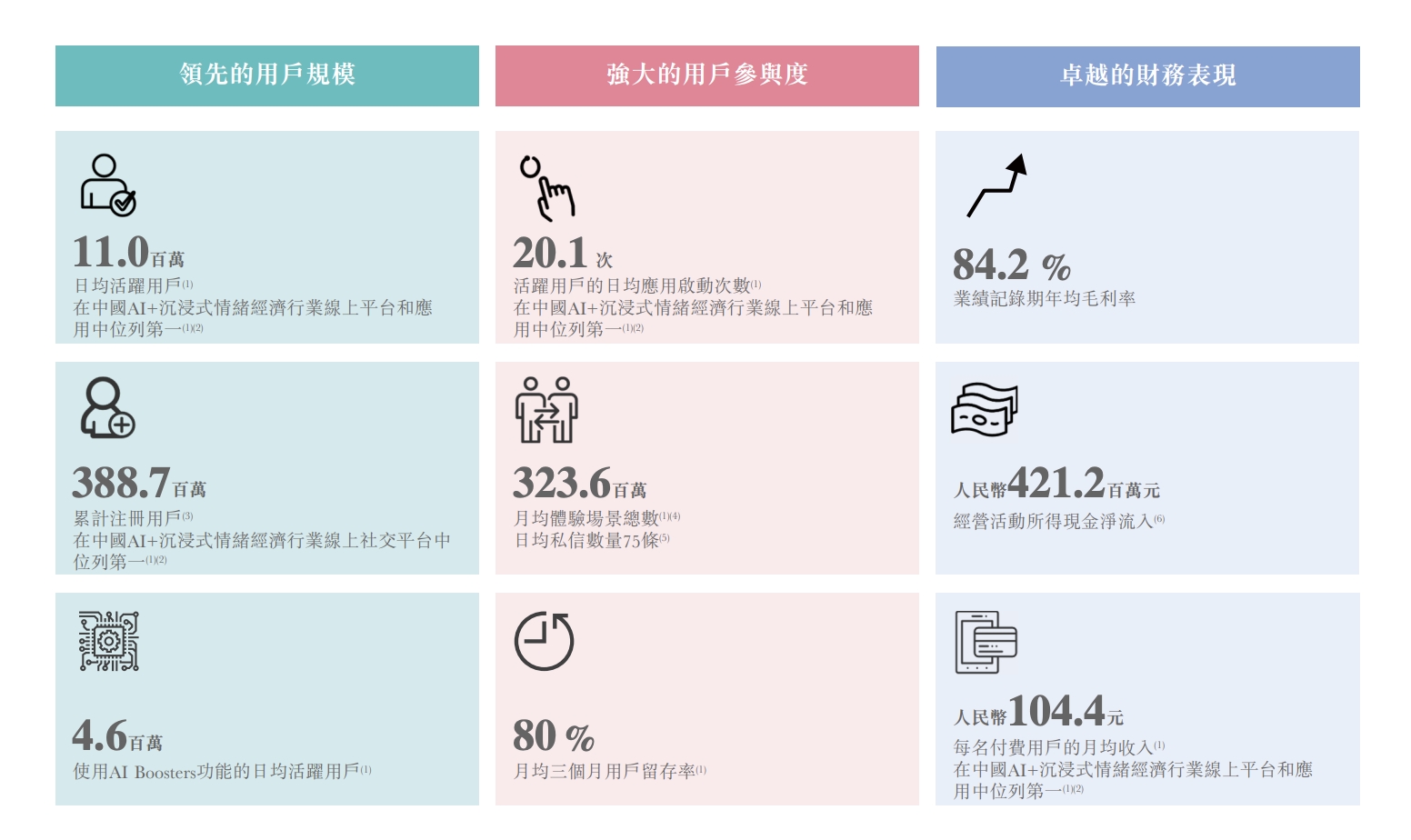
The prospectus states that Soul mainly generates revenue by operating an AI + immersive social network platform to provide emotional value services to users. The revenue from emotional value services accounts for 90.8% of the total revenue, and the average monthly revenue per paying user reaches RMB 104.4, ranking first among Chinese AI + immersive social platforms.
AI Transforms Social Needs
The prospectus discloses three dimensions of user data:
As of August 31, 2025, the daily average active user count reached 11.0 million, of which 78.7% were Generation Z users;
The average monthly active user interaction participation rate reached 86.0%, and each user sent approximately 75 peer - to - peer private messages per day on average;
The three - month average monthly user retention rate reached 80%.
According to the Frost & Sullivan report, Soul ranks first among Chinese AI + immersive social platforms in terms of average daily active user count, average daily app launches per user, and 30 - day retention rate of newly installed users. Soul has accumulated approximately 389 million registered users. In the first eight months of 2025, users logged in to Soul every day to communicate, connect, and explore for more than 50 minutes. Each month, users create or participate in more than 323 million active "experience" scenarios based on interests on the Soul platform.
The image is from Soul's prospectus
The revenue contributed by these users to Soul increased from RMB 498 million in 2020 to RMB 2.211 billion in just four years. In the first eight months of 2025, Soul's revenue was RMB 1.683 billion, a 17.86% increase compared to RMB 1.428 billion in the same period of the previous year.
Soul's revenue structure mainly consists of two parts: emotional value services and advertising. Among them, emotional value services have remained at around 90% since 2022 and are the largest source of revenue.
Soul's emotional value services are mainly realized through an AI + immersive social network platform. Users' payment points include purchasing Soul Coins or subscribing to become members to unlock various virtual items and membership privileges on the platform, such as sending gifts to and making phone calls with AI virtual partners.
The AI gameplay on the platform also includes the "interest map + AI algorithm" to help users find people with similar interests and emotional resonance; the AI - driven recommendation system can understand user profiles, interaction intentions, and interest preferences with the smallest cognitive granularity and match the most "understanding people" for users in each interaction; and the AI Boosters based on Soul X can assist users in initiating conversations, breaking social barriers, and boosting self - confidence, etc.
Searching for the keyword "Soul + AI" on social platforms, one can see many users sharing their chat contents with Soul's virtual partners. Interestingly, the most - followed posts all express "I suspect the one on the other side is not an AI but a real - life customer service" - because the voices sent by Soul's virtual partners are so realistic that their emotional fluctuations, tones, pauses, gasps, and laughter are almost indistinguishable from those of real people, and even their speaking attitudes are very similar to those of ordinary Soul users.
Users have tried various ways on social platforms to prove that the AI on the other side is a real person, including "he told me his real name", "he didn't remember what I told him before, which proves that the customer service has changed", "he asked me to send him a photo of me in a skirt", "he made an appointment to meet me"... But these all seem to be normal mistakes that an AI might make, and there is currently no solid evidence to prove that Soul is using real - life customer service to pretend to be AI.
And the money is really spent. The prospectus shows that Soul's technology and development expenses were RMB 187 million in 2020, then rapidly increased to RMB 472 million in two years, and were RMB 546 million last year. In the first eight months of this year, this expenditure reached RMB 407 million, higher than the same period last year, accounting for 24.2% of the revenue.
"Technology and development expenses constitute a large part of our costs and expenses." The prospectus states: "We have made substantial investments in AI capabilities, proprietary recommendation systems, AI Boosters, and other areas of our technology infrastructure, contributing to user engagement and revenue growth."
Developing large - scale AI models is a high - cost business. Currently, technology and development personnel account for nearly half of Soul's total employees. Soul writes in the prospectus that it also plans to "continue to increase investment in technology infrastructure", including developing a GPU computing platform, enhancing data analysis capabilities, and recruiting and retaining top - notch talents.
The First Stock in AI + Social, an Untrodden Path
The high cost of AI has been repeatedly verified by medium - sized and large - sized enterprises, but Soul seems to have ensured a stable return on investment. In 2022, when Soul spent RMB 472 million on technology and development expenses, its adjusted net loss was RMB 21 million. But one year later, its adjusted net profit turned positive for the first time.
In 2023 and 2024, Soul's adjusted net profits were RMB 360 million and RMB 340 million respectively. In the first eight months of 2025, it was RMB 286 million, a year - on - year increase of 73%. Out of the total revenue of RMB 1.683 billion in the first eight months of this year, nearly RMB 300 million was brought by "recommendation privileges + AI - related revenue".
Relying on AI to attract users to pay is, to some extent, a result of "seeking change in adversity" because users of stranger - socializing apps are generally becoming less willing to pay. In the second quarter of this year, the number of paying users of Momo was halved from 7.2 million in the same period last year to 3.5 million, and the number of paying users of Tantan was only 700,000, a 30% year - on - year decrease.
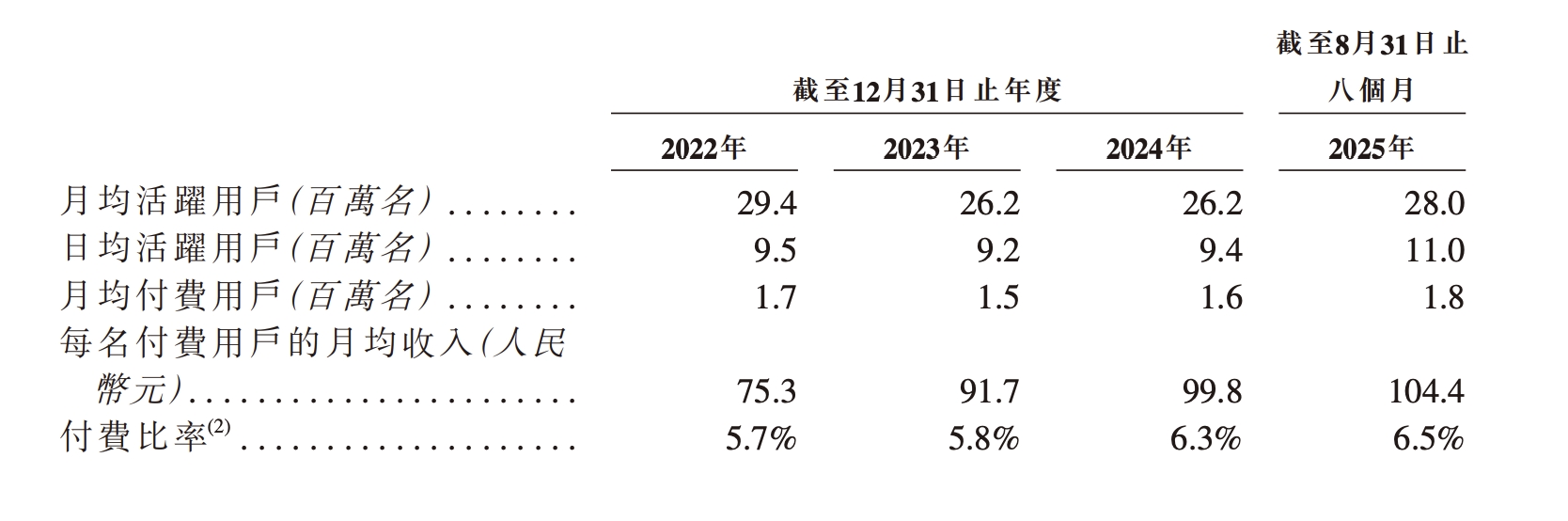
In this environment, the number of Soul's paying users has not fluctuated significantly. Over the past four years, this number has remained stable between 1.5 million and 1.8 million, and the ARPPU has increased from RMB 43.5 in 2020 to RMB 104.4 now, an increase of approximately 140%.
The image is from Soul's prospectus
However, there is also a problem - because Soul's average monthly 1.8 million paying users are based on 28 million monthly active users, the payment rate is actually only 6.5%.
The current situation for Soul as the "first stock in AI + social" is a low payment rate but a high ARPPU. In the current situation where the stranger - socializing market is generally shrinking, AI presents an opportunity for differentiated competition.
However, when AI is linked to socializing, emotions, and business, the risks it brings are also huge. Just as many posts on social platforms expressing "suspecting that Soul's AI virtual partners are real - life customer service" indicate, once it comes to genuine emotions and consumption, users become extremely sensitive. Many users have posted complaints, saying that Soul's virtual partners would express "I want you to send me a gift" to them, and such consumption hints are undoubtedly a shock that pierces the dream for users who are truly immersed in a virtual relationship.
The AI Boosters that assist users with weak social skills in initiating conversations pose more obvious moral risks. When AI can handle the conversation skills in a relationship, is this relationship also like being filtered?
The prospectus states in the risk factors: "We may face significant challenges in ensuring that our AI Boosters operate in a safe, reliable, and human - value - compliant manner. As AI models become more complex, their inherent risk lies in the possibility of unexpected behaviors, pursuing goals inconsistent with user or social interests, or failing to perform as expected in high - risk or new situations. For example, advanced AI systems may develop new capabilities not foreseen during the development process."
Risks and needs coexist. In 2024, the number of marriage registrations in China decreased by 20.5% compared to the previous year, hitting the lowest record since 1980, and the marriage rate dropped to 4.3‰, but people's need to be loved always exists - whether it's falling in love with an AI or having an AI help them fall in love.
The image is from Soul's prospectus
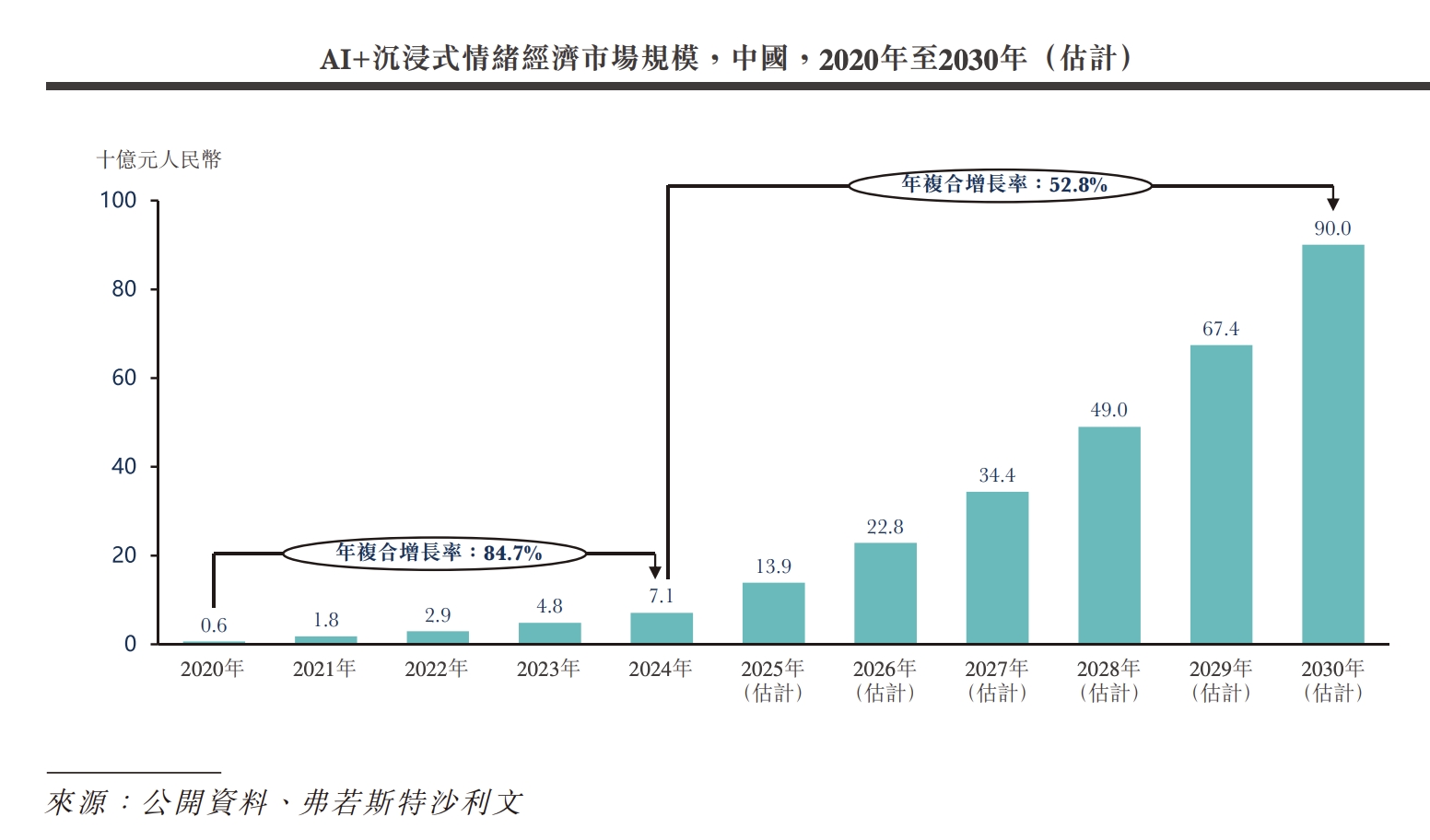
The Frost & Sullivan report shows that in 2024, the market size of China's AI + immersive emotional economy was RMB 7 billion, and it is expected to reach RMB 90 billion by 2030, with a compound annual growth rate of 52.8% during this period.