How to make people willing to go shopping?
We all encounter situations like this: two roads of the same length, one makes you want to take a car, while the other makes you forget about time as you stroll along.
Although the distances are the same, the choices are completely different.
The reason often lies not in how far it is, but in how it feels to walk - some journeys are just for commuting, while others can turn into an experience.
But the problem is, this "feeling" can only be described, but is difficult to define. Can it be quantified? Can it be verified? Can it become a basis for guiding urban planning and commercial site selection?
Recently, a study titled "Data-Driven Facility Layout for Enhancing Walk Appeal" led by Associate Professor Qi Wei from the Department of Industrial Engineering at Tsinghua University attempted to find answers using real data.
Why, even when the distance is close
do people still dislike walking?
In the past decade, the "15-minute living circle" has almost become the standard answer in urban planning. Its logic is clear: as long as the distance is short enough, people will naturally be willing to walk.
However, reality is often more stubborn than the model.
You may have also noticed that even if the map shows it's only 1 kilometer away, you still choose to rent a bike; but when you really take a walk on the streets of Chengdu, you may "keep walking until all the lights go out".
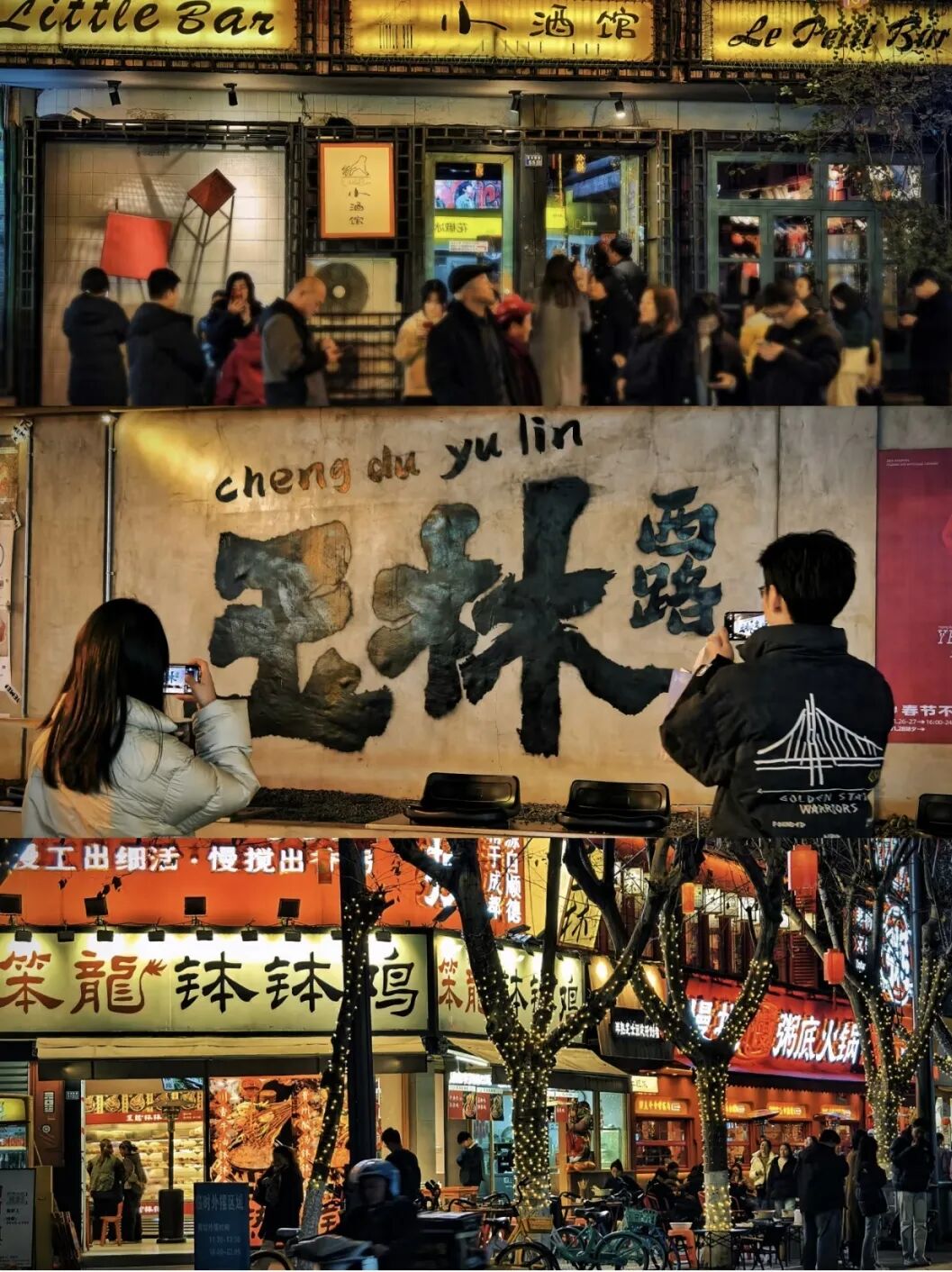
Yulin Road in Chengdu makes many people linger | Source: Xiaohongshu @Luke Ma
Therefore, distance is only a prerequisite, not the answer. For ordinary people, "walking comfortably and having an interesting stroll" is far more persuasive than simply "being close".
To quantify this comfortable feeling, this study used two core datasets from Amap: millions of real user travel origin and destination records, and the detailed distribution of all key POIs (such as restaurants, convenience stores, and shops) in the entire city.
Through the analysis of the Latent Class Model, they divided pedestrians into two categories -
"Experience-oriented travelers" - those who go shopping, for entertainment, or socializing, and walk for the process; "Task-oriented travelers" - those who commute, handle affairs, or deliver goods, and just want to reach their destinations as soon as possible.
The two types of people have completely different feelings about the streets.
Task-oriented travelers pay more attention to efficiency, such as whether the road is smooth, if there are any obstacles, and if they can save effort. What kind of shops are along the way actually doesn't matter much. Experience-oriented travelers, on the other hand, are the "potential stocks" of walking willingness. The more diverse, interesting, and vibrant the street is, the more willing they are to walk slowly and farther.
So, what kind of commercial street can attract these "strolling enthusiasts"? The study provided a detailed but somewhat counterintuitive formula for the business mix - shopping stores are a significant factor in increasing the probability of walking. A wide variety of goods means more things to see and consumption possibilities, which becomes an important motivation for people to slow down.
However, the high density of restaurants actually reduces the walking appeal.
It's not that restaurants are bad, but the negative impacts brought by a large number of them - cooking fumes, sidewalk dining areas taking up space, and the constant shuttling of food delivery riders make the street look more chaotic, making people want to avoid it or take other means of transportation.
Service facilities (such as beauty salons and express delivery points) have little impact. Most people only go there when they need to, and they won't add extra walking appeal.
Instead, those seemingly ordinary convenience stores and general merchandise stores will quietly enhance the sense of security and the living atmosphere of the street. They are like what Jane Jacobs called "the eyes of the street", spreading the flavor of daily life on the street and making it more human.
Based on these conclusions, the types and quantities of shops directly affect the walking experience of a street and determine whether people are willing to keep walking.
In other words, creating a pedestrian-friendly street is like mixing a cocktail - retail is the base liquor, convenience stores are the garnish, and restaurants need to be added in just the right amount. When the proportions are adjusted correctly, the atmosphere of the street will be like a well-balanced good wine, with clear layers and irresistible charm.
Who is quietly determining
the clustering and density of shops?
Should commercial facilities be concentrated or dispersed? This has been a question debated in urban planning for over a century. Those who support dispersion believe that convenience is the most important, and there should be "shops everywhere" in daily life; those who support concentration think that we should "focus our efforts in one direction" to gather the flow of people and make business prosperous.
The same goes for brand site selection. Some people insist that "main roads have more customer flow", while others think that "side streets are more cost-effective".
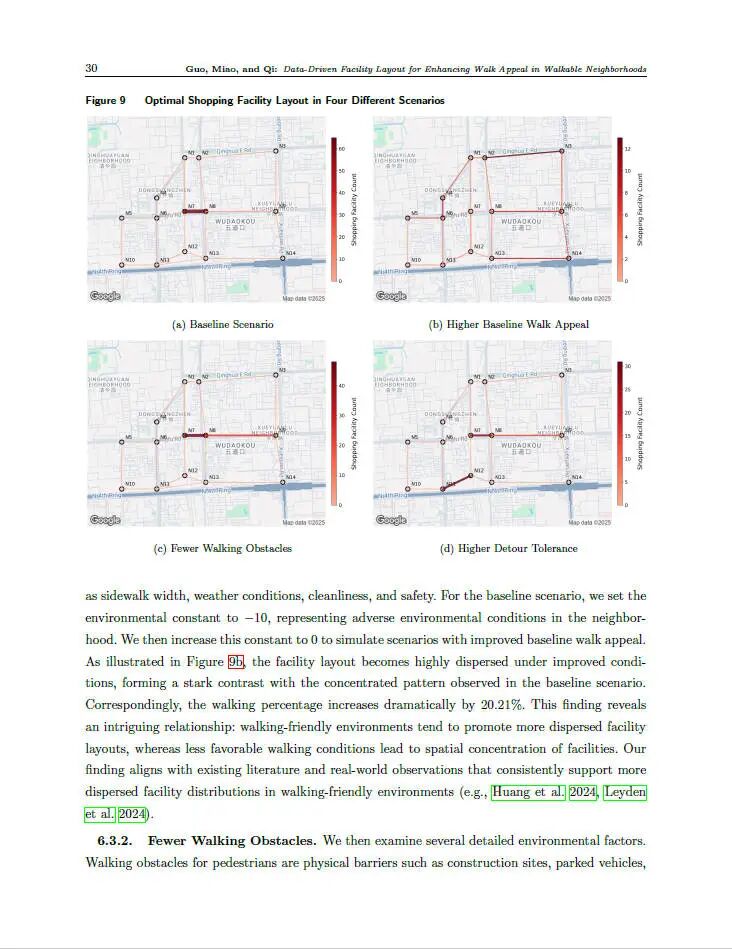
This paper provides a clearer and more quantifiable judgment - whether to cluster or disperse depends on the walking environment of the neighborhood itself and the density of existing facilities.
When the walking environment of a neighborhood is poor, it is more effective to create a strong central area.
For example, negative factors such as heavy traffic, narrow sidewalks, monotonous streetscapes, and lack of greenery and shade can all make people reluctant to take an extra step. In this case, if the commercial facilities are too dispersed, each street will lack something special and fail to create an attractive highlight.
By concentrating the commercial density on a main axis, it can be strong enough to offset the deficiencies in the environment - this is why many cities spontaneously form a core commercial street.
However, if the neighborhood itself has good conditions: a dense road network, diverse directions, tree-lined streets, and a comfortable walking environment, the situation will be completely different.
Continuing to cram all the commercial facilities onto the main street at this time will only cause congestion and excessive competition. A better approach is to spread the shops to the side streets and let the business penetrate the entire neighborhood like capillaries. This can not only improve the commercial efficiency of the entire area but also bring a light, interesting, and exploratory urban experience.
From this perspective, the emergence of more and more popular small streets in cities like Shanghai and Chengdu, where the supply of shopping malls is already saturated, is also inevitable.
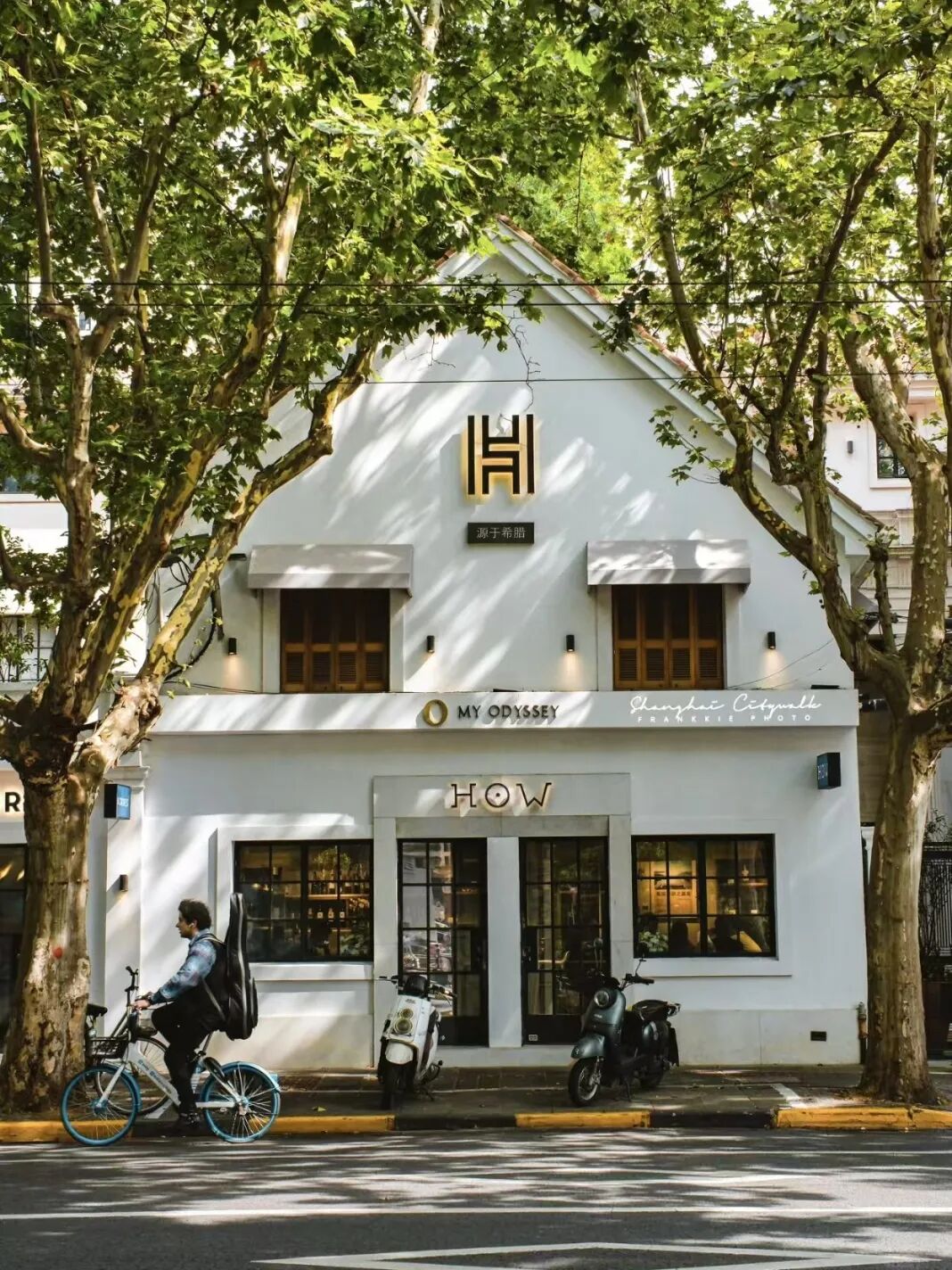
A group of small streets in the Wutong area of Shanghai | Source: Xiaohongshu @Frankkie Fan
Furthermore, the paper also provided a very important indicator: the minimum clustering level.
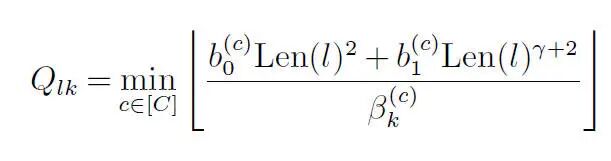
In plain language, based on how long the street is (Len), how uncomfortable it is to walk (b₀, b₁, γ), and how attractive the facilities on the street are to people (β), the corresponding threshold can be calculated.
When the number of existing facilities is less than this threshold, concentrating the incremental commercial facilities on the main street can most effectively enhance the overall vitality. But when the number of shops exceeds this threshold, opening new stores in the surrounding neighborhoods may be more cost-effective.
To be honest, the calculation of the formula is a bit complicated, and the setting of some parameters is also relatively subjective. It's difficult to finally turn it into an exact number that can't be more or less. But even so, this is still a very meaningful exploration in the fields of urban planning and commercial real estate -
It gives the commercial layout of neighborhoods an indicator of "calculable saturation" for the first time. Site selection and planning also have the opportunity to move from experience and intuitive judgment to model and data analysis.
As more detailed spatio-temporal data (such as the flow of people and consumption data at different times) are incorporated into the model, perhaps the future commercial layout will be as dynamically precise as the Internet recommendation algorithm.
The direction of people's footsteps
points to the future of planning and business
As the recipient of the Annual Best Paper Award (Finalist) in the Field of Public Sector Operations Research of INFORMS (Institute for Operations Research and the Management Sciences) in 2025, there is no doubt about its academic value.
It's just that this data-driven study is in English, which is very difficult to understand. I only managed to get a general idea with the help of AI.
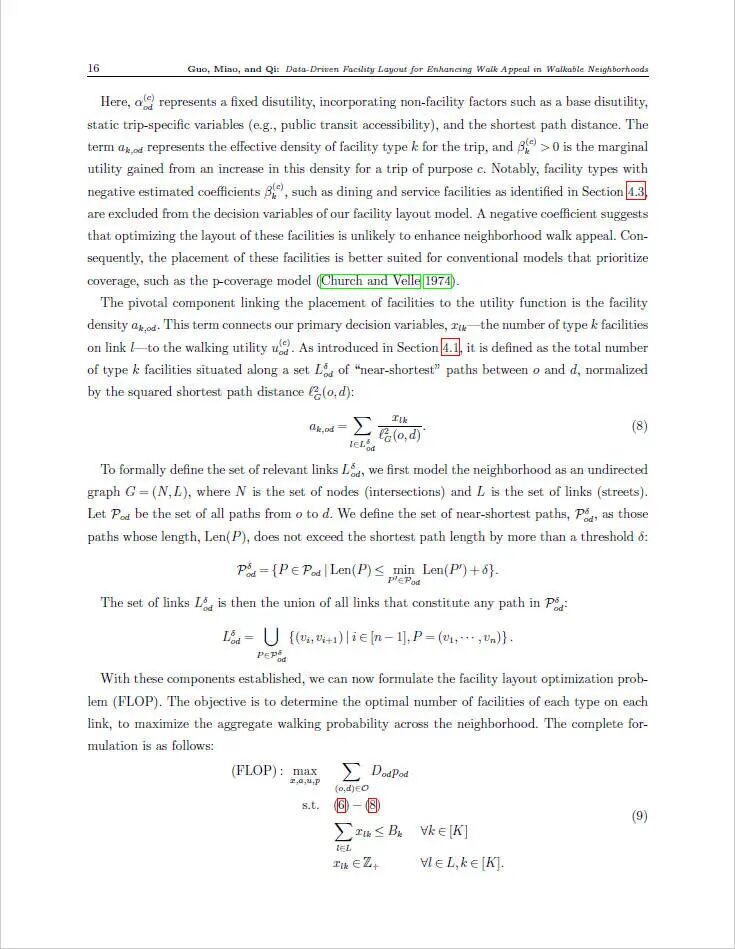
But I think the significance of this study lies not only in deriving a few new concepts through a bunch of formulas but also in changing the way we view cities and business.
First, it makes site selection shift from a static "point" to a dynamic "path".
Traditional site selection judgments are more based on static information such as transportation nodes, building density, and occupancy rates, which tell us "how many people" are in a certain area; now we know that the dynamic experience along the way determines "how many people" it can attract, and it should also become an important basis for site selection.
At the same time, the judgment of the attractiveness of the surrounding business mix can also rely less on intuition and gain more technical confidence.
Secondly, it can promote the construction and renewal of commercial neighborhoods into a more quantitative and refined era.
In the past, neighborhood renovation relied more on the experience of planners and the intuition of operators. The model provided in this paper can simulate different layout strategies, give an effective range for the commercial density of the main street, and the starting point for spreading the site selection, making planning no longer completely dependent on past experience.
Thirdly, it also brings a new discussion direction to the "15-minute living circle" - from "physically accessible" to "emotionally accessible".
If the first-generation concept emphasized the distance of the journey, then this study reminds us that what really determines the "walkability" of these commercial facilities is the comfort of the entire journey -
The openness of the building facades along the street, whether there is enough shade, greenery, and rain shelters on the street, the aggregation degree of the shop business mix, and the winding and exploratory road network, etc., can all stimulate the willingness to walk more than a cold and straight road.
On a deeper level, it means that future commercial community planning should also shift from being "time-centered" to being "experience-centered", and elevate the walking comfort to a new standard for measuring community vitality and urban quality.
The magic of design
and the vitality of the city
Today, urban planners and business operators are increasingly aware that in an era when the urbanization rate has reached a new high, the competition for the next stage of urban competitiveness no longer depends solely on the height of buildings and the density of facilities, but on whether it can provide citizens with high-quality and enjoyable daily experiences.
Architectural genius Thomas Heatherwick also emphasized a similar view when talking about the walking experience in his book "Humanism": The complexity and interestingness of street buildings will directly affect people's mood and happiness.
Different languages and logics all point to the value of pedestrian streets for cities and life.
When a street can make people genuinely willing to slow down, stop, and keep walking, it will unleash the most lasting commercial creativity and the most happiness - bringing urban vitality.
This article is from the WeChat public account "Mr. Mall". Author: Wabi - Sabi Pete. Republished by 36Kr with permission.