Raised 500 million yuan, a post-90s entrepreneur favored by LU Qi: Secured two consecutive rounds of financing.
If you've ever fantasized about wearing an "Iron Man suit" - walking more easily, running faster, and carrying dozens of kilograms of equipment without getting out of breath - then this ability is being gradually turned into reality by a Chinese company.
Recently, the exoskeleton robot company, Hypershell, announced the completion of two rounds of financing, Pre-B and B, accumulating a total investment of $70 million (approximately 495 million RMB).
The Series B round was led by Photosynthetic Venture Capital and Wuyuan Capital, with Meituan Longzhu participating as a follow-on investor. The Pre-B round was led by Monolith, with participation from institutions such as Wuyuan Capital, IDG Capital, and Sequoia China. The post-investment valuation of the company is approaching $400 million.
Hypershell specializes in consumer-grade exoskeleton robots. Through mechanical power, sensors, and intelligent control systems, it can help users save effort, increase strength, and enhance endurance, enabling people to walk farther and carry loads with less effort.
This type of equipment is not only targeted at ordinary consumers such as outdoor enthusiasts, hikers, and trail runners but also has the potential to be applied in more professional scenarios such as industrial handling, outdoor inspections, and walking assistance and rehabilitation.
The core users of Hypershell are those who have higher physical fitness requirements or hope to use technology to reduce the physical burden.
- 01 -
Hypershell is the world's first company to mass-produce and actually sell "consumer-grade exoskeletons" in the market.
The founder, Sun Kuan, born in 1991, is an outdoor enthusiast. He enjoys activities like hiking, mountaineering, and trail running. At the same time, he has been working on robot hardware for more than a decade, conducted academic research on exoskeletons, and participated in the entrepreneurship of a hardware brand targeting overseas markets.
What prompted him to start a business was a very intuitive feeling: modern people are becoming less active.
Urbanization has led to less walking, aging has made mobility problems more common, and immersive digital content (short videos, games) has reduced the physical activity of many people. He began to think: Is there a way to use technology to restore people's mobility?
Traditional exoskeletons are mainly used by the military, hospitals, and factories - they are expensive, bulky, and far from ordinary people. But what he wanted to do was to make exoskeletons accessible and affordable to ordinary people.
Outdoor sports provided him with very specific demand scenarios: People who like hiking or mountaineering often need to carry equipment weighing more than 10 kilograms for several hours, and many people's experiences are limited by their physical fitness. However, the exoskeletons on the market are either worth hundreds of thousands of dollars or weigh more than ten kilograms themselves - completely unsuitable for ordinary consumers.
So he set a very simple but extremely challenging goal for the team: to create an exoskeleton that is "affordable, portable, and truly usable."
At the end of 2021, he founded Hypershell in a small office of more than 20 square meters in Zhangjiang Electronic Port, Shanghai. The space was small, with test parts, batteries, and sensors piled on the desktop, and semi-finished structural parts placed on the ground. It looked a bit messy, but everyone was fully committed to the research and development of the prototype.
The startup team came from different fields such as robotics, ergonomics, and AI algorithms, and many members had backgrounds in large companies or top hardware companies. The first difficult problem they faced was: How to simultaneously achieve a good balance among weight, cost, and assistance performance?
If the exoskeleton is too heavy, it becomes a burden to wear; if it is too expensive, consumers can't afford it; if the assistance is insufficient, it is meaningless.
The most core problem for the team at that time was how to find a balance point that ordinary users were willing to pay for among weight, cost, and assistance performance.
To achieve this, Sun Kuan did not follow the common practice in the industry of "adding more motors and using hydraulic systems." Instead, he referred to Elon Musk's approach to building rockets - first reducing the complexity and then redesigning the product structure using the consumer electronics supply chain.
Finally, the team developed the world's first single-motor-driven Omega architecture. They even replaced the hydraulic system of traditional exoskeletons with a technology similar to the vibration motor of a mobile phone. Thanks to these "counterintuitive" structural optimizations, the weight of the exoskeleton dropped directly from the common ten-plus kilograms in the industry to 1.8 kilograms.
At the same time, by self-developing core components, they reduced the overall cost of the machine to 1/10 of that of traditional exoskeletons, laying the foundation for future pricing in the thousands of yuan range.
Although the technological breakthrough was smooth, the financing was anything but. Before 2023, Sun Kuan met nearly a hundred investors, and the two most frequently asked questions were: "Why is there a consumer-grade market for exoskeletons?" and "Why can a Chinese team develop them?"
It wasn't until 2022, when Hypershell entered the incubation system of Qiji Incubator led by Lu Qi, that it received the first angel investment in the millions, and the company was finally able to survive until the product was launched.
In 2023, the first product based on the Omega architecture, Hypershell Go, was released, and the team launched a crowdfunding campaign on Kickstarter. This "inverted U-shaped" exoskeleton, which is fixed at the waist and connected to the thighs on both sides, can provide assistance during mountain climbing and running, reducing the energy consumption equivalent to carrying a 30-kilogram load. It is priced at $799, similar to an iPhone 14.
As soon as the product was launched, it caused a stir among overseas users. The final crowdfunding amount reached $1.23 million, with 2,638 supporters, 40% of whom were from the United States. Hypershell Go also made it onto the bestseller list on Kickstarter that year.
After the successful crowdfunding, the team quickly advanced the mass production. At the beginning of 2024, they launched the Hypershell X series targeting hardcore outdoor enthusiasts, and the mass production process ran smoothly. Since then, the attitude of the capital market has changed significantly.
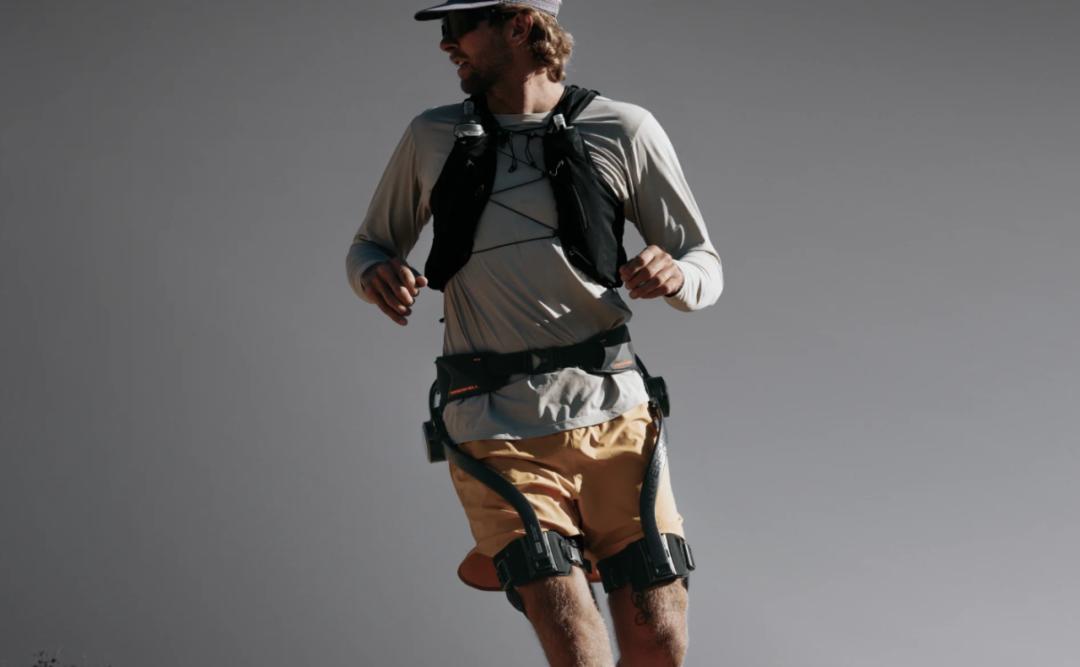
The latest product, Hypershell X Ultra
Today, Hypershell has a R & D team of nearly 200 people, holds hundreds of core patents, and has the ability for large-scale mass production and supply chain integration.
- 02 -
With the rapid progress of technologies such as materials, sensors, drives, and batteries, the cost and weight of exoskeletons are continuously decreasing, and intelligent control is becoming more mature. The industry is evolving from "professional equipment" to "consumer goods," and the demand is shifting from hospitals and factories to more daily-life scenarios such as hiking, traveling, walking assistance, and daily fatigue reduction.
According to institutional forecasts, the global exoskeleton market is expected to reach a scale of $5.8 billion in 2028, with a compound annual growth rate of approximately 47.7% from 2025 to 2028. The scale of the Chinese market is about 4.2 billion yuan in 2025 and is expected to maintain a growth rate of about 50% in the next few years.
Although the growth rate is rapid, the industry is still in its early stage, and the penetration rate is not high. Especially in China, although the market scale has started from "hundreds of millions of yuan" in the past few years and has shown obvious growth, there is still a long way to go before real popularization.
Currently, the players in the market can be roughly divided into two categories:
1. Traditional manufacturers: They started with medical or industrial exoskeletons, such as Lifeward and Ekso Bionics.
2. Emerging startups: They focus on consumer-grade wearables, such as Skip, Roam Robotics, Cheng Tian Technology, Hepuman Robotics, and Dnsys.
The overall market structure is fragmented, and it remains a blue ocean market with insufficient supply and expanding demand.
Among these players, Hypershell's approach is relatively unique: It does not enter the consumer market from the medical or military sectors but designs products for ordinary consumers from the very beginning. It aims to create an exoskeleton that "ordinary people can really buy, carry, and use."
This means that it focuses most on the following aspects:
Is it comfortable to wear?
Can the weight be reduced to a level that ordinary people are willing to carry with them every day?
Can the cost - performance ratio be comparable to that of a sports equipment?
Can the purchase and use threshold be lowered to be as simple as putting on sports protective gear?
- 03 -
From a technological perspective, exoskeletons are accelerating towards a common direction: becoming lighter, more intelligent, and adaptable to more daily scenarios.
The progress of AI, sensor, battery, and material technologies is making exoskeletons more and more like an "intelligent device that can keep up with your movements." It can automatically adjust assistance, recognize terrain, and work in coordination with other wearable devices.
With the changes in population and labor force structure, global aging, labor shortages, and industrial upgrading have led to a continuous increase in the demand for "enhanced physical fitness."
The current most - concerned technological highlights are mainly concentrated in the following categories:
1. Lighter, stronger, and more power - efficient drive solutions
The difficulty of exoskeletons lies not in "being able to run" but in "how long it can run." Whoever can make the whole machine as light as possible without sacrificing assistance performance and achieve a battery life of more than one day can transform the product from "equipment" to "daily necessities."
2. Human motion recognition and prediction algorithms
Exoskeletons are not simply "power boosters." They must predict the user's movement intentions in advance. Higher - precision IMU sensor fusion and AI - based gait prediction models have become important directions for new players to break through.
3. Modular structure and flexible materials
Traditional exoskeletons have an industrial style, being bulky and having a rigid structure. The current trend is to create wearable devices "like sports protective gear": with flexible support, quick disassembly and assembly, and adaptation to different leg shapes. Modularity can also reduce costs and pave the way for mass production.
4. Autonomous safety systems (fall prevention, sprain prevention)
For walking assistance and outdoor scenarios, safety is the most critical indicator. Some manufacturers have started to add real - time posture monitoring and rapid braking systems, which can intervene proactively before the user loses balance. This is a new growth point.
5. Specialized algorithms for specific scenarios
For activities such as skiing, cross - country running, trail running, and factory handling, the movement patterns vary greatly. Some teams are developing "scenario - specific exoskeletons," optimizing certain types of movements through specialized algorithms. The results are more prominent, and it is easier to find niche markets willing to pay.
This article does not constitute any investment advice.
This article is from the WeChat official account "Pencil News" (ID: pencilnews), written by Song Ge, and is published by 36Kr with authorization.