Wang Zhiguo of Coocaa: Break Data Islands with AIOS and Move from Individual Efficiency Improvement to Full-domain Resonance | WISE2025 King of Business
From November 27th to 28th, the WISE2025 Business King Conference of 36Kr, hailed as the "annual technology and business trendsetter", was held at the Conduction Space in the 798 Art Zone in Beijing.
This year's WISE is no longer a traditional industry summit but an immersive experience centered around "technology hit drama short - plays". From AI reshaping the boundaries of hardware to embodied intelligence opening the door to the real world; from brand globalization in the wave of going global to traditional industries equipping with "cyber prosthetics" - what we restore is not only trends but also the true knowledge honed in numerous business practices.
In the following content, we will dissect the real logic behind these "hit dramas" frame by frame and witness the "unique scenery" of business in 2025.
On the 28th, Wang Zhiguo, the CTO of Skyworth Group and the CEO of Coocaa Technology, delivered a speech titled "AI Exploration from Individual Happiness to Global Resonance".

Wang Zhiguo, the CTO of Skyworth Group and the CEO of Coocaa Technology
The following is the content of the speech, sorted out and edited by 36Kr:
Hello, everyone! I'm the CTO of Skyworth Group and also the CEO of Coocaa Technology. However, this CEO position may change by the middle of next year. To be honest, among all the tasks in the CEO job, the thing I least want to do is management, and the thing I like most is technology. Especially after the arrival of the AI era, I increasingly feel that various problems I encountered in management work in the past can now be solved with the help of large - scale AI models.
Today, the topic I want to share with you is "AI Exploration from Individual Happiness to Global Resonance". Regarding individual happiness, I once put forward a view within the company: Most applications focus on improving individual - level efficiency, that is, the so - called "point - based AI", while the two AI systems we focus on building belong to "surface - based AI", which is a complete AI operating system (AIOS).
Currently, in the industry, if we only rely on large - scale models for simple algorithm development, we can't fully leverage the real advantages of AI. The more knowledge a large - scale model has, the slower its response speed is. At the same time, the cost of such large - scale models is relatively high, and there are still many difficulties in achieving large - scale application.
Therefore, since 2021, Coocaa has focused its core energy on algorithm accumulation. Most of these algorithms are optimized and modified based on open - source algorithms. The real core competitiveness lies in the large amount of parameter tuning, data adjustment, and training we have done for these algorithms, and we have accumulated a vast amount of data assets and label systems.
These are the core prerequisites for the implementation of the two AIOS systems I'm going to talk about next, Happy Life AIOS and Happy Work AIOS.
Coocaa is the first company in China to build an AIOS. It has completed the native intelligent reconstruction of the underlying system first. With "Happy life, Happy work" as the core, it conducts product R & D and innovation. Now, with in - depth multi - scenario layout of AI agents, it has transformed cutting - edge technologies into commercial products and system solutions.
In the middle of this year and in August, Alibaba and OpenAI successively put forward the concept of AIOS. They believe that large - scale models can be made into AIOS, and even directly equate large - scale models with AIOS.
How to understand AIOS? Taking Coocaa's Happy Life AIOS as an example, it is an operating system for the family scenario. It takes family members as interfaces to connect to the system. Through data dimensions or with the help of agents, AI can understand the needs of family members. At the same time, we also connect various devices in the family, and external third - party services can also be connected to this system.
It is worth mentioning that what services the whole system ultimately provides for the family are not artificially designed but are autonomously fed back and decided by AI according to the actual situation.
For example, when this system was first launched, we paired it with a smart refrigerator with a camera, which can monitor the food put into the refrigerator in real - time. The traditional AI application logic is that when you put in an ingredient, the refrigerator will recommend corresponding recipes. However, once during a demonstration, the situation exceeded my expectations. We put a potato into the refrigerator, and immediately the system popped up a prompt saying "Refrigerator anomaly: Potatoes are not suitable to be placed in the refrigerator". Maybe I don't even know that potatoes can't be put in the refrigerator, but the large - scale model has mastered such a vast amount of knowledge, which just makes up for the knowledge blind spots of ordinary users. This is the value brought by the vast knowledge reserve behind AIOS.
Of course, this is just a small case. What I really want to talk about is the core of "Happy Life". Many people will ask, what exactly is the definition of "a happy life"? To be honest, I can't give a precise definition because I'm a rational person with little emotional fluctuation in life, and I put all my energy into technology. However, I'm very clear about what things will make people unhappy.
For example, in a common family scenario: When a child is doing homework, the wife quarrels with the child about it every day. The child thinks he has done a good job, but the mother thinks it's not enough, and thus the conflict arises. The original intention of Happy Life AIOS is to solve the coordination problem between people.
Most of the time, conflicts between people stem from information and cognitive asymmetry. The child thinks he has worked hard, but the parents don't recognize it. Once emotions take over, he can't focus. It's not that he doesn't want to learn, but that emotions dominate first. So what AIOS needs to do is to build a bridge between the two sides, eliminate the information gap, improve mutual cognition, and resolve such emotional conflicts.
Now, there is a learning machine in my home connected to this system. Now, my wife and child rarely quarrel directly about homework. The learning machine equipped with AIOS can communicate with the child in a way he can accept through personalized and high - EQ communication, so that he is willing to complete his homework tasks. This is the core power of AIOS.
In addition to the AIOS that can make families happier, the pain points in the work scenario are also worthy of attention. As I mentioned earlier about management problems, I come from a technical background and put most of my energy into technological innovation, so it's difficult for me to take care of the tracking and implementation of specific things. Of course, there are some extremely excellent people who can do everything well, but they are in the minority.
Actually, the core problem of management is essentially an execution problem. What is the biggest pain point in work? It's the feeling of "unfairness", that is, the value one pays is not equal to the return one gets. This feeling gradually wears down many people's work will. Our Happy Work AIOS aims to eliminate the information gap in work and change the past model that completely relies on human - to - human collaboration to complete work. You know, it's very difficult to do this well just by relying on people for collaboration.
Currently, well - run enterprises in China can be roughly divided into three categories: The first category is enterprises with profound corporate culture; the second category is enterprises with good digital construction; the third category is enterprises where the bosses work hard and explore unique management mechanisms. On the contrary, most enterprises are still in a difficult situation, researching how to carry out digital transformation. We are no exception and have been exploring how AI can help enterprises break through the competitiveness bottleneck. And the root cause of all these problems is management.
Based on this pain point, we built Happy Work AIOS. We input all the resources of employees and the company into the AI system, and let AI be responsible for resource scheduling and work evaluation. In this way, every employee can clearly know what to do and how to do it, fundamentally solving the information gap and fairness problems in work collaboration.
Coocaa Technology is working hard to transform the company into an AI - driven enterprise. Of course, the company's strategic direction must be clearly defined first. We provide the board of directors with a visual dashboard so that they can see all the company's operating data and progress in real - time. After the strategic direction is determined, the operation of the whole company no longer depends on the CEO's drive. Instead, the overall corporate goals are broken down, and AI drives employees to implement specific work. At the same time, AI can also discover various problems in the operation process from a vast amount of data.
Our ultimate goal is very clear: Through the two systems of Happy Life and Happy Work, we will connect all employees, suppliers, customers, upstream partners, and end - users, so that the information of all parties can be fully communicated. In this way, we can capture market opportunities immediately and ultimately create greater value.
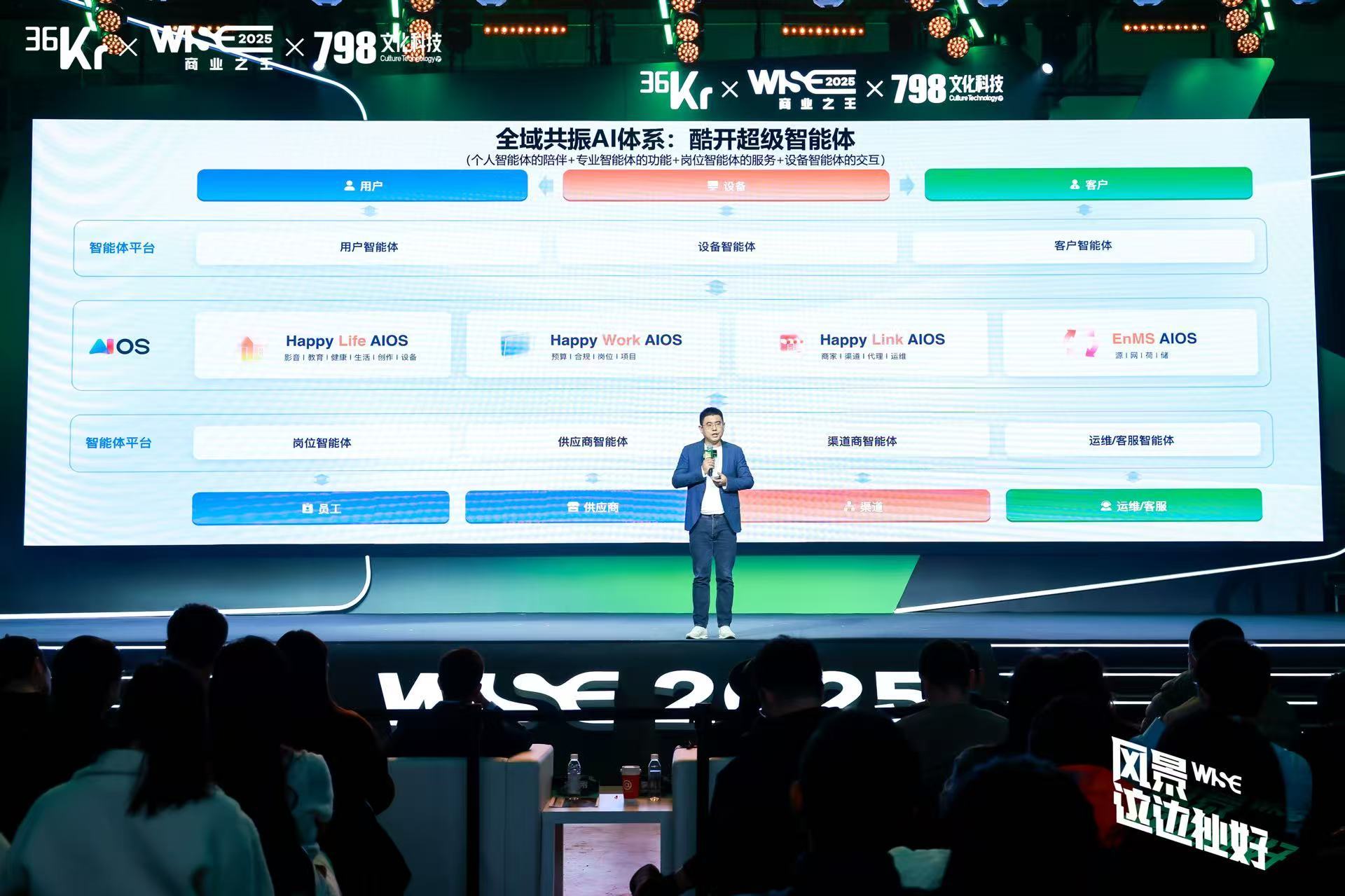
Global Resonance AI System
Currently, many enterprises are developing agents. After many practices, we have also summarized six internal rules for agents.
First, the person in charge of an agent must be a product manager. Different from the "design interaction" thinking of traditional product managers, the logic of agents needs to fit the operating logic of large - scale models. It focuses more on data input and weakens the interaction link. The thinking mode of traditional product managers is difficult to adapt, and it must be led by a product manager who understands the logic of large - scale models.
Second, the person in charge of an agent must also be a user. Only with a deep understanding and perception of the user scenario can an agent that meets expectations be tuned. The core of the process of improving an agent's ability is continuous tuning. Only by personally perceiving user needs can the tuning direction be accurately controlled.
Third, each agent must have a clear positioning. Take the family butler agent in our Happy Life scenario as an example. Its core positioning is to help the family make "the most cost - effective" consumption decisions. For example, when a user shows the intention to pay for a video platform, the agent will first remind the user "Don't rush to buy" and help the user analyze the most suitable video platform to make the most cost - effective choice.
Fourth, the emotional value of agents in the future should be greater than the functional value. We define "pleasant chatting" as emotional value and "precise service" as functional value. These two values should be matched, integrated, and jointly provide users with a high - quality experience.
Fifth, agents need to have the ability of human - machine co - driving, especially in the enterprise scenario. For example, when a family member calls me, the system can communicate with them first. I can intervene and monitor the whole process in real - time and adjust the content and direction of the communication. Human - machine co - driving is the most crucial logic to make up for the lack of AI data and improve the reliability of agents in the short term.
Sixth, agents operate 24/7. For all AIOS to truly play their value, the core lies in the ability to continuously run and process data even during "non - usage periods". Even if the user doesn't actively call it, it is still working in the background, capturing needs in time and making preparations in advance. This is the core value of AIOS.
In the future, agents will be the life in the virtual world. In the past, the virtual world was like a warehouse storing a vast amount of data. In the physical world, we used apps, algorithms, etc. to make use of this data. In the future virtual world, a large number of real - world things and people will become assets in the virtual mirror world.
Let me give you an example. The audio - visual agent launched by Coocaa can conduct both broad and in - depth searches on film and television works, accurate to each plot and each segment.
I personally like the works of Wang Zhiwen and Chen Daoming very much. I have watched all their films that I could find before. Some time ago, I tried to ask the audio - visual agent. At first, the works it recommended were all the ones I had watched. But as I dug deeper, I finally found two works of Wang Zhiwen that I had never seen before, "Cell Phone" and "Autumn of a Tree".
On the surface, this agent just helps us search for films, but its value is far more than that. In the future, its application scenarios can be infinitely extended. For example, if I plan to travel to a certain place, I can use the audio - visual agent to retrieve relevant film and television resources to learn about the local scenery in advance. That is to say, we have covered all the video resources on the whole network and deeply explored the visual and content capabilities of these videos, which can fully meet the different needs of users.
Similar to this are our education agent, health agent, creation agent, and life agent, etc.
The core logic of Happy Work AIOS is the same. The key to enabling the company to be driven by AI lies in building a standardized model of all the company's assets, business objects, and value systems.
First, we transform all the value resources in the company into quantifiable "objects" and use specific indicators to measure their value. The second step is to build a "processing factory" operation system for these "objects": Transform the organization into a pipeline studio, connect different positions and different people with the value chain, and make the input and output of each link clearly traceable. Only in this way can the independent value of each person be maximized.
This system has actually achieved cost reduction and efficiency improvement. For example, I have a dedicated terminal. Without attending any meetings, I can keep track of the problems that the company needs to solve, the things that are happening, and the potential risks in real - time. The system will also automatically push the risks to the corresponding responsible persons for follow - up and solution.
Since this system is built on the basis of a "data lake", everyone can become a data connection point to supplement and improve the data. The bottom layer of the whole system is the traditional digital system, above it is the data lake, and the top layer is various indicators. The logic of problem discovery is also very clear. As long as any indicator is abnormal, the system will directly trace back to the corresponding data source point through the data lineage relationship, and the corresponding problem can be quickly solved and implemented.
The core advantage of this mechanism is that it breaks the data silos in the AI system.
Of course, what we have built most importantly is the "post agent factory". Each key position in the company corresponds to a dedicated agent, and these agents have the corresponding post capabilities. For example, programming and design agents can help employees sort out and design requirements.
Currently, we have initially achieved "post agent + human - machine co - driving". The most obvious change is that there is no need for meetings in the company. Many people may not understand this and think that meetings are an important way of ideological exchange. But you must believe that with the support of large - scale model AI, the communication efficiency of ideas and information will be much higher than sitting together in a meeting.
Ultimately, we want to build a model of an "AI - native enterprise" at Coocaa Technology, driven by AI to achieve a full - closed loop from "earning money happily" to "spending money happily". We often tell our employees that embracing post agents is not only working for Coocaa but also creating value for all enterprises using Coocaa AIOS. We can even imagine that even if our physical lives disappear in the future, can our post agents, as "digital lives", continue to create value for families? This is what we call "digital immortality".
I believe this era will come soon. Here, I also want to remind everyone present: Embrace and use AI today, and focus on letting AI help us do the things we don't want to do. More importantly, we must clarify our own core values, such as the emotional value brought by high - EQ and the unique creative value. These are things that AI can never replace.
Above all, I hope this can be helpful to you. Thank you!