Tencent's €1.16 billion investment in Ubisoft shows its excessive obsession with games.
Tencent's game business has made another overseas investment.
On November 21st, Paris time, Ubisoft announced that Tencent's strategic investment in Ubisoft Nova SAS (Vantage Studios) had been successfully completed. According to the agreement reached between the two parties, Tencent will inject 1.16 billion euros (approximately 9.5 billion RMB) into Vantage Studios and acquire approximately 26% of the shares. The valuation of this subsidiary is 3.8 billion euros, while Ubisoft will retain exclusive control of the subsidiary.
Ubisoft is a French multinational video game developer, publisher, and distributor. It owns game series such as "Assassin's Creed", "Far Cry", and "Tom Clancy's Rainbow Six". The company is listed on the Paris Stock Exchange.
Tencent's game business is Tencent's most core revenue pillar and growth engine, occupying an irreplaceable and crucial position in the company's overall strategy. In recent years, Tencent's game business has adopted different approaches in the international and domestic markets. In the domestic market, Tencent mainly focuses on self - developed games and emphasizes the "evergreen game" strategy, highlighting that core products need to focus on long - term operation. In the international game market, Tencent mainly focuses on investment and usually does not seek control. The investment in Ubisoft is part of Tencent's overseas game strategy.
Tencent has previously stated that it hopes the revenue from the domestic game market and the overseas market can each account for 50%. However, according to Tencent's Q3 financial report in 2025, although the revenue growth rate of the overseas game market is higher than that of the domestic market, there is still a significant gap in revenue scale.
What will both parties gain from this investment cooperation with Ubisoft? Is this a worthwhile deal for Tencent?
Tencent's Distant Aid Relieves Ubisoft's Immediate Need
As a game giant, Ubisoft has had a tough time in recent years. Tencent's investment may be a "life - saving fund".
In May 2025, Ubisoft released its annual report for the 2024 - 2025 fiscal year. The operating revenue for this fiscal year was 1.8992 billion euros, a year - on - year decrease of 17.5%, and the operating loss reached 82.6 million euros.
Ubisoft postponed the release of its semi - annual report for the 2025 - 2026 fiscal year until November 21st. The financial report shows that Ubisoft's net bookings in the second quarter reached 491 million euros, higher than the expected 450 million euros, and a year - on - year increase of 39%. The net bookings for the entire first half of the year also increased by 20% compared to the same period last year.
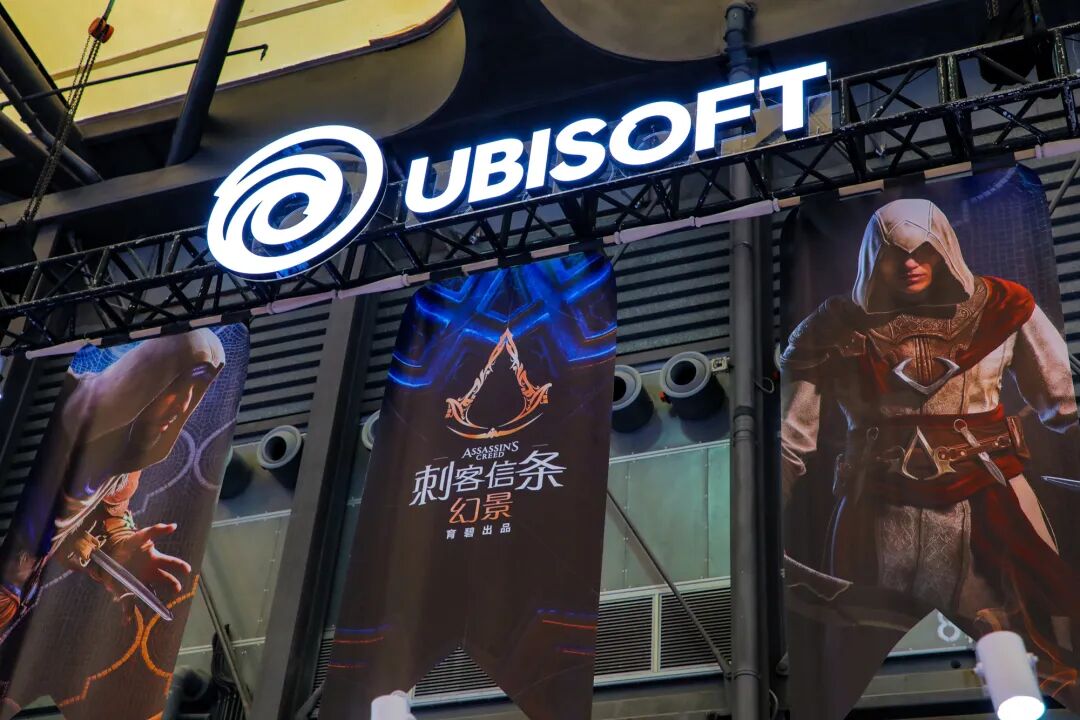
This is due to the good market performance of Ubisoft's major game product lines since this year. For example, since the release of "Assassin's Creed: Mirage" in March, its Metacritic scores have basically remained at 79 points for the PC version and 81 points for the PS5 version. The word - of - mouth has basically reached the average level of the series, and the sales volume in the second quarter was better than expected. Also, under the influence of core IPs such as "The Division", it has driven the number of active players.
Although Ubisoft showed a better side in the first half of the year, it does not mean that Ubisoft can reverse the situation on its own. Ubisoft's overall finances are still under pressure.
For example, in terms of cash reserves, the situation is deteriorating. Ubisoft currently only holds 668 million euros in cash, a decrease of 260 million compared to the same period last year. Currently, the development cost of a 3A game often exceeds 100 million or even 200 million US dollars (approximately 86 million and 170 million euros). To cover the simultaneous development of multiple major IPs, Ubisoft faces significant pressure.
At the same time, Ubisoft also faces short - term debt pressure. There is 1.15 billion euros in debt on Ubisoft's books, and the cash on hand is insufficient to cover the debt. Ubisoft postponed the release of its semi - annual report for the 2025 - 2026 fiscal year by one week. Ubisoft's official explanation is that during the audit of the accounts, the auditors found that the company had problems in revenue recognition before - the sales of some partners were prematurely included in the revenue (violating the IFRS 15 accounting standard).
After the correction, Ubisoft must postpone the recognition of the revenue from some new cooperation agreements that will be included in the second quarter of the 2026 fiscal year. This accounting adjustment directly violates the leverage clause in the loan agreement, constituting a "technical default".
To avoid further expansion of the default, Ubisoft decided to prepay 286 million euros of the loan principal, which further exacerbated Ubisoft's capital problem.
To relieve the financial pressure, Ubisoft reduced its staff by approximately 1,500 in one year. At the end of last year, Reuters reported that some Ubisoft shareholders were trying to force a takeover to seek privatization. It can be said that Ubisoft's management is under great pressure.
Tencent's offer of an olive branch at this moment, with an 1.16 - billion - euro investment in Ubisoft, can be said to be "extending its life". The 286 - million - euro loan that Ubisoft needs to prepay will be used immediately after Tencent completes the transaction. In short, part of Tencent's investment will be used to repay the loan.
It is worth noting that as of November 29th, Ubisoft's total market value is 1.12 billion US dollars, less than 1 billion euros. Tencent's 1.16 - billion - euro investment has exceeded the company's market value, almost equivalent to a "full - scale support" transaction.
In addition, Tencent's investment also has great potential in terms of business for Ubisoft.
Facing difficulties, Ubisoft has chosen to make changes. In addition to betting on the next 3A game with increasing production costs, Ubisoft also hopes to layout GaaS (Game as a Service) games because if a game is successful, it can generate continuous and stable income.
This is an area that Ubisoft, which previously mainly focused on single - player game production, is not good at. Ubisoft needs an experienced insider like Tencent to help. After all, "Honor of Kings" is still firmly ranked among the top three in global revenue even ten years after its release. It can be said that no one is more proficient in GaaS than Tencent.
Even just licensing IPs would be like making money effortlessly for Ubisoft. Not to mention that with Tencent's help and demonstration, Ubisoft has the confidence to learn from Tencent and develop its own GaaS games.
This is not without precedent. For example, after the SLG game "Three Kingdoms: Strategy Edition" developed by Lingxi Interactive Entertainment under Alibaba was a great success, Koei Tecmo, the owner of the "Three Kingdoms" game IP, successively developed several similar SLG games such as "Three Kingdoms: Hegemony". Ubisoft also has the potential to become the next Koei Tecmo.
In addition, Tencent's investment method is also one of the points that Ubisoft values.
Before the investment plan was announced this year, there were rumors that Tencent would directly acquire Ubisoft. However, considering that Ubisoft has a special status in France and could even be featured prominently at the opening ceremony of the Paris Olympics, this special national - treasure - like status poses challenges to a direct acquisition. In addition, the Guillemot brothers, the founders of Ubisoft, have never given up control of the company since its establishment. So even though Ubisoft is currently facing difficulties, it is unlikely to be easily sold to others.
For Tencent, which focuses on investment rather than control in its overseas game layout, the inability to directly acquire is not a problem. Since the acquisition of the Nordic game company Supercell, which developed "Clash of Clans", in 2016, Tencent has not had a similar large - scale acquisition case. Instead, it has shifted to strategic investments with more controllable risks. Moreover, the current cooperation method can also avoid the anti - monopoly review faced by Microsoft when it acquired Activision Blizzard and avoid the risks caused by a long - drawn - out process.
It sounds like a story where a princess is in trouble, a prince comes to the rescue bravely, and the princess doesn't have to marry the prince in return.
Tencent's Calculations and Challenges
Tencent also has its own calculations regarding the investment in Ubisoft.
It all starts with the relationship between Ubisoft and Tencent. Ubisoft and Tencent have always maintained a good relationship. In 2018, when facing a hostile takeover by Vivendi, Tencent stepped in bravely and acquired 5% of the shares to help Ubisoft out of a tight spot. The two parties have also cooperated on several mobile games. The transaction price of 1.16 billion euros in this year's cooperation is not low. Since this year, the market value of Ubisoft (Ubisoft Entertainment SA) has been hovering between 800 million and 1.7 billion euros, and the trend has been mainly a slow decline.
From this perspective, Tencent is like a white - knight who has selflessly helped Ubisoft out of trouble twice. If only looking at the market value and transaction figures, it seems that Tencent is making a losing deal. However, if we take a long - term view, we will find that Tencent actually has its own precise calculations.
Tencent's 2024 financial report shows that in 2024, Tencent's game revenue was 197.7 billion yuan, accounting for approximately 29.9% of Tencent's total revenue, close to 29.5% in 2023. Although the game business is no longer half of Tencent's revenue, it is still an important source of income for Tencent.
According to Tencent's latest Q3 financial report, in this quarter, Tencent's game business revenue in the domestic market was 42.8 billion yuan, a year - on - year increase of 15%, and the revenue in the overseas game market was 20.8 billion yuan, a year - on - year surge of 43%. The growth rate overseas is faster.
As early as in the group strategy meeting in April 2023, Ren Yuxin, Tencent's COO and President of the Interactive Entertainment Group, stated that Tencent should transform from a platform - type game company to a combination of a "game production company + platform company". Tencent's overseas game business obviously has a stronger platform color, that is, mainly focusing on investment rather than control as we can see now.
This is actually a rational choice.
Comparing with another global game company, EA (Electronic Arts), we can see how difficult it is to be rational and restrained. EA is known as the "studio killer" in the game industry because it has acquired many studios full of creativity and with well - known games. However, many of these studios failed to continue producing excellent works under EA and were eventually disbanded by EA.
Among these disappeared studios are the production teams of "Command & Conquer: Red Alert 2", Westwood Studios, and the production team of "Need for Speed", Ghost Games, which are very familiar to Chinese players.
Perhaps it is precisely because of seeing the drawbacks of the acquisition model that Tencent Games has chosen a strategic investment method with more controllable risks and can maintain the vitality of game companies in its international market expansion, because in the content industry, no one can predict the next big trend.
This investment model has also brought rich rewards to Tencent. According to Game Look statistics, among the games nominated for the TGA in 2024, 12 had Tencent's investment background, with a total of 23 nominations. Among them, "Black Myth: Wukong" and "Elden Ring: Shadow of the Erdtree" were also nominated for the Game of the Year Award. In the previous year, "Baldur's Gate 3", in which Tencent invested, won the TGA Game of the Year Award.
Returning to the investment in Ubisoft, Tencent's restrained choice not to control Ubisoft is both a choice based on reality and a respect for the production model of the content industry.
The 1.16 - billion - euro investment may seem to pay a premium, but historically, when "Assassin's Creed" was still known as an "annual release", Ubisoft's market value once exceeded 10 billion euros. Although the stock price has plummeted now, it still holds multiple major IPs and still has a strong appeal in the game field.
At the same time, after the subsidiary permanently and exclusively obtains the authorization of the three core IPs of "Assassin's Creed", "Far Cry", and "Tom Clancy's Rainbow Six" to develop GaaS games, the success rate is actually not low with Tencent's support. If Ubisoft's market value was 10 billion euros, Tencent might not have been able to reach an agreement.
However, it must be mentioned that the risks and opportunities of Tencent's investment this time are equally prominent.
Firstly, in overseas investment cooperation in the game business, Tencent can only partially influence the business direction, and the rest depends on the output of the invested company. For example, Tencent's investment in Japanese game companies has not brought corresponding returns. From this perspective, strategic investment in the game industry is actually a form of venture capital. Whether the investment in Ubisoft is worthwhile depends on whether Ubisoft can continue to maintain high - quality output in the future.
Another point is that Tencent's previous cooperation with Ubisoft has not been smooth. Ubisoft once faced a hostile takeover by the French media giant Vivendi, and Vivendi's shareholding ratio once reached 27.3%, with the intention of controlling core IPs such as "Assassin's Creed" and "Tom Clancy's Rainbow Six". In 2018, Tencent injected 369 million euros and joined hands with Ubisoft's management to acquire the shares from Vivendi, maintaining the company's independence. After saving Ubisoft, the two parties cooperated on several games through IP licensing, and the most well - known one is the mobile game "Assassin's Creed: Chronicles".
After seven years of development, it was reported that the project was suspected to be cancelled, the project team members started taking vacations, and neither Tencent nor Ubisoft responded. There has also been no update on other games.
So if the two parties continue to choose to cooperate on mobile games, how to avoid failure and improve the success rate is also one of the issues that must be faced.
Against the backdrop of Tencent's increasingly rich overseas game layout, Tencent is gradually approaching the status of an "old - money" in the game industry. However, whether it can truly become an "old - money" still requires longer - term market testing.
This article is from the WeChat official account "Delin Society" (ID: delinshe). Author: Liu Yimo, Editor: Liu Zhentao. Republished by 36Kr with permission.