The "Three Big Oil Companies" don't really belong to the "oil" business.
Author | Wang Hanyu
Editor | Zhang Fan
Recently, the stock prices of China National Petroleum Corporation (CNPC), Sinopec, and China National Offshore Oil Corporation (CNOOC), known as the "Big Three Oil Companies," have been on the rise.
Theoretically, the main business of the "Big Three Oil Companies" is oil and gas sales, and their stock price performance should generally align with the fluctuations in crude oil prices. However, since October, the two have deviated.
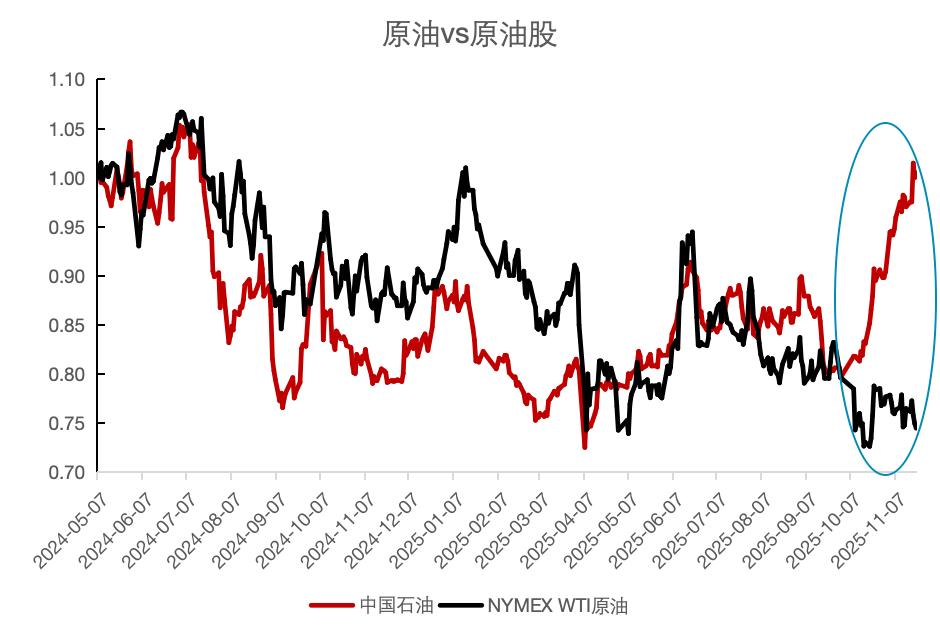
Data source: Wind Charting: 36Kr
After entering October, the international crude oil price has been fluctuating downward. The price of Brent crude oil dropped from $66.18 per barrel at the opening on October 1st to $63.99 per barrel at the closing on November 17th; the price of WTI US crude oil dropped from $62.46 per barrel to $59.72 per barrel.
Meanwhile, from the first trading day after the "Golden Week" holiday to the present (November 17th), the stock prices of the "Big Three Oil Companies" have all risen. The A-share price increases of CNPC, Sinopec, and CNOOC during this period reached 22.46%, 9.26%, and 13.71% respectively.
Currently, oil and gas sales account for a relatively large proportion of the operating income of the "Big Three Oil Companies." As of the end of the first half of this year, "oil and gas sales" accounted for 79.76% of CNPC's revenue, 82.73% of CNOOC's revenue, and gasoline, diesel, crude oil, and kerosene products contributed 67.43% of Sinopec's revenue.
Moreover, the drag caused by the decline in crude oil prices has been continuously reflected in their operating performance. As of the end of the third quarter, both the annual revenue and net profit attributable to the parent company of the "Big Three Oil Companies" have declined.
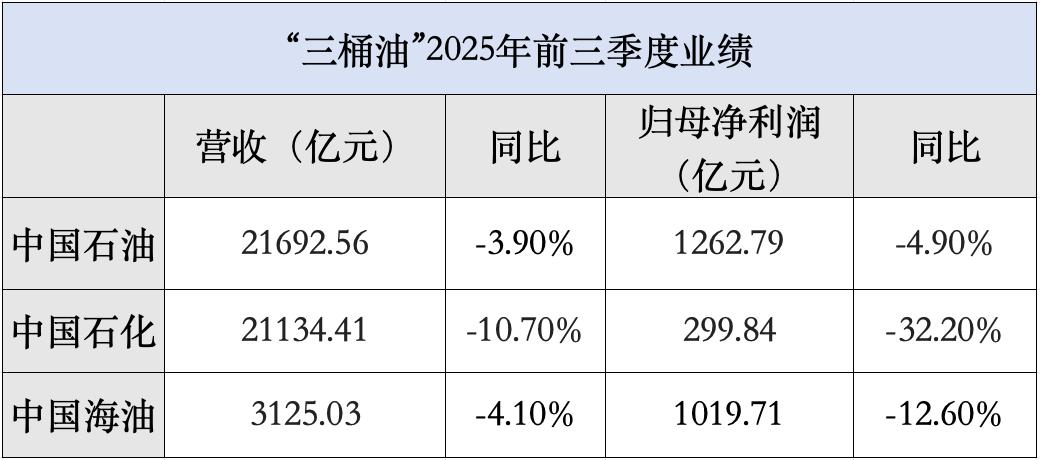
Data source: Company financial reports Charting: 36Kr
In this situation, why have the stock prices of the "Big Three Oil Companies" risen instead of falling?
Fund holdings may shift to standard allocation
The rise in the stock prices of the "Big Three Oil Companies" may reflect the changes in fund holdings.
Data shows that as of November 12th this year, a total of 1,378 public - offering funds were issued in the entire market, reaching a new high in the past three years. Among them, the number of index funds issued reached 813, accounting for 59% of the total.
In addition, as of the end of the third quarter, the total scale of equity ETFs in the entire market reached 5.63 trillion yuan, also setting a new historical high.
Generally, the holdings of index funds must be configured according to the weight of the index. As stocks with extremely high total market values, the "Big Three Oil Companies" have a relatively large weight in major broad - based indexes such as the CSI 300 Index and are typical heavy - weight stocks.
That is to say, theoretically, any index fund that tracks or uses the CSI 300 as a benchmark should allocate a considerable proportion of the "Big Three Oil Companies."
Therefore, with the booming issuance of index funds, the fund holdings of the "Big Three Oil Companies" will naturally increase accordingly.
In addition, from the perspective of the switching of the investment style of public - offering funds, the ongoing fee reform in the industry may also prompt fund managers to actively increase the allocation ratio of the "Big Three Oil Companies."
In the past, under - allocating the "Big Three Oil Companies" was almost a "common choice" for active equity funds.
On the one hand, for most of the past decade, the investment mainlines in the A - share market were "consumption upgrading" and "technological innovation." Most fund managers focused on sectors such as liquor, medicine, the Internet, and new energy. Traditional energy and financial sectors have always lacked the effect of making money and received less attention from funds.
On the other hand, as traditional energy giants, CNPC and Sinopec, which were listed earlier, are considered to have passed their high - growth periods, and their future development potential is far less than that of sectors such as technology, consumption, and medicine. Moreover, their large scale often results in less stock price elasticity compared to some small - and medium - cap companies.
Therefore, from the perspective of active stock selection, it is difficult to obtain excess returns by over - allocating the "Big Three Oil Companies" in the long term. Many growth - oriented fund managers prefer to allocate funds to growth stocks and under - allocate stocks like the "Big Three Oil Companies."
However, there have been important changes in the public - offering fund market.
On May 7th this year, the "Action Plan for Promoting the High - Quality Development of Public - Offering Funds" was released, clearly stating that fund managers' compensation should be linked to performance, breaking the past "guaranteed income" fee model. Fund managers' compensation has shifted from a fixed fee rate to a floating fee rate.
The plan requires fund companies to "significantly reduce" the performance - based compensation of fund managers whose products have been managed for more than three years and whose performance is more than 10 percentage points lower than the performance benchmark. For fund managers whose performance significantly exceeds the benchmark, their compensation can be reasonably and moderately increased.
36Kr has also learned from many public - offering industry insiders that most fund companies have adjusted their assessment rules according to this guidance, such as increasing the proportion of long - term return assessment and assessing the profitability for fund investors.
The adjustment of linking management fees to performance and adding indicators such as "profitability for fund investors" to performance assessment may lead to two consequences:
One is stability. In the future, fund managers will closely monitor the performance benchmark, without making excessive deviations, striving for stable and improving performance to ensure stable salaries.
The other is conservatism. The overall style of fund managers will tend to be conservative, unwilling to take risks for high elasticity. Because if the short - term performance is too high and they fail to withdraw completely at the high level, it will inevitably lead to a rapid decline in performance, which will cause excessive losses to retail investors who enter the market at the high level and then drag down the "profitability for fund investors" indicator of the fund manager.
Under such an assessment mechanism, large - cap blue - chip stocks with low valuations can effectively reduce net value retracement and are regarded as the "ballast stones" in the investment portfolio. The continuous high - proportion cash dividends can directly contribute to the fund's net value. The "Big Three Oil Companies" are expected to change from the "unavoidable choice" of fund managers to the target of active allocation.
In market fluctuations, dividend - paying assets become the preferred choice for risk aversion
Actually, looking at the long - term trend, the situation of the "Big Three Oil Companies" being under - allocated by funds began to change around 2023.
At that time, the concept of "valuation of Chinese - characteristic enterprises" began to attract attention. The market gradually broke through the limitations of cyclical stocks and re - examined the value of large - state - owned enterprises, including dividend - paying ability, governance improvement, and strategic value. The "Big Three Oil Companies," as the leading central enterprises, benefited from this.
After 2023, the A - share prices of the "Big Three Oil Companies" once rose significantly, and the proportion of fund holdings also increased year by year. CNOOC, which only listed on the A - share market in April 2022, was a slight exception in this trend.
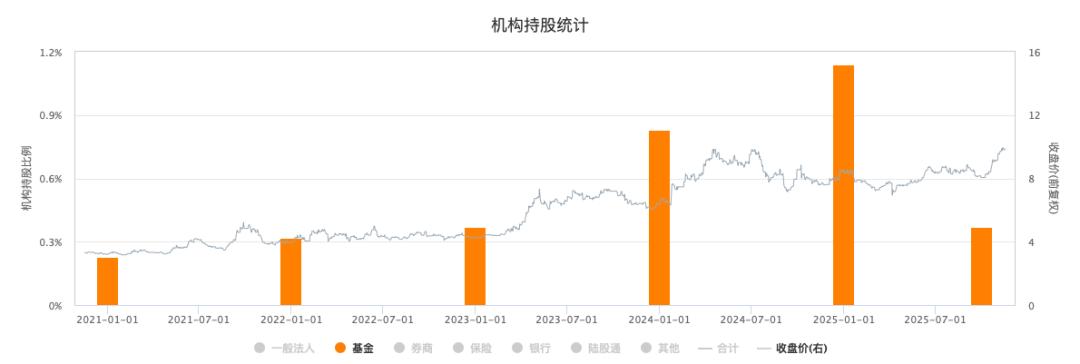
Changes in the fund holdings of CNPC's A - shares Source: Wind
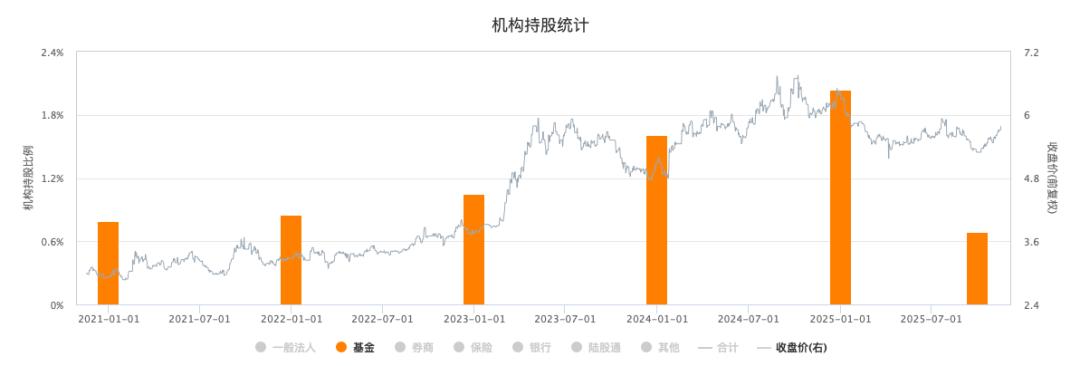
Changes in the fund holdings of Sinopec's A - shares Source: Wind
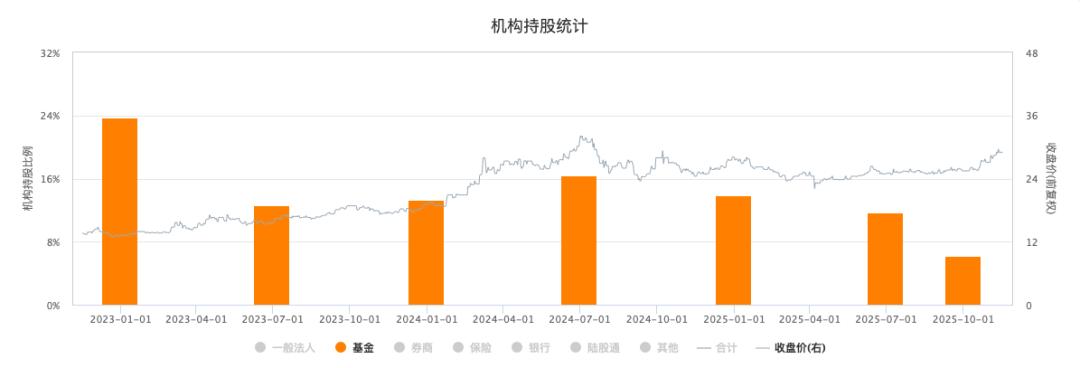
Changes in the fund holdings of CNOOC's A - shares Source: Wind
Currently, with strong market uncertainty and the overall decline in interest rates, investors are starting to pursue stable cash flows. The "Big Three Oil Companies" are attracting the inflow of risk - averse funds with their continuous and high - proportion dividends.
Looking at the past history, the "Big Three Oil Companies" have obvious characteristics of dividend - paying assets.
First, the dividend ratios of the three companies are maintained at a relatively high level. The interim dividend payout ratio of CNPC in 2025 reached 47.9%, that of Sinopec reached 49.7%, and that of CNOOC reached 45.5%.
Second, as the pillars of national energy security, the "Big Three Oil Companies" have gas stations all over the country, which provide them with stable income and cash flow. They can maintain overall profitability even during periods of low oil prices, laying a foundation for their continuous dividends.
Third, the dividend willingness of the "Big Three Oil Companies" provides investors with stable expectations. All three companies have clearly stated in their financial reports or public occasions that they are committed to improving shareholder returns. For example, CNOOC promised that from 2025 - 2027, the annual dividend payout ratio will not be less than 45% (subject to the approval of the general meeting of shareholders).
In a low - interest - rate environment, high - proportion dividends and a solid profit foundation are usually the preferred choices for long - term allocation.
Especially since October, the fluctuations in the A - share market have increased. Compared with the sectors with relatively large increases in the previous period, the valuation of dividend - paying assets is relatively reasonable and more cost - effective.
Minsheng Securities said that in recent years, the risk - free rate of return has continued to decline. The listed one - year deposit interest rate of large - state - owned banks has dropped below 1%, and the annualized returns of most bank wealth management products are between 2% - 3%, while the current dividend yield of the CSI Dividend Index is about 4.5%, which is obviously advantageous.
Meanwhile, after bank wealth management products broke the rigid payment and implemented net - value management, the volatility of some wealth management products has increased. For pension funds, insurance funds, and stable funds in family asset allocation, dividend - paying assets not only provide predictable cash returns but also take into account certain liquidity and appreciation space, gradually evolving into a high - quality choice with "quasi - fixed - income" characteristics.
However, it is worth noting that the profitability of the "Big Three Oil Companies" is highly correlated with international oil prices. Although the profitability is relatively certain, the performance fluctuations are still relatively large. This has also made the "Big Three Oil Companies" a "disaster area" for active funds to deviate from the benchmark over the years. Even if a fund only under - allocates a few percentage points, due to their large weight, it may have a relatively large impact on the performance of the fund's net value relative to the benchmark.
*Disclaimer:
The content of this article only represents the author's views.
The market is risky, and investment should be cautious. In any case, the information in this article or the opinions expressed do not constitute investment advice to anyone. Before making an investment decision, if necessary, investors must consult professionals and make decisions carefully. We have no intention to provide underwriting services or any services that require specific qualifications or licenses for the trading parties.

Follow for more information