What is Web3 and what problems does it aim to solve?
God Translation Bureau is a compilation team under 36Kr, focusing on fields such as technology, business, workplace, and life, and mainly introducing new foreign technologies, new ideas, and new trends.
Editor's note: Web3 is far more than just cryptocurrencies and avatars. It's about a more fundamental question: Who is the master of your digital life? The shift from being a passive "platform tenant" to becoming a property owner with "digital property rights" is becoming a new dividing line. The core of Web3 is digital ownership and governance rights, which is not only a technological concept but also the key to reshaping everyone's online way of existence. This article takes you beyond the jargon to understand this profound transformation from "what you own" to "how you own." This article is from a compilation.
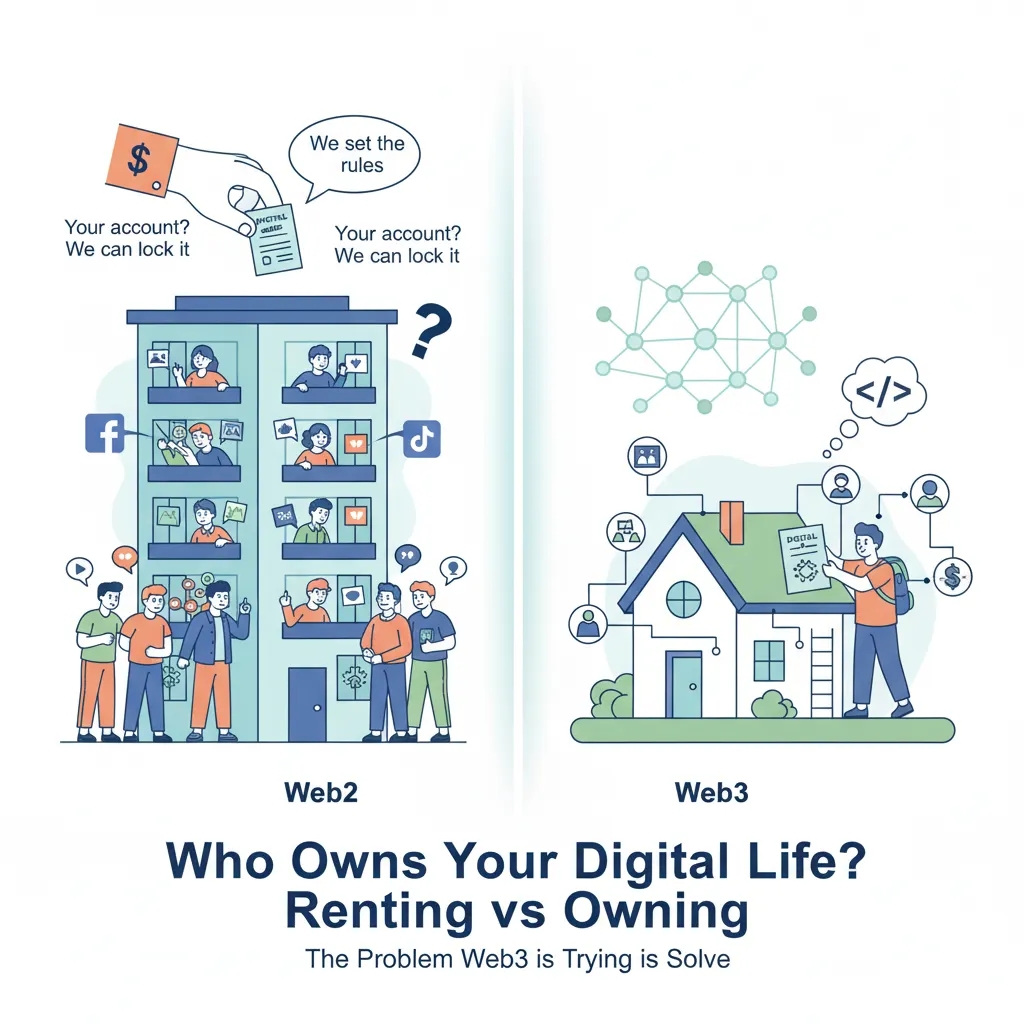
The picture is generated by Gemini.
To be honest, the outside world's explanations of Web3 are often off - putting. A pile of technical terms like "decentralization" and "blockchain" are put together, making it hard to understand and easy to make people think it's a matter for the tech circle and has nothing to do with themselves.
But this is exactly the source of the misunderstanding. Web3 is not equal to the Bitcoin price, nor is it the cartoon avatars of those cryptocurrencies. Instead, it goes back to a more fundamental issue, that is, ownership itself.
Think about your daily digital life. Who does the photos you post, your friend list, and your like records really belong to? Who truly controls your online identity? The answer is not complicated. The control lies in the hands of the platforms. Facebook sets the rules, Google decides the information you see, and TikTok's algorithm decides what's popular. We're like living in the digital apartments provided by the platforms, paying "rent" with our attention but not owning any part of them.
Thus, a often - overlooked question emerges: Why can't users own the whole building? This is exactly the starting point of Web3.
This concept sounds radical, and it is indeed complex and chaotic. Many of the attempts may not succeed. But it doesn't come out of thin air. Instead, it's a reaction to the current highly centralized and advertisement - driven Internet. To understand why it's appealing, we need to first review the evolution of the Internet.
What is Web3?
Today's Internet, that is, Web2, can be understood as a city controlled by large technology companies. Giants like Meta and Google own the streets, buildings, and public spaces here. Although you can live here, you have to follow the platform rules. They can adjust the terms at any time, sell your attention to advertisers, and even ban your account if necessary. You're always just a tenant.
The core idea of Web3 is to allow users to own their own "digital land." You can build a house on it, and you truly hold the property rights. Data, identity, and creative content are all bound to the individual and stored in your "wallet." The city rules are written in the public open - source code and maintained by the community together, rather than being decided by a single company or a CEO.
This is less of a technological change than a fundamental difference between "renting" and "buying." The underlying technology that supports this digital property - rights structure is the blockchain.
How does the blockchain achieve property rights?
Don't be distracted by the complex terms. You can understand it as a way of "neighborhood group - chat bookkeeping."
Suppose someone in the group says, "I sold my vinyl record to Alex." All members will write down this transaction in their own little notebooks: "Now the record belongs to Alex." There is no single official ledger here; instead, everyone keeps a copy. If someone denies it later, people can compare the records to find out the truth. The consistent records of the majority determine the real situation, and it's difficult for any individual to tamper with it.
This is where the power of the blockchain lies. The records are public and transparent, and it doesn't rely on a single - point institution. Instead, it's maintained by a large number of computers simultaneously. Because the consensus is difficult to tamper with, your ownership of digital assets won't be casually taken back by a company.
From Web1 to Web2, and then to the next stage
Looking back at history, we can understand the future direction more clearly.
Web1 was the "read - only" Internet. In the era of dial - up Internet access, web pages were like a huge static library. When you visited GeoCities or the early Yahoo, you mostly browsed information with very little interaction. It was decentralized and free, but its functions were limited.
Web2, which is today's Internet, is the "read - write" stage. Social platforms allow ordinary users to create and share content, and people have changed from content consumers to content producers.
However, there are also costs. We entrust the platforms to keep our photos, relationship chains, and chat records, which become an important source of the platforms' value. In return, we only get a free account. Instead, the platforms have mastered a huge amount of data about us. Unconsciously, we've become free content workers, and the platforms gain huge benefits by selling our attention.
At first, this seemed like a good exchange because the tools were really useful. But when surveillance and algorithm - controlled information flows become part of our daily lives, the Internet is becoming more and more like a commercial center rather than a public square. Users are gradually realizing that they're being treated as commodities.
What problems does Web3 want to solve?
Web3 is not just a simple technological upgrade. It's an idea to address the structural problems of Web2.
First, digital assets don't really belong to users. The followers you've accumulated on Instagram belong to the platform. Algorithm changes, account bans, or even the platform going out of business could make you start all over again. The vision of Web3 is to put your followers, content, and digital items into your digital "backpack" so that you can carry them freely across different platforms.
Second, the power of content review is too centralized. Currently, a few companies decide which content is visible and which is taken down. Although governance is important, the risks brought by centralized power cannot be ignored. In theory, Web3 platforms will write the rules into open - source protocols and involve the community in governance, thus reducing the influence of centralized power.
Third, the exclusivity of the traditional financial system. The banking system may exclude some groups, and cross - border transfers are complex and costly. Web3 proposes a permissionless global financial architecture through cryptocurrencies. As long as you can access the Internet, you can participate in financial activities.
The resistance the vision encounters in reality
The experience of most Web3 applications is not user - friendly. Using them is like solving a complex math problem before sending an email, and you also have to pay a constantly changing "gas fee." There are many difficult - to - understand terms, and the operation threshold is high. A single character error could lead to the permanent loss of your assets.
In addition, many applications claiming to be decentralized still rely on centralized infrastructure and still have single - point failures. Early participants or users with abundant resources may hold most of the tokens or voting rights, re - forming the power structure that Web2 wants to get rid of.
A more realistic problem is that the Web3 ecosystem is dominated by a large number of speculative activities. The hype of cryptocurrencies and NFTs has attracted speculators and scammers, and scams occur frequently, causing many inexperienced users to suffer huge losses. There are also environmental protection controversies. Although technological upgrades such as the Ethereum "merge" have significantly reduced energy consumption, the early impression of Bitcoin's high energy consumption is still a concern.
How to judge the value of Web3?
Web3 is worthy of discussion, not because it can bring opportunities for sudden wealth, but because it puts a core question on the table: Do we have to accept the current structure of the Internet, and is there a better alternative?
It should be clear that today's Web3 is not the final version but a messy yet important draft. It will experience a lot of failures, and the process is full of rough code, speculative behavior, and unsolved problems.
Ordinary users should respond more rationally. Don't be influenced by the atmosphere of "getting in quickly." A more practical approach is to understand the core appeal of Web3: to respond to people's fundamental dissatisfaction with the ownership and governance rights in the digital world.
There is still room to reshape the future of the Internet. Despite the many problems with Web3, it has thrown the first stone at the surveillance - style structure of large technology companies. We don't have to live in their houses forever. The key is to figure out what kind of home we want to build on that empty land.
Translator: Xiaochuan