DJI engages in a tug - of - war with the so - called "Mini DJI"
The straight - line distance from DJI's headquarters, "Sky City," to the Rongchao United Headquarters Building where Bambu Lab is located is less than 10 kilometers. It's so close that employees don't even need to move when changing jobs, yet it has also made the relationship between the two companies rather tense.
Recently, the incident where DJI "hunted down" Bambu Lab and Bambu Lab's founder, Tao Ye, "blasted" DJI in a WeChat Moments post has been making waves in the tech circle.
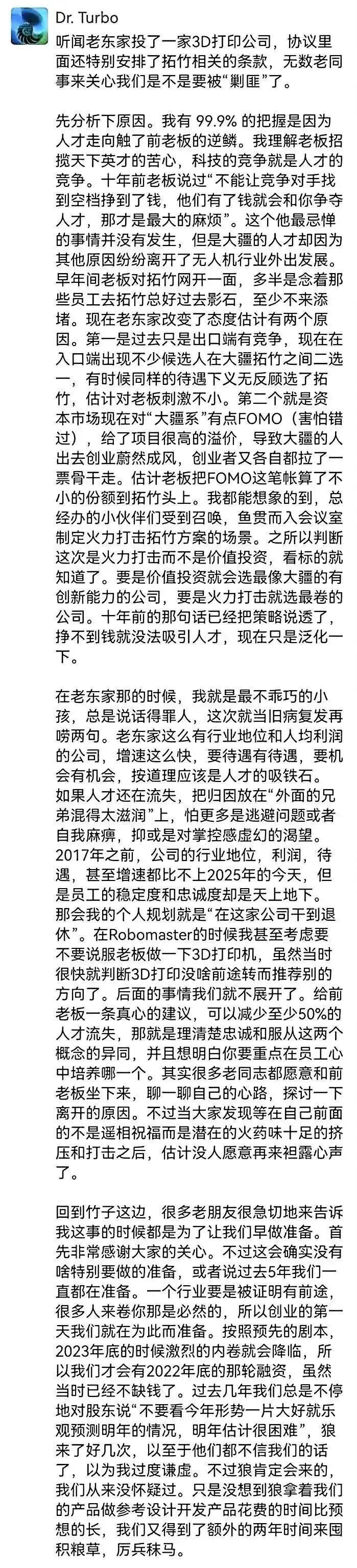
The fuse was that DJI invested in the 3D printing company "Intelligent Pie" and included clauses targeting Bambu Lab in the agreement. Tao Ye didn't hold back and pointed out that this was a "fire attack" on Bambu Lab: "Just look at the target. If it's a value investment, they would choose a company with innovative capabilities that is most similar to DJI. If it's a fire attack, they would choose the most competitive company."
Behind this "mentor - protégé showdown" is not simply a business competition but an all - out war involving talent, technology, and living space.
"I'm 99.9% sure it's because the flow of talent has touched the former boss's sore spot," Tao Ye believes that DJI is taking it out on Bambu Lab because it is gradually losing the upper hand in the talent competition.
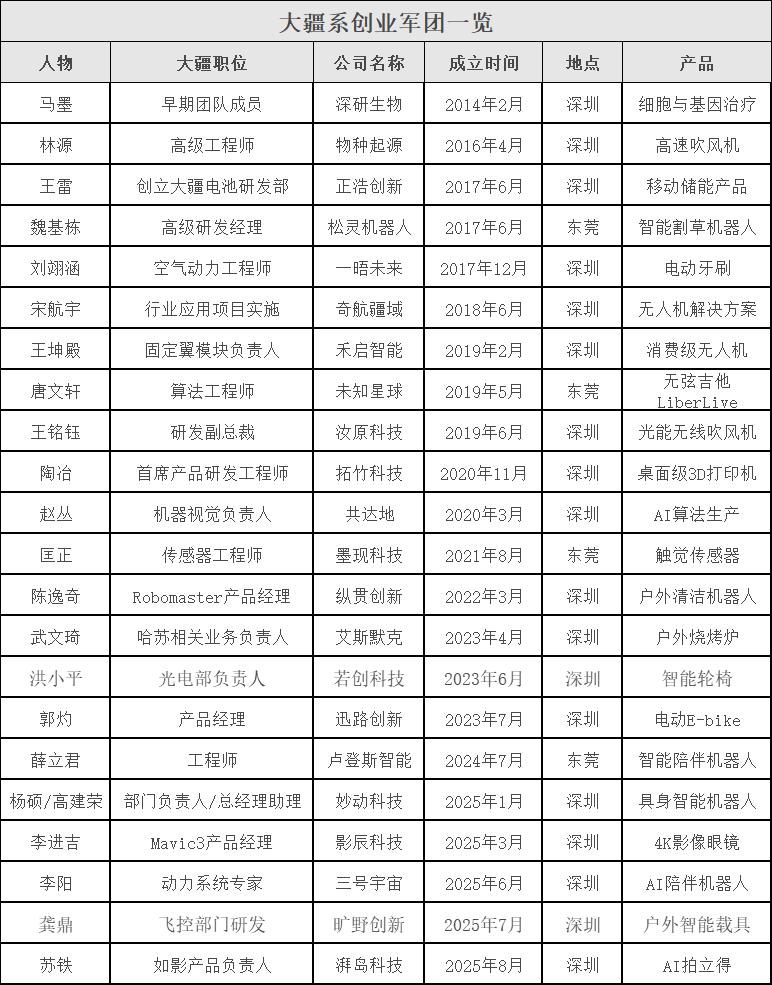
In fact, entrepreneurs like Tao Ye who have left DJI to start their own businesses have been emerging continuously over the past decade or more. They carry the genes of DJI, follow DJI's strategies, enter new fields, and quietly grow into leaders in niche markets. As these companies grow, they inevitably start to encroach on DJI's territory, evolving from "mentors and protégés" to "rivals."
Ten years ago, DJI's founder, Frank Wang, warned his team: "Don't let competitors find a gap to make money. Once they have money, they will compete with you for talent, and that's the biggest trouble."
Now, his words have come true. DJI, the "Whampoa Military Academy" of hardware startups, and the "DJI - affiliated startup legion" it has nurtured have become each other's most dangerous rivals.
01 Copying DJI
What kind of people are suitable for entrepreneurship? Some say that entrepreneurs have some "naive" missions and visions. "Without these, it's just doing business, not entrepreneurship."
In this regard, people from DJI are naturally suitable for entrepreneurship. Frank Wang once wrote in a message to new employees that DJI is a pure land, with only pure entrepreneurship and artists born for their dreams.
Bambu Lab is a typical example. In 2020, Tao Ye left DJI resolutely, saying, "This is my last chance to do something big in my life. I feel that my youth is slipping away, so I'm going to take a gamble," and founded Bambu Lab.
The same goes for EcoFlow. In 2017, 27 - year - old Wang Lei founded EcoFlow, aiming to create better mobile energy storage products for C - end users. Wang Lei joined DJI right after graduating in 2014 and established the battery R & D department, successfully solving the problem of drone battery life.
Wang Lei said that the biggest inspiration DJI gave him was that technological innovation can truly change people's lives. He started his business to ensure that everyone can use electricity without worry anytime, anywhere. In 2024, EcoFlow's revenue exceeded 8 billion yuan, and its business covered more than 140 countries and regions worldwide, firmly ranking first in the mobile energy storage market.
DJI brings not only ideals but also a proven set of successful methodologies.
Frank Wang once recalled DJI's success, saying, "It comes from the attitude of always focusing on products." People who leave DJI also inherit this approach, placing R & D in a supreme position and driving business growth through product innovation.
For example, Bambu Lab entered the market six years later than its peers, but its first product shocked the entire industry. In May 2022, after 22 months and 7 product iterations, Bambu Lab launched its first product, the Bambu Lab X1 series of high - speed multi - color 3D printers.
The Bambu Lab X1 was a "game - changer" at that time: its printing speed was twice that of ordinary printers; it supported 16 - color printing, while traditional 3D printers could only output in single color; it also featured an AI automatic calibration system, significantly lowering the usage threshold.
Its excellent performance conquered overseas geek users. In just one month after its launch on Kickstarter, the crowdfunding amount exceeded 50 million yuan. In the same year, it was named one of the "Best Inventions of 2022" by Time magazine, which commented, "This is the first time an Asian company has redefined industry standards in terms of performance rather than price."
In just five years, Bambu Lab has rapidly risen to become an industry leader. Data shows that in 2024, Bambu Lab's revenue was about 6 billion yuan, with a shipment volume of 1.2 million units, accounting for 29% of the global consumer - grade 3D printing market. In the first quarter of this year, Bambu Lab's revenue reached 2 billion yuan. Some industry insiders predict that its annual revenue is expected to exceed 10 billion yuan.
Just two days ago, there were rumors in the market that Bambu Lab was about to complete a new round of financing with Tencent participating, with a valuation as high as 10 billion US dollars. However, Tao Ye quickly refuted the rumor himself, half - jokingly responding, "I'm like a girl waiting to get married. I haven't been engaged yet, so you can't just spread false rumors."
An industry insider said, "The secret to Bambu Lab's success is that it has truly turned 3D printing into a tool that ordinary people can use. In the past, 3D printers were like DIY computers assembled in computer malls, while Bambu Lab is the first real branded product in this industry."
Bambu Lab's growth path is exactly the kind of simple business story that DJI people like. Hong Xiaoping summarized it as: creating leading innovative products, meeting needs, earning real profits, and then reinvesting in R & D, and repeating the cycle.
Hong Xiaoping joined DJI in 2016, built the optoelectronic department from scratch, and developed the LiDAR product line Livox. In 2023, he found former colleagues from DJI, founded Ruochuang Technology, and launched the mobility brand Strutt, focusing on intelligent wheelchair products.
Just as Tao Ye believes that 3D printers have great potential, Hong Xiaoping is also convinced that the wheelchair industry is in urgent need of innovation. Traditional wheelchairs or electric wheelchairs only meet basic needs, rather than making life better or allowing users to go to more places. However, wheelchair users also need more convenient, user - friendly, and adaptable daily mobility devices. What Hong Xiaoping wants to create is not just a simple intelligent wheelchair but a whole new way of mobile travel.
The imaginative market prospects have made Ruochuang Technology one of the "DJI - affiliated" companies sought after in the venture capital circle. Although its first product, ev¹, won't be launched until early 2026, it has already received investments from many global institutions such as Matter Venture Partners and Vertex Ventures.
02 Mentor - Protégé Confrontation
As these "DJI - affiliated" companies grow, they are increasingly touching DJI's nerves.
Almost all of Bambu Lab's founding team are core backbones from DJI: CTO Gao Xiufeng was once the head of DJI's system engineering department; COO Liu Huaiyu was in charge of products such as DJI goggles and the digital FPV system; Chief Engineer Chen Zihan once managed DJI's gimbal department.
Now, Bambu Lab even has an advantage in attracting talent. Tao Ye said bluntly in his WeChat Moments that in recruitment, candidates often have to choose between DJI and Bambu Lab. "Sometimes, with the same treatment, the candidates choose Bambu Lab without hesitation. I guess it's quite a blow to the boss."
In fact, it's not uncommon for DJI employees to leave and start their own businesses, pulling together a group of former colleagues to form an initial team.
For example, in 2017, Liu Yihan founded "Yiwu Future," and all team members were from DJI. Liu Yihan himself was an aerodynamic engineer at DJI; CTO Bai Rui was the head of the motor control team; Chief Engineer Lin Jiajing was an overall design engineer; and COO Deng Tao led the design of the power system structure.
Miaodong Technology, founded in January this year, was also jointly founded by two former core executives from DJI. Founder Yang Shuo joined DJI in 2015 and led the R & D of multiple consumer - grade drones and platforms; Co - founder Gao Jianrong held positions such as assistant general manager and senior director at DJI and was deeply involved in multiple core businesses.
These "DJI - affiliated" startups are also continuously attracting talent from within DJI. In April this year, Li Haonan, a core figure in DJI's flight system technology platform, left and joined Miaodong Technology; at the end of June, Gong Ming, the person in charge of DJI's Mavic series image transmission, resigned. There are reports that he has joined a leading 3D printing company.
Now, entrepreneurs with a DJI background are highly sought after by capital. Tao Ye pointed out that capital has a strong FOMO (fear of missing out) attitude towards people from DJI and gives very high valuation premiums to their projects, "leading to a trend of DJI employees leaving to start their own businesses."
It is reported that some FA institutions even set up their offices near DJI, mobilizing employees to get to know DJI employees and keep a close eye on their latest movements. Some FA institutions have even set KPIs for their employees: they must meet with one or two managers from ByteDance or DJI every week.
"The capital market is not short of money now; it's just afraid of not having attractive stories, and DJI entrepreneurs come with their own stories," an investor told BrandsFactory.
As a result, a closed - loop of talent loss has gradually formed: capital favors teams with a DJI background → the success rate and expected return of entrepreneurship increase → more backbones leave to start their own businesses → new companies continue to poach former colleagues to form teams.
Perhaps for this reason, some industry insiders revealed that DJI has very strict controls over employees leaving to start their own businesses, especially those who take away technology. An employee from Bambu Lab said, "Bambu Lab was put on DJI's non - compete list as soon as it was registered five years ago and is still on it."
03 DJI's Anxiety
The rise of the "DJI - affiliated" legion may really be making DJI anxious. They not only compete with DJI for talent but also block DJI's expansion path to some extent.
In recent years, although DJI has firmly held the dominant position in the drone market, its growth has gradually hit a ceiling. Data from institutions such as Frost & Sullivan and Gartner shows that in 2023, the global drone market growth rate was only about 5%. The sales of consumer - grade drones have been declining for three consecutive years, and the saturation of the To C market is obvious.
Actually, as early as 2016, Frank Wang said that the company might hit a ceiling when its annual revenue reached 20 billion yuan. Later, with the explosion of short - video, it opened up a new growth channel for the drone and imaging industry. However, such opportunities are hard to come by now. DJI has also clearly stated that the growth of the consumer - grade drone market is slowing down year by year.
What's more serious is that DJI's overseas market is facing increasingly strict policy supervision. The United States plans to ban the sale of DJI's new drones on the grounds of "national security"; the Italian antitrust agency has also launched an investigation into DJI's European subsidiary. These measures have undoubtedly put a heavy yoke on DJI, which is heavily dependent on the overseas market.
With the development of its main business restricted, finding second and third growth curves has become an unavoidable task for DJI.
Therefore, DJI's strategy has become significantly more aggressive. It has successively entered multiple consumer electronics and intelligent hardware fields such as sweeping robots, panoramic cameras, outdoor power supplies, panoramic drones, and e - bikes. Now, entering the 3D printing field is just one of its many moves.
However, opening up new battlefields requires excellent talent. The implementation of all new businesses ultimately boils down to the word "talent." In the past, DJI even had a tradition of "creating positions based on talent." It would first find top - notch talent and then establish specific departments. For example, Wang Lei founded the battery R & D department, and Wang Mingyu built the camera department.
Without suitable people, new businesses will be like water without a source. That's why the current situation of continuous talent loss has really hit DJI's sore spot.
More importantly, the "DJI - affiliated" companies are becoming insurmountable mountains in front of DJI's new business expansion. The entrepreneurial fields chosen by DJI employees are often the directions that DJI is interested in, so the chances of confrontation between the two sides are quite high.
For example, in the outdoor power supply field, DJI launched its first - generation products at the end of 2023, while EcoFlow's revenue that year had already reached 5 billion yuan. Whether in terms of brand recognition, accessory ecosystem, or user circle, DJI's outdoor power supplies still have obvious gaps compared with EcoFlow's.
Currently, DJI's profit mainly comes from consumer - grade drones, industrial - grade drones, and imaging equipment such as handheld gimbals. New businesses such as sweeping robots and panoramic drones in the process of transformation and expansion are still in the stage of "high investment and uncertain returns." Whether DJI can achieve revenue and profit growth through these new businesses in the next few years remains unknown.
As DJI expands in all directions, it will inevitably collide head - on with more "DJI - affiliated" companies. This time with Bambu Lab is just the beginning.
This article is from the WeChat official account "BrandsFactory". Author: Chen Ting. Republished by 36Kr with permission.