DJI is involved in a new battlefield, and hot money is surging in this "money-printing machine" industry.
Consumer-grade 3D printing is becoming a new wave.
3D printing is not a new thing, and the industry boom has long existed.
However, consumer-grade 3D printing has been developing slowly. Factors such as high modeling thresholds and high prices have kept ordinary consumers at bay.
Recently, several players have been engaged in a "war of words" while rushing to go public and raise funds. Even DJI, the leader in the drone industry, has been involved, which has quickly heated up this field.
Hundreds of millions of views: A "3D printing trend" has swept across social media
How popular is consumer-grade 3D printing?
On Xiaohongshu, the search volume of the term "3D printing" has exceeded 1.3 billion.
On Douyin, the playback volume of the term "3D printing" has reached a staggering 10.11 billion times. Topics such as "3D printing pens", "Playing with 3D printing", "3D printing works", and "3D printing toys" have all achieved playback volumes in the hundreds of millions.
Creative products, figurines, fridge magnets, phone cases... Sharing 3D works on social media seems to have become a trend.
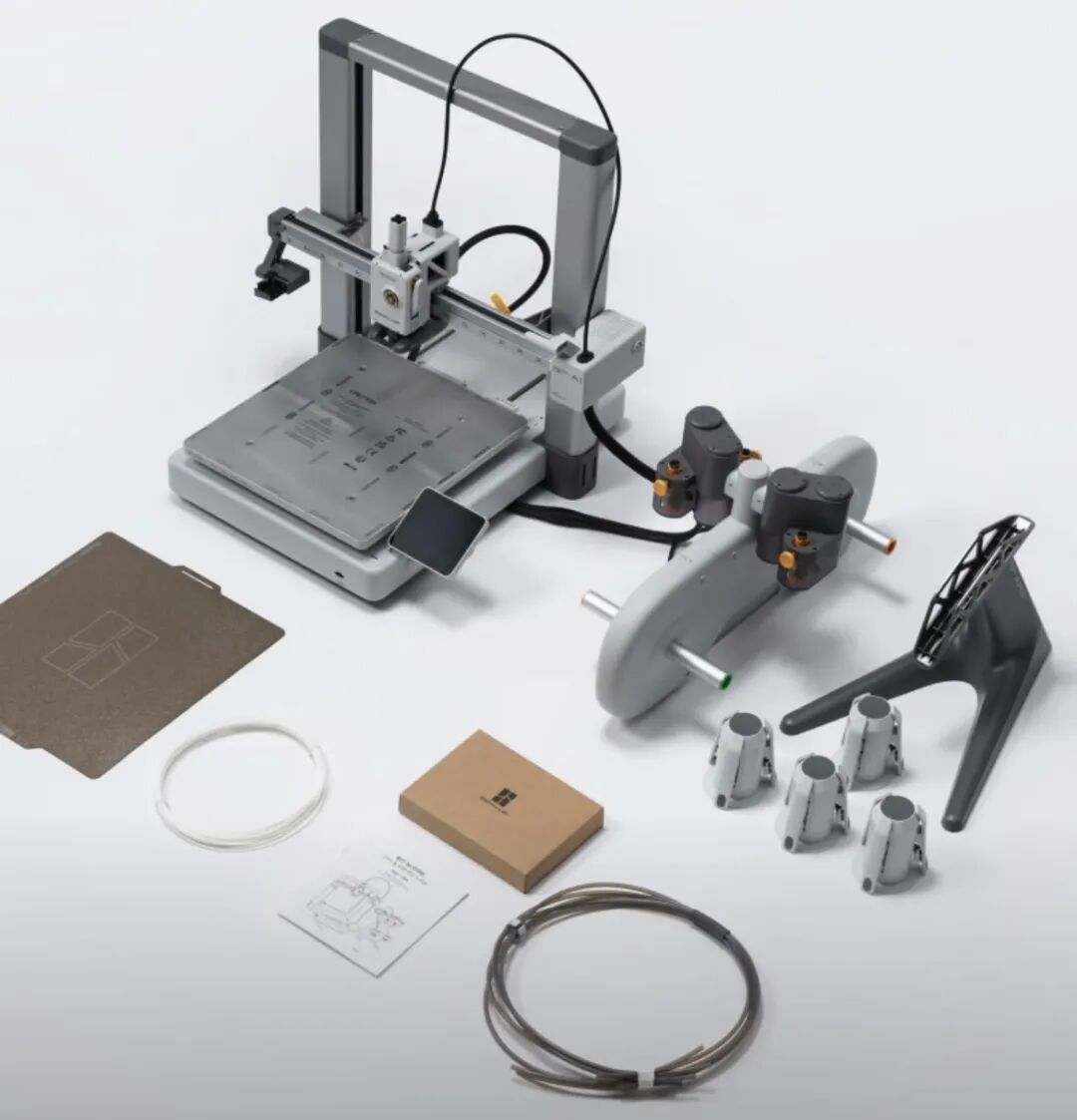
Image source: TROZEN's official flagship store on JD.com
Against the backdrop of the development of artificial intelligence and the improvement of printer performance, the consumer-grade 3D printing market is experiencing high growth, which has sparked extensive discussions among users.
The 3D printer is the core hardware in the 3D printing industry. In terms of shipment volume, according to the prospectus of Creality 3D, in 2024, the shipment volume of the consumer-grade 3D printer industry was 4.1 million units. It is estimated that it will increase to 13.4 million units by 2029, with a compound annual growth rate of 26.6%. The market scale will continue to expand. In 2024, the market scale calculated by GMV was $4.1 billion. It is estimated that it will increase to $16.9 billion by 2029, with a compound annual growth rate of up to 33.0%.
From being a niche hobby for geeks in the past to being widely purchased by ordinary consumers, consumer-grade 3D printing has entered the homes of ordinary people. According to EqualOcean, there are three main underlying logics driving its rapid development:
Firstly, technological development has lowered the threshold. Traditional 3D modeling highly depends on professional software, making it difficult for ordinary users without a technical background to operate. With the development of generative AI, users can quickly generate 3D models through text, pictures, or voice, which has lowered the technical barrier of 3D modeling.
Secondly, price cuts have reduced the cost. In the early days, consumer-grade 3D printing was mainly concentrated in fields such as healthcare and education. The high price of tens of thousands of yuan kept ordinary consumers away. However, in the past two years, the price of 3D printers has gradually dropped below 10,000 yuan. Coupled with various platform discounts, the price has reached the level of a few thousand yuan. Moreover, the price of printing consumables has also dropped significantly, making printing no longer exclusive to a few people.
Thirdly, product improvement has enhanced the experience. Printing time is an important factor. In the past, traditional multi-color printing took more than 4 hours for a single color and more than 20 hours for four colors. Now, four-color printing can be completed in only about 5 hours, greatly improving the printing efficiency. In addition, the problem of material waste has also been gradually solved.
Compared with industrial-grade 3D printing, consumer-grade 3D printing pays more attention to convenience, practicality, low cost, and personalization. Currently, it is still in the stage of rapid penetration among ordinary users. EqualOcean believes that AI agents will further improve the efficiency of 3D creation, and the industry is expected to enter an era of mass creation.
Capital rushes in, and startups are madly making money
Capital has the keenest sense of smell. Long before the wave of 3D printing reached ordinary consumers, many institutions had already entered the market in advance.
So far, most institutions' bets have achieved relatively satisfactory results. In the field of consumer-grade 3D printing, the market competition pattern is "one dominant and many strong". TROZEN, Creality 3D, Anycubic, Intellifusion, KUIZAO, Atomresh, Second Life and other companies are in fierce competition.
Among them, TROZEN is in the leading position. According to a research report by Soochow Securities, in 2024, TROZEN's revenue is expected to reach 5.5 - 6 billion yuan, and its net profit is close to 2 billion yuan.
TROZEN is just an example. Even in the entire consumer-grade 3D printing industry, many startups have really made money. According to the Venture Capital Daily, the annual revenues of 3D printing companies in Shenzhen have basically reached 1 billion yuan.
In the current consumer hardware field, these are very impressive figures.
Compared with smart glasses, the smart glasses industry has been heating up since 2024 and has been hailed by the media as a "battle of a hundred glasses". However, despite this, the operating performance of smart glasses startups has been mediocre, and "losing money to gain popularity" has become the norm. In terms of performance, consumer-grade 3D printing is undoubtedly a field full of "hot money".
Institutions have shown their attitudes with real money. Since 2025, the number of investment and financing events in the entire 3D printing field (including consumer-grade) has reached a five-year high. Some media have counted that the number has exceeded 40.
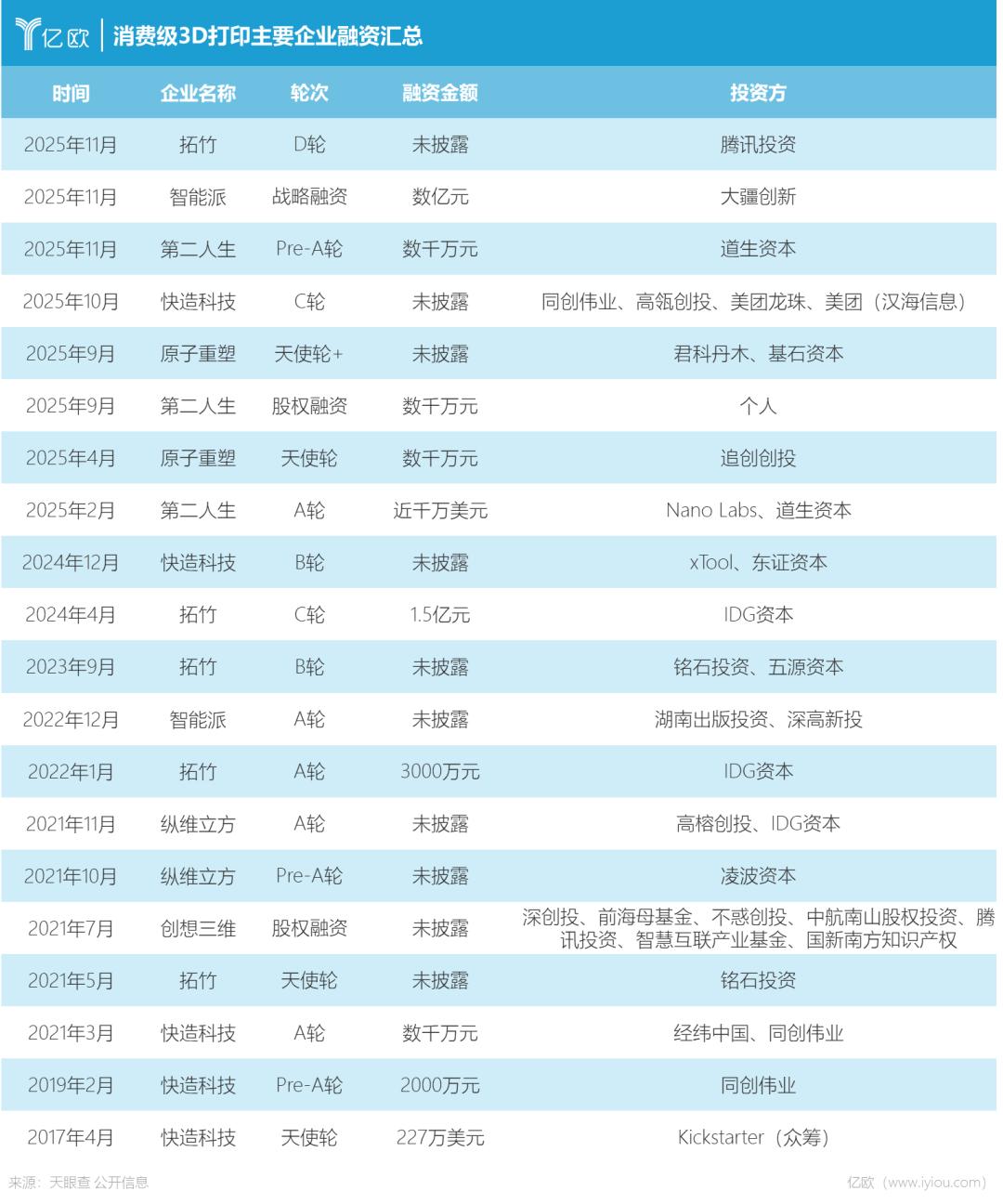
Among the recent financing parties (TROZEN was close to completing its financing in November), Intellifusion and KUIZAO are quite notable.
Intellifusion entered the cross-border e-commerce industry in 2015 and then entered the consumer-grade 3D printer market, accurately hitting the "trend". In 2024, its revenue reached 1.6 billion yuan.
Interestingly, Intellifusion's investor is DJI. It should be noted that Tao Ye, the founder of its competitor TROZEN, worked at DJI for many years.
In other words, DJI's move is very much like "hunting" a startup founded by a former employee. Tao Ye didn't sit idly by and publicly "criticized" his former employer DJI, revealing many unknown details about DJI. Of course, this is another business war story.
In contrast, KUIZAO completed its Series B financing at the end of October. The investors were Hanchen Information (Meituan) and Hillhouse Capital. Its new product, Snapmaker U1, performed impressively, with a crowdfunding amount exceeding 140 million yuan, breaking the industry's crowdfunding record.
It is worth mentioning that while many players are still constantly raising funds, some have already wanted to take the lead.
In August 2025, Creality 3D submitted its prospectus to the Hong Kong Stock Exchange, planning to list on the main board of the Hong Kong Stock Exchange.
According to Creality 3D's prospectus, in terms of the cumulative shipment volume of consumer-grade 3D printers from 2020 to 2024, Creality 3D is the world's largest provider of consumer-grade 3D printing products and services, with a market share of 27.9%.
From 2022 to 2024, Creality 3D's performance increased year after year, reaching 1.346 billion yuan, 1.883 billion yuan, and 2.288 billion yuan respectively. During the same period, the net profits were 104 million yuan, 129 million yuan, and 88.66 million yuan respectively.
Obviously, although Creality 3D's performance is not as good as TROZEN's, in terms of listing, TROZEN is one step behind Creality 3D. If Creality 3D successfully goes public, under the halo of being the "first stock in consumer-grade 3D printing", it is also expected to add more "fuel" to the 3D printing industry.
The consumer-grade market has broad prospects, and the competition has just begun
Currently, all listed companies in the 3D printing field are industrial-grade manufacturers, such as BLT and Farsoon Technologies. However, it is worth noting that the business of 3D printing for the B2B market is not very attractive.
Taking BLT as an example, it focuses on industrial-grade 3D printing and is in a leading position in the industry. From 2022 to 2024, BLT's revenues were 918 million yuan, 1.152 billion yuan, and 1.326 billion yuan respectively, and its net profits during the same period were 79.49 million yuan, 110 million yuan, and 104 million yuan respectively.
Looking at its own performance, BLT has performed well and has been in a growth state in the past three years. However, the revenues of several consumer-grade 3D printing startups in Shenzhen have all exceeded 1 billion yuan. Compared with them, BLT's performance is significantly inferior.
With the continuous high growth of the consumer-grade 3D printing market, will industrial-grade 3D printing enterprises enter the consumer-grade market? This is a question worth considering for listed companies.
Now the question is, where is the market potential for consumer-grade 3D printing in the future?
In terms of its business model, the revenues of 3D printing companies mainly come from selling 3D printers, 3D printing consumables, 3D printed finished products and services, as well as various accessories.
Among them, 3D printing consumables are an important foundation. EqualOcean checked TROZEN's official flagship store on JD.com and found that the price of one roll of consumables (1 kilogram) is generally over 50 yuan.
According to the official customer service, the degree of consumption during printing mainly depends on the size of the model and the set parameters. Even for the same model, the actual consumption during use may vary.
This means that users only need to purchase a 3D printer once and use it for a long time, but they may need to purchase consumables frequently for a long time.
It is not difficult to imagine that as the price of 3D printers gradually drops and consumers' acceptance increases, printing consumables are expected to become an important factor affecting the performance growth of enterprises.
Some enterprises have already verified this judgment.
Taking Creality 3D as an example, in 2024, among its total revenue of 2.288 billion yuan, 3D printers were the largest business, with a revenue of 1.416 billion yuan during the same period. However, in its business structure, the proportion of 3D printer revenue has been decreasing year by year, dropping from 81.7% in 2022 to 61.9% in 2024.
In sharp contrast, the revenue of the 3D printing consumables business has been continuously increasing. In 2022, its proportion in the total revenue was 3.0%, and by 2024, the proportion had risen to 11.4%, reaching 262 million yuan.
Of course, the above is an optimistic speculation about the industry trend. One of the problems with consumer-grade 3D printing is how to make users continuously love printing instead of just being curious for a moment. This is the key to determining the amount of consumables used. In addition, the richness of printing content is also an evaluation dimension.
This article is from the WeChat official account "EqualOcean" (ID: i-yiou), author: Wang Yuanlei, published by 36Kr with permission.