From being written off to staging a comeback: Google Search vice president reveals the inside story of AI search's turnaround
Many of people's basic needs have not changed with the advent of AI

In May this year, Google claimed to have "launched the biggest upgrade in Chrome's history" by adding a new AI Mode to the browser's search bar. On October 7th, Google announced again that the AI search mode would undergo a large-scale expansion, adding support for 35 languages and covering 40 countries and regions. More users around the world will be able to search directly in their native languages, significantly lowering the language barrier. The core driving this change is Google's latest Gemini model, which enables the search engine to truly understand semantic nuances and engage in multimodal interactions.
From the AI anxiety triggered by ChatGPT to Gemini briefly topping the App Store, Google has made a comeback in just two years, prompting people to reevaluate Google's role in the AI era.
In the latest episode of "Lenny’s Podcast", host Lenny Rachitsky interviewed Robby Stein, the vice president of Google Search and a former product director who created Instagram Stories. They discussed how Google is reshaping search with AI, the future of the AI ecosystem, and the philosophy of obsession behind "good products".
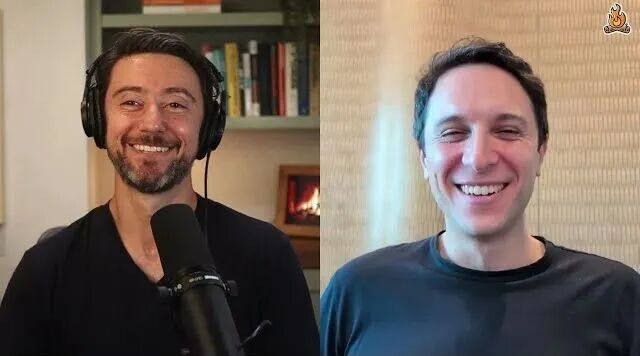
●Lenny Rachitsky (left) and Robby Stein (right)
Robby admitted in the show that after the emergence of ChatGPT, many people said "search is dead", but for Google Search, AI is not a replacement but an evolution. "Google's goal has never changed, which is to make information accessible to everyone. The essence of search is to explore questions, and AI makes exploration more natural and human - centered. The future of search is not an input box but a conversation. We hope that AI can understand the world and why you're asking questions."
The following is the essence of this podcast, compiled and translated by the Future Human Laboratory:

The Rise of Gemini: Google's "AI Comeback"
Host: Recently, Gemini became the number one app on the App Store, which hardly anyone expected. In the past few years, everyone was asking, "Where is Google? Why did ChatGPT win?" Now, it seems that the situation has completely changed. What brought about this turning point? Is Nano Banana the main source of the recent growth?
Robby: Nano Banana is indeed the main source of growth. But I think people are also realizing that they can do many cool things with a series of other Google products. What I'm feeling now is an incredible sense of focus and an urgent need to quickly deliver excellent products. Google has always been committed to making information accessible to everyone, and with AI, we can actually achieve this more easily than ever before. Behind Gemini's success is the long - term and unremitting efforts of the team. We've closely collaborated with teams like DeepMind, integrating research with products. This isn't an overnight change but a "tipping point" accumulated through continuous monthly and daily improvements.
Host: Was there something like a major reshuffle of the company's team or a new leader coming in with new ideas that made Gemini a world - class app?
Robby: I think a lot of the time, people tend to attribute a company's development to a one - time change or the change of a single person. But when you see the team relentlessly improving the product or model every month and making it better every day, you'll find that the key actually lies in this cumulative compound effect. Then the product will reach a tipping point where people like it, use it, and enjoy it.

Google's Ace: An AI That Truly "Understands Search"
Host: In the past few years, with the emergence of ChatGPT and other chatbots, many people thought that instead of sitting in front of a pile of search results and clicking on links in the traditional search mode, why not just get the answers directly in an AI dialog box? But now the situation doesn't seem to be the case, and Google is doing well. What can you share about the current state of Google Search?
Robby: I find it interesting that people search for an incredibly wide range of things. They want a specific phone number, the price of something, directions and routes, a webpage for tax payment... People want to do anything you can imagine. I think many people don't fully realize that many of people's basic needs have not changed with the advent of AI.
AI is covering more and more areas, so now more and more questions and curiosities can be satisfied through AI, and this is where our advantage lies. In my opinion, the core function of Google Search hasn't really changed, but you'll see the expansion of the combination of AI and search. For example, you can now take a photo at will and then ask the AI. For instance, take a photo of your homework and say you're stuck on question 2, or take a photo of your bookshelf and ask which books you should buy based on them. The AI can help you solve these problems. Google Lens is one of the fastest - growing products, with its visual search volume increasing by 70% year - on - year, which is a huge scale.
Host: So you don't see the demise of search. You recently launched AI search, and I don't think enough people are talking about it. Can you talk about the AI mode of Google Search?
Robby: The AI mode is the next stage of the search experience, integrating three major capabilities: AI overview, multimodal search, and conversation mode. The AI overview is the quick answer at the top of the page. The multimodal ability allows users to search through images or voice. Finally, the conversation mode creates an end - to - end cutting - edge search experience on the most advanced model, truly enabling you to ask Google Search any question and have a back - and - forth conversation with Google like chatting.
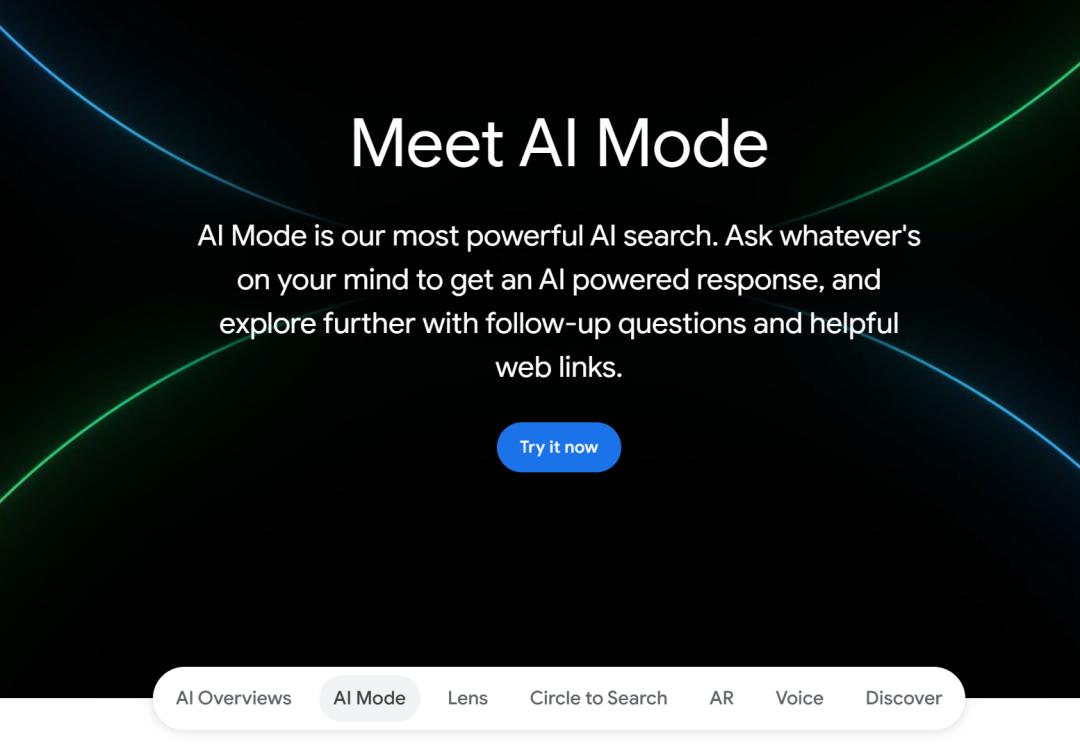
●The AI search method shown on Google's official website
I think search shouldn't make people think "Where should I enter my question?", but rather "As long as I go to Google, I can get the answer." What we need to do is to enable users to easily use the new product. Our pursuit for the product is to ultimately provide users with a consistent and simple product experience, and currently, we're still exploring and experimenting. Since users are accustomed to a specific way of using Google, they're used to entering keywords, but in fact, you can now use natural language to ask questions on Google, which is the most significant change at present.
We've observed that people are starting to ask really long and complex questions. This was unimaginable in the past. Now you can even enter an entire paragraph on Google, such as "I've been to these four restaurants. What other good places are there for a night date? It should have outdoor seating, and my friend is allergic to a certain kind of food." We're committed to making such complex queries as simple and convenient as keyword searches, and this is the most exciting direction for us.
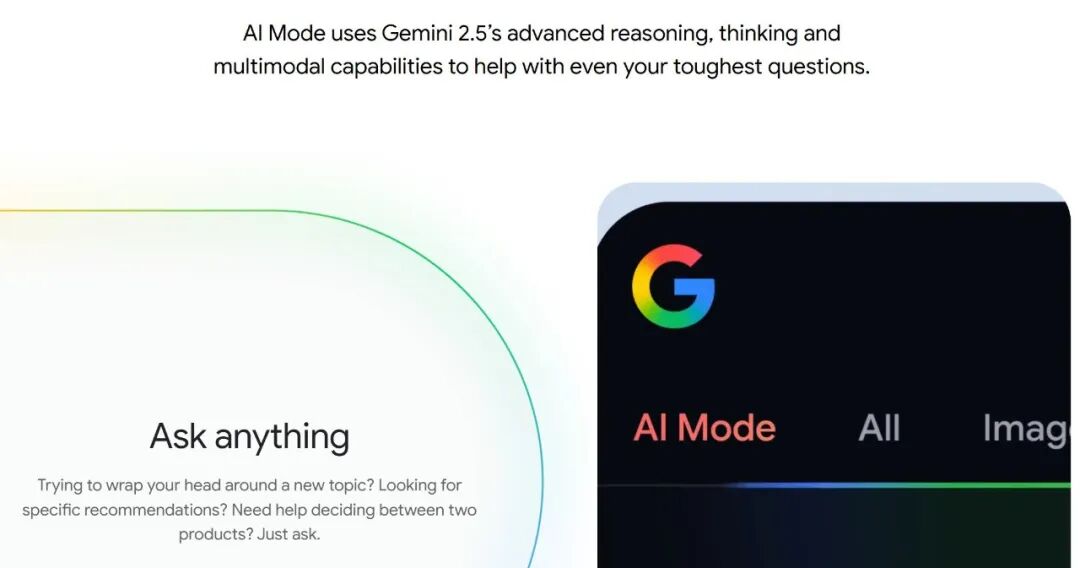
●A screenshot of the official website of Google Search's AI mode
Host: What exactly has it changed? How is it different from ChatGPT?
Robby: Google's AI obviously has the ability to use parametric memory, think, reason, and do all the other things that AI can do. Its uniqueness lies in being specifically designed for information tasks. How does it find information? How does it know if the information is correct? How does it check its own work? These are all things we've built into the model.
The biggest difference between Google's AI mode and other AIs is that it really "searches the world". Whenever Gemini answers a question, it retrieves web pages in real - time, calls the index, queries the shopping database, and even conducts multiple search verifications in the background, with each search paired with content. This mechanism makes Google's AI verifiable and traceable, reducing "hallucinations" and errors. You can look up Google's Search Quality Evaluation Guidelines, which is a very long document that has been carefully crafted over decades around what great information is. This is something Google has studied more than anyone else.
Host: Traditional SEO (Search Engine Optimization) seems to be being replaced by AEO (AI Answer Engine) and GEO (Generative Engine). What's your view on this?
Robby: When AI becomes the primary entry point for people's searches, the rules for content creators also change. In the past, they relied on SEO to compete for rankings, and now the era of AEO and GEO has arrived. AI still depends on human - generated content, but it will choose more useful and credible sources. For example, it will evaluate whether an article is original and whether it provides specific solutions. Therefore, the core of future writing is no longer keyword density but answering users' real questions. Those who best understand users' questions are most likely to be cited.

The Philosophy of Obsession Behind Good Products is "Never Be Satisfied"
Host: What do you think is really helpful for product builders to build more successful products?
Robby: I think two things are important. First, perseverance, always making full efforts in a positive and productive direction. Second, never be satisfied. You must always be dissatisfied with the existing situation and be committed to making things better.
This actually comes from an interesting story of mine. I was at a large all - team meeting at Instagram, and they had an ice - breaker activity, "Describe yourself in one word." So in the backstage area, I quickly texted my wife, "Hey, what's the first word that comes to your mind to describe me?" She just replied "dissatisfied". I giggled in the backstage area. At first, I was a bit angry because I thought it wasn't a nice word like "loving" or "caring". After she saw my message, she wrote me a very thoughtful thing. What she meant was that "dissatisfied" doesn't mean you're unhappy or dissatisfied, but that you want to make the world a better place. You're driven by an inner desire and dissatisfied with what the world offers. You want to make it better and have the motivation to do so.
There's another story told by Tony Fadell in a TED talk about 10 years ago, with a title like "Think Younger". He talked about how as we grow up and become adults, we get more and more used to accepting and tolerating everything. We just say, "This thing is terrible. Oh, well," and then shrug it off and move on. But if you don't do that, you can ask "Why is this terrible? Why should I tolerate this? How can I make it better?" I think this is how the best product people or the best thinkers think. It's one of the great motivations for building products, which is actually to identify users' problems and feel extremely dissatisfied on behalf of users.
Host: Suppose there are two different types of people. One type is "make things better and create amazing experiences". The other type is "driven by metrics and goals to achieve our KPIs". What do you think of these two types of people?
Robby: I don't think it's an either - or situation. I think they must intersect. Most great companies and products start from a problem, and a better way will emerge from the problem. But ultimately, you need tools and metrics to measure whether you're on the right track.
For example, when you build your first - version product, you need to know if people like it. You may talk to people and also add some analytical tools, such as the retention rate, which is the percentage of people still using the product on the 7th, 30th, or 90th day. Does it level off? Maybe users are churning over time because the product is no longer exciting. If there aren't enough users over a long enough period and the product can't improve, then you're in trouble. If people are using it, great, we need more people to use it and set new metrics or thresholds for its growth.
Every product has its own journey. No product starts big. Even if some products grow big quickly, internally, they start small, with only 10 to 100 users at the beginning. So you must pay attention to metrics. In this regard, I really think a more analytical and systematic way of thinking is helpful because if you want to create value in the world, you need to quantify it in some way.
